Most people compare a cash offer to their Zillow estimate and stop there. That comparison is wrong. The right comparison is net proceeds: what you walk away with after every cost is settled, in each scenario. Run that calculation honestly and the gap between the two paths is usually smaller than the headline numbers suggest, though not always in the direction sellers expect.
Why the Headline Numbers Mislead
A cash offer of $270,000 on a house worth $320,000 looks like a $50,000 discount. But a $320,000 listing comes with its own costs: agent commission, pre-listing repairs, staging, carrying costs while the house sits on market, a potential buyer concession after the inspection, and closing costs the seller typically covers. Strip those out and the real comparison looks different.
That $270,000 cash offer, paid direct to you at closing with no agent commission, no repairs, and no four-month carrying period, may net more than a $320,000 sale with all its deductions. Or it may not. The only way to know is to build the actual numbers for your house.
What a Traditional Listing Actually Costs
These are the costs a seller absorbs on a standard listed sale:
- Agent commission: typically 5 to 6 percent of sale price, split between buyer’s agent and listing agent. On a $320,000 sale, that is $16,000 to $19,200
- Pre-listing repairs: cosmetic fixes buyers or their lenders require. Common items include paint, carpet, HVAC service, and roof certification. Budget $3,000 to $15,000 depending on condition
- Staging and photography: often $1,000 to $3,500 for a competent job
- Carrying costs during the listing period: mortgage, property taxes, insurance, and utilities for every month the house is on market. A four-month listing at $2,000 per month in carrying costs is $8,000
- Inspection concessions: once the buyer’s inspector files a report, they often request credits or repairs. A 1 to 2 percent credit is normal. On a $320,000 sale, that is $3,200 to $6,400
- Seller-paid closing costs: title insurance, transfer taxes, recording fees, attorney fees in attorney states. Budget $2,000 to $5,000
Add those up and a $320,000 sale often nets between $265,000 and $285,000 after everything clears. That is before you account for the sale falling through, which happens in roughly 5 percent of signed contracts, forcing you to start over.
What a Cash Offer Actually Costs
Cash sales are not free of costs, but the costs are different and usually lower:
- Offer discount: cash buyers typically offer 70 to 85 percent of market value, sometimes higher in a competitive market or for a well-maintained house
- No agent commission in most cases, though some sellers hire an attorney to review the contract
- Minimal closing costs: the buyer usually covers them, though this varies. Read the offer carefully
- No carrying costs beyond the title period: a cash closing typically takes 1 to 3 weeks from accepted offer to funded
- No repair requirements: cash buyers purchase as-is, though they price condition into the offer
A Worked Example with Real Numbers
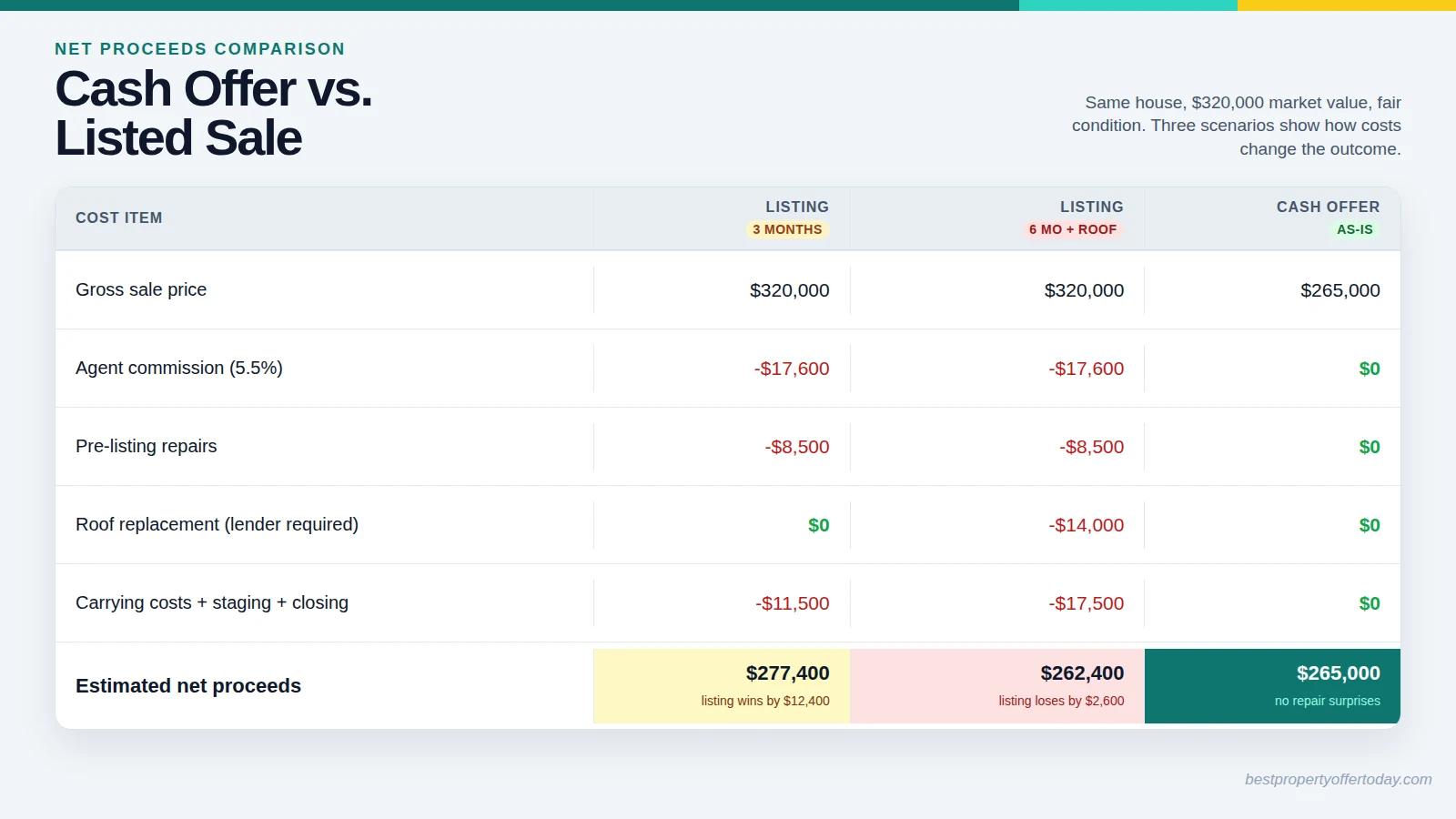
Take a house with a realistic market value of $320,000, in fair condition: the kitchen is dated, the roof has 5 to 7 years left, and the HVAC is 14 years old. The seller needs to move in 60 days for a job relocation.
| Cost item | Traditional listing | Cash offer |
|---|---|---|
| Gross sale price | $320,000 | $265,000 |
| Agent commission (5.5%) | -$17,600 | $0 |
| Pre-listing repairs | -$8,500 | $0 |
| Staging and photography | -$2,000 | $0 |
| Carrying costs (3 months) | -$6,000 | $0 |
| Inspection concession | -$5,000 | $0 |
| Closing costs | -$3,500 | $0 |
| Estimated net proceeds | $277,400 | $265,000 |
In this scenario, the listing nets roughly $12,400 more. Whether that gap is worth four to six months of your time, the uncertainty of a deal falling through, and the carrying costs on a house you no longer want to own is a personal calculation, not an obvious one.
Now change one variable: the listing takes six months instead of three, and the inspection turns up an aging roof the buyer’s lender requires replaced before close.
| Cost item | Traditional listing (extended) | Cash offer |
|---|---|---|
| Gross sale price | $320,000 | $265,000 |
| Agent commission (5.5%) | -$17,600 | $0 |
| Pre-listing repairs | -$8,500 | $0 |
| Roof replacement required post-inspection | -$14,000 | $0 |
| Staging and photography | -$2,000 | $0 |
| Carrying costs (6 months) | -$12,000 | $0 |
| Closing costs | -$3,500 | $0 |
| Estimated net proceeds | $262,400 | $265,000 |
In the extended scenario, the cash offer nets more. This is not a thought experiment. FHA and VA loan programs require a remaining roof life of at least 2 years, and an appraiser who flags a roof condition will stop the loan. The buyer then walks, renegotiates a repair credit, or demands you replace the roof before closing. Sellers who did not know this detail before they listed are the ones who end up paying $14,000 in repairs they never budgeted for.
Three Costs Nobody Mentions Until Closing Day
Seller-paid buyer closing cost credits. In a buyer’s market, buyers routinely ask sellers to cover 2 to 3 percent of the purchase price in closing costs. On a $320,000 sale, that is $6,400 to $9,600 off the top, on top of commission. It is a legitimate ask, and many sellers agree to it to keep the deal alive.
HOA transfer fees and pro-rated dues. If your property has a homeowners association, expect a $200 to $1,000 transfer fee plus a pro-rated dues settlement at closing. It appears on page two of the closing disclosure and surprises people every time.
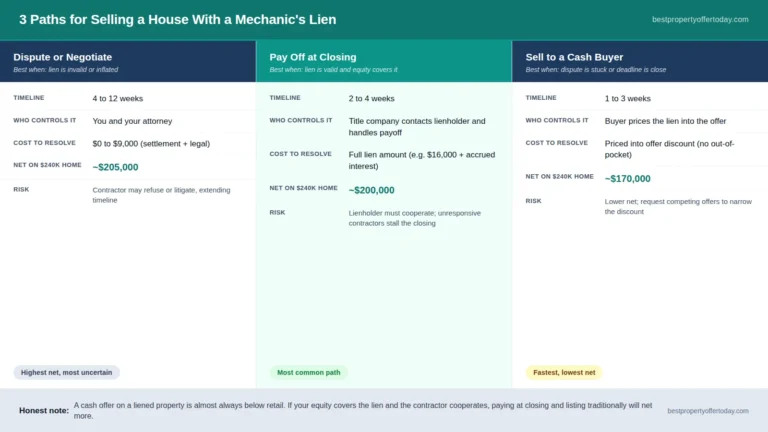
Title cure costs. If a title search turns up an old lien, a judgment, an unreleased mortgage, or a boundary problem, the closing delays while the problem is resolved. Attorneys charge $200 to $500 per hour for title curative work. A cash buyer faces the same title issues, but in a cash deal there is no lender adding review time and no appraisal requirement that can trigger a rate lock problem if the title delay drags into the following month. Our post on what happens if a cash buyer backs out explains how earnest money and contract terms protect you if the deal falls apart on either side.
When a Cash Offer Makes Financial Sense
A cash sale closes the net proceeds gap and can eliminate it entirely in these situations:
- The house needs significant repairs: deferred maintenance, foundation issues, roof replacement, or outdated systems that would require a large credit or expensive pre-listing repair on a traditional sale
- The seller cannot carry the property through a 90 to 180 day listing period, including mortgage, taxes, insurance, and utilities
- The sale is time-sensitive: a job relocation, an estate that needs to settle, a looming foreclosure, or a court-ordered sale with a deadline
- The property is a rental with tenants who make showings difficult or unpredictable
- The seller wants certainty: cash deals rarely fall through on financing, because there is no financing to fall through
If any of these apply, use the net proceeds calculator to run both scenarios with your actual carrying costs and condition before deciding.
When a Traditional Listing Is Clearly Worth It
If your house is in genuinely good condition, the local market is active, and you have 90 to 180 days before you need the money, a listed sale almost always nets more. The agent commission is the largest single cost in that scenario, but a well-priced house in a competitive market sells quickly and attracts the kind of buyer competition that does not happen in a private cash transaction.
A marketplace like Best Property Offers Today will tell you this plainly, because collecting competing offers is the service, not buying the house. If your property would net significantly more through a traditional listing, a cash offer is probably not the right answer for you, and you should hear that before you sign anything.
A cash offer is not right for every seller. If the house is in good shape and the seller has time, listing with an agent usually produces a higher net. Say that honestly and the sellers who do benefit from a cash sale will trust you more, not less.
iBuyers: A Middle Path with Its Own Costs
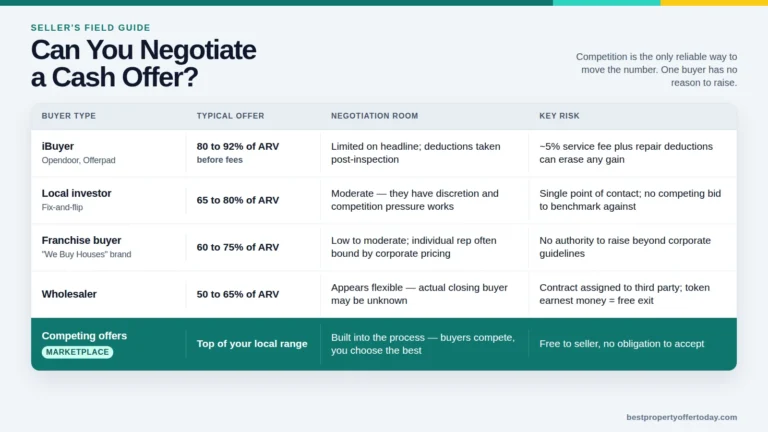
iBuyers like Opendoor and Offerpad occupy the space between a traditional listing and a private cash buyer. They typically offer 85 to 95 percent of market value and can close in 2 to 3 weeks. The trade-off is a service fee of roughly 5 percent, plus post-inspection deductions that often add another 1 to 2 percent. The net, after those deductions, is often close to what a private cash buyer offers, but the process is more standardized and the company is more accountable than an individual investor.
We cover the specific fee structures at Opendoor vs. Offerpad hidden fees, including the post-inspection deduction process that surprises most sellers. Before taking any single-buyer number at face value, compare it to competing offers. That comparison is what our marketplace exists to produce.
Does a cash buyer pay closing costs?
Usually yes. Most cash buyers absorb their own closing costs, and many will cover the seller’s as well, particularly title fees and transfer taxes. This is negotiable, and the offer letter should spell it out. If it does not, ask in writing before signing.
What if the only cash offers I get are too low?
A low first offer is not a final offer. Buyers who start low often have room to move, particularly if you can show recent comparable sales that support a higher number. The practical advantage of a marketplace is that you are comparing several buyers at once rather than negotiating with one, and the low offer is easy to decline when you have a better one sitting next to it.
Can I get cash offers while my house is also listed with an agent?
Yes. You can submit to a cash buyer marketplace before listing or while listed. Some sellers use cash offers as a floor, taking the listed route but knowing they have a backup if the listing sits too long. Check your listing agreement first, since some agents include clauses about off-market transactions during the listing period, and you do not want a dispute with an agent over a commission on a deal they did not bring you.
How do I know if a cash buyer is a real buyer and not a wholesaler?
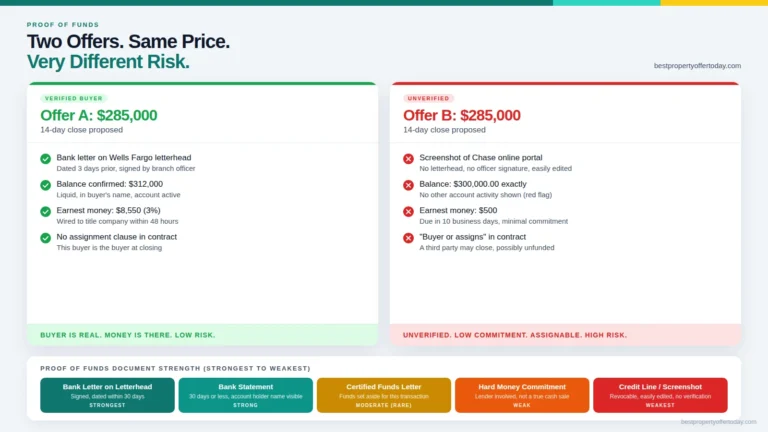
Ask about earnest money. A serious buyer will put down $5,000 to $10,000 or more on a transaction in this price range. A deposit under $1,000 on a $300,000 house is a warning sign. Also check the contract for assignment clauses: a buyer who wants the right to assign the contract to a third party before closing may not intend to close themselves. Our full guide to vetting cash buyers covers the specific questions to ask before you sign. You can also call 804-361-7460 to talk through what an offer should contain before you commit to anything.