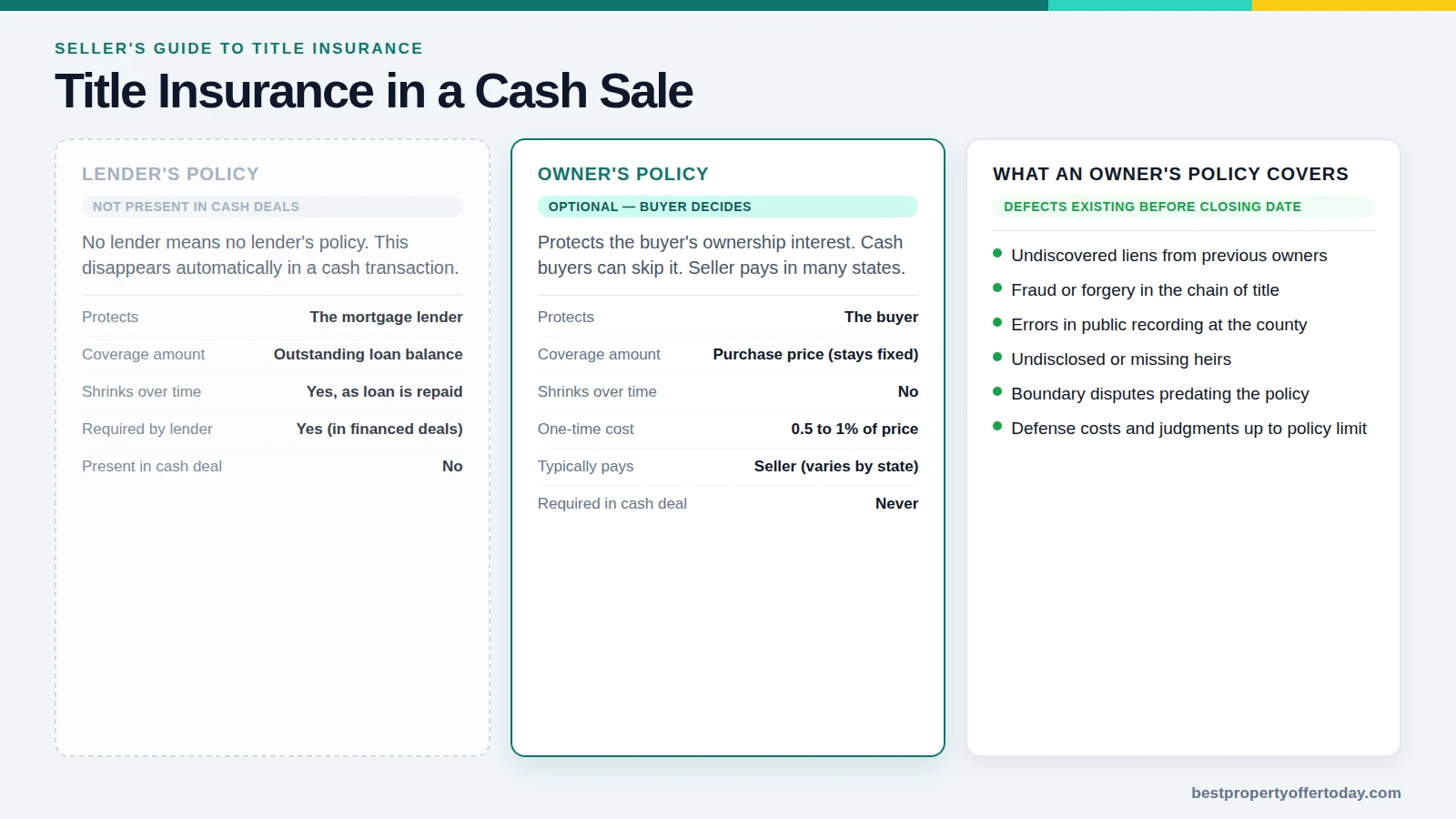
A cash sale eliminates one type of title insurance automatically: the lender’s policy. There is no lender, so no lender needs protection. What remains is the owner’s policy, which is optional for a cash buyer, and which the seller in many states is expected to pay for. Understanding the difference matters because each type covers a different party from a different set of risks, and the presence or absence of each changes what happens when a title problem surfaces after closing.
Two types of title insurance, and what each one does
Every title insurance policy protects one party against title defects that existed before closing but were not discovered by the title search.
The lender’s policy protects the mortgage lender up to the outstanding loan balance. As the loan is paid down, the coverage shrinks. When the loan reaches zero, the policy is worthless. This policy exists entirely for the lender’s benefit. A buyer who purchases a lender’s policy is spending money to protect a bank.
The owner’s policy protects the buyer’s ownership interest for as long as they own the property, and in most states, it continues to protect their heirs. The coverage amount is the purchase price. If a title defect surfaces years later that clouds or defeats the buyer’s ownership, the policy defends the title and covers any resulting loss up to the policy limit.
In a financed purchase, both policies are typically issued at the same time. The lender requires its policy as a condition of the loan. The buyer usually purchases the owner’s policy simultaneously, because the marginal cost of adding it is low when the closing machinery is already in motion.
In a cash purchase, there is no lender’s policy at all. The owner’s policy is entirely voluntary. Some cash buyers waive it to save money. Some institutional buyers, funds and experienced investors, skip it because they have in-house legal teams and tolerance for known defects. First-time cash buyers often skip it because no one told them it existed.
What the owner’s policy actually covers
A standard owner’s policy covers defects in title that existed before the policy date and were not disclosed to the insurer at closing. The categories that most often produce claims:
- Prior liens that were not satisfied and not discovered in the title search, including old mortgages, mechanic’s liens, and judgment liens.
- Fraud in the chain of title, such as a forged deed or a signature obtained under false pretenses.
- Errors in public records, including clerical mistakes in recording a deed or a release.
- Undisclosed or missing heirs who had an interest in the property when it was transferred.
- Boundary disputes where the legal description in the recorded deed does not match the ground.
- A deed that was not properly executed under the law of the state where it was recorded.
Coverage includes both defense costs (hiring a title attorney to fight the claim) and any financial loss, up to the policy limit. The limit is the purchase price at closing. The policy is a one-time premium paid at closing. There are no annual renewals.
What it does not cover
Title insurance is not a general home warranty. It covers defects in ownership history, not physical condition. What falls outside a standard owner’s policy:
- Problems that arise after the policy date, including new liens recorded after closing.
- Issues the buyer knew about and accepted in writing at closing.
- Physical encroachments visible from inspection or a current survey, such as a fence on the neighbor’s land that was visible at walkthrough.
- Zoning violations, code violations, or land use restrictions that are a matter of public record.
- Environmental contamination and hazardous materials.
- Matters created by the buyer’s own actions after closing.
Extended coverage policies, called ALTA Homeowner’s Policy in many states, can expand some of these exclusions for an additional premium, including coverage for post-policy forgery and certain encroachments. The base policy is more limited than most buyers expect.
Who pays for title insurance in a cash sale, and who decides
Custom varies by state, and there is no federal rule. In many states, the seller customarily pays for the buyer’s owner’s policy as part of normal closing costs. In others, the buyer pays for their own coverage. In a cash transaction, because no lender is involved to enforce anything, the allocation is more openly negotiable than in a financed deal.
States where sellers most often pay for the owner’s policy include Florida, Georgia, and most of the Southeast. In California, the convention varies by county. In New York, buyers typically pay. In Texas, the seller customarily pays, and the Texas Department of Insurance sets premium rates by statute, so there is no negotiation on the premium itself.
In a cash sale, either party can pay for the owner’s policy, or neither party can purchase it. A cash buyer who waives title insurance does not create any obligation on the seller, but it does mean the buyer is accepting the risk that the title search missed something. That is the buyer’s decision to make, and sellers should understand it is not their problem to solve.
A worked example: the unpaid contractor lien
A seller accepts a cash offer of $320,000 on a house they owned for seven years. The title search is clean. The closing happens in 11 days. Eighteen months later, the new owner receives a letter from an attorney representing a roofing contractor who did work on the property in 2019. The contractor filed a mechanic’s lien that was never released when the original dispute settled. A clerical error at the county recorder’s office meant the lien did not appear in the title search.
The amount claimed is $14,000. The owner’s legal costs to defend it could run another $5,000 to $8,000 if it reaches litigation.
If the buyer purchased an owner’s policy at closing: the title insurer defends the claim, pays any judgment up to the $320,000 policy limit, and the buyer pays nothing beyond the premium paid at closing.
If the buyer waived the owner’s policy: the buyer must resolve this on their own. They may have a claim against the seller for failing to disclose a known lien, but the lien was not known to anyone because of the recording error. The legal costs fall on the buyer.
The one-time owner’s policy premium for a $320,000 property ranges from roughly $1,200 to $2,000 depending on the state. That premium is the protection against a class of losses that cannot be predicted or inspected away. Title problems of this kind are more common than most sellers expect, which is why title issues that surface during a cash closing are one of the main reasons transactions extend past their expected date.
What sellers should understand about title insurance in a cash sale
A seller does not purchase title insurance to protect themselves from future claims in the ordinary sense. The seller’s obligation is to deliver clean title. If the title is not clean, the seller is responsible for clearing it before closing.
A few things sellers often get wrong about their position:
- If a title defect surfaces after closing that the seller knew about and did not disclose, the buyer can pursue the seller regardless of whether a title insurance policy exists. Title insurance does not absolve the seller of fraud or knowing misrepresentation.
- If the seller paid for the buyer’s owner’s policy, the insurer may have a subrogation right against the seller if the defect resulted from the seller’s actions or from knowledge the seller had but did not disclose.
- A cash buyer who skips title insurance is not the seller’s problem. It is the buyer’s risk to carry. The seller’s job is still to produce clear title at closing.
One situation where a seller might consider their own title coverage: selling a property acquired through an estate, where the chain of title includes a probate proceeding and there may be heirs who were not notified properly. In that case, some sellers purchase a seller’s title indemnity policy. These are uncommon and usually arranged by the seller’s attorney.
How this compares to a cash offer vs. a financed deal
A cash sale does not change what title insurance covers. It changes who holds each policy. In a financed deal, two policies are issued and one is mandatory. In a cash deal, one policy is optional and zero are mandatory.
The risk that a title policy addresses, an undiscovered defect in the chain of ownership, exists in either transaction. A cash buyer who skips the owner’s policy is not skipping the risk. They are accepting it personally.
For sellers, a cash closing can happen faster, because there is no lender’s underwriting process to wait on. It does not mean the title search matters less. A cash buyer still orders a title search, still opens escrow, and still waits for the title company’s report. That process typically takes 5 to 10 days. Title work is what sets the closing date in a cash sale, not the buyer’s funds. If the search turns up a lien, an heir who never signed, or a boundary problem, the timeline changes regardless of how the buyer is paying.
A cash offer is typically below what a fully marketed listing would bring. Speed and certainty are what the seller is trading for. If the house is in good condition and the seller has time, a traditional listing with a financed buyer usually nets more. You can run a comparison using the net proceeds calculator to see what each path actually puts in your pocket after costs.
If you want to collect competing cash offers and compare what different buyers will actually pay, submit one request here and offers typically come back within 24 to 48 hours, free with no obligation to accept.
Does a cash buyer have to buy title insurance?
No. A cash buyer is not required to purchase any title insurance. There is no lender to require the lender’s policy, and the owner’s policy is always voluntary. A buyer who waives it accepts the risk that the title search missed a defect. Most title attorneys recommend purchasing the owner’s policy regardless of how the property is financed, because the class of risk it covers cannot be found by inspection.
Does the seller pay for title insurance in a cash deal?
It depends on the state and on what the purchase contract specifies. In Florida, Georgia, and most of the Southeast, seller-paid owner’s title insurance is customary. In California, it varies by county. In New York, the buyer typically pays. In a cash transaction, the payment responsibility is more negotiable than in a financed deal because no lender is enforcing any requirement. Both parties can agree to any allocation in the purchase contract.
What happens if a title problem surfaces after a cash closing with no title insurance?
The buyer bears the cost directly. They would need to hire a real estate attorney, potentially litigate the defect, and pay any resulting judgment or settlement. If the problem results from something the seller knew and did not disclose, the buyer may also have a separate claim against the seller. The existence or absence of title insurance does not change what the seller was required to disclose before closing.
Is an owner’s policy worth the cost in a cash sale?
The one-time premium is typically 0.5 to 1 percent of the purchase price, paid once at closing, with no renewals. For a $300,000 property, that is $1,500 to $3,000. The policy lasts as long as the buyer owns the property and extends to their heirs in most states. Whether it is worth the cost depends on the age and complexity of the chain of title and the buyer’s tolerance for a class of risk that no inspection can detect or rule out.