Yes, a seller can back out of a cash offer after accepting it. Whether that exit costs nothing or costs thousands depends on when it happens and what the signed purchase contract says.
What Accepting a Cash Offer Actually Means, Legally
When a seller countersigns a purchase agreement, they enter a binding contract. This is not a handshake or a preliminary agreement. The signed document creates mutual obligations: the buyer promises to pay, and the seller promises to transfer the deed at closing.
Most sellers do not read this carefully enough. “Acceptance” is the contract. From the moment of signing, the seller’s options narrow considerably.
One exception matters in certain states: neither party is fully bound until a statutory attorney review period has expired. Outside that window, or in states without one, the contract is live from the signature date.
The Attorney Review Period: Where It Exists and What It Gives You
New Jersey, New York, Connecticut, Maryland, and Illinois all provide a statutory or customary attorney review window. The standard in New Jersey is three business days from the date both parties sign. In Illinois the window runs five business days. In New York the period is typically negotiated into the contract itself, usually three to five days.
During this period, either party’s attorney can disapprove the contract, cancel the deal, or propose modifications. No reason is required. A seller who changes their mind during attorney review can exit clean: no financial exposure, no obligation to return earnest money beyond what the contract specifies, and no lawsuit risk.
If you are in one of these states and you have doubts about the sale, call your attorney the same day. The window is short. Once it closes, you are in different legal territory.
In states without a review period, including Texas, Florida, California, Georgia, and most others, the contract is binding from the moment both parties sign. There is no built-in exit. A seller who backs out after signing is looking at breach of contract consequences.
Whether you are in an attorney-review state affects almost everything about what happens next. If you are unsure, our post on whether you need a lawyer to sell your house for cash covers the state-by-state picture in more detail.
What Happens When a Seller Backs Out After the Review Window
A buyer whose seller has backed out has two main legal remedies under contract law.
The first is monetary damages. The buyer can sue for the actual costs they have already incurred: title search fees, inspection costs, travel, lost interest on their escrowed deposit, and potentially the difference between what they agreed to pay and what they now pay for a comparable property. In cash transactions, where the buyer has often moved fast and spent money quickly, these costs add up.
The second remedy is more serious: specific performance. A court can order the seller to complete the transaction. Real estate contracts are treated differently from most other contracts because courts have long recognized that real property is unique, and that money damages may not fully compensate a buyer who wanted a specific house in a specific location.
Specific performance suits are not common, but they happen, particularly when the seller backed out to accept a higher competing offer. While the suit is pending, the buyer can file a lis pendens, which is a notice of pending legal action recorded against the property. A lis pendens makes the house effectively unsaleable to anyone else. Title companies will not insure a sale with a lis pendens on record. The seller cannot simply sign a contract with a new buyer and close while litigation is pending.
Most sellers who change their minds settle with the buyer rather than fight through litigation. That settlement typically involves the buyer releasing the contract in exchange for a cash payment, often several thousand dollars on top of the earnest money return.
Earnest Money When the Seller Backs Out
Earnest money is the buyer’s good-faith deposit, held in escrow by the title company or closing attorney. In a cash deal, a typical earnest deposit runs from one to three percent of the purchase price. On a $220,000 house, that is $2,200 to $6,600.
If the seller breaches the contract, the buyer is entitled to their earnest money back in full. The escrow agent does not require a court order in most cases. The contract language governing “default by seller” almost always directs the escrow holder to return the deposit to the buyer on written notice of the breach.
Returning the earnest money is the floor of the seller’s obligation, not the ceiling. The buyer can still pursue actual damages on top of the returned deposit.
For context on what a normal earnest deposit looks like and what a thin deposit signals about buyer seriousness, see our post on earnest money in a cash sale.
When a Seller Can Exit Without Consequences
The clean exits are narrow. There are a few situations where backing out carries little or no legal risk.
The cleanest: the attorney review window is still open. Cancel before it closes and you are free.
The next cleanest: the buyer defaults first. If the buyer fails to deliver proof of funds by the contract deadline, misses a closing date, or breaches in any other way, the contract typically gives the seller the right to cancel and retain the earnest money as liquidated damages. In a cash deal, this most often happens when the buyer cannot actually produce the funds or fails to provide acceptable proof by the deadline the contract specifies.
Some purchase contracts include a kick-out clause, which lets the seller accept a backup offer and give the original buyer a fixed window, usually 24 to 72 hours, to waive contingencies or release the contract. These are more common in financed transactions but do appear in some cash contracts.
If the contract was formed through fraud, duress, or a mutual mistake about a material fact, a court may rescind it. These claims require legal proceedings and are far from guaranteed.
If a title search uncovers a defect that makes it legally impossible to convey clear title, the seller may have grounds to cancel. This is a genuine defect the title company surfaces, not something a seller can manufacture as an excuse to exit.
Everything else is a breach: changing your mind, receiving a better offer, deciding not to move, finding out the buyer plans to rent it out. None of those are legal exits under a standard purchase agreement.
A Worked Example: What Backing Out Actually Costs
A seller in Georgia accepts a cash offer of $220,000. The earnest deposit is $3,300, held in escrow at the title company. No attorney review period applies.
Ten days later, the seller receives an unsolicited offer for $238,000 from a different buyer and decides to back out of the first contract.
The first buyer’s attorney sends a demand letter. The buyer has already spent $850 on a title search and $450 on an inspection they requested. They have also paid $600 in non-refundable moving coordination costs.
To resolve the matter without going to court, the seller agrees to: return the $3,300 earnest money from escrow, reimburse the buyer’s $1,900 in documented out-of-pocket costs, and pay an additional $4,000 cash payment in exchange for a signed release of the purchase contract.
Total exit cost: $9,200, not counting the seller’s own attorney fees, which typically run $1,000 to $2,500 for this kind of negotiated resolution.
The gap between the two offers was $18,000. After the settlement and attorney fees, the net gain from backing out was roughly $6,000 to $7,000. The seller also spent three weeks navigating a dispute while the property sat under a cloud and the second buyer grew uncertain about whether a clean closing was possible.
Some sellers decide that trade-off is worth it. Many do not.
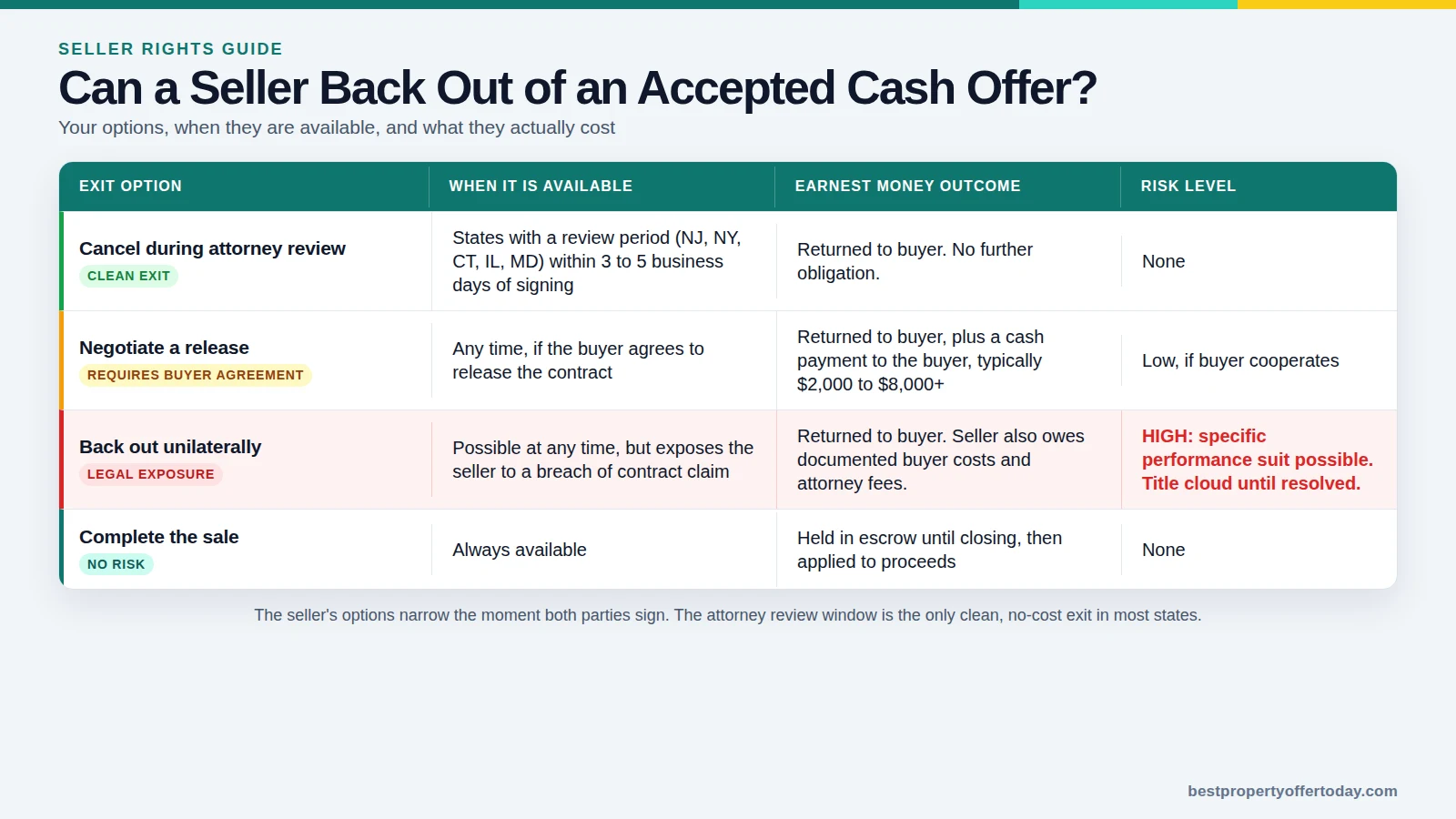
Seller Exit Options, Side by Side
| Exit option | When available | Earnest money | Other cost | Risk |
|---|---|---|---|---|
| Cancel during attorney review | Attorney-review states only, within 3 to 5 business days of signing | Returned to buyer | None | None |
| Negotiate a release | Any time, if buyer agrees | Returned to buyer | Cash payment to buyer, typically $2,000 to $8,000+ | Low, if buyer cooperates |
| Back out unilaterally | Any time, but legally exposed | Returned to buyer | Buyer documented costs plus attorney fees | High. Specific performance suit possible. Lis pendens clouds the title until resolved. |
| Complete the sale | Always | Applied at closing | Normal closing costs only | None |
A Note on Whether to Accept in the First Place
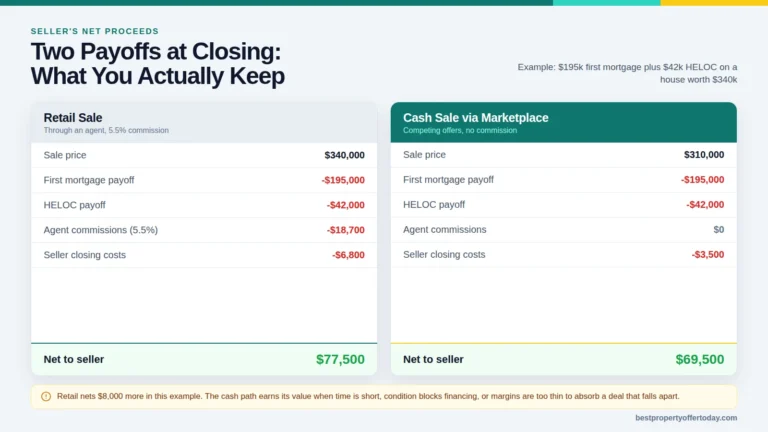
Cash offers are typically below a fully marketed retail price. That is the trade the seller makes: speed, certainty, no repair demands, and no risk of a financed buyer falling out at the end, in exchange for a lower headline number.
If the house is in good condition and the seller has time, a traditional listing with an agent will usually produce a higher net price than any cash offer, including a set of competing offers through a marketplace. The honest question is whether the premium from a listed sale is worth the additional time, the repair negotiations, and the risk of a failed financing contingency after 45 days under contract.
If you want to run the full comparison before accepting anything, our net proceeds calculator lets you compare a cash sale against a listed sale with your own numbers. There is no obligation to request offers.
If you do want to collect competing cash offers, you can submit a single request here and receive offers from multiple vetted buyers within 24 to 48 hours. Comparing before accepting avoids the situation this post describes entirely.
Common Questions
What if the seller receives a better offer after accepting?
Receiving a higher offer does not create a legal right to cancel the existing contract. The original agreement is binding. The seller’s choices are to negotiate a release with the first buyer, accept the exit cost and breach the contract, or complete the original sale. Backing out to take a better offer is the most common reason sellers end up in settlement negotiations, and it is rarely as profitable as the gap between the two offers suggests.
Can a seller back out if the home appraises low?
In a cash deal, there is typically no appraisal contingency. Cash buyers usually skip the appraisal entirely because there is no lender requiring one. A low appraisal in a financed deal sometimes gives the seller grounds to renegotiate or the buyer grounds to exit, but in a pure cash transaction, the seller cannot use a soft appraisal as a basis for cancellation unless the contract specifically provides for it.
Can the buyer stop the seller from selling to someone else?
Yes. If the buyer files a lis pendens against the property, the recorded notice clouds the title and blocks any other closing until the dispute resolves. Most title companies will not issue a policy with a lis pendens on record. A buyer with a legitimate breach claim has this tool available and experienced buyer attorneys use it when needed.
If the buyer backs out instead, does the seller keep the earnest money?
When a buyer cancels outside a valid contractual contingency, the seller is typically entitled to keep the earnest money as liquidated damages. If the buyer cancels because a legitimate contingency failed, such as an inspection clause that allowed them to exit, the money goes back to the buyer. In a cash deal, financing contingencies do not apply, so the buyer’s valid exits are generally limited to inspection and title issues. Our post on what happens when a cash buyer backs out covers the buyer-side mechanics in full.