Selling a House During Bankruptcy: What Trustees, Courts, and Cash Buyers Actually Require
Selling a house while a bankruptcy case is open is possible under both Chapter 7 and Chapter 13. The catch is that the proceeds do not go to you first. A trustee or a court controls what happens to the money, and neither will approve a sale without documentation, proper notice to creditors, and often a hearing. Which chapter you are in, and when the sale happens relative to filing, determines the entire process.
Chapter 7 versus Chapter 13: Two Very Different Sale Processes
The two most common personal bankruptcy chapters treat a home sale differently enough that they are almost separate topics.
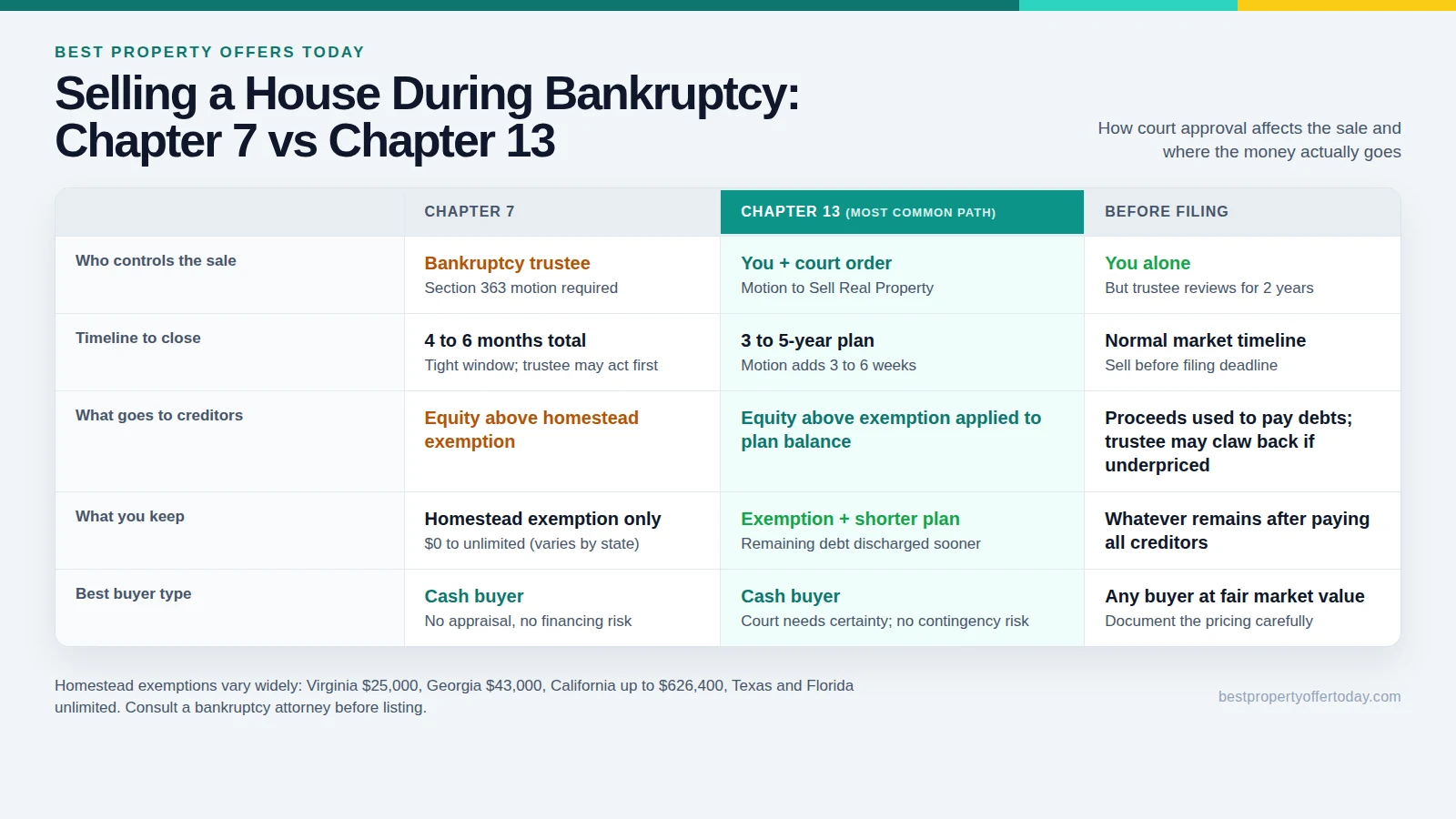
In a Chapter 7 case, the moment you file, a trustee is appointed and the non-exempt portion of your estate falls under their authority. If your home has equity above your state’s homestead exemption, the trustee can sell it to pay creditors. You do not initiate that sale; the trustee does. If you want to sell before the trustee acts, you need the trustee’s consent and, in most federal districts, court approval through a motion filed under 11 U.S.C. Section 363. A Chapter 7 case typically closes in four to six months, so the window is tight.
In a Chapter 13 case, you keep your assets and repay creditors through a three- to five-year plan. If you want to sell your home during that plan, you must file a Motion to Sell Real Property with the bankruptcy court. The trustee and creditors have an opportunity to object. If no one objects within the notice period (21 days in most districts), the court issues an order approving the sale. The proceeds then flow through the plan: the mortgage lender gets paid first, then any equity above the exemption goes toward plan payments, and you keep only what falls within your exempted amount.
The Homestead Exemption Is the Number That Controls Everything
Every state sets a homestead exemption that protects some portion of your home equity from creditors. What falls outside that exemption belongs to the bankruptcy estate.
The range is wide. The federal exemption, used in states that permit it, is $27,900 as of 2024. Texas and Florida offer unlimited homestead exemptions, meaning all equity is protected regardless of the amount. Virginia’s exemption is $25,000. California’s reaches up to $626,400 depending on the county median home price. Georgia caps it at $43,000. If your equity is at or below your state’s exemption, the trustee has no financial incentive to sell your home, and in a Chapter 7, they will likely formally abandon the property back to you.
If your equity exceeds the exemption, that surplus belongs to the estate. The trustee can sell the home in a Chapter 7, or the court can approve a sale in a Chapter 13, with the understanding that the excess proceeds go toward creditors.
A Worked Example: Chapter 13 with $80,000 in Equity
Take a house worth $320,000 with a mortgage balance of $240,000. Equity: $80,000. The seller lives in Virginia, where the homestead exemption is $25,000.
| Item | Amount |
|---|---|
| Sale price (cash buyer) | $305,000 |
| Mortgage payoff | $240,000 |
| Closing costs (approx.) | $6,000 |
| Net proceeds | $59,000 |
| Seller keeps (homestead exemption) | $25,000 |
| Applied to Chapter 13 plan | $34,000 |
The seller files the Motion to Sell. A cash buyer offers $305,000 with no financing contingency. The motion passes without objection after 21 days. At closing, the lender receives the payoff. The $34,000 above the exemption flows into the plan and accelerates payments to unsecured creditors, which may shorten the plan length.
A financed buyer would have introduced an appraisal, a mortgage commitment deadline, and a financing contingency that could collapse before the court order issues. Bankruptcy courts are not patient with uncertain closings. A cash buyer removes that risk and gives the court a clean transaction to approve.
Why a Cash Sale Fits a Bankruptcy Timeline Better
A bankruptcy sale has two requirements that are hard to satisfy with a financed buyer.
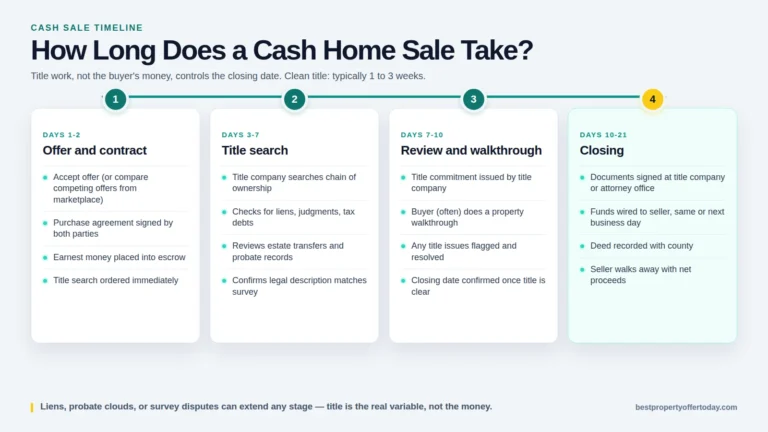
First, the timeline is set by the court, not the market. The motion process adds three to six weeks before closing can happen. A buyer who needs 30 days to secure a mortgage commitment is already competing with that clock, and their lender’s appraisal contingency runs parallel to the court’s notice period. A cash sale closes when the order comes through, not when a lender gives the green light.
Second, the court wants certainty. When you file the Motion to Sell, you name the buyer, the price, and the terms. If that buyer walks before the order issues, you start over. A cash offer has no financing contingency to collapse. The offer that goes into the motion is the one that goes to closing.
None of this means accepting any number. The court will scrutinize whether the price reflects fair market value. An offer that is too low can draw a creditor objection on the grounds that more equity could be recovered. Competing cash offers from multiple buyers produce a stronger record for the court than a single off-market offer does. That is where a marketplace model has a structural advantage over calling one buyer directly.
Selling Before Filing: A Different Set of Risks
Some sellers assume the solution is to sell the house before filing bankruptcy and use the proceeds to pay debts. This is legal, but it carries a serious risk: fraudulent transfer.
The Bankruptcy Code’s look-back period for ordinary transactions is two years. If you sell your home below market value within two years of filing, the trustee can sue to void the sale and recover the difference. “Below market” does not mean dramatically below; it means below what a reasonable arm’s-length sale would have produced. The trustee can pursue this against even an innocent buyer who believed they paid a fair price.
Selling at full market value before filing, and then using the proceeds to pay creditors, is generally permissible. The problem arises when the sale is structured to move equity out of the trustee’s reach. Do not attempt a pre-filing sale without a bankruptcy attorney reviewing the transaction first. The timing and the pricing both matter.
The Honest Limits of a Cash Sale in This Situation
A cash offer on a bankruptcy-constrained property is normally below what a fully marketed, time-rich sale would produce. A seller comparing options should run the numbers honestly before signing anything. Our net proceeds calculator can help model the difference.
If the house is in good condition and the bankruptcy case allows time to list on the open market, a traditional sale with an agent will almost always net more. The trade is certainty and speed for price. In a Chapter 13 where the repayment plan is unmanageable, a faster close that shrinks the plan balance has real value that does not show up in a raw price comparison. In a Chapter 7 where the trustee is about to list the property themselves, a seller-initiated cash sale may preserve some control over timing and terms that would otherwise be lost entirely.
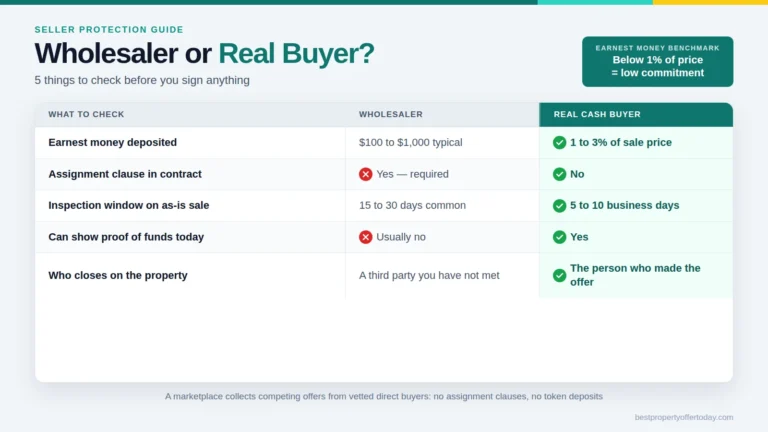
The other thing worth saying plainly: not every cash buyer operates the same way. Some work with clean contracts and close on the date they say. Others assign contracts, change numbers after inspection, or string out the timeline until a distressed seller accepts a lower price. Vetting matters here more than in a normal sale, because the court will ask who the buyer is and the seller needs a straight answer.
Red Flags to Watch For
- A buyer who pressures you to skip the court motion and close quickly: a sale without court authority is voidable, and the trustee can reverse it after money has changed hands
- An assignment clause in the purchase agreement: the court approved the named buyer, not whoever they sell the contract to
- Anyone who says bankruptcy does not need to be disclosed to the title company: it does, and the automatic stay affects title
- Token earnest money or no earnest money: if the buyer walks after the motion is filed, you have wasted court time and notice costs with nothing to show for it (see how much earnest money to require)
- An offer that arrives before any competing bids have been solicited: a single-buyer motion is more vulnerable to creditor objections on price
- A buyer who has not seen the property but is submitting an offer sight-unseen, based on a number that will “adjust after inspection”: that is a price reduction mechanism, not a cash offer
Questions to Ask Before Signing
- Has your bankruptcy attorney reviewed the proposed sale price against recent comparable sales?
- Does the buyer understand there will be a 21-day (or longer) objection window before closing?
- Is there an assignment clause, and if so, who actually closes?
- What is the earnest money, and what happens to it if the court denies the motion?
- If this is Chapter 13, how does this sale affect your remaining plan balance and length?
- Has the buyer provided proof of funds, not just a pre-approval letter?
Can you sell a house in Chapter 7 without the trustee’s permission?
No. Once you file Chapter 7, the automatic stay and the trustee’s authority over the estate prevent any transfer of property without court approval. A sale without that approval is voidable. The trustee can reverse it after the fact even if money has changed hands and the buyer believed they had good title.
What if the sale proceeds do not cover the mortgage?
If the sale price falls short of the mortgage balance, you are in a short sale situation within bankruptcy. The lender must agree to accept less than the full payoff. This is more complicated than a standard short sale because it involves both the lender’s approval and the court’s approval simultaneously. Some trustees will abandon a property where there is no equity to recover for creditors. At that point, the automatic stay may lift, and the lender can proceed with foreclosure. A bankruptcy attorney and a real estate attorney both need to be in the room for this scenario.
Does the automatic stay stop a buyer from closing?
The automatic stay stops creditors from acting against you. It does not stop you from selling. But any title company, any buyer’s lender, and any escrow officer involved in the transaction will require confirmation that the court has authorized the sale before they will proceed. The motion and the resulting court order do that job. Without the order in hand, most title companies will not issue a clean title policy, and the sale cannot close.
Can you keep any of the sale proceeds?
Yes, up to your state’s homestead exemption amount. What exceeds the exemption belongs to the estate and goes toward creditors. If your equity is entirely within the exemption, you keep all of it. That is one reason trustees in Chapter 7 often abandon properties when the exemption covers all available equity: there is nothing left for creditors, so the trustee has no incentive to pursue the sale.
If you are considering a cash sale during bankruptcy, the place to start is the offer itself. Submitting a single request to multiple vetted buyers gives the court a price that was tested against competition, not just taken from the first caller. Call us at 804-361-7460 or submit a request at the top of this page to see what competing offers look like for your property.