You can sell a house with termite damage. What you cannot do is pretend it does not exist. Disclosure rules in most states require you to report known pest damage, and lenders who finance the buyer’s purchase will require a clean inspection report before closing. If you have active termites or structural damage from a past infestation, those two facts shape every option available to you.
Why Termite Damage Stops a Financed Sale
Most buyers financing a home purchase through a mortgage need their lender to approve the property as collateral. FHA, VA, and USDA loans each require a Wood-Destroying Organism (WDO) inspection as a condition of approval. If that report shows active termites or unrepaired structural damage, the loan will not close until the seller addresses it.
Conventional loans (Fannie Mae and Freddie Mac guidelines) do not universally require a WDO inspection, but the lender’s appraiser is required to flag visible pest damage. If the appraiser notes it, the lender can make a clearance report a condition of funding. In practice, visible termite damage on a conventional loan works the same way: the seller treats and repairs, or the deal collapses.
This is the practical wall that stops many traditional sales. A buyer makes an offer, the home inspection uncovers termite history, the lender requires a clearance report, and the seller is now on the clock to treat and repair before closing. For a seller who does not have the cash or the time to manage a contractor project, the deal often falls apart entirely.
What Termite Treatment and Repairs Actually Cost
The range is wide, and the final number depends on the type of termite, the size of the infestation, and how much structural wood was affected.
Treatment costs:
- Liquid barrier or baiting system for subterranean termites: $300 to $1,200 for a typical single-family house, plus an annual monitoring contract that most buyers will want to see
- Tent fumigation for drywood termites: $1,200 to $3,500 for a 2,500 square foot house, and the house must sit empty for two to three days during treatment
Structural repairs are the larger variable. Termites favor soft, moist wood, so floor joists, rim joists, sill plates, window framing, and sub-floor sheathing are the usual targets. A contained repair, replacing a section of floor joists and sub-flooring in one area, runs $2,000 to $6,000. Extensive damage through a crawl space or along an entire foundation wall can reach $10,000 to $20,000 or more, depending on access and scope.
Treatment plus repair is often a $5,000 to $15,000 project. That number is not trivial, but it also has to be weighed against what skipping repairs costs you in price and buyer pool.
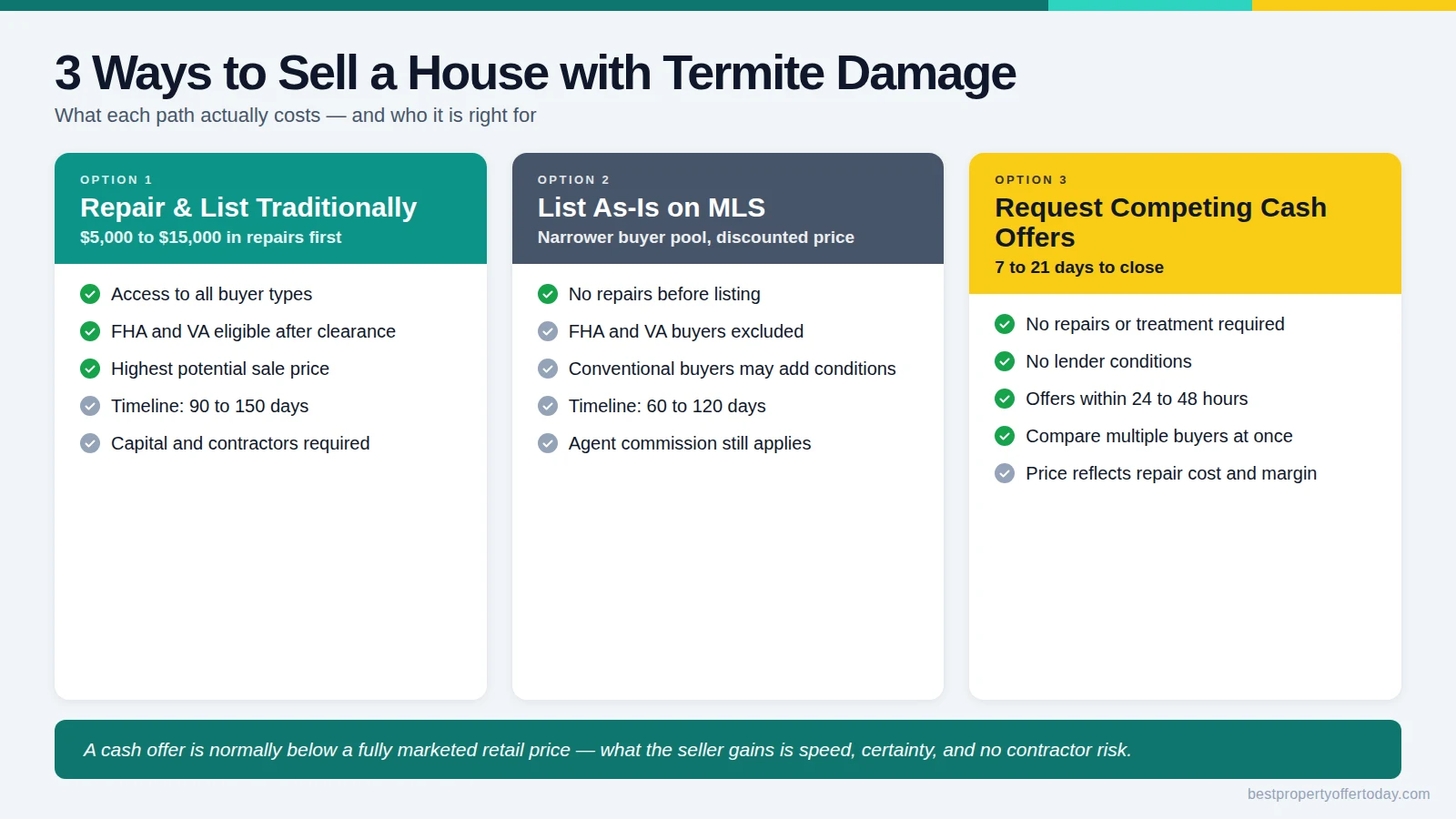
Three Paths to Selling
Fix it, then list on the open market
Treat the infestation, repair the structural damage, obtain a clearance letter from a licensed inspector, and sell to any buyer including those using FHA, VA, or USDA financing. This path typically produces the highest sale price, but it requires capital upfront, reliable contractors, and time, usually 60 to 120 days from discovery to a clean listing.
List as-is with full disclosure at a reduced price
Some buyers using conventional loans will accept known termite history if the price accounts for it. You disclose everything, provide your inspection reports, and set the asking price to reflect the repair cost. FHA and VA buyers are out unless you make repairs first. Cash buyers on the open market will make offers, but they will price in the damage and their overhead margin. This path is slower than a direct cash offer request, and you are still negotiating around a repair number that both sides are estimating.
Request competing cash offers
Cash buyers do not need a lender to approve the property. They run their own assessment, price in the treatment and repair cost, and make an offer based on the house’s repaired value minus what it will cost them to get it there. The seller does not manage contractors or carry the property through a months-long repair cycle. At BestPropertyOffersToday.com, one request goes to multiple vetted cash buyers, so you can compare what each is actually willing to pay. The service is free and there is no obligation to accept any offer.
If the repair costs are genuinely high, this path sometimes nets more than sellers expect. Buyers who close on termite-damaged houses regularly will often come in above a naive first estimate because they have contractor relationships and know exactly what the job costs.
Worked Example: A House with Moderate Termite Damage
A 3-bedroom ranch, 1,800 square feet, built in 1968. Market value in good condition: $235,000. A home inspection found past subterranean infestation, some damage to the sill plate along the back wall, and one section of floor joists in the laundry room. No active termites at the time of inspection.
Path A: treat, repair, then list traditionally
- Soil treatment and bait stations: $900
- Sill plate replacement and joist repair: $7,200
- Clearance WDO inspection and letter: $175
- Carrying cost during 90-day repair and listing period (mortgage, taxes, insurance): $3,400
- Agent commission at 5.5 percent: $12,925
- Seller-paid closing costs: $2,400
- Total deductions: $27,000
- Estimated net to seller: $208,000
Path B: request cash offers as-is
- Two offers received: $188,000 and $196,500
- Accepted the higher offer
- No agent commission, no repairs, close in 16 days
- Seller-paid closing costs: $1,900
- Net to seller: $194,600
The difference between paths is roughly $13,400. Whether that gap justifies 90 to 120 days and a contractor project with real execution risk is a genuine decision, not an obvious one. Use the net proceeds calculator to run your own numbers with your actual carrying costs and a realistic repair estimate before committing to either path.
Disclosure: What You Are Required to Tell Buyers
In most states, sellers must disclose known material defects, and prior termite infestation or structural damage qualifies as a material defect in virtually every jurisdiction. The required form varies: some states have a specific wood-destroying organism section on their disclosure form, others include pest history in a general property condition statement. Texas, California, Hawaii, and several other states require the seller to provide a termite inspection report to the buyer as part of the transaction.
Selling as-is does not waive your disclosure duty. As-is means the buyer accepts the physical condition without requiring you to make repairs. It does not mean you can withhold known problems. A seller who conceals known termite damage faces potential liability for fraud or misrepresentation even after closing, because disclosure obligations survive the sale.
If you are uncertain what your state requires, a real estate attorney can give you the exact form and tell you whether your current documentation is adequate. See when to use a real estate attorney in a cash sale for what a review covers and what it typically costs.
Option Comparison
| Option | Best for | Typical timeline | What you give up |
|---|---|---|---|
| Repair and list traditionally | Limited damage, seller has time and capital | 90 to 150 days | Upfront repair cost, carrying costs, contractor risk |
| List as-is on MLS | Moderate damage, can wait for a conventional or cash buyer | 60 to 120 days | Narrower buyer pool, agent commission, uncertain final number |
| Request competing cash offers | Severe damage, fast timeline, no capital for repairs | 7 to 21 days | Price below a repaired retail listing |
A cash offer is normally below what a fully repaired, fully marketed house would sell for. That is the honest trade: the seller skips the repairs, the carrying costs, and the contingency renegotiations, and the buyer prices all of that into their number. If the house is otherwise in good condition and the termite damage is contained, treating and repairing first often nets more. If the damage is extensive or the seller cannot carry the property through a repair cycle, the cash path frequently produces a better financial outcome than the headline price difference suggests.
Red Flags When Evaluating a Cash Offer
The cash offer market for damaged properties includes buyers who are serious and buyers who are not. Before signing anything, check these:
- The buyer provides proof of funds promptly. A bank statement, a line of credit letter, or a verified funding source should come within 24 to 48 hours of your request. Hesitation or stalling is a warning sign. See what proof of funds should actually look like.
- Earnest money is meaningful. On a damaged house, $1,000 in earnest money on a $190,000 transaction signals a buyer who is testing the water rather than committing. A serious buyer puts up 1 to 3 percent.
- The contract does not include an assignment clause. If it does, the person making the offer may not be the person who closes on it. They intend to sell the contract to someone else, and that someone else may not perform.
- The inspection period is short or waived. On an as-is damaged property, an extended inspection window with an unlimited right to cancel is not a real offer. It is an option on your time.
Frequently Asked Questions
Do sellers have to fix termite damage before selling?
No, not unless a financed buyer’s lender requires it as a loan condition. FHA, VA, and USDA lenders require a clear WDO report before funding. Conventional lenders may require it if an appraiser flags visible damage. Cash buyers have no lender requirement and can close on a house with unrepaired termite damage. If you want to preserve access to FHA and VA buyers, you need to treat and repair before listing.
How much does termite damage reduce home value?
Unrepaired termite damage with an active infestation can reduce a home’s value by 10 to 25 percent, according to pest control and real estate industry estimates. The actual effect depends on the severity of structural damage, whether any infestation is active, and how buyers and appraisers in the local market price this type of risk. Fully repaired damage with a clearance letter and documented treatment history has a much smaller price impact, sometimes near zero in regions where termite history is widespread.
Can FHA buyers purchase a house with termite damage?
Not until the damage is treated and repaired. FHA guidelines (HUD Handbook 4000.1) require a WDO inspection in termite-prone geographic areas, and the appraiser is required to report observed evidence of infestation or structural damage. If the inspection finds active termites or unrepaired damage, the property fails the FHA appraisal conditions and the loan will not fund. VA loans carry similar requirements: VA Pamphlet 26-7 requires a pest inspection in most states, and active infestation or significant structural damage is a repair condition before the loan closes.
Who pays for termite treatment when selling?
In a traditional listed sale, sellers most often pay for treatment and minor repairs because the deal cannot close otherwise. In a cash sale, treatment and repairs are priced into the buyer’s offer rather than paid out of pocket by the seller. The cost still comes from the seller’s proceeds either way. The question is whether you pay it directly and control the scope, or let the buyer price it in and close faster. Most cash buyers will deduct the full estimated repair cost plus their margin, so the seller rarely comes out ahead by skipping the repairs and accepting a cash offer unless speed or capital constraints make that the better choice.
If you want to see what competing buyers would offer on the property as-is, submit a request here. It takes a few minutes, costs nothing, and carries no obligation to accept any offer. You can also call 804-361-7460 to talk through the situation before deciding anything.