HOA violations rarely stop a sale outright, but they commonly freeze a financed one. The reason is the lender, not the HOA. Most lenders require a property to be in good standing with its HOA before they approve a loan, and a certificate showing open violations is enough to stall or kill that approval. A cash buyer skips that layer entirely. What you do with that fact depends on what the violation is, whether it attaches to the property or only to your name, and how much time you have before you need to close.
Selling a house with HOA violations? Compare cash offers from buyers who price it in.
Enter your property address to get competing offers from verified cash buyers. No repairs, no agent fees, and you pick the closing date.
Prefer to talk? Call (804) 361-7460
HOA violations and delinquent dues are two different problems
A violation is a rule infraction: an unapproved fence, a storage unit parked in the driveway, a deck built without architectural committee sign-off, an exterior paint color outside the approved palette, or a basketball hoop left in a restricted area. The HOA documents this as a citation, sends you a notice, and sets a deadline to cure.
Delinquent dues are a different issue. Those are money you owe the HOA for assessments you did not pay. Dues can accumulate fines, those fines can become liens, and in super-lien states some HOAs have the power to foreclose. That process is covered in the delinquent HOA dues guide.
The two problems overlap when a violation citation goes unresolved long enough that the HOA starts adding fines to your account and those fines grow into a balance. At that point you have both a violation on the property and a delinquency on your account. This post covers the violation side: the citation, the lender problem it creates, and the three realistic exits.
The lender problem: HOA good standing at closing
When a financed buyer makes an offer on your home, the lender orders a due-diligence package that includes an HOA certificate or estoppel letter. This document tells the lender the current status: dues paid or unpaid, outstanding special assessments, and whether any open violations are on record.
FHA and VA loans require explicit HOA certification. The lender verifies that the HOA is financially solvent, that the property is not under any enforcement action, and that dues are current. A certificate with open violations is an enforcement action. Those loans do not close until the violations are cleared.
Conventional lenders are less explicit in their written guidelines, but most underwriters will not approve a loan on a property carrying open HOA citations. The practical result is that a large share of financed buyers cannot close on a property with an active violation on the certificate. Cash buyers require no lender certificate, so this entire layer does not apply to them.
What transfers to the new owner and what does not
This is the question that fills the HOA forums, and the answer splits in a way most pages do not explain clearly.
The money does not transfer. Outstanding fines and dues are the seller’s obligation. At closing, they are paid from the seller’s proceeds before any funds are disbursed. The new owner does not inherit your unpaid balance.
The physical violation can transfer. If you built a deck without approval, that deck is still there after closing. The new owner takes title to a property with a non-compliant structure on it. The HOA does not close its file because ownership changed. The citation may be in your name, but the violation is on the house.
In practical terms: a buyer who closes on a property with an unapproved structure inherits the obligation to cure it or negotiate a retroactive approval with the HOA. Some buyers price this in and proceed. Most buyers who need a lender never get that far, because the lender will not fund the loan with the violation on the estoppel certificate.
How different buyer types handle violations
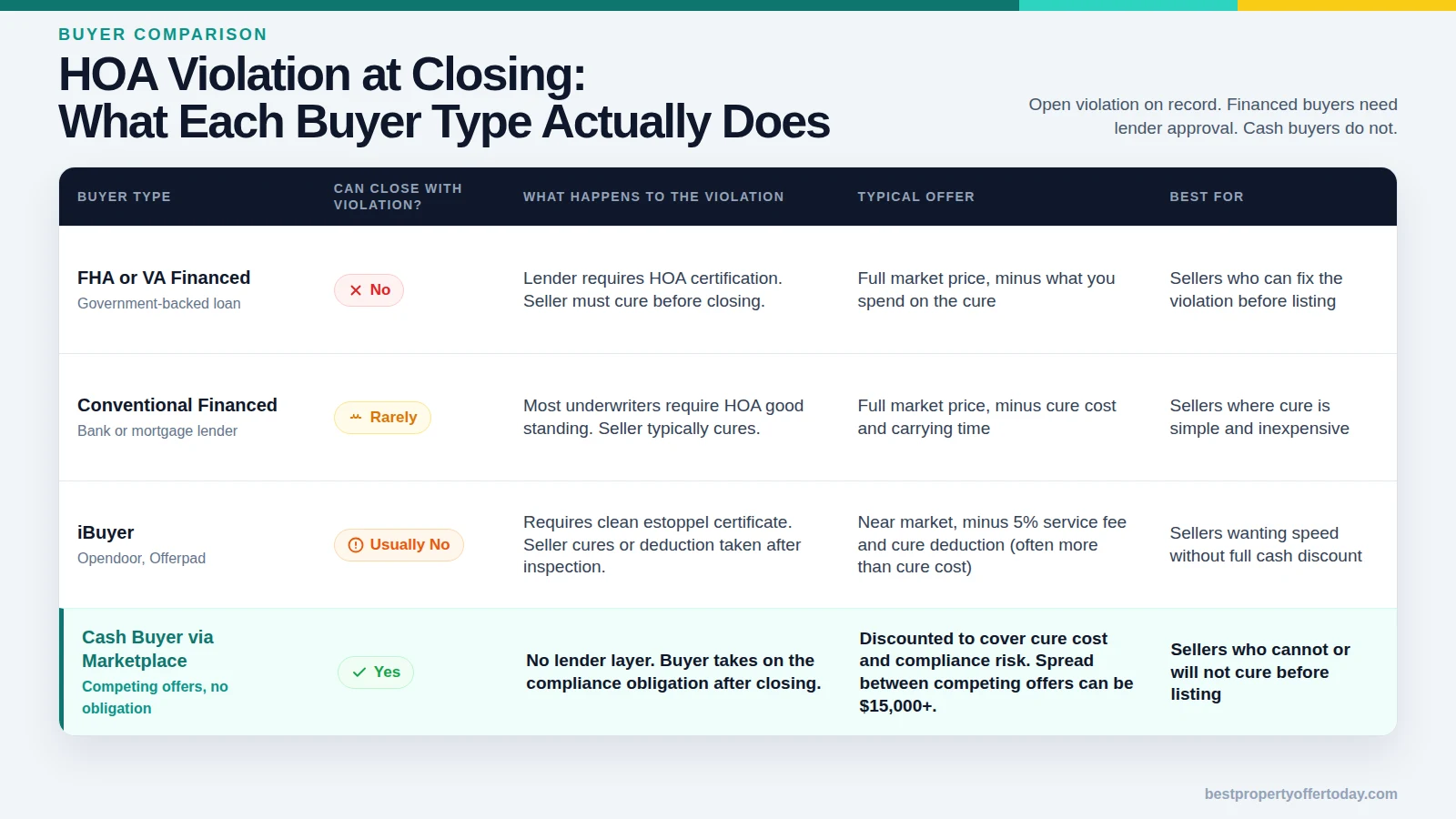
| Buyer type | Can close with open violations? | What happens to the violation | Net effect on price |
|---|---|---|---|
| FHA or VA financed | No. Lender requires HOA certification. | Seller must cure before closing. | Full market price, minus your cure cost |
| Conventional financed | Rarely. Most underwriters require good standing. | Seller typically must cure. | Full market price, minus cure cost and any carrying time |
| iBuyer (Opendoor, Offerpad) | Usually no. Clean estoppel required. | Seller cures or deduction taken after inspection. | Near market, minus service fee and cure deduction |
| Cash buyer via marketplace | Yes. No lender layer. | Buyer takes on the compliance obligation. | Discounted to cover cure cost and compliance uncertainty |
The iBuyer route deserves a note. Opendoor and Offerpad process high volumes and their underwriting flags open violations automatically. They either require you to cure before closing or deduct the estimated cure cost from your offer after their inspection. That post-inspection deduction is frequently larger than what you would have spent handling the violation yourself. A comparison of their fee structures is in the Opendoor and Offerpad fees guide.
Three paths for a seller with open violations
Cure the violation before listing
The cleanest path to market price. Fix what the HOA cited, document the completed work, and request a compliance clearance letter from the HOA before you list. Lenders see a clean certificate. Your full buyer pool opens up.
Cure costs vary widely depending on what was cited:
- Repainting to the approved color: $1,500 to $4,500 for a standard exterior
- Removing unapproved storage or equipment: $200 to $1,000
- Bringing a fence into compliance: $500 to $3,500, depending on whether it needs to be moved or replaced
- Retroactive architectural approval for a deck or addition: $500 to $1,500 in fees if the structure already meets design standards
Not all violations require physical work. Some HOAs will grant retroactive approval for a structure that was built without going through their process but meets their design criteria. Ask before you start removing anything. The HOA may accept a compliance application and approve the work as-built, which resolves the citation without demolition or reconstruction.
Sell with the violation and negotiate a credit
You can disclose the violation, build in a closing credit equal to the cure cost, and let the buyer address it after closing. The problem is the lender. A financed buyer who wants to accept your credit instead of requiring you to cure will still hit the lender wall when the estoppel certificate comes back showing an open citation. The credit is real, but the lender’s requirement takes precedence, and lenders do not negotiate on HOA good standing.
This path works most reliably when the buyer is paying cash, or when the violation is a paper issue that the HOA will clear on receipt of a cure commitment letter rather than proof of completed work. Some HOAs accept an escrow holdback arrangement where funds to complete the cure are held at closing and released once the work is finished. Few lenders agree to this structure, but a title company with HOA transaction experience may know whether the specific HOA will cooperate.
Request competing cash offers
A cash buyer does not need a lender certificate. The violation stays on the property, the buyer prices it in, and the sale closes. Through a marketplace, one submission produces competing offers from multiple vetted buyers. You compare them side by side. The buyer takes on the compliance obligation going forward; you accept a price that reflects the cure cost and the uncertainty involved.
This is the realistic path when the cure cost is high, when the non-compliant structure cannot be removed without significant expense, or when the timeline does not allow for an HOA approval process that may run six to twelve weeks.
A worked example
A homeowner in Virginia has a property with an ARV of $310,000. In 2022 they built a 200-square-foot deck off the rear of the house without submitting an architectural approval application. The HOA has carried an open citation on the property for two years. The deck is structurally sound and built to county code, but the HOA never reviewed or approved the design. The outstanding fine balance from the citation is $1,400.
Path 1: Cure first. The homeowner submits a retroactive architectural approval application. The HOA board reviews the deck design, requests minor trim adjustments to match the approved color scheme, and grants approval after seven weeks. The $1,400 fine is paid from closing proceeds. Total out-of-pocket cure: $600 in application fees plus seven weeks of delay. The property lists with a clean certificate. After a financed sale with a 3 percent commission and standard seller-paid closing costs, the seller nets approximately $291,000.
Path 2: Credit at closing. The homeowner lists and discloses the violation, offering a $3,000 closing credit. Three financed buyers make offers. All three have their loans stalled when the estoppel certificate comes back showing the open citation. A fourth buyer, paying cash, offers $297,000, declines the credit, and closes in 18 days. After the $1,400 fine balance and standard closing costs, the seller nets approximately $291,500.
Path 3: Cash marketplace. Without listing publicly, the homeowner submits to a cash buyer marketplace. Offers come in between $198,000 and $221,000. The spread of more than $23,000 between offers reflects how differently buyers priced the compliance risk. The buyer at $221,000 confirmed the deck was code-compliant and was confident a retroactive HOA approval was achievable. The seller accepted that offer and closed in 14 days, netting approximately $218,000 after the fine payoff and minimal closing costs.
Path 1 and Path 2 produced similar net proceeds in this scenario. Path 3 gave up about $73,000 compared to market price, but required no repair, no HOA waiting period, and closed two months faster. That tradeoff makes sense for some sellers and not others.
Red flags when reviewing offers on a property with violations
- A financed buyer who says they will handle the HOA after closing: the lender controls the closing, not the buyer’s intentions, and lenders will not fund a loan on a property with open citations
- A long inspection window paired with token earnest money on an as-is contract: this is the wholesaler pattern, where the buyer plans to assign the contract rather than close themselves. See the guide to spotting wholesalers for the specific signals to watch
- A cash buyer offering near-market value without asking any questions about the violation: if they are not pricing it, they are planning to renegotiate after due diligence or walk away
- A buyer who does not request the HOA documents in the due diligence package: any serious buyer intending to close wants to know exactly what they are inheriting
Questions to ask the HOA before you list
- What is the specific citation, what is required to cure it, and is there a deadline before fines escalate further?
- Is the fine balance still in the notice phase, or has it been referred to the HOA’s attorney?
- Will the HOA issue a compliance clearance letter after cure, and what is the typical turnaround time?
- Does the HOA have a right of first refusal? A small number of HOAs, typically in 55-plus communities or older planned developments, require the HOA or existing residents to be offered the property before an outside buyer can purchase
- Does the violation involve a structure that also needs a retroactive building permit from the city or county, separate from HOA approval?
Can an HOA prevent me from selling my house?
Not directly. An HOA does not have the authority to block a property transfer. What it does is produce an estoppel letter or certificate showing the current status of the property, and lenders use that document to approve or decline a loan. An open violation on the certificate does not stop the sale; it stops the loan approval. The result looks the same to a financed buyer, but the mechanism is the lender acting on HOA-provided information, not the HOA acting unilaterally.
What happens to HOA fines when I sell?
Outstanding fines and dues are the seller’s obligation, paid at closing from your proceeds. The title company requests the estoppel letter showing the full balance, and that amount is deducted from the seller’s funds before disbursement. If fines have grown into a recorded lien, the lien must be satisfied to transfer clean title. The buyer does not inherit your financial balance, but if the underlying violation is a physical condition on the property, they inherit the property in that condition.
Do I have to fix the HOA violation before selling?
Not legally. You can disclose and sell. The practical constraint is your buyer pool. Financed buyers will encounter lender approval problems if the HOA certificate shows open violations. Cash buyers do not face that constraint, but they will price in the cost and uncertainty of resolving the violation. If the cure is straightforward and inexpensive, fixing before listing almost always produces more money. If the violation involves a major unapproved structure, the math depends on what resolution looks like and how long it takes.
Can I get a cash offer on a house with HOA violations?
Yes. Cash buyers are not subject to the lender’s HOA certification requirement. Competing offers through Best Property Offers Today, at 804-361-7460 or through the request form, come back within 24 to 48 hours with no obligation to accept. Each buyer prices the violation differently based on their own assessment of the compliance risk, and the spread between offers on a property with a significant violation is often substantial. Comparing them side by side is the clearest way to see what the market will actually pay. The net proceeds calculator can help you model what each scenario nets after costs.
The honest limits of a cash sale
A cash offer on a property with open HOA violations will be below what the same property would produce on the open market with a clean certificate. The discount reflects the buyer’s cost to resolve the violation, their uncertainty about whether the HOA will cooperate, and the cost of carrying the property while the process runs.
If the violation is minor and the cure is straightforward, the discount will be modest. If the violation involves an unapproved structure with possible permitting implications, the discount will be larger, and it will vary significantly between buyers because each one is estimating a different outcome.
A traditional listing after curing the violation produces more money in most cases, provided you have the time, the funds to cure upfront, and confidence that the HOA approval process will not stall. For a seller who cannot fund the cure out of pocket, does not have weeks or months to wait for an architectural committee review, or is dealing with a violation tied to a structure that cannot be easily removed, a cash offer through a marketplace is a real and practical exit. The decision comes down to which option is actually available given your timeline and your balance sheet.
Ready to see real numbers for your house?
Enter your property address to get competing offers from verified cash buyers. No repairs, no agent fees, and you pick the closing date.
Prefer to talk? Call (804) 361-7460