Plumbing problems can sell a house one of three ways: you repair before listing, you disclose and discount, or you take it to a cash buyer who does not need a lender’s sign-off. The choice depends on how much the repairs cost, how much time you have, and how much certainty matters to you. Use our free net proceeds calculator to run the numbers for your specific situation before deciding.
Selling a house with plumbing problems? Compare cash offers from buyers who price it in.
Enter your property address to get competing offers from verified cash buyers. No repairs, no agent fees, and you pick the closing date.
Prefer to talk? Call (804) 361-7460
What Counts as a Plumbing Problem When You Are Selling
Not every dripping faucet triggers a lender condition. The line that matters is whether the defect affects livability, safety, or structural integrity. That standard comes from Fannie Mae’s appraisal guidelines and from the FHA Minimum Property Requirements, and it determines which buyers can finance your house as-is.
Defects that routinely trigger required repairs on government-backed loans:
- Non-functional water heater, or one without a T&P relief valve and discharge pipe
- Active leaks at supply or drain lines visible during the appraisal
- No hot water at any tap in the house
- Sewage odor or evidence of backup inside the living space
- Corroded supply lines showing active staining or dripping
Defects that appraisers usually note but do not require repair before closing on a conventional loan:
- Slow-draining sinks or tubs without evidence of sewage backup
- Dripping faucets or a running toilet
- Low water pressure at one fixture (but not throughout the house)
- Water hammer noise without structural damage
The buyer’s inspector will flag everything. The lender’s appraiser will flag what blocks financing. Knowing which column your house falls into tells you whether a financed deal is even possible without repairs.
FHA and VA Loans Create the Biggest Obstacle
FHA and VA appraisers work from a government-mandated checklist. If your water heater is 20 years old and the inspector notes it as near end-of-life, FHA typically requires replacement before closing. If the appraiser sees corroded supply lines, that becomes a conditional appraisal: the repair must happen, a licensed re-inspection must confirm it, and only then will the lender issue a clear-to-close.
That process adds two to four weeks and thousands of dollars. It also creates a window for the buyer to walk. If your target buyer is using FHA or VA financing, any plumbing defect that makes the appraiser’s list puts you back in repair mode, even if you listed the property as-is.
Conventional financing (Fannie Mae, Freddie Mac) is more forgiving. A conventional appraiser notes defects on the report but is not required to condition the loan on repair unless the defect is severe enough to affect the home’s marketability or structural soundness. A running toilet does not meet that threshold. A wet ceiling with an active supply line failure does.
What You Must Disclose
Selling as-is limits your obligation to repair. It does not limit your obligation to disclose. Every state requires sellers to reveal known material defects, and plumbing problems fall squarely in that category. A material defect is anything a reasonable buyer would want to know before making a decision.
That includes:
- Known leaks, past or present, even if the visible source was patched
- History of sewage backup or recurring drain failure
- A water heater you know to be non-functional or past its rated lifespan
- Any prior plumbing repair that was not done to code
Concealing a known defect to push through a sale creates a different problem entirely: it exposes you to rescission claims, damages, and in some states, misrepresentation liability after closing. Disclosure forms vary by state, but the duty to disclose is uniform. Selling to a cash buyer does not waive it.
A Worked Example: $290,000 House, Three Plumbing Problems
Here is what the numbers look like in practice. Take a house with an after-repair value of $290,000. The seller gets a pre-listing plumbing inspection and finds three issues: corroded galvanized supply lines in a bathroom addition ($5,000 to $9,000 to repipe), an 18-year-old water heater flagged as near-failing ($1,400 to $2,800 to replace), and a partially blocked main drain line causing a slow drain in the master bath ($800 to $1,500 to clear or line). Total repair range: $7,200 to $13,300.
Path A: Repair everything, then list at full price. Budget $10,000 for repairs at the midpoint. Delay listing by three to five weeks. List at $290,000. Agent commission at 5.5 percent: $15,950. Seller closing costs: $5,800. Carrying costs during the repair period (mortgage, insurance, utilities for five weeks): roughly $3,200. Estimated net: $255,000. Risk: the buyer’s inspector finds additional problems, triggering a second round of repair requests or a price reduction.
Path B: List as-is at a reduced price, target conventional buyers. Price at $275,000 to reflect the known issues. FHA and VA buyers are largely excluded. A conventional buyer submits an offer, their inspector identifies the full scope, and they request a $12,000 repair credit. Effective sale price drops to $263,000. Commission at 5.5 percent: $14,465. Seller closing costs: $5,260. Estimated net: $243,275. This path keeps repair costs off your plate but does not guarantee the deal survives the inspection.
Path C: Collect competing cash offers through a marketplace. Cash buyers price plumbing work into their offer formula. Offers on a $290,000 ARV house with $10,000 in known repairs typically land in the $210,000 to $232,000 range, depending on the buyer type, the local market, and what else they find on their walkthrough. No commission. Seller closing costs (title, transfer taxes): $4,000 to $5,000. Estimated net: $205,000 to $228,000. Closes in one to three weeks. No lender conditions, no re-inspection, no second round of negotiations.
The gap between Path A and Path C is roughly $27,000 to $50,000. What Path C provides instead of that gap: no upfront repair outlay, five fewer weeks of carrying costs, and a transaction that does not unravel if the plumber finds something worse behind the wall.
A cash offer is normally below a fully marketed retail price. If the house is in good condition otherwise and the seller has two to three months, a traditional listing after repairs done will almost always net more. The cash route makes sense when the repair scope is uncertain, when time matters, or when the cost of carrying the house through a full listing cycle approaches the discount a cash buyer takes.
How Cash Buyers Price Plumbing Repairs Into Their Offer
Cash buyers, whether local investors, house flippers, or iBuyers, work from a version of the 70 percent rule. They target a purchase price at roughly 65 to 75 percent of after-repair value, minus their estimated repair cost. Plumbing is a known quantity in that formula: a plumber with investment-property experience can price corroded supply lines in a couple of hours, and that number goes directly into the offer before the buyer signs anything.
This matters for the seller because a cash buyer is not surprised by your plumbing problems. The offer reflects them already. There is no inspection renegotiation because the inspection is baked in from the start. The number you receive is, within the normal range of variation, the number at closing.
A marketplace collects offers from multiple cash buyers competing on the same property. Because each buyer has a different cost structure and a different appetite for rehab work, the spread between the lowest and highest cash offer on the same house can reach $25,000 to $40,000. That spread is exactly why collecting multiple offers matters: see how to compare cash offers side by side before accepting the first number you receive.
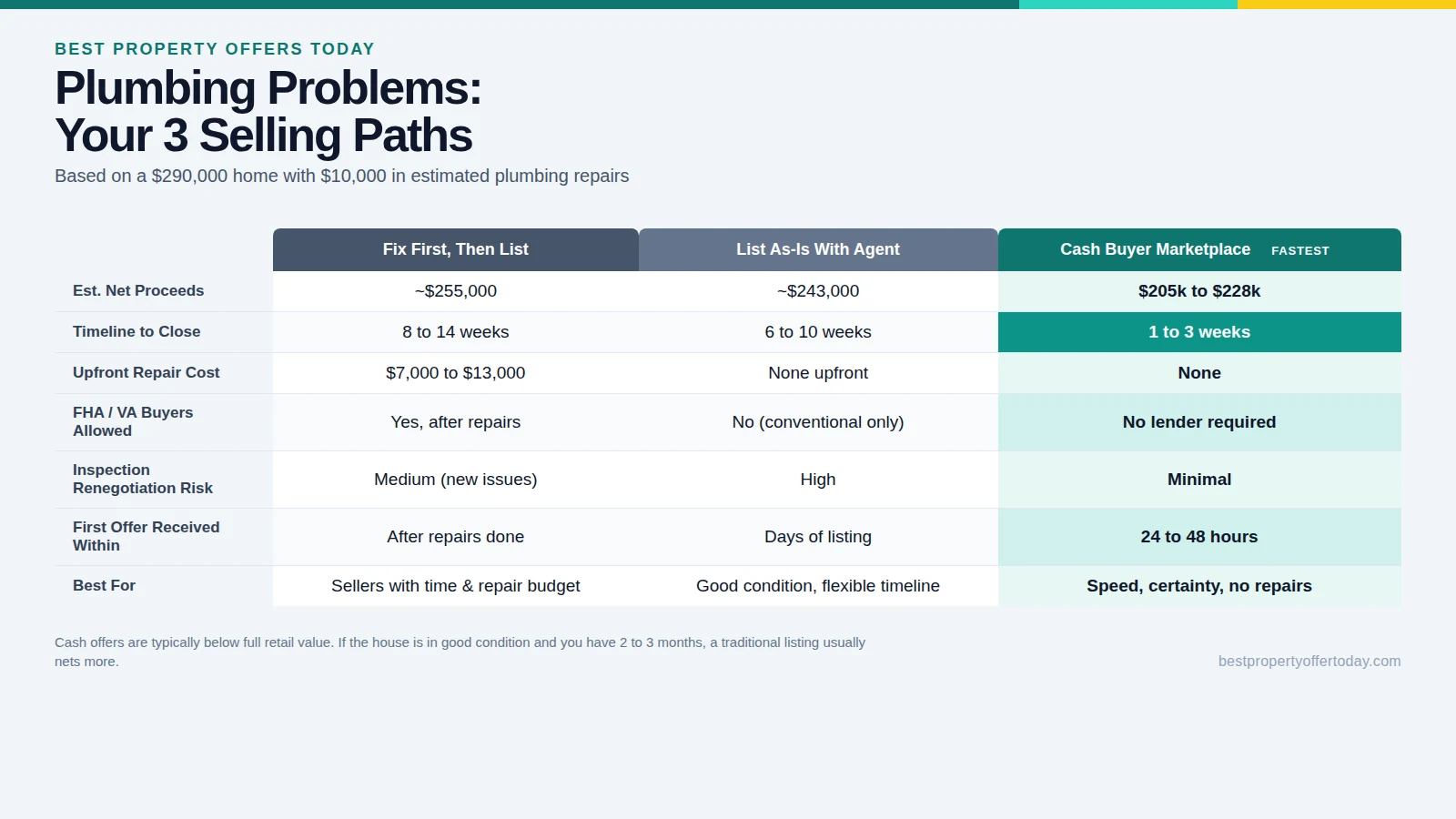
Comparison Table: Three Paths for a House with Plumbing Problems
| Path | Net proceeds (estimated) | Timeline to close | Upfront repair cost | Lender required |
|---|---|---|---|---|
| Repair first, then list | ~$255,000 | 8 to 14 weeks | $7,000 to $13,000 | Yes |
| As-is with agent (conventional buyers only) | ~$243,000 | 6 to 10 weeks | None upfront | Yes |
| Cash buyer via marketplace | $205,000 to $228,000 | 1 to 3 weeks | None | No |
Red Flags in a Cash Buyer’s Plumbing Offer
Not every cash offer is what it appears. Watch for these before you sign:
- An inspection window longer than 21 days on an as-is cash deal. Fourteen to 21 days is standard. A 30- to 45-day window often means the buyer intends to renegotiate after getting a plumber’s estimate.
- An assignment clause. This allows the “buyer” to transfer the contract to a third party before closing. The person who made your offer is a wholesaler, not a direct purchaser. The real buyer may offer less, or may not materialize at all.
- Earnest money below 1 percent of the purchase price. A $500 deposit on a $210,000 offer makes walking away nearly free for the buyer.
- A price reduction request after the inspection on an as-is contract. Legitimate cash buyers price condition into the offer upfront, not into a post-inspection adjustment. See what separates a real cash buyer from a wholesaler for more on this pattern.
Questions to Ask Before You Sign
Before accepting any cash offer on a house with plumbing issues, ask the buyer:
- Can you provide proof of funds or a bank statement showing available capital?
- Do you buy directly, or do you assign contracts to other buyers?
- What is your earnest money deposit, and at what point does it become non-refundable?
- Is your offer subject to change after inspection on this as-is contract?
- Who handles the title search, and do you use a licensed title company?
If the buyer will not answer those questions directly, treat that as your answer. For a free comparison of what multiple vetted cash buyers would offer for your specific property, call 804-361-7460 or submit your address at the top of this page.
Can you sell a house with plumbing problems without disclosing them?
No. You can sell without repairing them, but disclosure of known material defects is required in every state. A seller who conceals an active leak or a known drain failure faces rescission claims and potential liability after closing. The disclosure duty survives an as-is sale and applies regardless of buyer type.
Does the water heater have to work for a house to sell?
For FHA or VA financing, yes. Both programs require a functional water heater with a T&P relief valve and a proper discharge pipe. A conventional appraiser will flag a non-functional heater on the report but may not condition the loan on immediate replacement if the property is otherwise sound. A cash buyer has no lender requirements at all.
How much less will a house with plumbing problems sell for?
Minor issues, a slow drain or dripping faucet, typically reduce a cash offer by little more than the repair cost. Major issues, corroded supply lines throughout the house or an active sewer failure, can reduce a cash offer by $15,000 to $40,000 from after-repair value, depending on local labour costs and buyer competition. The range of offers from different cash buyers on the same property is wide. Getting three or more offers through a marketplace is the only accurate way to find out where your market is.
How fast can a cash sale close when the house has plumbing problems?
One to three weeks is typical. The limiting factor is title work: clearing the title search, obtaining title insurance, and handling any liens or encumbrances. The plumbing condition does not slow the closing, because no lender inspection or re-inspection is required. Most cash buyers in an active marketplace can give you an initial offer within 24 to 48 hours of a property submission.
Ready to see real numbers for your house?
Enter your property address to get competing offers from verified cash buyers. No repairs, no agent fees, and you pick the closing date.
Prefer to talk? Call (804) 361-7460