Selling a House with Wood Rot: Your Options and What to Expect
Wood rot turns a straightforward sale into a decision tree. The rot itself is not always the biggest problem. The bigger issue is what it does to financing: FHA, VA, and USDA appraisers are required to call out visible wood rot as a deficiency, and once it is noted, the loan cannot close until the repair is done. A cash buyer skips that requirement entirely. Which path nets you more depends on how much rot you have, where it is, and how long you have before you need to close.
Dry Rot vs. Wet Rot: Why the Distinction Matters
These are two different problems with different scopes and different price tags.
Dry rot is a fungal decay. The fungus digests the cellulose in the wood and can spread to adjacent unaffected areas even without a continuous moisture source, because it generates its own moisture as it grows. Once it takes hold inside a wall or floor system, it can travel along joists, studs, and sill plates. Inspectors and structural engineers treat dry rot findings more seriously because a small visible patch can have an invisible network extending several feet in every direction.
Wet rot stays where the moisture is. The wood breaks down because water has been sitting on or against it long enough to cause decay, but the problem does not spread the way dry rot does. Find the moisture source, fix it, replace the affected wood, and the problem is contained. Wet rot is far more common than dry rot and, in most cases, significantly less expensive to remediate.
For sellers, the practical difference shows up in two places: the disclosure conversation and the buyer’s reaction. A dry rot finding implies an unknown scope. A wet rot finding bounded by a specific leak source is a defined repair estimate. Buyers and buyers’ agents treat them very differently in negotiation.
How Wood Rot Affects Financed Buyers
Government-backed loans create a specific barrier. FHA, VA, and USDA appraisers operate under protocols that require them to flag any readily observable physical deficiency in the property. Wood rot is on that list, particularly when it involves structural members, exterior wood in contact with the ground, or areas where water intrusion is evident. Once the appraiser flags it, the lender conditions the loan on the repair. The buyer cannot close until a licensed contractor completes the work and someone signs off.
Conventional loans under Fannie Mae and Freddie Mac guidelines are slightly less rigid, but appraisers are still required to note adverse physical conditions that affect value or habitability. Structural wood rot in floor joists, rim joists, or load-bearing posts will get flagged on most conventional appraisals, especially if the appraiser has access to an inspection report that identified it.
This matters for sellers because it shrinks the buyer pool. In many price ranges, a significant portion of active buyers rely on FHA or VA financing. If your property has rot that would trigger an appraisal condition, you have two realistic choices: repair it before listing, or market primarily to cash buyers and well-qualified conventional buyers who can tolerate the uncertainty.
What You Are Required to Disclose
Selling as-is does not mean selling without disclosure. Virtually every state requires sellers to disclose known material defects, and wood rot qualifies. A material defect is generally defined as anything a reasonable buyer would want to know before purchasing the property.
If you have had an inspection report that identified rot, that document exists. Trying to suppress it creates legal exposure far worse than the cost of the repair. The duty to disclose is about what you knew, not about what you chose to fix. As-is language in the contract limits the seller’s obligation to make repairs. It does not limit the obligation to tell the buyer what you know about the property’s condition.
What varies by state is the form and scope of the disclosure. Some states require a detailed written disclosure statement covering every known defect. A few states have minimal statutory disclosure requirements. If the sale involves a closing attorney, which is required in about a dozen states, they can confirm your specific duties. When in doubt, disclose. The risk of concealment is always larger than the risk of disclosure.
Three Paths: What Each One Nets a Seller
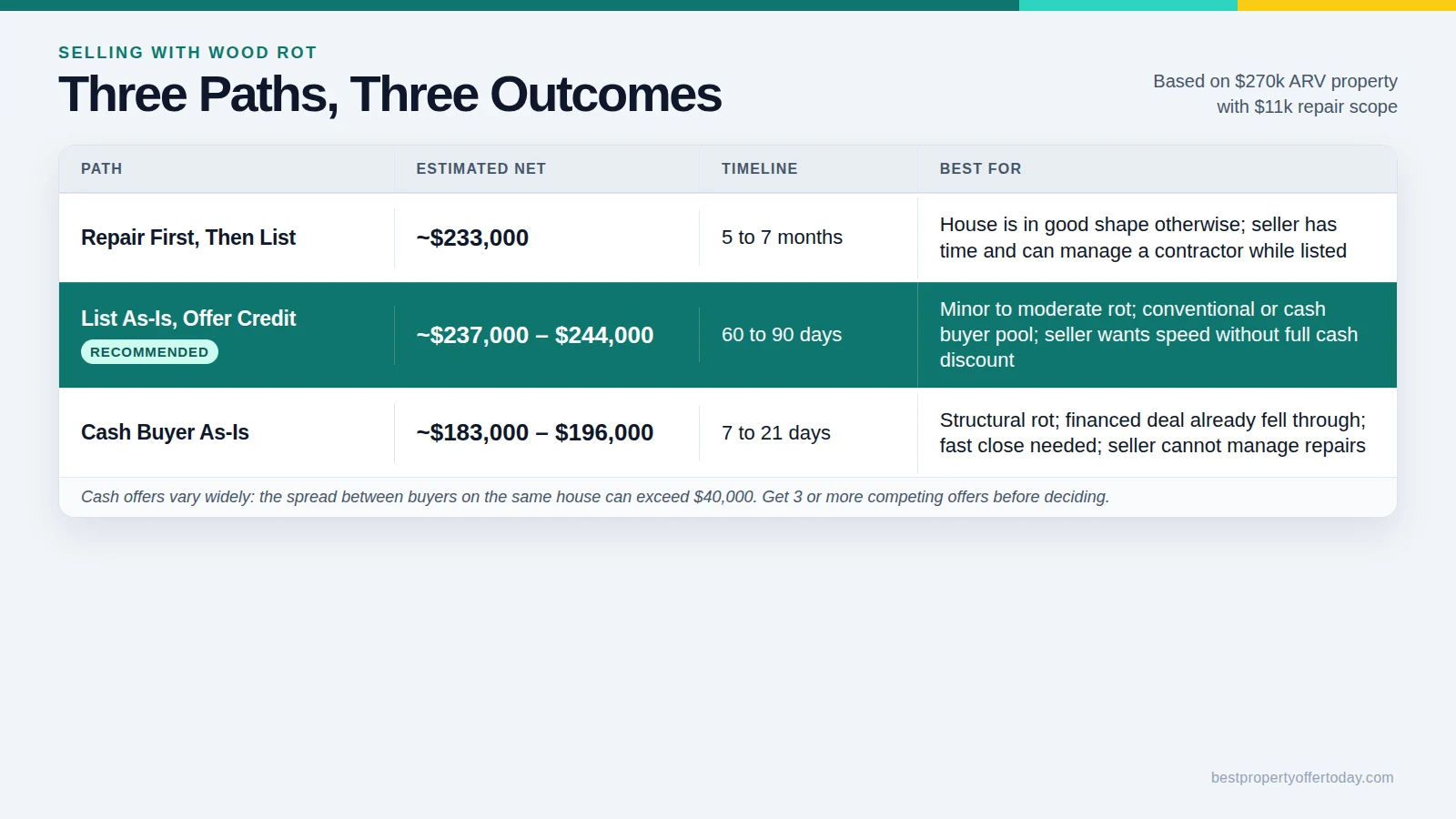
Most sellers with significant wood rot face the same three choices. Here is how they compare on a concrete example. Use the net proceeds calculator on this site to run your own numbers.
The property: A 3-bedroom ranch with an after-repair value of $270,000. The inspection identified wet rot on two exterior door frames, the window sills on the south-facing wall, the deck ledger board, and a 6-foot section of rim joist over the crawl space. A licensed contractor quotes $11,000 for the full repair scope.
| Path | Estimated net | Timeline | Primary risk |
|---|---|---|---|
| Repair first, then list | approx. $233,000 | 5 to 7 months | Carrying costs; contractor delays; buyer renegotiates on unrelated inspection items |
| List as-is, offer repair credit | approx. $237,000 to $244,000 | 60 to 90 days | Financed buyer’s lender refuses the credit; deal falls at appraisal; second renegotiation after inspection |
| Sell to cash buyer as-is | approx. $183,000 to $196,000 | 7 to 21 days | Wide spread between buyers; getting only one offer instead of competing offers |
How the numbers break down:
Repair first: $270,000 sale price after completed repairs, minus $11,000 for the contractor, minus $16,200 in agent commission at 6 percent, minus $2,700 in seller closing costs, minus approximately $5,000 in carrying costs over four months while the work is done and the house is listed. The net is around $235,000 before any renegotiation on the buyer’s post-inspection requests for unrelated items, which can reduce the final number by another $2,000 to $5,000.
List as-is with credit: Price the house at $259,000 to $263,000 and offer a $9,000 to $11,000 repair credit at closing. Net after commission and closing costs lands in the $237,000 to $244,000 range on paper. The practical risk is that a financed buyer’s lender may refuse to pass the credit at closing if the appraiser has already conditioned the loan on repair. Lenders are cautious about credits that effectively let a buyer take money out at closing without the underlying repair being done.
Cash buyer as-is: Buyers in this category typically apply the 70 to 76 percent rule against the after-repair value, then subtract their estimated repair costs. At 73 percent: $270,000 times 0.73 equals $197,100, minus $11,000 in repairs, which gives $186,100. The range reflects the fact that different buyers use different multipliers and different repair estimates. On the same property, the spread between the lowest and highest cash offer can exceed $40,000. Getting three or more competing offers matters significantly to the final number, which is why a marketplace approach is worth using rather than accepting the first offer that comes in.
What Wood Rot Repair Actually Costs
The range is wide because location and structural involvement drive the number more than the visible extent of the damage.
- Exterior trim, door frames, window sills: $150 to $600 per opening, unless the sheathing or framing directly behind it is compromised
- Deck framing and ledger board: $1,500 to $8,000, depending on deck size and whether the ledger has compromised the band joist on the house side
- Rim joist and sill plate in a crawl space: $1,500 to $12,000, depending on how many linear feet are affected and whether the floor joist ends are involved
- Structural floor joists: $4,000 to $25,000 or more, depending on how many joists are involved and whether the subfloor must come up to access them
The jump from surface rot on exterior trim to structural rot in the floor system is the calculation that changes everything. A $1,200 door frame repair is a different situation than an $18,000 joist repair. Get a licensed contractor to distinguish cosmetic rot from structural rot before you choose a path. See what repairs actually move a sale for context on how buyers and agents weigh repair costs against price reductions.
Red Flags From Buyers During the Process
Not every cash offer is the same, and some buyers behave differently after they have a signed contract. Watch for these patterns, whether you are selling to a cash buyer or a financed buyer who plans to take the rot as-is. See the full vetting guide at are cash home buyers legitimate.
- Earnest money deposit under $1,000 on a $200,000 transaction. At that level, walking away costs the buyer nothing. Read the breakdown at earnest money in a cash sale
- An inspection window longer than 10 days on an as-is cash deal. Legitimate investors scope work quickly because they inspect properties regularly
- A price reduction request after the inspection period has closed. In a true as-is sale, the inspection period is when re-trades happen. A request after that period closes is a negotiating tactic, not a discovery
- An assignment clause in the purchase contract, giving the buyer the right to assign the contract to a third party before closing. That is a wholesale structure, not necessarily a problem, but worth understanding before signing
The Honest Limit of a Cash Sale on a Property with Rot
A cash offer on a house with wood rot is normally below what the house would sell for after repair on the retail market. That gap is the trade. What the seller receives in return is speed, no contractor coordination, no carrying costs, no appraisal condition, and no deal falling apart because a financed buyer’s lender backed out at the last stage. Compare a cash offer against a fully listed sale before deciding which makes more sense for your situation.
If the rot is limited to exterior trim and one deck board, and the house is otherwise in good shape, and you have two to three months, the retail path will almost certainly net more money. The scenario where a cash sale wins on total net is when the rot is structural or extensive, when carrying costs are significant, when the seller cannot manage a contractor while the house is listed, or when a financed deal has already fallen through because of the appraisal condition.
A traditional listing generally nets more if the house is in otherwise good condition and the seller has time. That is worth saying plainly. Cash offers exist for situations where the trade is worth making.
Frequently Asked Questions
Does wood rot have to be repaired before closing?
Only if the lender requires it. FHA, VA, and USDA lenders require the appraiser to condition the loan on repair when rot is visible and noted. Conventional lenders may or may not, depending on severity and location. A cash buyer has no lender and no appraisal requirement, so no repair is mandatory before the sale closes.
Will an appraiser always flag wood rot?
Not automatically. Appraisers note readily observable deficiencies. Rot hidden inside a wall cavity, under siding, or in a crawl space the appraiser does not physically enter will not be flagged unless an inspection report already identified it and that report is part of the file. Visible rot on an exterior door frame, a deck ledger, or a porch post is a different situation. Most appraisers call it.
Does selling as-is protect you from disclosure duties?
No. As-is means you will not make repairs. It does not exempt you from disclosing what you know. If you have an inspection report that identified rot, that information is in your possession and most states require it to be disclosed to the buyer. The consequence of concealment, a lawsuit for misrepresentation after the buyer discovers it post-closing, is far more expensive than the repair would have been.
How much does wood rot repair typically cost?
Exterior trim and window sills: $150 to $600 per opening. Deck ledger and framing: $1,500 to $8,000. If the deck is the main defect rather than the adjacent structure, the decision tree is covered in selling a house with deck problems. Rim joist and sill plate: $1,500 to $12,000. Structural floor joists: $4,000 to $25,000 or more. The scope and structural involvement drive the number far more than the visible size of the patch. Get a written estimate from a licensed contractor before choosing a path. Call 804-361-7460 to see what competing cash offers look like on your property before committing to repairs.