Cigarette smoke damage is one of the most underestimated devaluation problems in residential real estate. Sellers often assume a fresh coat of paint and a few days of airing out will handle it. Buyers and their lenders know better. What nicotine does to a house takes years to accumulate and does not reverse quickly.
This post covers what smoke damage actually costs to fix, how it affects your buyer pool, and what each of your three real options nets when you run the numbers. For a quick sense of where you stand, the net proceeds calculator lets you plug in your own figures.
What Smoke Damage Actually Does to a House
Tobacco smoke is not just an odor. Nicotine and tar are sticky compounds that bond to porous surfaces over time: drywall, insulation, ceiling tiles, subflooring, and the interior surfaces of your HVAC ductwork. A house where someone smoked indoors for a decade has those compounds embedded throughout the building envelope, not just on visible surfaces.
This matters for a few practical reasons:
- Standard cleaning removes surface residue but does not reach what is in the drywall paper or the duct lining
- Primer and paint reduce volatilization temporarily, but nicotine migrates back through unsealed surfaces within weeks to months in warm weather
- HVAC systems circulate the residue to every room every time the system runs, which is why a house often smells worse after the heat kicks on in fall
Professional remediation means sealing every porous surface with a nicotine-blocking primer (KILZ Original or equivalent), cleaning or replacing ductwork and HVAC components, replacing carpets and soft goods, and sometimes replacing drywall in the most affected rooms. In mild cases, where smoking was limited to one or two rooms for a few years, that work runs $3,000 to $8,000. In severe cases, where heavy smoking occurred throughout the house for a decade or more, full remediation can reach $20,000 to $40,000 or higher.
Why Financed Buyers Pull Back
Strong tobacco odor creates three specific problems for buyers who need financing.
First, VA and FHA appraisers are trained to flag properties with habitability concerns. Strong persistent odor can be noted as a condition requiring remediation before the loan closes. That hands the lender leverage to require repairs, which puts the deal on hold until the seller complies or the buyer walks.
Second, conventional buyers and their agents know what remediation costs. When a buyer’s inspector writes “pervasive tobacco odor throughout, including HVAC” in the inspection report, the buyer either renegotiates heavily or exits during the inspection contingency. Either outcome costs the seller time and often the deal.
Third, even if a buyer accepts the condition and the lender does not flag it, the buyer’s homeowner insurance underwriter sometimes declines or surcharges on a property with documented smoke damage history. That can unwind a deal at the final underwriting stage.
None of these barriers apply to a cash buyer. No appraisal, no lender, no inspection contingency. The cash buyer prices the remediation into the offer and moves forward without lender conditions.
Your Three Real Options
Option 1: Remediate before listing
You pay for professional remediation, then list at full market value. This makes sense if the damage is limited, the remediation cost is well under $15,000, and you have the time and cash to front the work. Get two contractor quotes before committing. Ask specifically whether they are sealing and cleaning ductwork or just cleaning visible surfaces. A quote that does not mention ductwork is not a complete remediation quote.
Option 2: List with a price reduction or repair credit
You disclose the smoke damage, price the home below comparable clean properties, or offer a repair credit at closing. Financed buyers can sometimes use this approach, but there is risk. If the buyer’s lender orders an appraisal and the appraiser notes the odor as a habitability condition, a repair credit does not satisfy the lender’s requirement and the deal may still fall apart. This works best when the damage is mild and the buyer is on conventional financing with a tolerant lender.
Option 3: Sell as-is to a cash buyer
You accept an offer below retail, close in one to three weeks, and pay nothing out of pocket for remediation. The buyer takes on the cleanup cost and the risk that their estimate was wrong. This is the right choice when the remediation cost is high, when you need to close quickly, or when you have already tried the market and gotten no traction with financed buyers.
One important point here: a cash offer is normally below a fully marketed retail price. The difference is what the buyer charges for taking on the work, the risk, and the carrying costs. If the house is in otherwise good condition and you have three to six months, completing the remediation and listing with an agent will almost certainly net more. That is worth knowing before you decide.
A Worked Example with Real Numbers
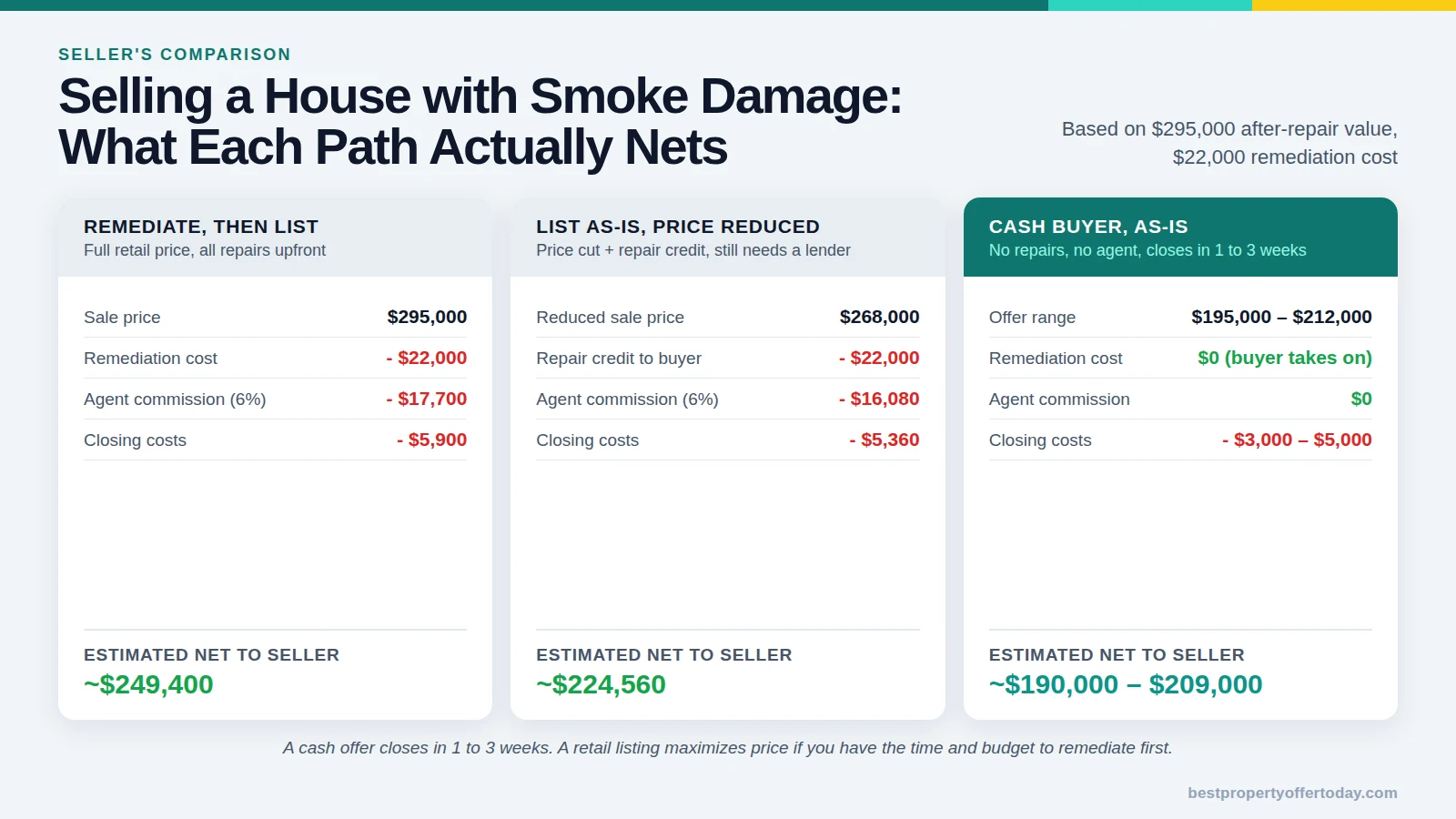
Say your house has an after-repair value of $295,000 in a stable market. A professional contractor quotes $22,000 for full remediation: duct cleaning and liner replacement, nicotine-blocking primer and two coats of paint on all walls and ceilings, carpet replacement throughout, and deep cleaning on all hard surfaces.
| Path | Gross sale price | Deductions | Estimated net to seller |
|---|---|---|---|
| Remediate, then list | $295,000 | $22,000 remediation + $17,700 commission + $5,900 closing costs | ~$249,400 |
| List as-is with repair credit | $268,000 | $22,000 credit + $16,080 commission + $5,360 closing costs | ~$224,560 |
| Cash buyer, as-is | $195,000 to $212,000 | $3,000 to $5,000 closing costs, no commission, no repairs | ~$190,000 to $209,000 |
The remediate-and-list path nets the most if remediation goes smoothly, the house sells quickly, and no buyer renegotiates after inspection. The cash path nets $40,000 to $60,000 less but involves no repair risk, no carrying time, and no lender conditions. Whether that gap is acceptable depends on your timeline and your finances.
What You Are Required to Disclose
Disclosure law varies by state, but most states require sellers to disclose known material defects. Pervasive tobacco damage can qualify. More practically, the smell is self-disclosing at the showing: buyers’ agents note it, inspectors write it up, and a seller who claimed no known defects faces a credibility problem when the buyer finds embedded damage behind the walls.
Selling as-is to a cash buyer does not eliminate your disclosure duties. It limits your obligation to make repairs, not your obligation to disclose what you know. Put the condition in writing, even if the buyer is a cash investor who already expects it. For a broader look at how disclosure works alongside other property conditions, the post on selling a house with code violations covers the same principle in a different context.
How Cash Buyers Price a Smoke-Damaged House
Most serious cash buyers use a version of the 70 percent rule: they start at roughly 70 percent of the after-repair value and subtract their estimated cost to remediate. On a $295,000 ARV house:
$295,000 x 0.70 = $206,500, minus a $22,000 remediation estimate = $184,500 as a starting point.
Different buyers use different multipliers and different remediation cost estimates, which is why competing offers on the same smoke-damaged house can vary by $20,000 to $40,000 or more. One buyer prices the ductwork cleaning at $6,000. Another prices a full duct replacement at $14,000. Their offers will look very different even from the same ARV.
This is where collecting competing offers creates real value. Getting three or four bids on a smoke-damaged property surfaces the buyer whose remediation estimate is most aggressive, which usually translates into the highest offer for you. A seller who takes the first offer they receive may leave $15,000 or more on the table. For more on how this calculation works across different buyer types, see the post on how cash buyers calculate their offer price.
Red Flags to Watch For
Not every buyer offering cash is a serious buyer. A few signs that a lowball or a bait-and-switch may follow:
- The buyer does not ask about the HVAC system. A buyer who plans to remediate properly will want to know the duct layout and the system age
- Earnest money under $1,000 on a $200,000 transaction. On a standard as-is deal, 1 percent is the floor for a buyer who means it. Anything under that means walking away costs them almost nothing. The post on earnest money in a cash sale has the numbers to know
- An assignment clause in the contract. This means the original buyer may sell the contract to a third party before closing, which adds closing risk and can reduce the amount that actually clears at the table. The post on what a wholesaler is and how to tell one from a real buyer covers this in detail
- A verbal promise to close in seven days with no contractual backstop. Closing timelines are set by the contract, not by a sales pitch
Does smoke damage require professional remediation before I can sell?
No. You can sell a smoke-damaged house as-is, with full disclosure. Many cash buyers purchase them regularly and factor the cleanup cost into their offer. Remediation before listing is only necessary if you want to qualify for the full retail price and avoid lender conditions during a financed sale.
Will a home inspector report tobacco smoke damage?
Yes. A thorough inspector will note pervasive odor, nicotine staining on walls and ceilings, and any signs of residue build-up in the HVAC system. That report becomes part of the buyer’s due diligence record and typically triggers a renegotiation request or an exit during the inspection contingency window.
How do I get competing cash offers on a smoke-damaged house?
Submit one request at bestpropertyoffertoday.com. We send it to a network of vetted cash buyers who compete for your property. You compare their offers side by side and decide. There is no obligation to accept any offer, and the service is free to the seller. Offers typically come back within 24 to 48 hours. Call 804-361-7460 with questions.
Does selling as-is mean I pay zero closing costs?
No. As-is means no repairs. Closing costs still apply. In a typical as-is cash transaction, the seller pays title transfer fees, any outstanding property taxes, recording fees, and sometimes a share of the title insurance premium depending on local practice. Budget $3,000 to $5,000 unless the buyer agrees to cover them, which some buyers offer as a concession to make their offer more competitive.