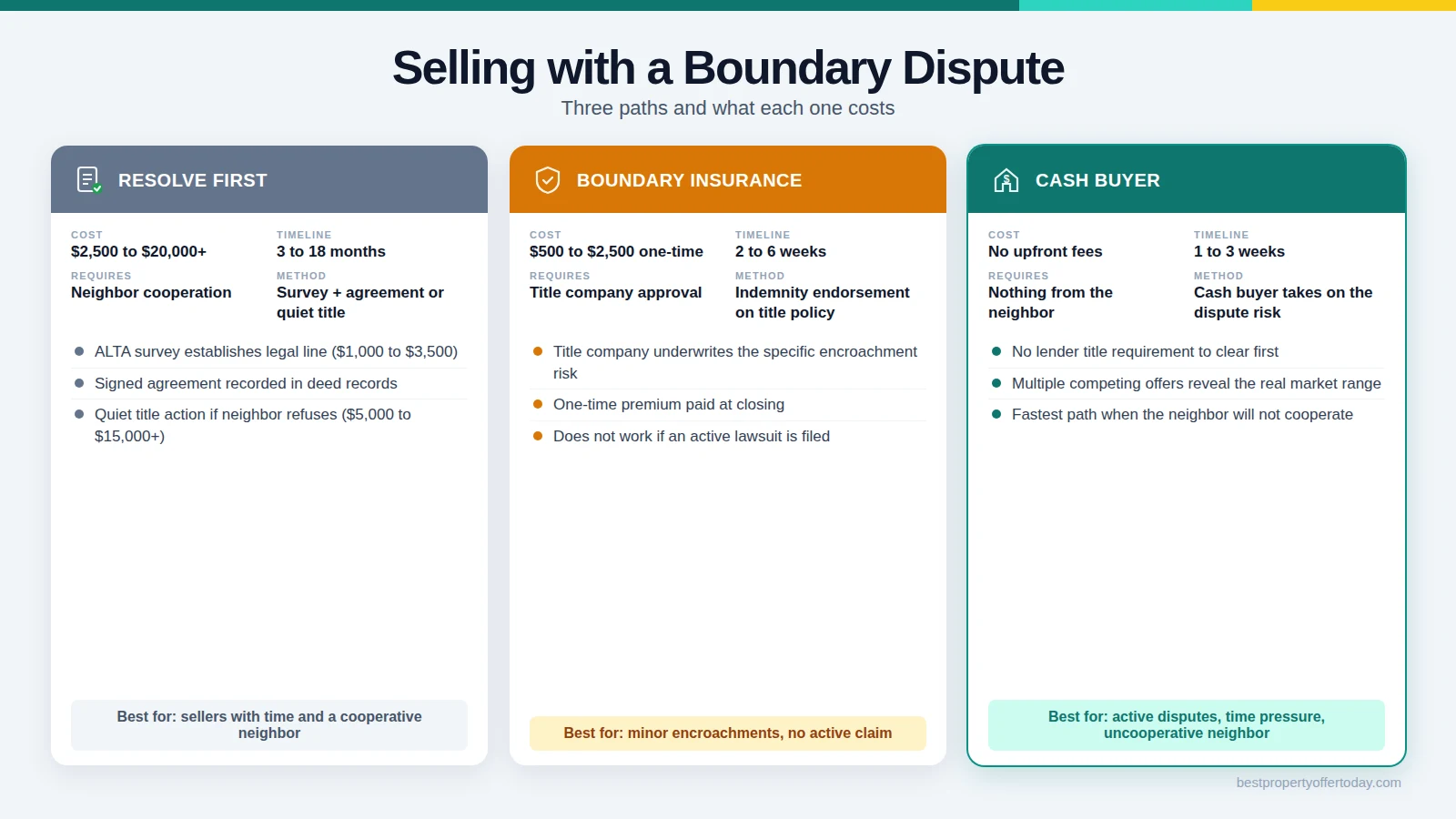
Yes, you can sell a house with an unresolved boundary dispute. The main obstacle is that most financed buyers cannot close on one: lenders require a clean title commitment, and a known dispute creates a title exception that most underwriters treat as a hard stop. You have three real options: resolve the dispute before listing, use boundary indemnity insurance to make the property lendable, or sell to a cash buyer who does not need lender sign-off. Which path makes sense depends on how severe the dispute is, how much time you have, and whether your neighbor is willing to cooperate.
What Counts as a Boundary Dispute
A boundary dispute is any unresolved disagreement about where one property ends and another begins. The most common forms:
- A fence or structure sitting on, or past, the legal property line shown on a survey
- Conflicting legal descriptions in two neighboring deeds, often from an old subdivision error
- An encroachment: a neighbor’s driveway, garage, or outbuilding that crosses onto your land
- An adverse possession claim: a neighbor arguing they have gained title to part of your land through long, open, uninterrupted use
A dispute does not require a lawsuit to be a dispute. It requires a neighbor who contests the line and some written record of that contest: a prior survey that flagged the problem, a letter from an attorney, or a formal notice. Once that exists in writing, you are legally required to disclose it to any buyer.
Why a Boundary Dispute Stops Most Financed Sales
Lenders require a clean title commitment before funding a loan. A title company will not issue a standard ALTA owner’s policy on a property with a known, unresolved boundary dispute, because the dispute is specifically excluded from coverage. No title policy, no loan commitment. No loan commitment, no financed buyer.
Here is the specific mechanic: when a title examiner finds a boundary dispute in the chain of title, they add an exception to the commitment. That exception tells the buyer and their lender that ownership of part of the property is contested. Most lenders treat this as a hard stop. The few that do not will require either a formal resolution before closing or a boundary indemnity endorsement from the title company naming them as an additional insured.
A standard home inspection does not catch boundary disputes. A basic property survey may reveal an encroachment but not the dispute history behind it. Buyers using conventional, FHA, or VA financing often discover the problem only when the title commitment arrives three to four weeks into the transaction, after earnest money is in escrow and the seller has already adjusted their plans.
Cash buyers are not bound by a lender’s title requirements. They still review the chain of title and they still take on the risk of the disputed boundary, which shows up in their offer price. But they are not blocked from closing the way a financed buyer is. That is the core reason cash becomes the most practical path when a dispute is ongoing and cannot be resolved quickly.
Three Paths, Side by Side
| Path | Cost range | Timeline | Best for |
|---|---|---|---|
| Resolve first (survey plus agreement or quiet title action) | $2,500 to $20,000+ | 3 to 18 months | Sellers with time and a cooperative neighbor |
| Boundary indemnity insurance | $500 to $2,500 one-time premium | 2 to 6 weeks | Minor encroachments, no active claim filed |
| Sell to a cash buyer as-is | Offer reflects the dispute risk | 1 to 3 weeks | Active or contested disputes, time pressure, uncooperative neighbor |
Path 1: Resolve the Dispute Before Listing
Resolution starts with a licensed survey. An ALTA/NSPS survey costs $1,000 to $3,500 depending on lot size, state, and local surveyor rates. It establishes the legal boundary line, maps any encroachments, and produces the document both attorneys and title companies will rely on.
If the neighbor accepts the survey results and signs a boundary line agreement, the dispute can be cleared before closing. The agreement is recorded in the deed records and removes the title exception. Attorney preparation and recording fees typically add $1,500 to $5,000 to the survey cost.
If the neighbor disputes the survey or refuses to cooperate, resolution may require a quiet title action: a court proceeding asking a judge to declare the legal boundary. Quiet title suits take 3 to 18 months depending on the state and the court docket, and attorney fees commonly run $5,000 to $15,000 before a final order. States including Texas, California, and Florida have specific quiet title statutes that shape the process and the timeline differently.
Resolving the dispute first is the right path when you have time, when the neighbor is willing to cooperate, and when the price difference between a retail sale and a cash offer is larger than what resolution costs. It is the wrong path when a lawsuit is already filed, when the neighbor has hired their own attorney, or when foreclosure, divorce, or another deadline rules out a process that could take a year or more.
Path 2: Boundary Indemnity Insurance
For minor encroachments where a financed buyer still wants the house, some title underwriters will issue a standard policy backed by a boundary indemnity endorsement. The endorsement specifically insures against the known encroachment, and the one-time premium runs $500 to $2,500 depending on property value and the assessed risk.
This path works when the encroachment is small, when the neighbor has not filed any formal claim, and when the title company’s underwriter considers the risk acceptable. It does not work when active litigation is pending, when the neighbor has sent a formal demand letter through an attorney, or when the encroachment is large enough that the underwriter declines to cover it.
You cannot shop this option yourself. The title company decides whether to offer it based on their underwriting guidelines. Ask the title company early in the listing process, before any buyer submits a loan application, to find out whether indemnity coverage is available for your specific situation. Some sellers get a written confirmation from the title company before listing, so they can represent to buyers that the path exists.
Path 3: Sell to a Cash Buyer as-is
A cash buyer does not need a lender title commitment. They still review the chain of title to confirm ownership transferred to you correctly, but an unresolved boundary dispute does not block their closing the way it blocks a financed one. The buyer takes on the dispute along with the property, and their offer price reflects that.
How much does the dispute reduce the offer? It depends on severity. A fence three inches over the line that the neighbor has never formally contested is a small adjustment. An active lawsuit with attorneys on both sides, or a neighbor asserting adverse possession over a 20-foot strip, is a larger one. Cash buyers price what it would cost them to resolve the dispute after they own the property, plus a margin for the uncertainty. That cost is visible in the offer, not hidden inside a fee schedule.
Submitting the property through a marketplace that collects competing offers from multiple vetted buyers is one way to get a range rather than a single number. Different buyers assess dispute risk differently, and one who has closed on encumbered titles before may offer materially more than one who has not. Call 804-361-7460 or submit a request to start that process at no cost and with no obligation to accept any offer.
Worked Example: The $275,000 House With a 4-Foot Driveway Encroachment
A mid-Atlantic ranch-style house has an as-repaired market value of $275,000. A survey commissioned by the neighbor in 2023 showed the seller’s driveway crossing 4 feet over the property line. The neighbor sent a letter objecting but did not file suit. The seller needed to move for work and tested all three paths.
Retail listing with a financed buyer: The buyer’s lender received the title commitment and found the boundary exception. Their underwriter required either a signed boundary line agreement from the neighbor or evidence of a resolved quiet title action before funding. The neighbor declined to sign anything. The deal fell apart at week four. The seller had already given notice at work and was carrying two mortgage payments.
Boundary indemnity insurance path: A second title company reviewed the file and offered a $1,400 indemnity endorsement. A new financed buyer was found, but they negotiated an $8,500 price reduction to offset their perceived risk of dealing with the neighbor after closing. Net to seller: $275,000 minus $8,500 price cut, minus $16,500 in agent commissions and seller-paid closing costs, minus $1,400 indemnity premium. Net proceeds: approximately $248,600, and 11 weeks elapsed from first showing to close.
Cash buyer through a marketplace: The seller submitted a request and received three offers. Two came in at $245,000 to $250,000, pricing the dispute at $25,000 to $30,000 below ARV. The highest offer came in at $251,000 from a buyer familiar with encumbered titles. No agent commission, no indemnity premium, no lender review. Closing costs paid by the buyer. Net to seller: approximately $251,000, in 14 days.
In this case the net difference between the two realistic paths was under $2,000, and the cash path was eight weeks faster and required no cooperation from the neighbor. Use the net proceeds calculator to run your own comparison before choosing a path.
What You Are Required to Disclose
Selling as-is does not mean selling without disclosure. Every state has a disclosure requirement for known material defects, and a known boundary dispute almost always qualifies as a material fact under state property disclosure law. Failure to disclose a dispute you knew about can expose you to a rescission claim, a misrepresentation lawsuit, or personal liability for the buyer’s costs after closing.
The disclosure does not require you to resolve the dispute. It requires you to describe it accurately in writing before the buyer signs a contract. If you have survey evidence, a neighbor’s letter, or attorney correspondence related to the dispute, attach it or reference it in the disclosure. Buyers who are surprised by a boundary problem after closing are far more likely to pursue legal claims than buyers who understood the issue from the start.
For a broader overview of how title problems interact with a cash sale, see the post on title problems that delay a cash closing.
Red Flags From Buyers to Watch For
- A buyer who asks you to sign an easement or lot line adjustment before closing, transferring the disputed strip to the neighbor, as a condition of sale. Negotiating with your neighbor on your behalf before they own the property is not normal and should prompt questions about what their actual plan is.
- An unusually long inspection or due diligence window (30 to 60 days) combined with an assignment clause in the contract. This pattern is a common signature of a wholesaler who plans to find another buyer during the window rather than close themselves.
- Proof of funds that shows a balance barely sufficient to cover the purchase price. Resolving a boundary dispute after closing costs money. A buyer who cannot cover that cost may demand a further price reduction after their due diligence period ends, or walk entirely.
- Earnest money held in escrow under conditions that allow a full refund for any title exception. A buyer who can exit penalty-free the moment the title commitment arrives has a free option on your time, not a real commitment.
For guidance on evaluating whether a cash buyer is credible before you sign anything, see the post on how to tell a legitimate cash buyer from one who is not.
The Honest Caveat
A cash offer on a house with an unresolved boundary dispute will be below the retail price you would get if the dispute were cleared. What you trade is that discount for speed, certainty, and the ability to close without the neighbor’s cooperation. If you have time and your neighbor is willing to cooperate, resolving the dispute first and listing on the open market will almost always net you more money.
If you do not have that time, or the neighbor is not cooperating, a cash marketplace is a direct way to find out what the house is worth to buyers who are willing to take on the complexity. The offer reflects their risk assessment, not a fixed discount formula, which is why comparing multiple offers produces better information than taking the first one.
Frequently Asked Questions
Can you sell a house legally while a boundary dispute is active?
Yes. There is no law that prevents a sale while a boundary dispute is pending, provided you disclose the dispute to any buyer in writing before they sign a contract. A financed buyer may be unable to close because of their lender’s title requirements, but the legal right to sell is yours regardless of the dispute’s status.
Does the boundary dispute transfer to the new owner?
Yes. A dispute that is not formally resolved before closing transfers with the property. The buyer inherits whatever claim the neighbor has asserted. This is why cash buyers price it into their offer and why lenders treat it as a title cloud that must be cleared or insured before they will fund. Resolution after closing, whether by agreement or quiet title action, becomes the new owner’s responsibility and cost.
Will title insurance cover a boundary dispute that existed before closing?
No. A standard title insurance policy excludes defects that were disclosed as known exceptions at the time of the policy. If the dispute appears in the title commitment as an exception, standard title insurance will not cover a future loss from it. A boundary indemnity endorsement specifically insures the known encroachment, but it requires a title company willing to underwrite it and a premium paid at closing. For a full explanation of what owner’s and lender’s policies cover, see the post on what title insurance actually covers in a cash sale.
A related problem is an encroachment, where a structure physically crosses the established line. The resolution paths and the lender impact are different. See the guide to selling a house with an encroachment for a comparison of all three options.
How long does a boundary dispute stay on the title record?
Indefinitely, unless formally resolved. A signed and recorded boundary line agreement, a court order from a quiet title action, or a final judgment in a property litigation all clear the exception from the chain of title. Without one of those, the dispute follows the property through every subsequent sale. Title examiners routinely find boundary problems from decades-old surveys that were never resolved, and each one has to be dealt with before a financed buyer can close.