A damaged or unpermitted deck stops more financed home sales than most sellers expect. FHA and VA appraisers flag unsafe decks as an appraisal condition, which means the buyer’s lender requires the repair before the loan can close. Cash buyers skip that step but price the deck into their offer. Here is what each exit path actually costs, and what each one requires from you.
Why a Deck Problem Blocks a Financed Sale
The mechanism is specific. FHA and VA appraisers follow minimum property condition requirements issued by HUD and the VA. An unsafe deck, which includes rotting boards, a ledger board pulling away from the house, guardrails below 36 inches on a deck more than 30 inches above grade, or missing stair handrails on four or more risers, is cited as a “subject to” repair. The appraiser assigns value to the property on the condition that the defect is corrected before closing.
Once that condition appears in the appraisal report, the lender cannot fund the loan until the seller provides documentation that the repair is done and the appraiser confirms it with a reinspection. That adds one to three weeks and a reinspection fee of $150 to $350, and it puts the seller in the position of paying for repairs on a property they are trying to exit.
Conventional loans backed by Fannie Mae or Freddie Mac are more flexible. The appraiser has discretion to note a deteriorated deck as a physical deficiency affecting value rather than calling it a required repair. But that flexibility is not guaranteed. If the deck presents a visible safety hazard, an appraiser on a conventional deal may apply the same condition standard as an FHA appraiser would.
What Counts as a Problem
Not every aging deck kills a sale. The distinction that matters is structural and safety risk, not appearance alone.
Cosmetic issues that rarely block a financed sale: faded or peeling stain, surface cracks in boards, minor splintering, a railing that wobbles but passes inspection.
Issues that typically trigger appraisal conditions or buyer concern:
- Soft or punky boards near the ledger board, where water collects against the house
- Rotted posts or footings, especially where posts sit in ground contact or in standing water
- A ledger board improperly attached to the house or fastened only through siding rather than into the rim joist
- Guardrail height under 36 inches on a deck more than 30 inches above grade
- Missing stair handrails where four or more risers exist
- Visible separation between the deck frame and the house structure
The ledger board is worth singling out. When a ledger fails or was never properly flashed, water intrudes between the deck and the house. By the time a seller notices the deck is soft near the connection point, the rim joist and band joist inside the house wall may already have moisture damage. That creates a potential wood rot problem that goes beyond the deck itself.
The Permit Problem
Most jurisdictions require a building permit for a deck that is more than 200 square feet or elevated more than 30 inches above grade. Decks built without permits were common throughout the 1980s and 1990s, and millions of them remain on houses now coming to market.
An unpermitted deck surfaces in a pre-listing inspection, in a survey, or in the disclosure form. In most states, sellers must disclose unpermitted structures as a known material defect. Selling as-is limits the duty to repair but does not eliminate the duty to disclose. The distinction matters: a seller who conceals a known unpermitted structure is exposed to post-sale liability even on an as-is contract. For more on that line, see selling a house with code violations.
Retroactive permits are available in most jurisdictions, but they require the deck to pass current code. Current code is typically stricter than whatever applied when the deck was built. A $7,000 deck from 1991 may need $3,000 to $5,000 in footing, guardrail, and ledger upgrades before a permit will issue. That cost has to come from somewhere in the negotiation, and the process usually takes four to eight weeks before the inspection is scheduled.
Three Paths and What Each One Costs
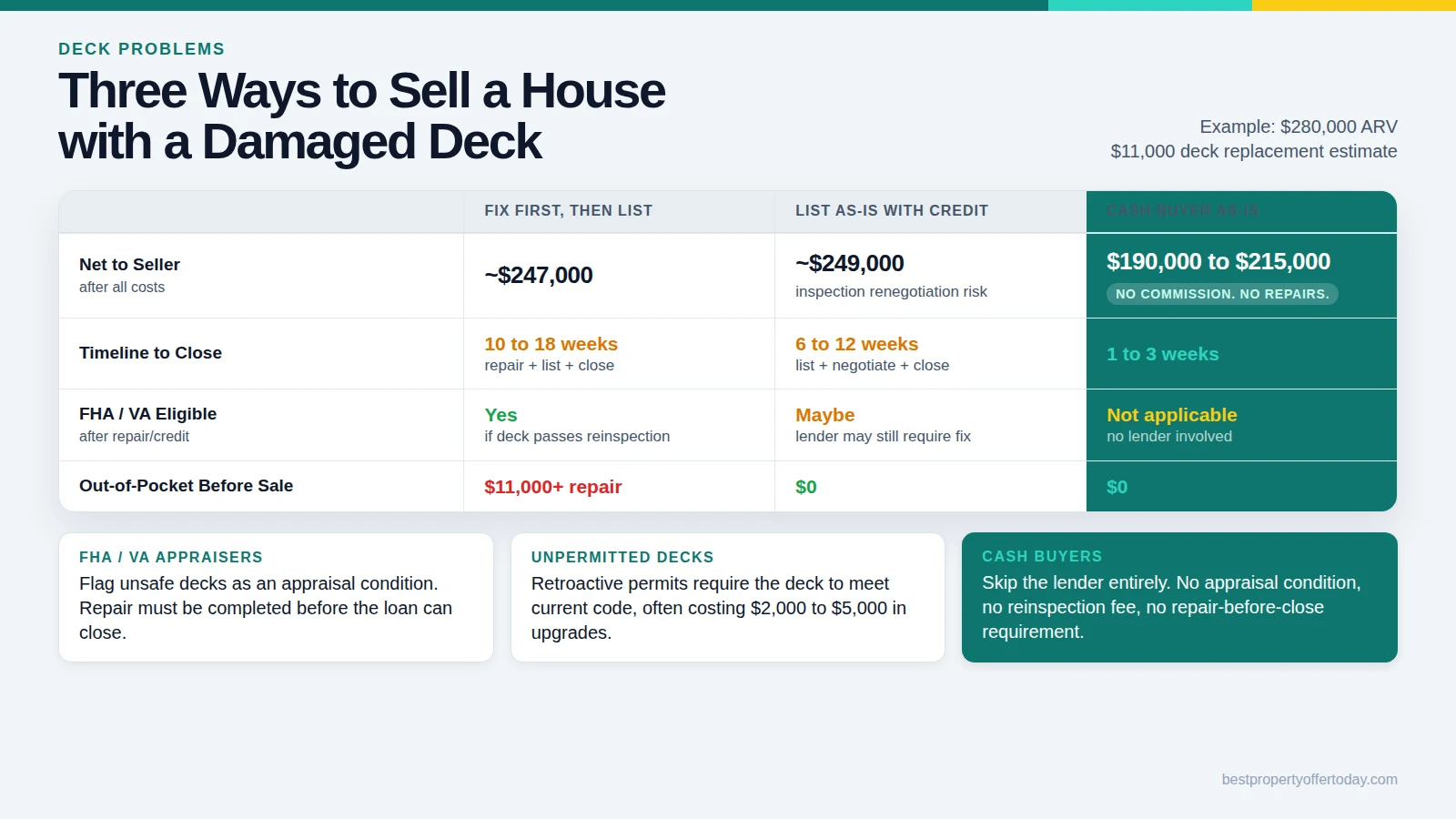
For this comparison: a house with an ARV of $280,000 and a deck that needs full replacement. The deck is 12 by 16 feet, with a rotted ledger board, failing posts, and a guardrail that does not meet current code. A licensed contractor quotes $11,000 to remove and replace it with pressure-treated lumber.
| Path | What it takes | Timeline | Approximate net to seller |
|---|---|---|---|
| Fix first, then list | Pay $11,000 for replacement, list at $280,000 | 10 to 18 weeks | ~$247,000 |
| List as-is with a credit | List at $269,000 with an $11,000 seller credit disclosed upfront | 6 to 12 weeks | ~$249,000 |
| Cash buyer as-is | No repairs, no agent, submit to a marketplace for competing offers | 1 to 3 weeks | $190,000 to $215,000 |
The math behind each number:
Fix first: $280,000 sale price, minus $11,000 repair, minus a 5.5 percent agent commission ($15,400), minus closing costs and transfer taxes (roughly $4,000). The repair may or may not recover its full cost in appraised value depending on comparables in the area, which vary widely.
Credit route: $269,000 list price, minus 5.5 percent commission ($14,795), minus $4,000 closing costs. The seller avoids paying a contractor upfront, but inspection renegotiation is common on a disclosed-defect listing. Buyers who know about a problem often come back after their inspection period with additional credit requests. The net figure above assumes the deal closes at the original credit without further reduction.
Cash buyer: Cash investors typically apply the 70 percent rule to ARV and then subtract their estimated repair cost. At $280,000 ARV, that produces a starting point around $196,000. After the $11,000 deck deduction, competing offers through a marketplace tend to land between $190,000 and $215,000 depending on each buyer’s overhead and their own cost estimate for the repair. No commission, no repair bill, no reinspection.
The honest framing: a cash offer is normally below a fully marketed retail price. A seller with time and the cash to front the repair will likely net more through a traditional listing. What the cash route buys is speed, certainty, and no out-of-pocket costs before the sale. Use our net proceeds calculator to run your own numbers.
When a Cash Sale Makes Sense
Cash buyers are worth contacting first when:
- The deck problem is combined with other deferred maintenance, so the total repair scope is large enough that fronting the cost is not practical
- The seller is under a time pressure, whether from an estate timeline, a job relocation, a divorce settlement, or an approaching foreclosure date
- The deck is unpermitted and retroactive permitting would require expensive upgrades to meet current code
- The ledger board issue suggests water intrusion at the connection point, meaning the problem may extend into the house itself
- The seller does not have the cash to fund the repair and cannot recover it until closing
If the house is otherwise in good condition and the seller has time and resources, fixing the deck and listing retail will often produce a better net. That is worth saying plainly because competitors in this space tend not to say it.
Red Flags When Collecting Cash Offers
Not every cash offer on a problem property comes from a buyer who will close. The markers of an unreliable offer are consistent across transaction types:
- Earnest money below 1 percent of the offer price. On a $200,000 deal, anything under $2,000 means the buyer can walk at no cost to themselves
- A long inspection window on a disclosed, as-is transaction. A 21-day inspection period on a property the buyer agreed to buy as-is usually means they are assigning the contract, not buying it themselves
- Assignment language in the purchase agreement. Phrases like “and/or assigns” after the buyer’s name mean the contract can be sold to a third party before closing
- A price-drop request after inspection on a disclosed-defect sale. The deck was disclosed. A buyer who requests additional credit after inspecting what they already knew about is renegotiating the price, not reacting to a surprise
Submitting to a marketplace rather than accepting a single direct offer reduces this risk because the offers come from multiple vetted buyers who are competing for the same house. If you are uncertain whether a buyer you found independently is legitimate, the guide on how to vet a cash home buyer covers the specific documents to request and what they do and do not prove.
Disclosure: What Selling As-Is Actually Means
Selling as-is tells the buyer you will not make repairs. It does not represent that the deck is sound. A seller who knows the deck is structurally compromised or unpermitted and fails to disclose it retains significant post-sale liability in most states even when the contract says as-is.
The safest position for a seller with a known deck problem is to disclose what they know, allow the buyer to inspect, and let the offer price absorb the condition. That is exactly what happens in a cash transaction when competing offers are collected through a marketplace and buyers bid with full knowledge of the property’s condition.
For questions about your situation, call us at 804-361-7460.
Does a deck need to be permitted to sell a house?
Not in every jurisdiction, but an unpermitted deck is a disclosure item in most states and a potential appraisal issue in financed transactions. Do not pull retroactive permits without first confirming what the current code requirements are and what the upgrade cost would be. The process can surface additional required work that was not apparent at the start.
Will an FHA buyer walk away because of a damaged deck?
Not necessarily, but their lender may require the repair before funding. FHA appraisers are required to flag safety hazards, and a structurally compromised deck qualifies. If the seller cannot pay for the repair, the transaction either dies or the buyer converts to a different loan type. That is why houses with damaged decks that were originally listed for retail often end up selling to cash buyers.
Can I just remove the deck instead of repairing it?
Yes, and removal is often cheaper than replacement. Demolition and haul-away for a 12-by-16-foot deck typically costs $800 to $2,500. Removing the deck eliminates the structural concern for a financed appraisal. The tradeoff is that a house without a deck may appraise lower than one with a functional deck, though a damaged deck that produces a required-repair condition may cost more in a financed deal than its absence would.
Is a deck collapse covered by homeowner’s insurance?
Typically only if the collapse is caused by a covered peril such as a falling tree or an ice storm. Collapse from rot, deferred maintenance, or a known structural defect is generally excluded as a maintenance issue. If someone is injured on a deck that the homeowner knew was in poor condition, the liability exposure is significant regardless of whether a sale is pending. That is a practical reason to disclose the problem and act on it, through repair, removal, or a cash sale that closes before the risk materializes.