Selling a House with Lead Paint: What the Law Requires and What a Cash Buyer Changes
A house built before 1978 can still be sold. Federal law does not require you to remove lead paint or even test for it before listing. What it requires is a specific disclosure process, and that process applies regardless of whether the buyer uses a mortgage or pays cash. What changes with a cash buyer is what happens after the disclosure is signed.
What the Federal Disclosure Law Requires
The law is the Residential Lead-Based Paint Hazard Reduction Act, codified at 42 U.S.C. § 4852d, with implementing rules at 40 CFR Part 745. It applies to any residential housing built before 1978. If your home falls into that category, you must do four things before a sales contract is signed:
- Give the buyer the EPA-approved pamphlet, “Protect Your Family from Lead in Your Home”
- Disclose all known information about lead-based paint or lead hazards in the property, including location and condition
- Provide copies of any test reports or inspection records you have
- Include the EPA Lead Warning Statement in the sales contract, with signed acknowledgments from both buyer and seller
The buyer then has ten days to conduct a lead paint inspection or risk assessment at their own expense. They can waive that window or shorten it in writing, but the seller must offer it. There is no version of this sale where that step disappears.
Failing to comply carries civil penalties of up to $16,000 per violation under EPA enforcement rules. The penalty applies to sellers, landlords, and real estate agents who knowingly fail to disclose. The EPA has pursued violations years after the sale when records showed the seller knew and stayed silent.
What Federal Law Does Not Require
Federal law does not require you to test your own home before listing. It does not require you to remove lead paint or pay for remediation. The EPA states plainly: the seller must disclose what is known, not conduct or finance an inspection.
That matters because many sellers of pre-1978 homes assume that lead paint in any condition forces them to remediate before selling. That assumption is wrong, at least as far as the law is concerned. The obligation is disclosure, not repair.
Where repair becomes an issue is with the lender, not the statute.
How Lenders Make Lead Paint Complicated
FHA and VA loans have their own property condition standards. If an appraiser or inspector notes chipping, peeling, or deteriorating paint in a pre-1978 home, the lender will typically require that the visible deterioration be remediated before the loan can close. This is a loan condition, not a statutory requirement, but the effect is the same: the seller either fixes it or the deal falls apart.
Conventional loans vary. Fannie Mae and Freddie Mac both treat visible deteriorating paint as a habitability concern that can trigger repair conditions. The threshold depends on the appraiser’s language and the underwriter’s read. Some lenders let it pass; others do not.
For a financed buyer, the 10-day inspection window creates real renegotiation risk. A buyer who tests and confirms lead paint can walk, request a price reduction, or require a remediation credit as a closing condition. Even if the buyer is willing to proceed, their lender may not be. The same dynamic comes up with other condition issues covered in our post on selling a house with code violations: the lender often has veto power the buyer does not.
What a Cash Offer Changes, and What It Does Not
A cash buyer has no lender. There is no underwriter, no appraisal condition, and no loan contingency that can impose a remediation requirement. If the buyer is willing to close on the property in its current condition, they can do so without any lead paint work being done first.
The buyer can also waive or shorten the 10-day inspection window. That is their legal right. But the federal disclosure form still gets signed before contract. There is no version of a cash sale that exempts either party from that paperwork. Cash offers buy speed and condition flexibility; they do not eliminate the federal disclosure obligation.
What this means in practice: a cash buyer prices in the lead paint. Their offer reflects the cost they estimate spending after closing, whether that is encapsulating specific surfaces or running a full abatement. The seller does not have to spend the money first. The buyer absorbs the cost and the risk, and adjusts their number accordingly.
What Lead Paint Work Actually Costs
Understanding the cost range helps you evaluate how much a cash buyer is likely to adjust their offer, and whether pre-listing remediation makes financial sense.
- Professional lead paint test: $200 to $500 for a certified lead inspector. A general home inspection does not produce a compliant result for the federal disclosure process. The test covers surface sampling, lab analysis, and a written report.
- Encapsulation: $1,000 to $8,000 for a room or a set of surfaces. The paint is sealed with a bonding compound or covered with a barrier material rather than removed. Appropriate when the paint is intact and the surfaces are stable.
- Full abatement: $10,000 to $30,000 or more for a whole house, depending on square footage and how extensively lead paint was applied. Involves physical removal of all affected material. Required when surfaces are badly deteriorated, when the buyer’s lender conditions the loan on it, or when the property will house children under six.
Encapsulation is faster and cheaper. Cash buyers who plan a full renovation may not care which method is used because they intend to open walls regardless. A buyer planning to rent or move in may prefer abatement and will price the uncertainty into their offer accordingly.
A Worked Example: 1968 Ranch House with Lead Paint Throughout
Take a 1968 single-story house in a mid-sized metro, estimated retail value $190,000. A professional test confirms lead paint in the kitchen, both bathrooms, and most interior trim. The kitchen paint is chipping. The rest is intact.
Traditional listing with a financed buyer:
- Pre-listing encapsulation and kitchen remediation: $5,500 to $9,000
- Listing agent commission at 5.5 percent: $10,450
- Seller-paid closing costs: $2,000 to $3,000
- Carrying costs for three months (mortgage, taxes, insurance): $3,600
- Inspection renegotiation risk, buyer tests intact paint and asks for a credit: $2,000 to $5,000
- Estimated net: $154,000 to $167,000
Cash offer path through a marketplace:
- Cash offers reflecting lead paint condition: $148,000 to $163,000
- No agent commission
- Seller-paid closing costs: $1,000 to $2,000
- No carrying costs; close in 10 to 18 days after title work clears
- No pre-listing repair spend
- Estimated net: $146,000 to $162,000
The ranges overlap. The traditional listing has a higher ceiling but requires money upfront, three months of carrying costs, and the risk that a financed buyer’s lender kills the deal after inspection. The cash path is narrower and faster, with no upfront costs and no lender veto. Use the net proceeds calculator to run your own numbers side by side.
If the house is otherwise in good shape and the seller has time, the traditional route likely nets more. If the house has other deferred maintenance alongside the lead paint, or if the seller is under time or financial pressure, the gap between the two paths shrinks quickly.
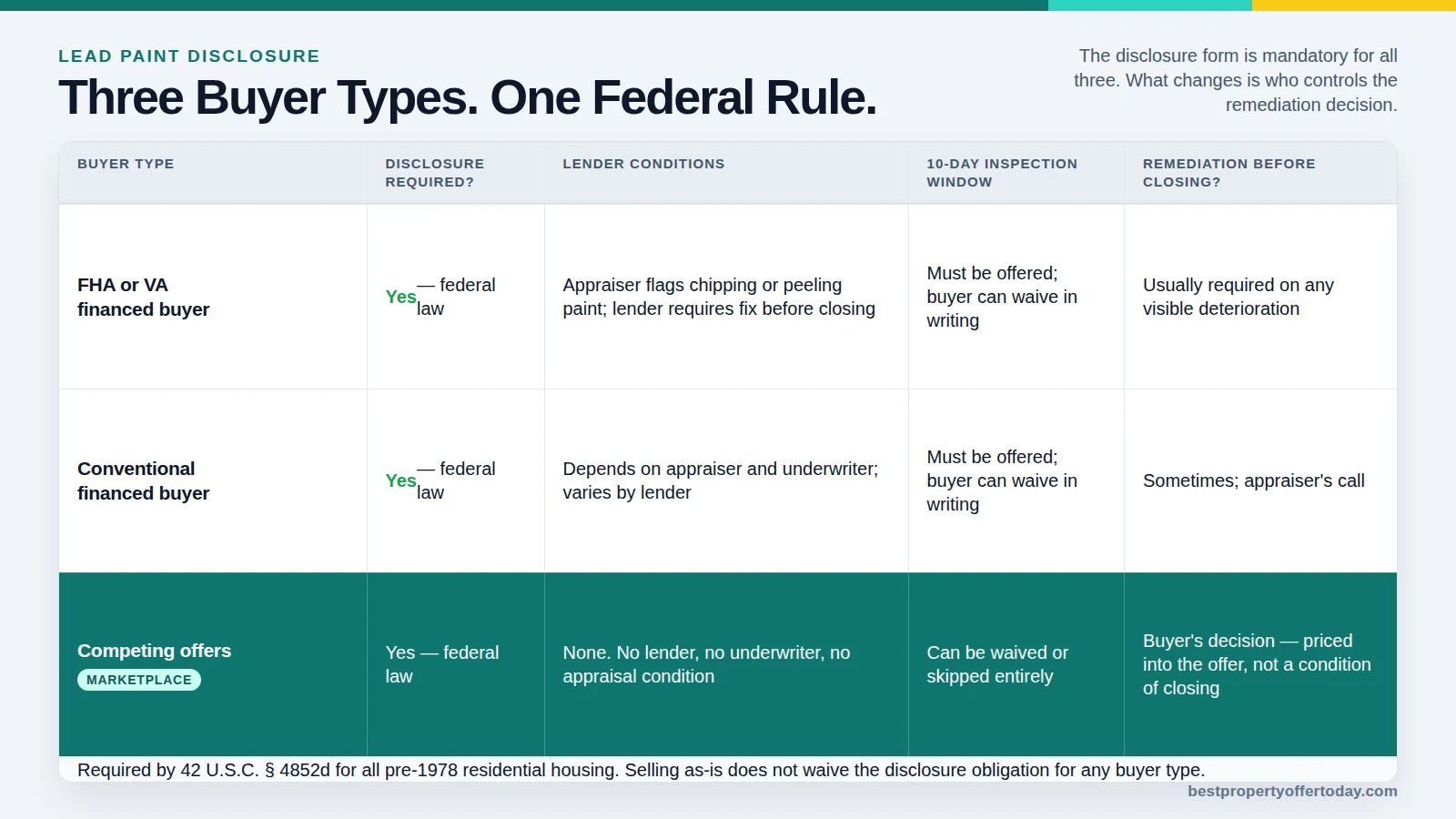
Buyer Type Comparison for a Lead Paint Property
| Buyer type | Disclosure required | 10-day window | Lender conditions | Remediation before closing |
|---|---|---|---|---|
| FHA or VA financed buyer | Yes, always | Must be offered; buyer can waive in writing | Yes: appraiser flags chipping paint, lender requires fix | Usually required on visible deterioration |
| Conventional financed buyer | Yes, always | Must be offered; buyer can waive in writing | Possible: depends on appraiser and underwriter | Sometimes, at lender discretion |
| Cash buyer | Yes, always | Can be waived or skipped entirely | None | Buyer’s choice, priced into the offer |
Red Flags When a Cash Buyer Makes an Offer on a Lead Paint Home
A buyer who tells you disclosure is not required because the sale is as-is is wrong. The federal lead disclosure law has no as-is exception. The form gets signed regardless.
Beyond that, watch for these specific patterns:
- The offer drops after the test results come back. A legitimate cash buyer builds the lead paint risk into the initial offer based on your disclosure. A number that drops after they see the inspection report is a bait tactic, not a new finding.
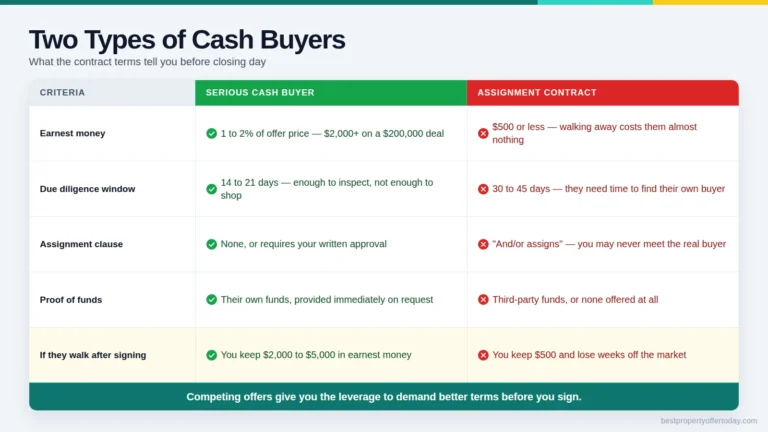
- Earnest money below 1 percent of the purchase price. A buyer putting up $500 on a $175,000 transaction can walk for nothing. They tie up your property for weeks at no cost to themselves.
- An assignment clause in the contract. This allows the buyer to transfer the contract to a third party before closing. See our guide to spotting a wholesaler for what that language looks like and why it matters.
- Pressure to close before title work is done. A proper title search takes seven to ten business days. Buyers pushing to close in three or four days are skipping a step that protects you.
Questions to Ask Any Cash Buyer Before Signing
- Is your proof of funds a recent bank statement, or a letter from a hard money lender? If it is a hard money letter, is the loan approved or still in underwriting?
- Which title company handles the closing, and who selects it?
- Does your offer change if a lead test finds paint in areas not yet tested?
- Does your contract include an assignment clause?
- What is your required closing date, and what happens if title work turns up a lien or a cloud on title?
For a broader buyer vetting checklist, see how to tell whether a cash home buyer is legitimate.
Does selling as-is exempt you from the lead paint disclosure?
No. Selling as-is limits your obligation to repair, not your obligation to disclose. The federal lead disclosure law has no as-is exception. Every sale of pre-1978 residential housing requires the signed disclosure form, the EPA pamphlet, and the offered 10-day inspection window, regardless of how the contract is written. A buyer who says otherwise is either uninformed or testing whether you will skip a federal requirement.
Can a cash buyer require you to remediate before closing?
Only if the contract says so. A cash offer on its own does not impose a remediation condition, because there is no lender to impose one. Whether remediation is part of the deal depends entirely on what the buyer writes into the contract and what you agree to. Most cash buyers on disclosed lead paint properties do not require pre-closing remediation; they build the cost into their offer and handle it post-closing on their own schedule.
What does lead paint remediation actually cost, and who pays it?
Encapsulation of specific surfaces runs $1,000 to $8,000. Full abatement of a whole house runs $10,000 to $30,000 or more. In a traditional sale, the seller often pays for remediation before listing or offers a credit at closing. In a cash sale, the buyer typically absorbs the cost after closing, which is reflected in a lower offer price. Neither approach is inherently better; the question is whether the seller prefers to spend the money upfront and potentially recover it in a higher sale price, or accept a lower number without any repair spend.
Should you get a lead test before listing?
A professional test at $200 to $500 tells you exactly what you are disclosing. Without a test, you disclose only what is currently known. If the house is pre-1978 with original paint and you have reason to suspect lead paint is present, getting the test before listing prevents surprises during the buyer’s 10-day window. A surprise that terminates a financed sale after contract costs far more than the test. If the house is clearly pre-1978 with original interior paint still intact, testing before listing is the lower-risk move.
A cash sale through a competitive marketplace is one path for sellers who cannot or will not remediate before listing. Submit one request through bestpropertyoffertoday.com and receive competing offers from multiple vetted buyers. There is no obligation to accept any offer. Offers typically come back within 24 to 48 hours. Phone: 804-361-7460.
Asbestos raises similar questions for sellers of pre-1980 homes. See selling a house with asbestos for how cash buyers price that condition and what disclosure requires.
A cash offer on a lead paint property will normally be below what a fully marketed, remediated property would sell for after commission and carrying costs are netted out. A traditional listing after targeted encapsulation will likely outperform a cash offer if the house is otherwise sound and the seller has six to twelve weeks to run the process. The cash route makes the most sense when remediation cost is large relative to the home’s value, when the seller cannot fund repairs upfront, or when speed and certainty matter more than the last few thousand dollars.