An encroachment on your property is a solvable problem, but it is not a small one. A garage that extends two feet onto a neighbor’s land, a fence that crosses the surveyed line, a shed that sits over a utility easement — any of these will show on a survey ordered before closing, and when they do, they stop most financed sales cold. This page explains exactly why, what your options actually cost, and where a cash marketplace fits into the decision.
An Encroachment Is Not the Same as a Boundary Dispute
A boundary dispute is a disagreement about where the property line runs. An encroachment is different: the line is not in question, but a structure physically crosses it. Your garage is built three feet onto your neighbor’s land. Their driveway extends two feet onto yours. Your deck sits within a recorded utility easement that prohibits permanent improvements.
The distinction matters because the legal remedies are different. A boundary dispute may require a court to establish where the line actually falls. An encroachment, where the line is already established, involves negotiation or litigation about the structure itself.
The three patterns that show up most often:
- You own a structure that sits on the neighbor’s land
- A neighbor’s structure occupies part of your land
- Your structure sits within a recorded easement that prohibits permanent improvements
Each has a different legal path and a different risk profile for a sale. Understanding which one you have changes the conversation with your attorney, your title company, and any prospective buyer.
How Encroachments Are Discovered
Most sellers find out during the transaction, not before. A buyer’s lender orders a title search. The title commitment comes back with an exception for “matters that a current survey would reveal.” The buyer’s contract requires a new survey. The surveyor marks the encroachment on the plat. The title underwriter flags it.
A residential survey typically costs $600 to $1,200 depending on lot size and location. In most transactions involving financing, a recent survey is required. That is when the problem surfaces, usually 2 to 3 weeks into a contract, after both sides have invested time and money.
Sellers in attorney states — primarily the Northeast, South Carolina, Georgia, and parts of the Southeast — may discover the issue earlier because an attorney reviews title before the contract is signed or at least before the inspection period ends. In non-attorney states, the survey issue may not land until the title commitment arrives on the closing table. That is the worst timing: the buyer is committed, the lender has spent money on the appraisal, and now the deal may fall apart.
What an Encroachment Does to a Financed Sale
This is the mechanism most sellers do not understand.
A lender requires two things before funding: a lender’s title insurance policy and clear, insurable title. An encroachment can create a title exception. The title underwriter may agree to insure the transaction but carve out the encroachment, meaning the policy explicitly does not cover claims arising from the structure crossing the line. A lender whose policy contains that carve-out may refuse to fund, because their security interest in the property includes the structure that is, legally, sitting on someone else’s land.
For conventional loans, FHA, and VA loans alike, the requirement is insurable title. An encroachment that the title company will not fully insure over is a deal-stopper for any buyer who needs financing.
There is also an adverse possession dimension. In most states, a trespassing structure that has been in place for a statutory period — five years in some states, twenty-one years in others — may give the encroaching party a colorable legal claim to the affected strip of land. A title attorney familiar with your state can tell you whether the encroachment’s age creates that exposure. This is not hypothetical in states with short adverse possession periods.
Your Three Paths: Costs and What Each One Actually Produces
There is no single right answer. The correct path depends on the encroachment type, the neighbor’s willingness to cooperate, and how much time and money you have available.
| Path | Upfront cost | Timeline | Best for |
|---|---|---|---|
| Resolve: encroachment agreement | $1,000 to $2,500 in attorney fees | 2 to 8 weeks | Cooperative neighbor, minor encroachment |
| Resolve: relocate or demolish structure | $5,000 to $35,000+ | 4 to 12 weeks | Uncooperative neighbor, structural encroachment |
| List with full disclosure | $0 upfront, reduced price | Normal listing period | Minor easement issues, realistic pricing |
| Sell to a cash buyer | $0 upfront, discounted offer | 1 to 3 weeks after offer | Any encroachment, seller wants a clean exit |
Resolving It With an Encroachment Agreement
An encroachment agreement, sometimes called an encroachment license, is a recorded document in which the neighboring landowner grants your property the right to maintain the encroaching structure. It does not transfer ownership of the land. What it gives the title company is a documented, recorded acknowledgment that the neighbor has consented. Most title underwriters will insure over a minor encroachment if a recorded agreement is in place.
A real estate attorney drafts and records the agreement in the county deed records. Attorney fees run $1,000 to $2,500 depending on complexity. The neighbor must agree and sign. If they are cooperative, this is the fastest resolution. If they are not, or if they see leverage in your pending sale, the process stalls or breaks down entirely.
Get the title company’s written confirmation before spending on attorney fees. Ask them directly: if a recorded encroachment agreement is in place, will you issue a standard policy without carving out the encroachment? Some underwriters will; others will not, depending on the severity and the county. Knowing the answer before you start saves time and money.
Removing or Relocating the Structure
A fence that crosses the line can usually be moved for $2,000 to $8,000 depending on length and material. A garage that extends three feet over the property line is a different problem. A structural engineer is typically required before any permit is pulled. Partial demolition and reconstruction on a garage may cost $15,000 to $40,000 or more. The work also requires permits, inspections, and time.
Run the numbers before committing to this path. If removing the encroachment costs $28,000 and produces a price increase of $20,000, the math is negative. The reason to take this path is when the neighbor will not sign an agreement, the title company will not insure over it, and you need the full buyer pool to sell at a price that makes sense for you.
Listing With Disclosure
You may disclose the encroachment upfront, price accordingly, and see who makes an offer. Cash buyers and real estate investors will still consider the property. Some conventional buyers will, too, if the encroachment is minor or if the title company has confirmed it will insure over it with a standard exception.
Retail buyers who need financing are a harder sell. Even with a price reduction, a lender that will not fund because the title underwriter will not issue a clean policy is an obstacle that price cannot solve. Sellers who take this path often face a longer time on market and a buyer pool that skews toward investors anyway. For a related discussion of how title complications affect closing, see our post on title problems that delay a cash closing.
How Cash Buyers Handle Encroachments
A cash buyer has no lender. There is no lender requiring title insurance before funding. The buyer and seller negotiate the encroachment into the price, both sign a contract that acknowledges it, and the sale closes. A title company still processes the closing, and the buyer may choose to purchase an owner’s title policy. But without a lender’s requirements, the title insurer’s exception for the encroachment does not kill the deal. The buyer accepts the known risk, priced into their offer.
This is the genuine marketplace angle. Submitting one request to multiple vetted cash buyers means each buyer evaluates the encroachment on their own terms. One buyer may discount it at $10,000. Another may factor in $30,000 for eventual remediation costs. Getting competing offers lets you see the full spread and choose the number that makes sense for your situation. A single cash buyer making a take-it-or-leave-it offer has no reason to come in at the top of the range. Competing buyers do.
A Worked Example
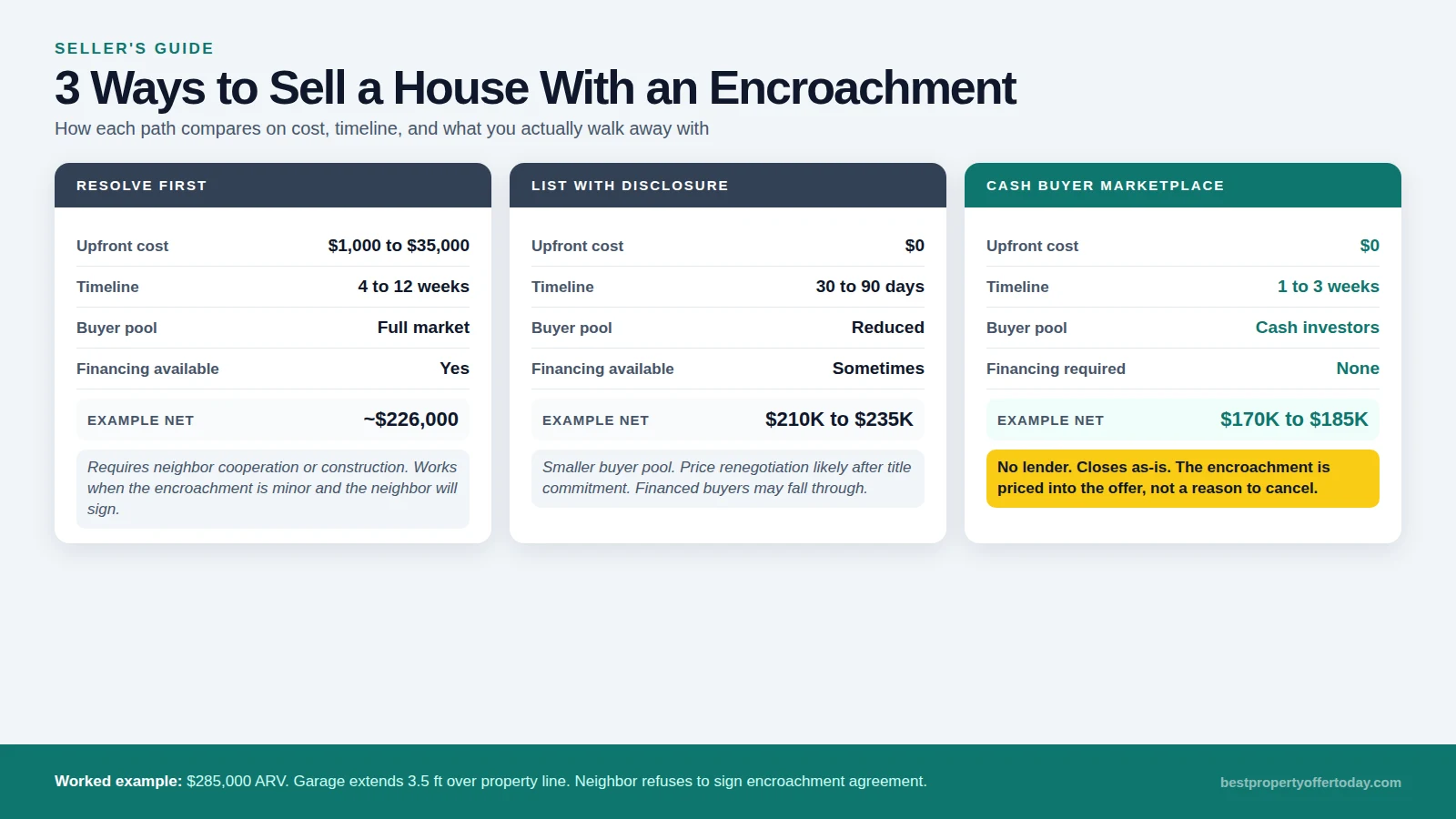
House ARV: $285,000. Attached garage built in 1981 extends 3.5 feet over the rear property line onto the neighbor’s land. The survey was ordered by the buyer’s lender. The title company will not insure over it without a recorded encroachment agreement. The neighbor has refused to sign.
Path 1, partial demolition and rebuild: estimated $22,000 to $35,000. The work returns the property to a fully insurable state. At a $285,000 ARV with $28,000 in remediation costs and a 6% commission plus closing costs, the seller nets roughly $226,000. This assumes no further renegotiation from the buyer after the work is done.
Path 2, listing with disclosure: a smaller buyer pool and a longer time on market. Realistic sale price after negotiation may land at $250,000 to $260,000. After commission and costs, the seller nets $210,000 to $235,000, assuming a buyer is found who can close.
Path 3, cash buyer offers: using the 70% ARV rule with a modest repair estimate, a local investor bids $170,000 to $185,000. No remediation required. Closing in 2 to 3 weeks. The seller avoids the construction timeline, carrying costs, and the legal uncertainty if the neighbor escalates.
Neither path is objectively correct. The question is whether the difference between $226,000 and $177,000 is worth a 12-week construction project, the risk of the neighbor contesting, and the possibility the financed buyer walks anyway during the process. You can use the net proceeds calculator to run your own numbers with current carrying costs and closing cost assumptions.
Red Flags: How Buyers Use an Encroachment Against You
An encroachment is a known weakness in your title. Buyers who are not serious use it as leverage:
- A financed buyer accepts the disclosure at signing, then demands a large price reduction during the attorney review period once the title commitment confirms the exception
- A cash buyer makes an attractive initial offer, then revises down significantly after “reviewing the survey” — even though the encroachment was already disclosed
- Long inspection windows paired with assignment clauses: the buyer ties up your property while searching for a downstream investor willing to take the encroachment, using your listing as free option value
- Token earnest money: a $500 deposit on a $250,000 purchase means walking away costs the buyer nothing
The protective moves: price the encroachment honestly and in writing from the first MLS description or disclosure packet. Require meaningful earnest money from any buyer. Get the title company’s written position on insurability before accepting any offer so you know exactly what you are negotiating from. For more on vetting buyers before you sign anything, see how to tell if a cash buyer is legitimate.
What You Are Required to Disclose
Most states require disclosure of known encroachments on the seller’s disclosure form. Some states have explicit checkboxes for easements, encroachments, or boundary issues. “As-is” language in a contract does not override the disclosure requirement. Selling as-is limits the duty to repair, not the duty to inform a buyer about a condition you already know exists.
A seller who conceals a known encroachment and completes a sale faces potential rescission claims and damages. The legal exposure of non-disclosure is typically more expensive than the encroachment itself. Disclose it, get legal advice on how to frame it, and build the known risk into your pricing. For the broader topic of how title issues affect cash closings, the boundary dispute selling guide covers related territory on surveys, title exceptions, and what cash buyers typically require.
An Honest Assessment of the Cash Route
Cash offers are normally below what a fully marketed retail sale would net. That gap exists because the buyer is absorbing the risk and the eventual cost of resolving the encroachment. If your encroachment is minor, the neighbor is cooperative, and a recorded agreement can be done in a few weeks, the retail path nets more. Pursue it.
The cash path makes sense when resolution is expensive, the neighbor is uncooperative, your timeline cannot absorb a 12-week construction project, or you want certainty over the maximum possible price. Getting competing offers through a marketplace at least tells you what the market will pay as-is. That number, compared against the net from path 1 or path 2, is the actual decision you are making.
Will a title company always catch an encroachment?
Not always. A title search alone may not reveal one. Title companies typically rely on the most recent recorded survey, and many residential transactions proceed without ordering a new one. If a survey is ordered mid-transaction by the buyer’s lender, and the encroachment surfaces then, the discovery happens at the worst possible moment. Ordering a survey before listing is the only way to find this on your schedule rather than theirs. It costs $600 to $1,200 and removes the surprise entirely.
Can I sell if the neighbor’s structure encroaches on my land?
Yes. The encroachment is on your land, which gives you a stronger negotiating position than a seller whose own structure crosses the line. You can ask the neighbor to remove the structure, negotiate an encroachment agreement in which you grant them a recorded license, or sell as-is and let the buyer and their title company handle the question. Some underwriters will insure over a neighbor’s minor encroachment with a survey exception. Others will not. Ask your title company directly and get the answer in writing before listing.
Does the age of the encroachment matter?
Yes, in two ways. First, older encroachments are often more deeply entrenched and harder to remove without significant cost. A fence that has been in place for 30 years may have landscaping, retaining structures, and utilities attached to it. Second, in states with short adverse possession periods, an older encroachment may carry a colorable legal claim if it has been continuous, open, and uncontested. A title attorney can review the encroachment history and give you a direct answer on adverse possession exposure. This is not something to resolve through assumptions.
How much should I discount for an unresolved encroachment?
There is no standard percentage. The market discount depends on the severity, the cost to resolve it, the neighbor relationship, and the local buyer pool. In markets with active investor activity, a cash buyer will factor in their resolution cost plus their profit margin and work backward from ARV. A $5,000 fence encroachment with a willing neighbor may shave 1 to 2% off a retail price. A structural encroachment with an uncooperative neighbor can reduce the effective buyer pool to cash-only investors and produce discounts of 15 to 30% of ARV, depending on what remediation actually costs. The most accurate answer comes from getting competing offers and seeing what the market says.