A low appraisal on a financed sale can collapse a deal that seemed settled. The lender will not loan above the appraised value, so the gap between what your buyer agreed to pay and what the appraiser says the house is worth has to be covered by someone. Who covers it, and how, determines whether this sale closes or restarts.
What the appraisal gap actually is
When a buyer takes out a mortgage, the lender sends an appraiser to verify the property is worth at least the loan amount. If the appraiser comes back with a number below the contract price, the lender will only loan against the lower figure. The difference is the appraisal gap.
Here is the arithmetic. Your buyer contracts to purchase your house for $340,000 and plans to put 20 percent down. Their lender will write a loan for 80 percent of the appraised value. If the appraisal comes back at $320,000, the loan is $256,000, not $272,000. The buyer suddenly needs $84,000 at closing instead of $68,000. That extra $16,000 has to come from somewhere, and it usually comes from a renegotiation with you.
On FHA and VA loans the problem is more acute. The VA will not guarantee a loan for more than the appraised value, and there is no mechanism for the buyer to bridge the gap from personal savings the way a conventional buyer can. An FHA appraisal also attaches to the property for 120 days as a case number, meaning the next FHA buyer who comes along faces the same number on file.
Your options after a low appraisal comes back
You have four realistic paths. Each one involves a tradeoff between price, speed, and certainty.
Reduce the sale price to the appraised value
The most straightforward fix. You accept $320,000 instead of $340,000, the loan works as originally written, and the deal closes on schedule. You absorb the full $20,000 gap. Whether that is acceptable depends on what you paid, what you owe, and what the market has done since you bought.
Ask the buyer to cover the gap from their own funds
Buyers who want the house badly enough will bring extra cash to closing. Some buyers include an appraisal gap clause in their offer upfront, which commits them to covering a gap up to a named dollar amount. If the buyer already agreed to cover $20,000, you may not need to renegotiate at all. If they did not, this is a renegotiation, and a buyer who cannot document the funds quickly is unlikely to produce them.
Split the difference
Seller reduces by $10,000 to $330,000. The buyer covers the remaining $10,000 gap from savings. Neither side is entirely satisfied, but the deal closes. In markets where listings sit for several weeks, most sellers take this path rather than restart the clock with a new buyer.
Challenge the appraisal through a Reconsideration of Value
Your agent can submit comparable sales to the lender that the appraiser may have missed, overlooked, or weighted too lightly. This is called a Reconsideration of Value (ROV). It works when a comparable is recent, genuinely similar in size and condition, and within a reasonable radius. It rarely closes a $20,000 gap entirely, and the appraiser is not obligated to change the number. Expect one to two weeks for a response, and expect a result that may not move the figure at all.
What a cash sale nets you when the appraisal has blown up a deal
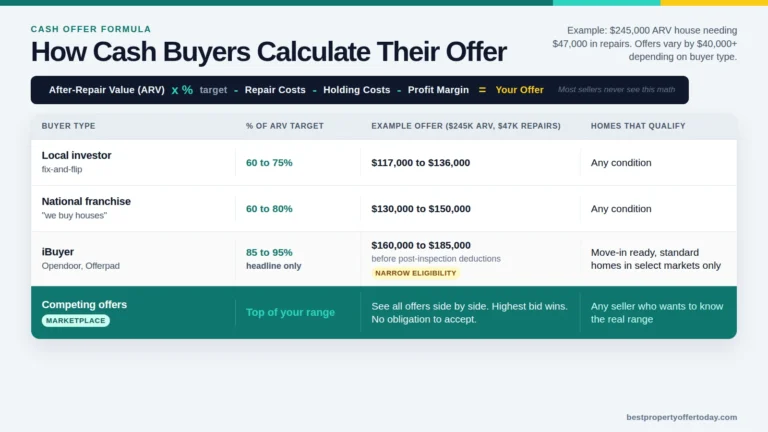
Cash buyers do not involve a lender. There is no appraisal requirement. The buyer uses their own money, so what any appraiser thinks the house is worth is irrelevant to whether the transaction closes. The tradeoff is price: a cash offer will come in below the retail price a financed buyer would pay. The question is whether the difference is worse than the certain losses staring at you in the renegotiation.
A cash offer is normally below a fully marketed retail price. What the seller buys with that gap is certainty and the elimination of appraisal risk entirely. If the house is in good condition and you have time to remarket, relisting after the current deal collapses and finding a well-qualified conventional buyer is usually the better financial outcome. If you are carrying the house at cost, if the deal has already been extended once, or if a VA or FHA case number is now attached to the property, the arithmetic starts to shift.
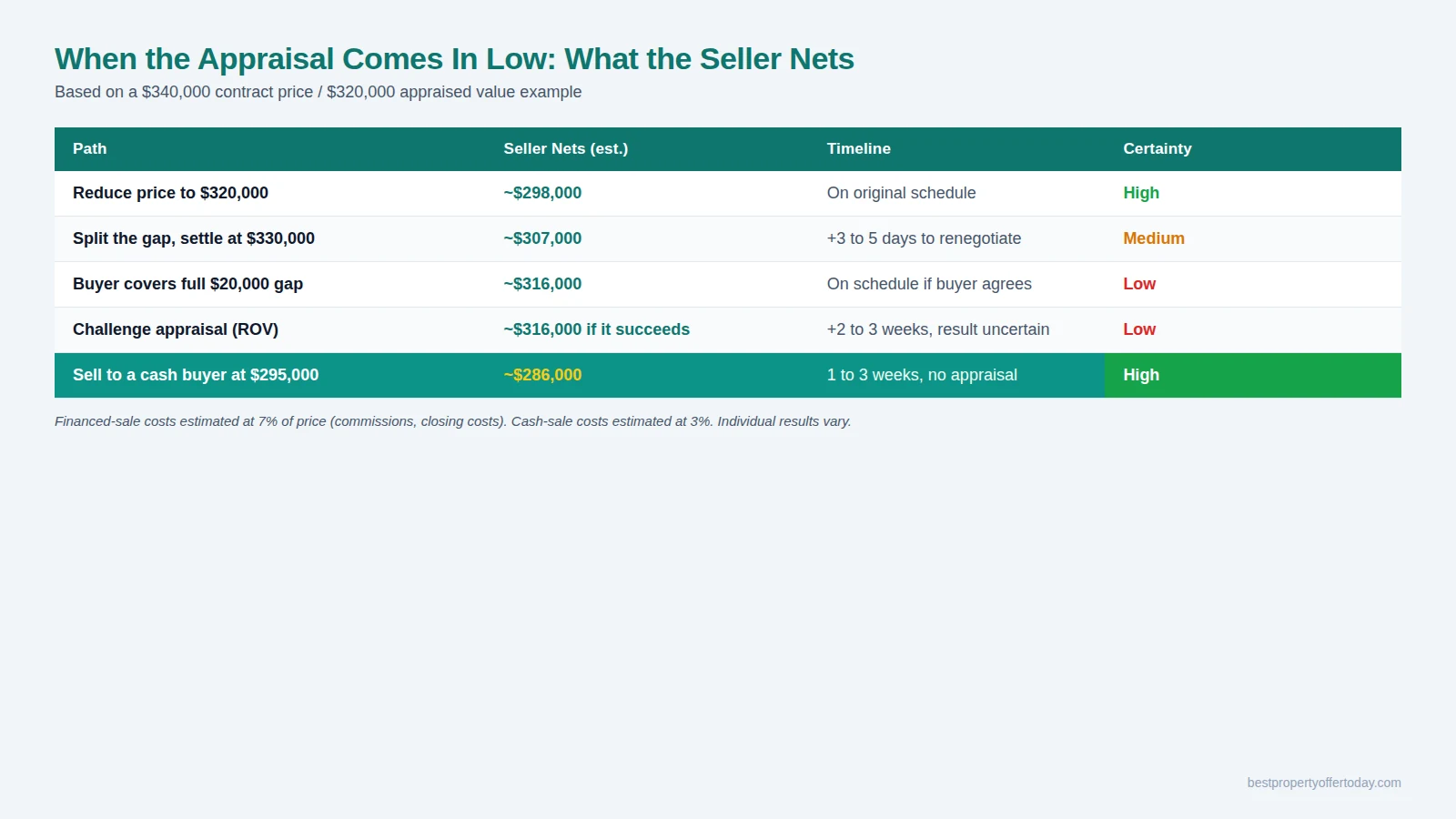
Worked example: $340,000 contract, $320,000 appraisal
Selling costs on a conventional sale typically run 7 to 9 percent of price, covering agent commissions, closing costs, and any repair credits. On a $320,000 settlement that is $22,400 to $28,800 in costs. Cash buyers typically require no seller-side agent commission and involve minimal closing cost exposure, so the gap between the headline prices and the actual net figures is smaller than it first appears.
| Path | Seller nets (est.) | Timeline | Certainty |
|---|---|---|---|
| Reduce price to $320,000 | ~$298,000 | On original schedule | High, if buyer agrees |
| Split the gap to $330,000 | ~$307,000 | +3 to 5 days to renegotiate | Medium, depends on buyer funds |
| Buyer covers full $20,000 gap | ~$316,000 | On schedule if buyer agrees | Low, most buyers cannot |
| ROV challenge succeeds | ~$316,000 | Add 2 to 3 weeks | Low, rarely moves the full gap |
| Sell to a cash buyer at $295,000 | ~$286,000 | 1 to 3 weeks, no appraisal | High, no appraisal contingency |
Use the net proceeds calculator to run these numbers against your actual mortgage balance, property taxes, and carrying costs. The difference between paths narrows considerably once you account for every month the house sits unsold.
Why FHA and VA appraisals create a separate set of problems
On a conventional loan the appraisal gap is a money problem. On FHA and VA loans it is structural.
The VA guarantees loans up to the appraised value only. The buyer cannot bridge the gap from personal funds the same way a conventional buyer can. If the VA appraiser says the house is worth $320,000, the loan tops out at $320,000. The buyer either renegotiates to $320,000 or walks. There is no splitting the difference.
The FHA 120-day case number is the less obvious problem. If your current FHA buyer walks after the appraisal, the case number stays attached to your property address. Your next FHA buyer will see the same low appraisal on file, and their agent will know it before the offer is written. Conventional buyers and cash buyers are the cleanest exits from a property carrying an FHA case number. If you are in this situation and want to understand all your options, the full comparison of cash versus a listed sale works through the carrying-cost math.
Red flags from buyers after a low appraisal
A low appraisal creates renegotiation leverage for a buyer who planned to use it all along. These behaviors are worth watching:
- Immediate request for a price reduction below the appraised value, not at it
- Repair credits demanded on top of a price reduction
- Stalling on the ROV submission while the inspection contingency period runs out
- Buyer cannot document they have the funds to cover any gap, even in writing
- Request that the seller cover the cost of a second appraisal ordered by the buyer’s new lender
None of these are automatic signs of bad faith, but taken together they are a pattern. A buyer using the appraisal as a price reduction tool rather than facing a genuine obstacle will continue negotiating after each concession. Get competing cash offers on the table before agreeing to the first reduction, so you know what your exit looks like. Vetting those buyers before you commit to one is part of that process.
When to push back and when to take the cash exit
If the house is in good condition and the low appraisal reflects a market timing issue rather than a real deficiency in the property, the right move is usually to demand the buyer cover the gap, or to relist and find a better-qualified buyer. Conventional buyers with large down payments are less constrained by appraisal figures because their loan-to-value ratio gives them room.
A cash exit makes more sense when some combination of the following applies: the low appraisal reflects a genuine problem with the property, you have already extended the sale once, you are carrying the house at monthly cost, a VA or FHA case number is now attached, or the buyer cannot document their finances. Submitting one request to a marketplace that collects competing offers from multiple vetted buyers takes less time than calling investors one by one, and the spread between offers on the same property can be substantial. See what competing buyers will offer on your property. For questions about whether the cash path makes financial sense in your case, call 804-361-7460.
Questions to ask before making any concession
- Did your agent provide the appraiser with the strongest available comparable sales before the inspection?
- Is the buyer willing to formally submit an ROV, and will they share the full appraisal report?
- Can the buyer document the funds to cover any gap, in writing, today?
- Is this an FHA loan, and is a case number now attached to your address?
- How many days does your contract allow before the buyer can terminate on the appraisal contingency?
How often do appraisals come in low?
It varies by market cycle. In a seller’s market where prices have risen faster than recent comparable sales can support, gaps are common. Data from Fannie Mae and CoreLogic covering recent cycles suggests 7 to 12 percent of transactions face an appraisal gap at some point in the process. In fast-appreciating markets the figure is higher. In flat or declining markets it is rarer because buyers tend to negotiate the price down before the appraisal runs.
Can a seller refuse to reduce the price after a low appraisal?
Yes, but the practical consequence is that the buyer invokes the appraisal contingency and exits the contract. Most standard purchase agreements give the buyer the right to terminate without penalty if the appraisal comes in below the contract price and the parties cannot agree on a resolution. The seller is not obligated to reduce the price, but refusing to negotiate typically ends the deal rather than forcing the buyer to pay more than the appraised value.
Can a seller back out of the deal because of the appraisal?
In most cases, no. The appraisal contingency is the buyer’s protection, not the seller’s. Once a contract is signed, the seller cannot simply cancel because the appraisal came back low and they want a different buyer. The seller’s rights around exiting a signed contract are narrower than most assume, and walking away without legal grounds typically exposes the seller to liability.
Does a cash buyer order an appraisal?
A cash buyer has no lender requiring one. Many cash buyers skip the formal appraisal entirely and rely on their own analysis: comparable sales data, an inspection report, and their own renovation cost estimates. Some do order an internal valuation as part of due diligence, but it does not trigger a contingency the way a lender’s appraisal does. The transaction does not fall apart over an appraisal gap because there is no bank in the middle defining one. That is the core structural advantage of a cash sale when a financed deal has already run into the appraisal wall.