You can sell a house with hail damage. The question is which path fits your situation: repair it first and sell to the full buyer pool, list as-is and work with cash buyers, or use the insurance proceeds to bridge the gap. Each route produces a different price and a different timeline, and the right one depends on how much time you have and what the rest of the house looks like.
What Hail Damage Does to a Sale
Most hail damage lands on the roof and siding. It ranges from granule loss on asphalt shingles, which shortens remaining useful life, to functional damage that compromises a shingle’s ability to shed water. Gutters, window screens, and softer metal surfaces show dents. Older roofs and wood siding absorb more of it.
None of this stays hidden. A buyer’s inspector will walk the roof and note every dent, bruise, and granule deposit in the gutters. Even if you do not mention the damage upfront, it appears in the inspection report. That means the negotiation happens anyway, just later, when the buyer has more leverage. Getting ahead of it is usually the better position.
If your house needs a new roof for reasons beyond hail, the same lender conditions apply. The full breakdown on selling with a roof that needs replacement covers what agents and appraisers look for in those cases.
The bigger complication is the lender. FHA, VA, and USDA loans all require the property to meet Minimum Property Requirements before the loan funds. A roof with visible functional damage, the kind an appraiser flags as compromising weatherproofing, is a required repair condition. The loan does not close until the repair is done or a funded escrow holdback is set aside to complete it. Conventional loans are less rigid but not immune: a conventional appraiser noting roof condition can trigger the same underwriting condition.
The practical result: unrepaired hail damage limits your buyer pool to cash buyers. Most financed buyers either cannot get their loan to close on a damaged roof or choose not to take on the repair obligation.
The Insurance Claim Decision
Homeowners insurance covers hail damage under a standard HO-3 policy, usually at replacement cost minus the deductible. The claim belongs to you as the policyholder, not to the property. If you file before closing, the proceeds are yours to keep.
How the money actually moves: your mortgage lender has a security interest in the property and will be named on the insurance check. When the check arrives, the lender typically holds it and releases funds in stages as repairs are completed. At closing, any unreleased balance gets reconciled in the settlement statement alongside the mortgage payoff. You do not lose the money simply by selling.
If you sell without filing a claim, the new owner has no path to collect under your policy for damage that occurred while you owned the house. The damage becomes a pricing factor instead of an insurance recovery. Whether that is better depends on how the repair cost compares to your deductible and how fast you need to close.
One timing reality worth knowing: contractor demand spikes after a regional hail event. The same storm that hit your house likely hit several thousand others nearby. Roofing crews in heavily affected areas book out 6 to 12 weeks from a major event. If you are in a hurry, waiting on a contractor may cost more time than the repair is worth.
Three Paths: A Worked Example
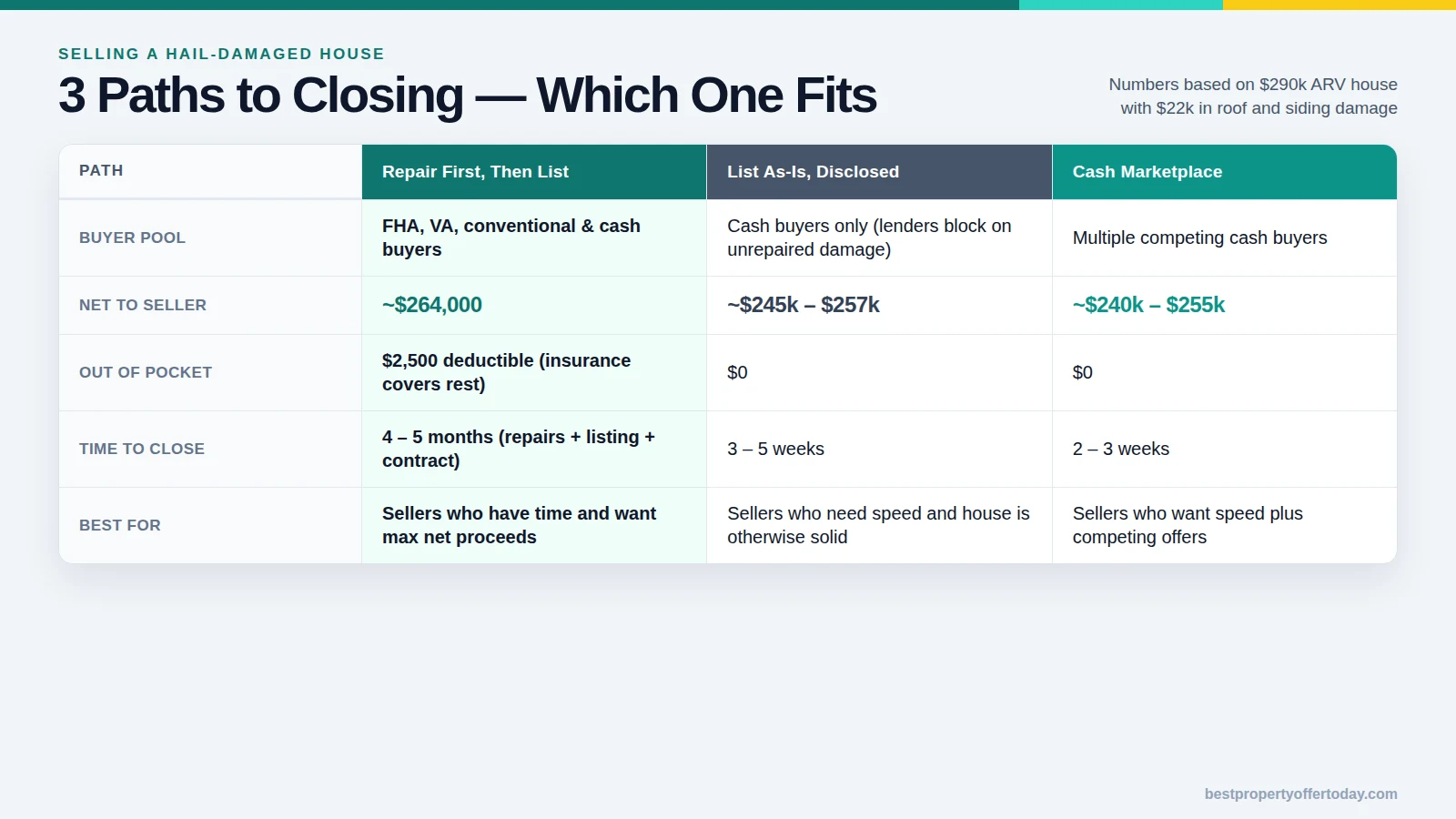
Here is how the numbers work on a house in the Denver metro: appraised value of $290,000, confirmed hail event 8 months ago, damage totaling $22,000 ($15,000 roof replacement plus $7,000 siding). The insurance deductible is $2,500, so a filed claim pays out $19,500.
| Path | What happens | Buyer pool | Approx. net | Timeline |
|---|---|---|---|---|
| File claim, repair, then list | Pay $2,500 deductible, complete repairs, list at full value | FHA, VA, conventional, cash | ~$264,000 | 4-5 months |
| List as-is, damage disclosed | Reduce price, disclose damage in writing, cash buyers only | Cash buyers only | ~$245,000-$257,000 | 3-5 weeks |
| Cash marketplace, competing offers | Submit one request, collect competing offers from vetted buyers | Multiple cash buyers | ~$240,000-$255,000 | 2-3 weeks |
Path 1 net breakdown: $290,000 list price, minus 5 percent commission ($14,500), minus $3,500 in seller closing costs, minus $2,500 deductible out of pocket, equals $269,500. Subtract four months of carrying costs (mortgage, property taxes, insurance, utilities) at roughly $1,300 per month and the realistic net lands near $264,300.
Path 3 net: cash buyers use the 70 percent rule as a starting floor. Seventy percent of $290,000 is $203,000. Subtract $22,000 in repairs and an isolated buyer might open at $181,000. That is the floor, not the market. Local investors with active roofing crews price repairs cheaper than an insurance adjuster and bid higher. A marketplace with competing offers pushes the number further. Realistic range on this property: $235,000 to $255,000, before roughly $2,500 in seller closing costs.
The gap between the two paths is $9,000 to $30,000 on this $290,000 house. What you buy with that gap is time and certainty. A cash close happens in two to three weeks. A traditional listing after repairs takes four to five months, plus the risk that the buyer renegotiates after their own inspection even though you already repaired the damage.
Red Flags from Buyers After a Hail Event
Hail damage attracts certain behaviors from buyers who plan to profit from urgency rather than close. The patterns below are the most common signals. More on how to distinguish a legitimate cash buyer from one who is not is covered in the guide to verifying cash home buyers.
- A fair-seeming price paired with a 30-plus-day inspection window and an assignment clause (the buyer plans to sell the contract, not close)
- A request to file the insurance claim and sign over the proceeds to the buyer before closing
- A price cut after inspection citing the same hail damage that was disclosed upfront
- An assignment of benefits (AOB) clause transferring your insurance rights to the buyer or their preferred contractor
On the assignment of benefits point: Texas, Florida, and Colorado have all passed legislation restricting or banning AOB in residential insurance claims, specifically because of widespread roof replacement fraud. If a buyer or contractor asks you to sign your insurance rights over to them, do not sign before consulting a real estate attorney. Any buyer proposing unusual contract terms is a situation the guide on spotting wholesalers and assignment deals covers in detail.
Disclosure Duty
Selling as-is does not mean selling without disclosure. In all 50 states, a seller must disclose known material defects. Hail damage you are aware of is a material defect. An as-is clause means the buyer accepts the condition as you have described it. It does not erase your obligation to describe what you know.
Failure to disclose known hail damage that a buyer later discovers is grounds for a rescission claim or a civil lawsuit, even in states with strong as-is protections. Disclose in writing on the seller disclosure form, keep a copy, and note any insurance claim you have filed or plan to file.
When a Cash Sale Makes Sense, and When It Does Not
A cash offer on a hail-damaged house is normally below a fully marketed retail price. That is not a failure of the cash market. It is how buyers price the repair cost and the obligation to complete it. The gap represents real risk they are absorbing so you do not have to.
A cash sale makes sense when you need to close before a roofing contractor can finish the work, when the contractor backlog in your area runs 8 to 12 weeks post-storm, when the house has compounding issues beyond the hail damage, or when four months of carrying costs erode more than the price gap between the two routes.
If the house is otherwise in good condition and you have time, repairing first and listing traditionally almost always nets more. The cash route is not better in absolute terms. It is faster and more certain, and those qualities have real value that varies by seller and situation.
The net proceeds calculator lets you run both scenarios with your actual numbers before deciding. If you want to see what competing cash offers look like on your specific house, call 804-361-7460 or submit through the site. Offers come back from multiple vetted buyers within 24 to 48 hours, and there is no obligation to accept any of them.
Does Hail Damage Affect the Asking Price on a Listed Home?
It does, in two ways. First, buyers factor in the cost of repair when making offers, even when you intend to use insurance proceeds to cover it. Second, buyers using FHA or VA financing cannot make competitive offers on an unrepaired home because their lender conditions the loan on the repair being done first. Until the damage is fixed, you lose the government-backed buyer pool, which is a large share of the entry-level and mid-market in most areas.
Can I Keep the Insurance Money and Still Sell the House?
Yes, if you filed the claim before closing. The proceeds belong to you as the policyholder. What complicates it is your mortgage lender, who holds the insurance check and releases funds only as repairs are completed. At closing, any unreleased insurance balance gets reconciled in the settlement statement alongside the payoff. Consult your insurance agent and the title company early so you know what number shows up on the closing disclosure. Do not assume the money disappears at closing.
How Do Cash Buyers Price a Hail-Damaged House?
Most start with the after-repair value (ARV), apply a margin, then subtract the estimated repair cost. On a $290,000 ARV house with $22,000 in damage, a local investor using the 70 percent rule arrives at roughly $181,000 as a floor. In practice, competing buyers push that number up, and investors who run their own crews price repairs cheaper than an insurance adjuster would. Getting three or four offers on the same property shows you the real market. A marketplace consistently produces a higher number than a single unsolicited direct buyer, because competition does what it always does.
What Happens If a Hailstorm Hits After I Accept an Offer?
Risk during contract typically sits with the seller until closing under most standard purchase agreements. If a storm hits after acceptance, you generally have a right to file a claim for the new damage. Most contracts require you to notify the buyer of a casualty event. Depending on the severity and the contract language, the buyer may have a right to renegotiate or exit. If the storm damage is significant, consult the contract and a real estate attorney in your state before deciding how to proceed.