Stucco problems come up at inspection and stop deals cold. The reason is not the stucco itself. It is moisture trapped behind it, rotting the wall you cannot see. Most lenders will not finance a home with active stucco moisture damage, which means most retail buyers cannot close. This post explains what the problem actually is, what it costs to fix, and what your three realistic options look like in dollars.
Hard-coat stucco and synthetic stucco are not the same thing
Traditional hard-coat stucco is a three-layer cementitious system that has been on houses since the 1920s. When it cracks, you can see it. It does not usually cause lending problems on its own.
Synthetic stucco, sold under the brand name Dryvit and generically called EIFS (Exterior Insulation and Finish Systems), looks nearly identical to hard-coat from the street. It is a foam insulation board covered with a mesh and a thin finish coat. EIFS was installed heavily on new construction and renovations from roughly 1988 through 2005, concentrated in the Mid-Atlantic, Southeast, and parts of the Southwest.
The difference matters because EIFS fails differently. The foam is moisture-resistant, but the system depends entirely on perfect sealing at every penetration: windows, doors, light fixtures, hose bibs, trim boards. When those seals crack, water enters behind the foam. Unlike hard-coat stucco, EIFS traps that water against the sheathing and framing with no drainage plane. The rot happens slowly, invisibly, behind a surface that looks fine.
What a stucco inspection actually involves
A general home inspector often does not probe EIFS. A dedicated stucco inspection uses calibrated moisture probes to measure water content in the wall behind the finish coat at multiple points around every penetration.
Readings below 16 percent are acceptable. Readings above 19 percent indicate active moisture. Above 25 percent, you are looking at wood rot and potentially mold inside the wall.
The inspection costs $400 to $800 for a typical single-family home. In states where EIFS failures are common, particularly Pennsylvania, Maryland, Virginia, North Carolina, and Florida, most listing agents on homes built between 1990 and 2005 will recommend one before going to market. If a buyer’s general inspector notices EIFS, they will recommend a dedicated stucco inspection before the buyer proceeds.
When the probe report shows active moisture, that finding becomes a disclosure item. You know about it. Most states require sellers to disclose material defects regardless of an as-is clause. Selling as-is limits what you agree to repair. It does not eliminate the duty to disclose a known defect. A real estate attorney in your state can confirm the exact form and the exposure.
Why lenders walk away from active stucco moisture findings
FHA and VA appraisers are trained to flag EIFS and note active moisture as a property condition issue. The loan is typically conditioned on remediation before funding, which means the buyer cannot close until the repair is done and re-inspected. That adds weeks or months to the timeline, even when the buyer is willing to wait.
Conventional lenders vary. Some will fund with a repair escrow. Others will not originate a loan while an open stucco remediation report sits in the file. And many homeowner insurance carriers add exclusions or higher premiums for EIFS, which affects a buyer’s ability to get the coverage their lender requires at closing.
The practical result is that a house with an active stucco moisture report is off-limits for FHA and VA buyers, and risky for most conventional buyers. Your realistic pool becomes investors, cash buyers, and buyers who can absorb the repair cost out of pocket and handle the lending complications themselves.
What remediation costs, by scenario
Costs depend on how much of the EIFS has failed and whether the damage reached the structural framing.
Caulking and resealing only: $2,000 to $5,000. Addresses cosmetic cracks and open seams at penetrations. Does not fix moisture damage already in the wall. May satisfy a buyer who received borderline probe readings, but it will not clear a report that shows active rot.
Partial remediation: $8,000 to $20,000. One or two elevations have failed while others probe clean. The affected sections come off, sheathing and framing are evaluated and replaced where rotted, and new siding properly integrated with flashings goes back on. Many contractors install fiber cement board on the remediated sections rather than re-applying EIFS, which eliminates future moisture risk in those areas.
Full EIFS removal and replacement: $15,000 to $50,000 or more. All four elevations are failing, or damage found during partial remediation turns out to run deeper than the initial probe suggested. A large two-story home with extensive rot can reach $40,000 to $60,000 for a complete re-side. This is the scenario where most sellers conclude the repair is not worth doing before listing.
Worked example: what each path actually nets
House: 2,100-square-foot Colonial built in 2001, EIFS on all four elevations, located in the Mid-Atlantic.
Estimated retail value with no stucco problems: $395,000.
Stucco inspection result: active moisture on two window bays and the front entry surround. Probe readings of 26 to 28 percent on the north elevation.
Remediation estimate from two contractors: $19,500 average.
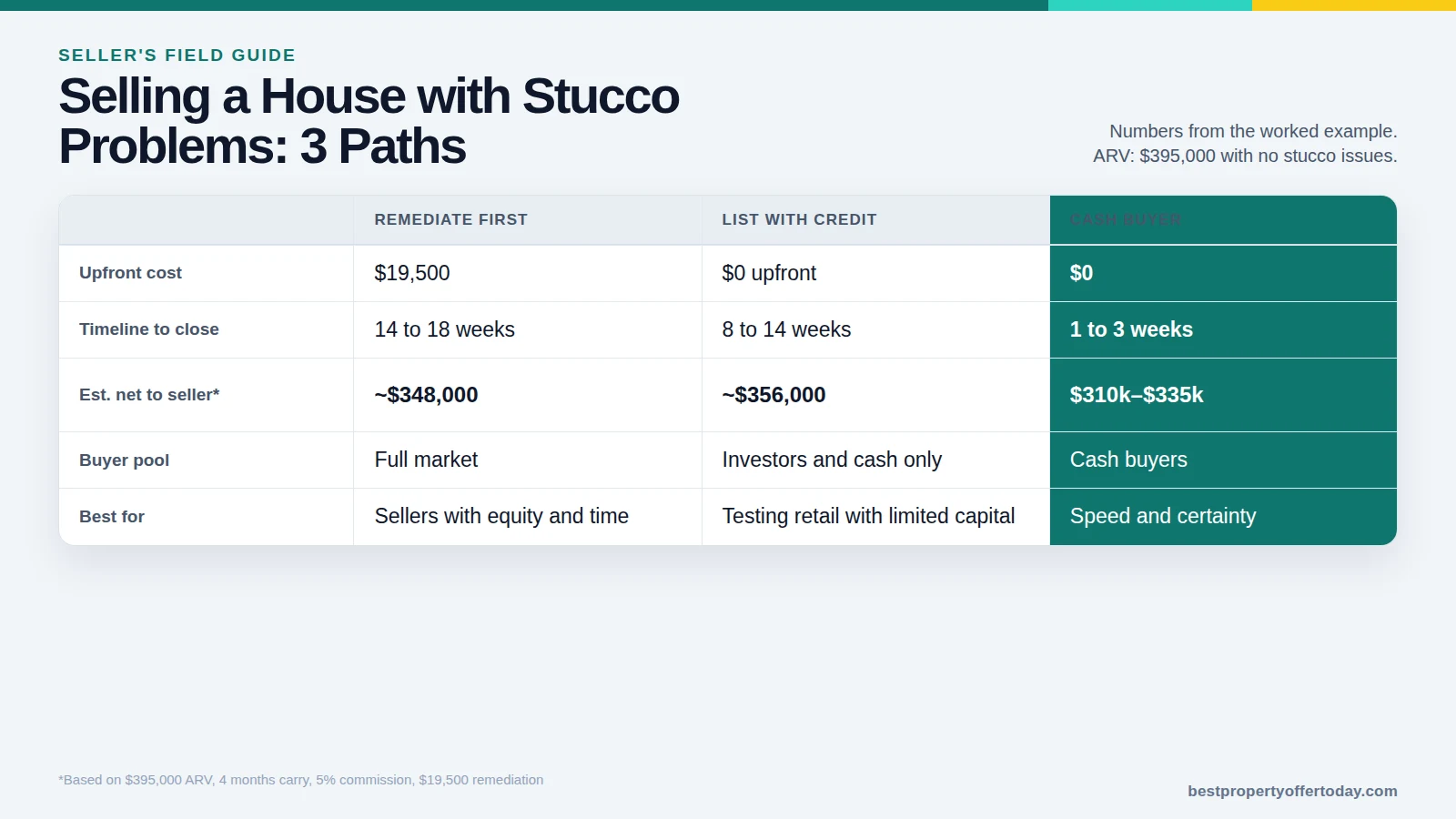
| Path | Upfront repair | Timeline to close | Est. net to seller |
|---|---|---|---|
| Remediate, then list at market | $19,500 | 14 to 18 weeks | ~$348,000 (after repair, 5% commission, 4 months carrying costs) |
| List as-is with a $20,000 price credit | $0 upfront | 8 to 14 weeks | ~$356,000 (if a financed buyer can close; often cash only anyway) |
| Sell to a cash buyer as-is | $0 | 1 to 3 weeks | $310,000 to $335,000 (no commission, no carrying cost) |
The gap between the cash buyer path and the remediated retail path in this example is roughly $13,000 to $38,000. Whether that gap is worth 14 to 18 weeks, a contractor project, and re-listing risk depends on your specific situation, not a formula.
Red flags from buyers to watch before signing
A legitimate cash buyer who will not renegotiate needs to see your stucco inspection report before making a final offer. An offer made before a buyer has reviewed the probe data is a placeholder, not a committed number. Watch for these behaviors before accepting anything:
- Offer presented before the buyer has seen your inspection report, with a large price reduction coming after their own inspection period
- An assignment clause in the purchase contract, meaning the buyer can sell your contract to a third party before closing
- Earnest money under $1,000 on a purchase above $300,000
- An inspection window of 21 to 30 days on an already-disclosed as-is property
These patterns appear most often from wholesalers, not end buyers. See what a wholesaler is and how to tell one from a real buyer for a checklist. For a broader vetting guide, are cash home buyers legitimate covers what documents and behaviors to verify before signing anything.
The honest tradeoff
A cash offer on a house with stucco moisture damage is normally below what a remediated retail sale would produce. A traditional listing on a fully repaired property, with a full buyer pool and normal financing available, typically nets more, if the seller has the capital to fund the repair, the time to manage it, and confidence that the probe report captured the full extent of the damage.
Many sellers do not have all three. The repair cost is real money out of pocket now. Contractor scheduling can push a re-list out three to four months. And it is not uncommon for partial remediation to reveal additional damage behind the finished sections, which restarts the cost estimate.
A marketplace that collects competing offers from vetted cash buyers exists for this situation. Submit one request, see what multiple buyers will pay for the property in its current condition, and compare side by side. There is no obligation to accept any offer, and the service costs you nothing. Call 804-361-7460 or request offers here to see the numbers for your specific property.
To model the numbers yourself before calling anyone, the net proceeds calculator lets you enter repair cost, carrying months, and commission to see what each path puts in your pocket.
Frequently Asked Questions
What does a stucco inspection involve, and how much does it cost?
A stucco inspector inserts calibrated moisture probes through the finish coat at intervals around every window, door, and wall penetration. The readings indicate whether water is accumulating behind the foam. The process takes two to four hours on a typical house and produces a written report with moisture levels mapped by location. Cost is $400 to $800. A general home inspector may flag EIFS and recommend further testing, but the probe inspection itself is a separate service that most general inspectors do not provide.
Can you sell a house with EIFS moisture damage without repairing it?
Yes. There is no law preventing an as-is sale of a home with EIFS problems. The practical barrier is financing. Most lenders will not fund a purchase while an active stucco remediation issue remains open in the inspection record. Cash buyers do not have that constraint, so they can and do close on homes with documented EIFS moisture damage. The offer price reflects what they estimate the repair will cost them plus their required margin.
Is older EIFS riskier than newer EIFS?
Generally yes. Barrier-EIFS systems installed before roughly 2002 have no drainage plane. They rely on perfect sealing to keep water out, and that sealing degrades over time at every window and door. Drainage-type EIFS, which became the industry standard after a wave of class-action litigation through the mid-1990s and early 2000s, incorporates a small gap between the foam and the sheathing so water that gets past the surface can drain out rather than accumulate. A home built after 2005 with stucco-looking siding is more likely to be a drainage system or hard-coat. The probe test is the only reliable way to confirm.
Does a title search reveal stucco problems?
No. A title search covers ownership history, recorded liens, and encumbrances on the property. It does not include physical condition information. Stucco moisture damage shows up in an inspection report, not in the title chain. For the issues that do appear in title and how they affect a cash closing timeline, see title problems that delay a cash closing.