Poor yard drainage can kill a financed deal before the buyer’s lender even orders the appraisal. FHA, VA, and USDA loans all require drainage that moves water away from the house, and an appraiser who sees standing water or soil sloping toward the foundation will flag it as a required repair condition. That condition either gets fixed before closing or the loan dies. Cash buyers have no lender and no appraisal requirement. That difference shapes every option below.
What counts as a drainage problem, for sale purposes
Not all drainage defects affect a sale the same way. These are the types that matter to appraisers and buyers:
- Standing water within 10 feet of the foundation after normal rain
- Negative grade: soil that slopes toward the house instead of away from it
- Saturated crawl space soil or water in the basement after rain (distinct from general wet basement issues, though often related)
- A failed French drain that backs up instead of carrying water off the property
- Downspout extensions that terminate at the foundation rather than extending away from it
- Yard drainage that pushes water toward a neighboring lot, which can create easement or nuisance claims
Surface puddling in a flat yard that clears within 24 hours is less likely to trigger a formal appraisal condition on a conventional loan, though it still affects perceived value. Persistent standing water within a few feet of the foundation almost always does.
Why FHA, VA, and USDA appraisers flag drainage
The mechanism is specific, and most sellers do not know about it until they are already under contract.
FHA’s Minimum Property Requirements (MPR), set out in HUD Handbook 4000.1, state that the property must have proper drainage away from the structure. VA uses nearly identical standards through its own MPR document. USDA Rural Development generally follows FHA appraisal standards for most programs.
When an appraiser working for any of these loan programs observes drainage that does not meet the standard, they write it up as a required repair condition. That means one of three things happens:
- The seller fixes the drainage, provides proof of completion, and the appraiser returns for a re-inspection at the seller’s cost.
- The buyer agrees to escrow funds for the repair and complete it after closing. Lenders are skeptical of this arrangement and many will not allow it for structural drainage defects.
- The deal dies.
Conventional loans do not carry the same mandatory repair trigger, but an appraiser will adjust the property’s value downward and note the condition. A large downward adjustment affects how much the lender will loan against the house, which can derail the deal just as effectively.
Cash buyers skip all of this. No appraisal, no MPR checklist, no required repair conditions. A cash buyer who knows about the drainage issue will price it into their offer. What they do not do is require you to fix it before you close.
What drainage repairs actually cost
Before deciding which path makes sense, sellers need real numbers. Get written estimates for the specific problem, but these ranges reflect what contractors charge across most of the country:
| Repair type | Typical cost range |
|---|---|
| Regrading or re-sloping the yard | $1,500 to $5,000 |
| French drain installation | $4,000 to $12,000 |
| Sump pump (basement or crawl space) | $1,500 to $4,000 |
| Dry creek bed or swale | $1,000 to $3,500 |
| Downspout extensions and splash blocks | $100 to $500 |
| Gutter replacement, if contributing to pooling | $1,200 to $2,500 |
The range is wide because soil conditions, the extent of the grading problem, and regional labor rates all move the number. A drainage problem on one side of the house may cost $2,500 to fix with regrading. A problem affecting the full perimeter and crawl space can run $15,000 or more. Get two written estimates before deciding: the repair cost is the key input into every option below.
Three paths, and what each one nets you
Here is the same house run through all three options. Use the net proceeds calculator to run your own numbers.
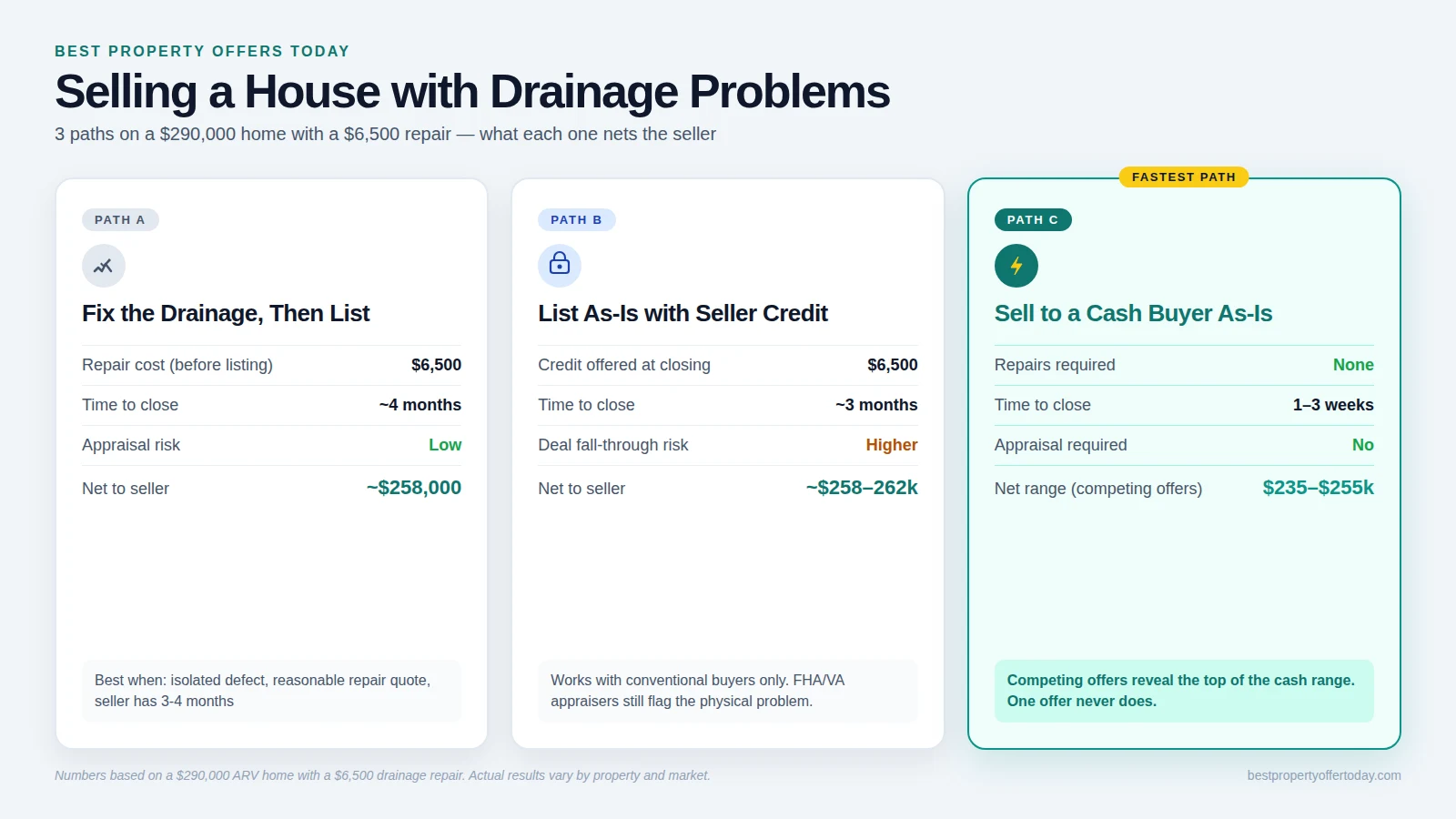
The house: market value in good condition of $290,000. Drainage problem: negative grade on the east side, water pooling within 8 feet of the foundation. Two contractor estimates came in at $6,000 and $7,000. The midpoint is $6,500.
Path A: fix the drainage, then list
You spend $6,500 before listing. The house now passes an FHA or VA appraisal and you list at full market value.
- Gross sale price: $290,000
- Agent commission (5.5%): $15,950
- Seller closing costs at 2%: $5,800
- Drainage repair already paid: $6,500
- Three months of carrying costs during repair and listing (mortgage, taxes, insurance): roughly $3,600
- Net to seller: approximately $258,000
This path makes the most financial sense when the drainage problem is isolated, repair quotes are reasonable, and the seller has time. If the house has other condition problems that will surface during inspection or appraisal, fixing only the drainage may not prevent the deal from collapsing on other grounds.
Path B: list as-is, disclose, offer a seller credit
You disclose the drainage issue and either reduce the list price or offer a closing credit. Financed buyers may still face an appraisal condition even with a credit in place: a credit does not fix the physical problem, and FHA and VA appraisers are not satisfied by closing credits alone.
This path works best with conventional buyers who can absorb a value adjustment. In practice, many sellers who try it face longer time on market and a higher deal fall-through rate, especially if the first buyers to tour are FHA or VA buyers.
- Effective sale price after a $6,500 credit on a $286,000 list: approximately $279,500
- Agent commission (5.5%): $15,400
- Seller closing costs at 2%: $5,590
- Net to seller: approximately $258,000 to $262,000, depending on negotiated outcome
The numbers look similar to Path A, but with more risk. A deal that dies after 60 days on market costs two months of carrying costs and puts the drainage problem in the MLS record, which affects every subsequent offer.
Path C: sell to a cash buyer as-is
No repairs, no appraisal, no required conditions. Cash buyers price the drainage issue into their offer and close in 1 to 3 weeks. The limiting factor is title work, not the drainage problem itself.
A fix-and-flip investor typically starts with the 70% rule:
- ARV ($290,000) x 70% = $203,000
- Minus repair cost ($6,500) = roughly $196,500
That is the floor of what a fix-and-flip wholesaler would offer. Buy-and-hold investors and direct cash buyers typically come in higher, often in the $235,000 to $255,000 range on a house like this. The spread between the lowest offer and the best direct buyer offer on the same property can exceed $40,000. That spread exists because buyers have different cost structures, different profit targets, and different plans for the house.
Submitting to one cash buyer means you have no idea where in that range you sit. Receiving competing offers from several vetted buyers is the only way to find the top of the market. The how to compare cash offers side by side post explains what to normalize before comparing: net to seller after fees, not headline price, and earnest money amount, not just offer size.
Disclosure duties survive an as-is sale
Selling as-is means you are not obligated to make repairs. It does not mean you are not obligated to disclose what you know.
Every state requires sellers to disclose known material defects. A drainage problem that causes water intrusion, crawl space moisture, or soil movement near the foundation is a material defect under almost every state’s definition. Failing to disclose it and having the buyer discover it after a heavy rain is how sellers end up in post-closing litigation.
The safe approach: write it clearly on the seller’s disclosure form, describe what you have observed, note any previous repair attempts, and let buyers price it into their offers. A cash buyer will. A retail buyer needs to know before they decide whether to proceed.
Disclosure duties are especially important when drainage problems have caused secondary issues. Water that has been pooling near the foundation for years may have contributed to foundation movement, crawl space moisture, or mold. Those are separate material defects that also need to appear on the disclosure form.
Red flags from cash buyers on a property with drainage issues
Not every buyer who calls themselves a cash buyer behaves like one. On a house with a known drainage problem, watch for these patterns before signing anything:
- The post-walk-through price cut: a buyer offers a strong number, then drops it by 150% of the repair cost after their “site review” or “assessment.” The initial offer was designed to get you under contract. The cut is the real offer.
- An assignment clause in the contract: the buyer is not buying your house. They are selling your contract to someone else, and your closing date shifts with every assignment. Read more in what is a real estate wholesaler and how to tell one from a real buyer.
- Token earnest money: $500 on a $250,000 house means walking away costs them almost nothing if a better deal comes along. A serious cash buyer typically deposits 1% or more. See earnest money in a cash sale: how much is enough for a number you can use as a benchmark.
- A request to delay closing “pending a drainage inspection”: real cash buyers price known conditions into the offer before submitting it. Requests for new technical reports after contract execution are usually setups for a renegotiation.
Comparing offers from multiple buyers makes these patterns easier to catch: an outlier offer with unusual contingencies looks different when three other offers are sitting next to it.
Will a drainage problem show up on a standard home inspection?
Yes. A competent inspector will flag negative grade, evidence of past standing water, and drainage issues visible on the day of inspection. They cannot observe what happens during a storm if the weather is dry, but water staining on the foundation, efflorescence on block walls, soft soil near the house, and debris lines from past pooling are all observable conditions that go into the report. Buyers who receive an inspection report noting drainage issues will typically ask for a price reduction, a repair credit, or walk away.
Can I sell for cash if the drainage problem has caused foundation movement?
Yes, but two separate conditions are now on the table. Cash buyers who see a drainage problem routinely check for secondary foundation effects, and visible cracks, uneven floors, or sticking doors will reduce offers beyond the drainage repair cost alone. The foundation damage is priced separately. See selling a house with foundation problems for that specific analysis, including the typical spread between a cosmetic crack and a structural repair.
Does fixing the drainage increase the sale price by more than the repair cost?
Usually, but not always. A $6,500 drainage fix that lets you list at full market value rather than discounting or accepting a cash offer typically nets the seller more than the repair cost, as the worked example above shows. The exception is a house with multiple condition problems that will also surface during appraisal or inspection. Fixing only the drainage does not prevent other issues from killing a financed deal, and the repair cost is spent without the expected benefit.
What if the drainage problem is directing water toward a neighboring property?
Drainage that crosses property lines can create nuisance liability. If your yard drainage directs water onto an adjacent lot, a buyer’s attorney or title company may flag it as a potential easement dispute. Some title companies will require a formal drainage easement to be established before they insure the title. This is not common, but it is worth knowing before listing. A real estate attorney can review the survey and confirm whether the drainage flow crosses the legal boundary.
A cash offer is normally below what a fully marketed retail sale would produce on a house in good condition. On a house in the $250,000 to $300,000 range, the gap between a well-marketed listing that passes FHA and the best cash offer is typically $25,000 to $40,000 or more. What a cash sale trades for that difference is speed, no appraisal conditions, and no repair requirements before closing. If your house would pass an FHA appraisal after the drainage fix, and you have the time and capital to do the repair, a traditional listing will almost always net more. The cash path makes sense when fixing the drainage is not economical, when the timeline does not allow a repair, or when the drainage problem is one of several condition issues that would make a financed sale difficult.
To see what the cash side looks like for your specific house, you can submit one request at bestpropertyoffertoday.com and receive competing offers from multiple vetted buyers. The service is free and carries no obligation to accept anything. Call 804-361-7460 with questions before submitting.