Asbestos siding is not the same problem as asbestos insulation or asbestos floor tiles. The material is non-friable when intact, meaning it does not release fibers under normal handling. But that distinction mostly matters to scientists. Buyers, lenders, and insurers hear the word “asbestos” and react before they hear the rest of the sentence.
You can sell a house with asbestos cement siding. Four practical paths exist, and which one makes financial sense depends on the siding’s condition, your timeline, and whether insurance is still active on the property. This post works through each path with actual costs and a worked example.
What Asbestos Siding Is and Why It Differs from Interior Asbestos
Asbestos cement siding, sometimes sold under the brand name Transite, was manufactured from the 1920s through the early 1980s. It was most common on homes built between 1940 and 1965. The material is Portland cement mixed with chrysotile asbestos fibers and pressed into shingles or flat panels. When intact, it cannot be crumbled by hand pressure, which is how the EPA and HUD define “non-friable.”
Interior asbestos products such as pipe insulation, popcorn ceiling texture, and floor tile backing are often friable. They shed fibers when disturbed and carry real inhalation risk. Asbestos siding in good condition does not behave the same way. That matters for how you approach the sale because the legal obligations and remediation requirements differ significantly.
Our guide to selling a house with asbestos covers interior materials in detail. What creates a different set of problems with exterior siding is not the fiber release risk during daily occupancy. It is three downstream effects: insurance, financing, and buyer perception.
The Three Blockers That Create Problems in a Sale
Most sellers with asbestos siding encounter at least one of these. Some encounter all three before a deal closes.
Insurance. Many standard homeowner insurers will not write a new policy on a home with asbestos siding, or they exclude coverage for remediation-related claims. A buyer who needs financing must have insurance active at closing. If they cannot get a policy, the deal collapses. Specialty insurers will cover asbestos siding properties, but premiums run higher and some lenders require pre-approval of the insurer before committing to fund.
Financing. FHA, VA, and USDA loans require that the property meet Minimum Property Requirements at appraisal. Deteriorated asbestos siding, meaning visibly chipping, cracking, or with broken shingles, triggers a required repair condition before the loan can close. The appraiser flags it; the lender withholds funds until it is addressed. Conventional loans are less prescriptive, but an appraiser who notes the deterioration can still generate a lender condition that stalls the deal.
Buyer perception. Disclosure of known asbestos sends a meaningful share of conventional buyers away regardless of the material’s actual condition. Those who remain often negotiate harder on price. The word carries more weight than the current exposure risk warrants, and you cannot manage that reaction once you have made the disclosure.
What You Are Legally Required to Disclose
Federal law under the Toxic Substances Control Act does not require residential sellers to test for asbestos before selling. There is no federal pre-sale testing mandate for single-family homes.
State disclosure laws vary. California requires disclosure of known asbestos. Most other states require disclosure of known material defects, and asbestos siding you are aware of falls into that category. The operative word is “known.” If you have never had the property tested and have no written documentation identifying asbestos, you cannot disclose what you do not know.
That changes once an inspector identifies it. If a home inspection or environmental assessment during a sale produces a written report identifying asbestos siding, that information becomes part of your documented knowledge. Concealing a material defect after that point creates liability that survives the closing in most states.
A pre-listing asbestos inspection typically costs between $400 and $800. The report can become a disclosure asset rather than a liability. It tells buyers exactly what they are dealing with, which prevents renegotiation surprises after contract and positions you as transparent rather than evasive.
Four Paths and What Each One Costs
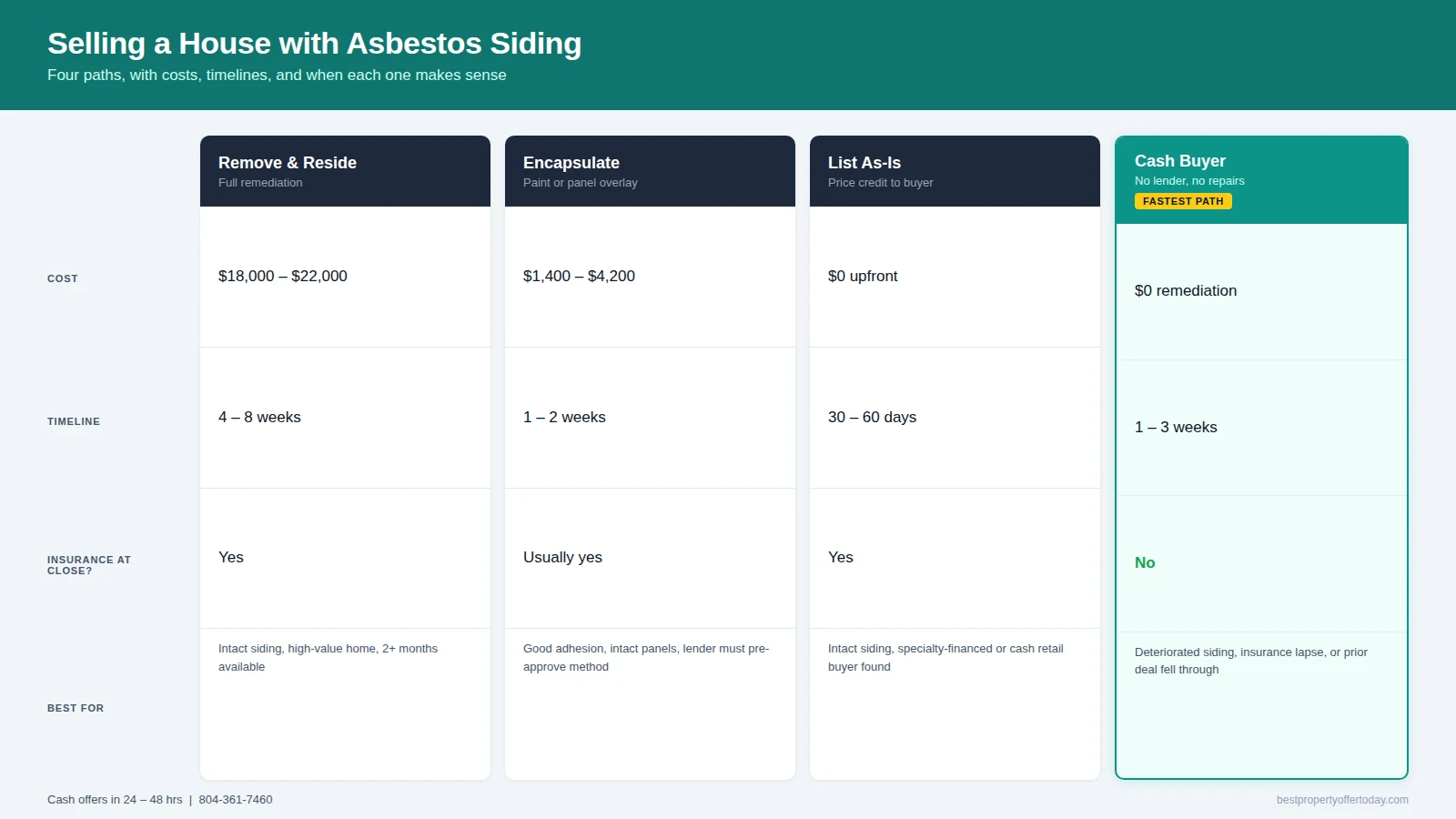
| Path | Typical cost | Timeline | Insurance required at close | Best for |
|---|---|---|---|---|
| Remove and reside | $18,000 to $22,000 | 4 to 8 weeks prep, then normal listing timeline | Yes | Intact siding, high-value home, 2+ months available |
| Encapsulate with paint or panel overlay | $1,400 to $4,200 | 1 to 2 weeks prep | Usually yes | Good adhesion, intact panels, lender must approve method |
| List as-is with price credit | $0 upfront | 30 to 60 days | Yes | Intact siding, buyer has specialty financing or cash |
| Sell to a cash buyer | $0 remediation | 1 to 3 weeks (limited by title work) | No | Deteriorated siding, insurance lapse, or prior deal fell through |
A Worked Example
Take a two-story colonial built in 1952, with approximately 1,400 square feet of asbestos cement siding exposure. Market value in current condition is $265,000. After-repair value with new vinyl siding installed is $290,000.
Remove and reside. Removal at a midpoint of $5.50 per square foot costs $7,700. New vinyl siding installation adds $11,000 to $14,000. Total out of pocket: roughly $18,700 to $21,700. After six to eight weeks of work plus thirty days on market, a retail sale might reach $283,000 to $288,000. After a 5 percent commission, the net is approximately $269,000 to $273,000.
List as-is with a price credit. Price at $250,000 to $255,000 to reflect the known condition and attract buyers who can get specialty insurance or are paying cash. After a 5 percent commission, the net is approximately $237,000 to $242,000.
Sell to a cash buyer via a marketplace. A vetted cash buyer network prices on the after-repair value, applying typical investor margins. At 75 percent of ARV, that is $217,500. No commission, no repair obligation, no insurance requirement at closing, and the timeline is one to three weeks limited by title work. The gap between that number and the remediate-and-list net is roughly $50,000 to $55,000. That gap is the cost of speed and certainty, not waste.
The right path is not the same for every seller. If the siding is intact, the house is high-value, and you have three months, remediation or a properly disclosed retail listing typically produces a higher net. If the siding is deteriorating, insurance has lapsed, or a previous deal fell apart at inspection, the cash path is often the rational exit. The net proceeds calculator lets you run both scenarios with your actual numbers before committing. If the exterior issue is EIFS synthetic stucco rather than asbestos siding, the financing barriers are similar but the costs and mechanisms differ: selling a house with stucco problems covers that comparison in detail.
When a Cash Buyer Is the Stronger Path
Four conditions make cash buyers the most practical option for asbestos siding situations:
- The siding is actively deteriorating, with chipping, broken shingles, or visible crumbling
- The homeowner’s insurance has been canceled or not renewed because of the siding material
- A prior deal fell through after inspection or appraisal flagged the asbestos condition
- Other deferred maintenance compounds the siding issue
A marketplace of competing cash buyers matters here because different buyers price asbestos siding differently. Some specialize in environmental remediation and factor it into their offer model as a standard line item. Others price defensively because they treat it as an unknown. Submitting one request to a vetted marketplace produces a spread of offers, and the seller can compare those numbers side by side before deciding. That comparison is not possible when you approach a single buyer directly.
For context on evaluating whether a cash buyer is legitimate before you sign anything, see: are cash home buyers legitimate.
Red Flags to Watch for from Buyers
Not every buyer who approaches a property with asbestos siding is working in good faith. Some use the material as leverage to renegotiate after a contract is signed.
- Earnest money below 1 percent of the offer price means walking away costs them nothing
- An inspection window longer than seven days on what was presented as an as-is cash deal
- An assignment clause, which lets the buyer transfer the contract to a third party you did not evaluate
- A price reduction request after inspection citing the asbestos on a deal that disclosed the asbestos before the offer was made
If you see two or more of these in the same offer, treat it as a placeholder rather than a genuine commitment. Read our full guide on what sellers should ask for before signing.
The Honest Limits of a Cash Sale
A cash offer on a house with asbestos siding will be lower than a fully marketed retail price. The buyer is absorbing the remediation risk, insurance complexity, and carrying costs during their hold. What you receive in exchange is certainty, no repair obligation, and a close date that does not depend on a lender’s schedule or an insurer’s underwriting decision.
If the siding is in good condition, the house is insurable, and you are not under time pressure, a traditional listing with proper disclosure usually nets more. That is worth saying plainly, because it is true. The right answer depends on your actual numbers and timeline.
If a cash sale fits your situation, submitting one request to a vetted marketplace at bestpropertyoffertoday.com produces competing offers within 24 to 48 hours, with no obligation to accept any of them. Call 804-361-7460 to talk through the situation first.
Does asbestos siding need to be removed before selling?
No, not unless the siding is deteriorated to the point where a lender’s appraiser flags it as a health or safety condition. Intact, non-friable asbestos siding can legally remain in place under both federal and most state law. Some buyers and lenders will require removal as a condition of purchase. Cash buyers typically will not, because there is no lender involved and no appraisal requirement to satisfy.
Can you get a mortgage on a house with asbestos siding?
Conventional loans can usually proceed if the siding is intact and the appraiser does not flag it as deteriorated. FHA, VA, and USDA loans apply stricter Minimum Property Requirements, and deteriorated asbestos siding must be addressed before loan funding on those programs. Specialty lenders with experience in older homes sometimes have more flexible internal guidelines than standard retail lenders. It is worth asking specifically about their asbestos siding policy before listing, not after you have an offer that falls through.
How much does asbestos siding reduce a home’s value?
A value reduction of 5 to 15 percent is commonly cited for intact siding in disclosed transactions. Deteriorated siding with active chipping or broken panels produces larger reductions, particularly when a financing contingency is involved, because the eligible buyer pool narrows sharply. Much of the impact is perception: buyers who are not deterred by the disclosure often know they have leverage, and they use it during negotiation.
Can I sell a house with asbestos siding as-is?
Yes. As-is sales are legal in all states. You disclose what you know, price to reflect the condition, and let buyers decide. The practical limitation is that buyers using standard financing represent a smaller pool than the full retail market when asbestos siding is disclosed, which constrains your offers. A vetted marketplace that reaches multiple competing buyers simultaneously gives you real data on what the siding costs you in a cash sale, without committing to any single buyer first.