Selling a House with a Pool: What Lenders and Buyers Actually Require
A pool either attracts buyers or complicates the sale, depending almost entirely on its condition and how the buyer plans to finance the purchase. If the pool has safety issues, structural damage, or non-working equipment, lenders on FHA, VA, and USDA loans may require repairs before they will fund the deal. Cash buyers carry none of those requirements, which changes the calculation for sellers whose pool needs work.
Does a Pool Help or Hurt When Selling?
The answer is location-specific, and most sellers already know which side of the line they are on.
In warm-climate markets, an in-ground pool in good condition typically adds real value. Real estate appraisers in Florida, Arizona, and Texas generally credit a functional pool at $10,000 to $40,000 in added value, depending on size, condition, and the neighborhood. In those markets, a pool is an expected amenity at a certain price point, and its absence can be the problem.
In northern climates, the math reverses. Buyers in colder states look at a pool and see a closing-season liability, a seasonal maintenance cost, and a safety exposure for their family. Comparable sales in many northern markets show pools returning close to zero, and in some price ranges they narrow the buyer pool by excluding anyone who does not want the upkeep.
Condition overrides geography in either case. A structurally sound, fully operational pool in a neutral market will sell. A cracked, equipment-dead pool in a market where pools add $30,000 will not, unless the buyer brings cash.
What FHA, VA, and USDA Appraisers Actually Check
Government-backed loan programs have the strictest appraisal standards, and pool condition falls squarely within them. The appraiser is not just estimating value; they are also confirming that the property is safe and habitable as a condition of the loan. A pool triggers that review.
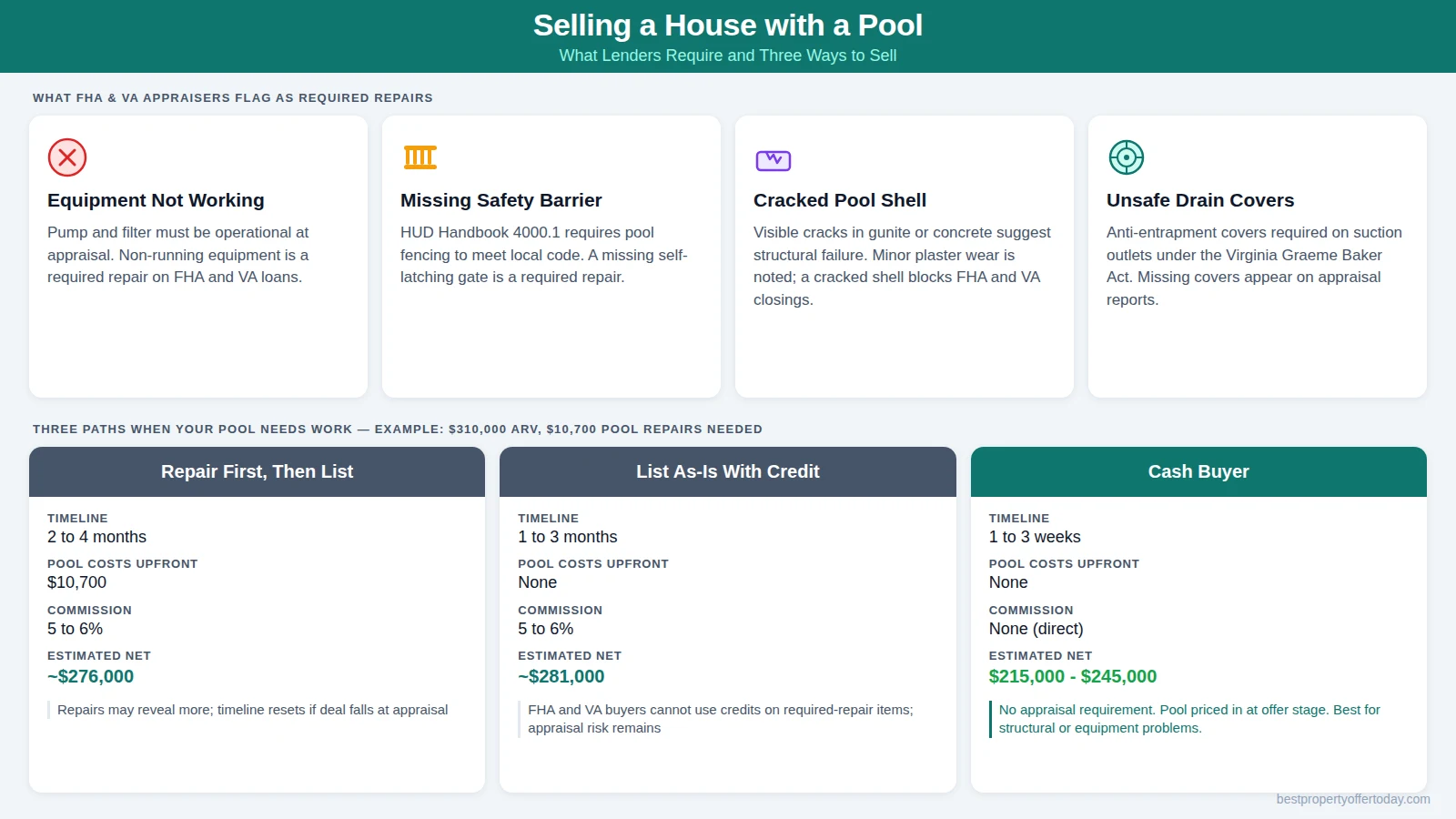
Here is what an FHA or VA appraiser will flag as a required repair:
- Non-operational equipment – if the pump and filter are not running at time of appraisal, or are clearly broken, the appraiser may cite it as a condition; the pool does not need to be pristine, but the equipment must function
- Structural damage – visible cracks in a gunite or concrete shell, significant settling, or evidence of leaks that suggest structural compromise; minor plaster wear typically does not trigger this, but a cracked shell does
- Missing or non-compliant safety barriers – HUD Handbook 4000.1 requires pools to comply with local ordinances on fencing and barriers; if local code requires a self-latching fence and one is absent, the appraiser notes it as a required repair
- Anti-entrapment hazards – broken or missing drain covers are a safety concern under the Virginia Graeme Baker Pool and Spa Safety Act; a missing cover on a main drain suction outlet will appear on the report
If the appraiser marks any of these as required repairs, the buyer cannot close until they are resolved. The seller either fixes them before closing, funds an escrow account for the repairs, or the deal falls apart. On VA loans, the appraiser’s list is non-negotiable: the lender cannot waive it. Pool barrier requirements often overlap with local code violations that also block financed sales.
Conventional Loans Offer More Flexibility, With Limits
Conventional lenders following Fannie Mae and Freddie Mac guidelines do not have a separate pool-condition checklist the way FHA and VA do. The appraiser still values the pool and notes condition, but the bar for triggering a required repair is higher: the issue generally needs to affect the habitability or safety of the main dwelling rather than the pool alone.
That said, two things can still derail a conventional sale over pool condition. First, individual lenders add their own overlays, and some flag damaged or non-operational pools as a liability. Second, homeowner’s insurance increasingly scrutinizes pool safety features. A buyer shopping for coverage on a pool property without a compliant barrier may face higher premiums or, in some states, declined coverage. A careful buyer’s agent will raise this before closing.
Three Paths When the Pool Needs Work
Here is how a realistic property runs through each option. The house has an after-repair value of roughly $310,000. The pool needs resurfacing ($6,500), a pump and filter replacement ($1,400), and a compliant fence installation ($2,800). Total pool work: $10,700.
| Path | Costs | Estimated net | Main risk |
|---|---|---|---|
| Repair pool, then list | $10,700 repairs + 5 to 6% commission + 3 months carrying costs (~$4,200) | ~$276,000 | Repairs may reveal more problems; timeline extends 2 to 4 months |
| List as-is with a price credit | 5 to 6% commission on a reduced ask price | ~$281,000 if the credit is structured correctly | FHA and VA buyers cannot use a seller credit on a required-repair item post-closing; deal can still fall at appraisal |
| Sell to a cash buyer | No repairs; no commission on a direct sale | $215,000 to $245,000 depending on buyer and local market | Offer is below retail; the tradeoff is speed and certainty, not price |
The credit path has a mechanics problem sellers often miss. An FHA buyer cannot take a seller credit and hire a pool contractor after closing, because FHA requires required-repair items to be completed before or at closing. A credit works on a conventional deal where pool issues are not lender-flagged, but it is a gamble when your listing attracts a government-loan buyer.
Comparing the numbers side by side before deciding is worth doing. The net proceeds calculator on this site lets you run the repair path and the cash path against each other with your own numbers.
How Cash Buyers Price a Pool That Needs Work
A cash buyer, whether a local investor or a national iBuyer, is not bound by an appraisal contingency or lender requirements. They walk through, assess the pool work needed, and fold that cost into the offer calculation.
Most local investors use a version of the 70 percent rule as a starting framework: they aim to pay no more than 70 percent of the after-repair value minus estimated repair costs. On a $310,000 ARV property with $10,700 in pool work, that starting point lands between $206,000 and $210,000, before the buyer adjusts for anything else they found in the walkthrough.
The more relevant comparison for a seller is not the gross number but the net after all costs. A traditional sale on a pool house requiring $10,700 in repairs, running for three months, and paying 6 percent commission will net in the $270,000 to $280,000 range if everything goes well. If the deal falls once at appraisal, the timeline and carrying cost reset entirely. A cash buyer at $230,000 to $240,000 becomes a real conversation when a financed sale on that property is high-risk.
Getting multiple competing offers rather than accepting the first one is especially important on a pool property. Offer spreads of $20,000 to $40,000 on the same house are common because different investors price pool repair costs differently.
Red Flags to Watch for From Buyers
Not every buyer claiming to pay cash on a pool property is positioned to close cleanly. A few patterns worth knowing:
- Long inspection periods on an as-is contract – a serious cash buyer with pool experience does not need 21 days to decide; a long inspection window often signals a wholesaler who needs time to find a buyer for the contract before committing
- Assignment clause language – if the purchase contract allows the buyer to assign their interest to another party, a different buyer will ultimately close on your home, possibly someone who has not walked the property
- Post-inspection price cuts on disclosed items – if you disclosed the pool condition in writing and the buyer uses it as grounds for a reduction after inspection, they are renegotiating on something they already knew about
- Token earnest money – serious cash buyers typically deposit 1 to 3 percent; a $500 deposit means walking away costs them almost nothing
For a broader guide to telling a legitimate cash buyer from a wholesaler or an opportunist, that post covers proof of funds, contract terms, and the questions worth asking before you sign.
Should You Fill In the Pool?
In northern markets where a pool adds no appraised value and costs $1,500 to $3,000 a year to maintain and open, filling it before listing is sometimes the right call. Removing and filling an in-ground pool runs $5,000 to $15,000, depending on size, depth, and material, and whether the local jurisdiction requires a permit for the fill, which most do.
Two things to confirm before you fill it. First, whether a permit is required in your municipality: an unpermitted fill creates a disclosure problem and can complicate the title later. Second, the fill will show on a survey or aerial, and future owners will be limited in what they can build over it. That is a material fact that belongs on the seller’s disclosure statement.
In warm-climate markets where pools add value, filling is expensive and counterproductive. Addressing the safety barriers and replacing the pump is usually $3,000 to $5,000 and keeps the asset intact for the buyer who wants it.
The Honest Tradeoff on a Cash Sale
A cash offer on a property with pool problems is almost always below what you would net after a successful traditional listing on a pool in full working order. What you are buying with that difference is certainty. The deal does not fall apart at the FHA appraisal because the pump failed. You do not spend three months and $11,000 making a pool you do not use attractive to buyers who may still walk.
If the pool is functional, the house is in otherwise good condition, and you have time to run a proper listed sale, a traditional listing will almost certainly net more. That is true, and pretending otherwise serves no one. The cash path makes sense when pool condition has already killed one deal, when you lack the capital for the repairs, or when the combination of pool issues and other property conditions makes a lender-financed sale genuinely high-risk.
You can request competing offers from multiple vetted cash buyers through the form on this site. Offers typically come back within 24 to 48 hours, with no obligation to accept any of them. Call 804-361-7460 with questions.
Does a pool increase or decrease the value of a house?
It depends on the market. In Florida, Arizona, and Texas, an in-ground pool in good condition is typically credited at $10,000 to $40,000 in appraised value, depending on size and neighborhood. In northern states, pools often add little to no value and can narrow the buyer pool significantly. Condition matters more than presence: a non-functioning or structurally damaged pool complicates a financed sale in any market.
Can you sell a house with a pool that does not work?
Yes, but the buyer’s financing type determines whether it is straightforward. A cash buyer or a conventional buyer whose lender does not flag the pool can proceed as-is. An FHA or VA buyer almost certainly cannot close until equipment is functioning and safety barriers are in place, because those loan programs require it as a condition of loan approval.
What happens if a pool fails the home inspection?
An inspection report alone does not stop a sale. The contract language determines what happens next: the buyer can request repairs, a price reduction, or they can walk if they have an inspection contingency. If the appraiser then cites the same issues as required repairs on an FHA or VA loan, the seller must fix them or lose the deal, regardless of what the contract says about as-is condition.
Do I need a pool inspection before listing my house?
Not required, but often worth the $150 to $250. A pre-listing pool inspection tells you what a buyer’s inspector will flag, which lets you fix small issues cheaply before they become deal-breakers. It also gives you accurate disclosure language. Sellers who have a recent inspection report and disclose the findings in writing are in a stronger position than sellers who say the pool looks fine.