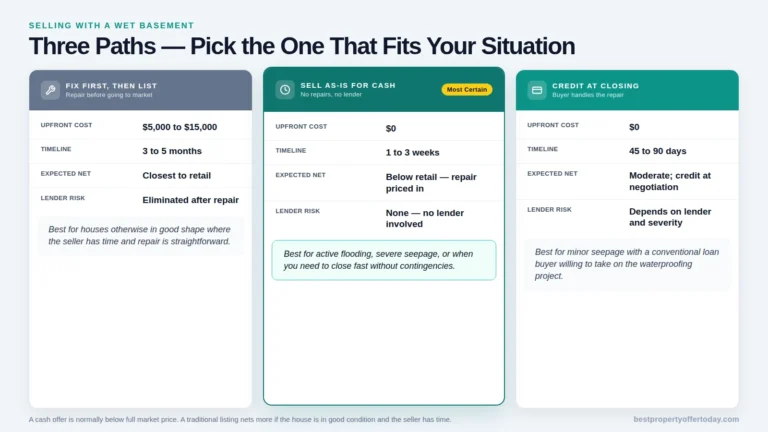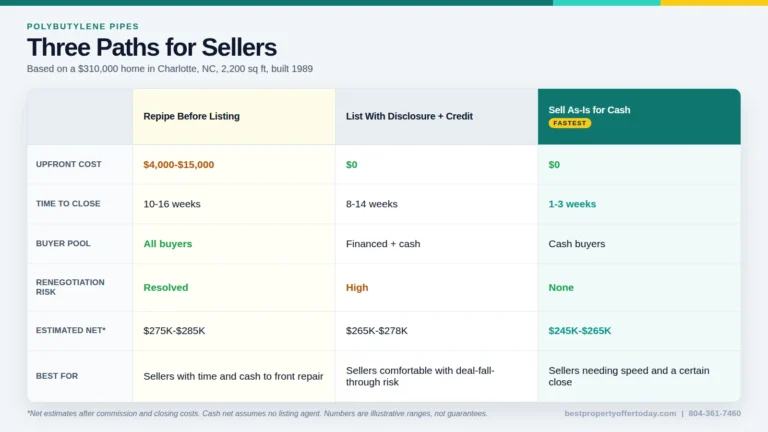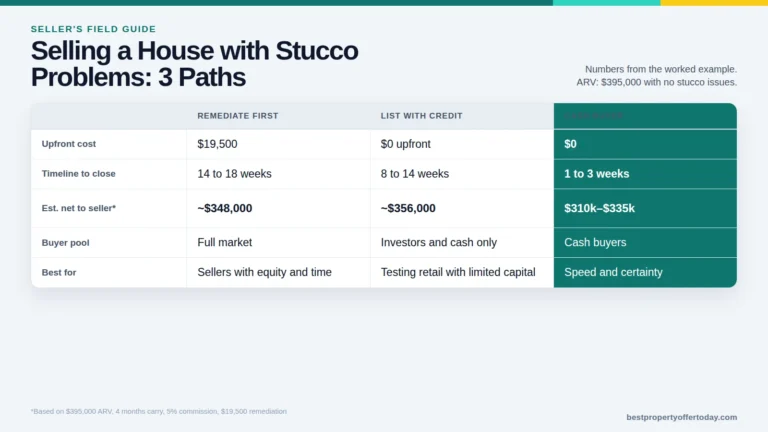
You can sell a house with crawl space problems. The three realistic paths are: fix the issues before listing, sell on the open market with a price reduction or repair credit, or sell as-is to a cash buyer who handles the remediation themselves. Which one makes sense depends on what the problems actually are, how much remediation costs, and how much time you have.
What Counts as a Crawl Space Problem
The range is wide. Some issues are cosmetic; others block financing or require a licensed contractor before any buyer can close.
- Standing water or chronic moisture. The most common issue. Can originate from a high water table, grading that directs runoff toward the foundation, or inadequate ventilation.
- Mold on joists, insulation, or subfloor sheathing. Surface mold may respond to treatment. Black mold on structural wood triggers automatic conditions on FHA and VA appraisals.
- Rotted floor joists or subfloor. Wood in sustained contact with moisture eventually fails structurally. Sistering damaged joists runs $100 to $300 per joist. Full subfloor replacement can reach $5,000 to $15,000 or more depending on scope.
- Failed or missing vapor barrier. A vapor barrier sits on the ground to block moisture migration upward. When it is absent, torn, or covered in debris, the crawl space reads as a chronic moisture environment even without standing water.
- Pest intrusion. Open vents, missing access covers, and gaps at the foundation provide entry for rodents, termites, and carpenter ants. Active infestation is a mandatory disclosure item and often a lender repair condition.
- Encapsulation failure. If the previous owner encapsulated the crawl space and the system is now failing, a dead dehumidifier or torn liner can trap moisture rather than control it, creating a worse situation than no encapsulation at all.
Why Crawl Space Problems Complicate a Financed Sale
FHA, VA, and USDA loans require an appraisal that meets minimum property condition standards. A crawl space with active moisture, standing water, structural damage, or mold will almost always trigger a condition requiring repair before the loan can close.
Conventional loans give appraisers more discretion, but visible structural damage or active mold still draws conditions or underwriter questions in most cases.
The practical effect: if you list without addressing the crawl space, you will likely lose financed buyers at inspection or appraisal, not at offer. That timing is worse. The buyer has spent money on an inspection, you have lost two to four weeks, and you are re-listing with a disclosed condition and a deal on record that fell through.
Cash buyers skip the lender layer entirely. No appraisal, no minimum property standards, no repair conditions before closing. That is the core reason sellers with significant crawl space problems often pursue cash offers even when the cash price is lower than what a repaired house would bring on the open market.
Three Paths for Selling with Crawl Space Problems
Path 1: Remediate before listing
Fix the problems, document the work with permits and contractor invoices, then list the house. This path nets the most money if the remediation cost is proportionate to the value it unlocks and you have the time and cash to front it.
The risk: contractors frequently find more once they are inside the crawl space. A $6,000 encapsulation estimate can grow when they discover rotted joists behind the moisture damage. Get two or three quotes and ask each contractor to itemize exactly what they plan to do and what falls outside their scope before you commit.
Path 2: List as-is with full disclosure and adjust price
Disclose the known problems, get a licensed contractor estimate, and price to reflect the buyer’s remediation cost. You can also offer a repair credit at closing rather than a price reduction. Credits work best with conventional financing. FHA and VA loans often cannot close on a property with active crawl space issues regardless of the credit offered, because the appraisal condition must be resolved first, not credited around.
Path 3: Sell as-is to a cash buyer
A cash buyer offers knowing the crawl space condition and prices the remediation into their number. The offer will be lower than market value, but there are no repair conditions, no appraisal delays, and no risk of a financed deal collapsing at the last moment.
This path makes the most sense when the remediation cost is uncertain or likely to grow, you cannot front the repair cash, the timeline is urgent, or the problems are severe enough that most financed buyers cannot close at all.
What Crawl Space Remediation Actually Costs
These are national cost ranges from licensed contractors. Actual quotes depend on crawl space square footage, how accessible it is, and what the inspection reveals.
| Problem | Typical repair cost |
|---|---|
| Full encapsulation (liner, drainage board, sealed vents) | $5,000 to $15,000 |
| Dehumidifier installation | $1,000 to $2,500 |
| Mold remediation (surface treatment on joists) | $500 to $6,000 |
| Sistering rotted floor joists | $100 to $300 per joist |
| Sump pump installation | $1,500 to $3,000 |
| Re-grading to direct water away from foundation | $500 to $3,000 |
| Pest treatment (active infestation) | $200 to $1,500 |
A crawl space with moderate moisture and a failed vapor barrier typically runs $6,000 to $10,000 to remediate properly. One with mold, rotted joists, and standing water can run $15,000 to $25,000 once contractors uncover secondary damage behind the primary problem.
A Worked Example
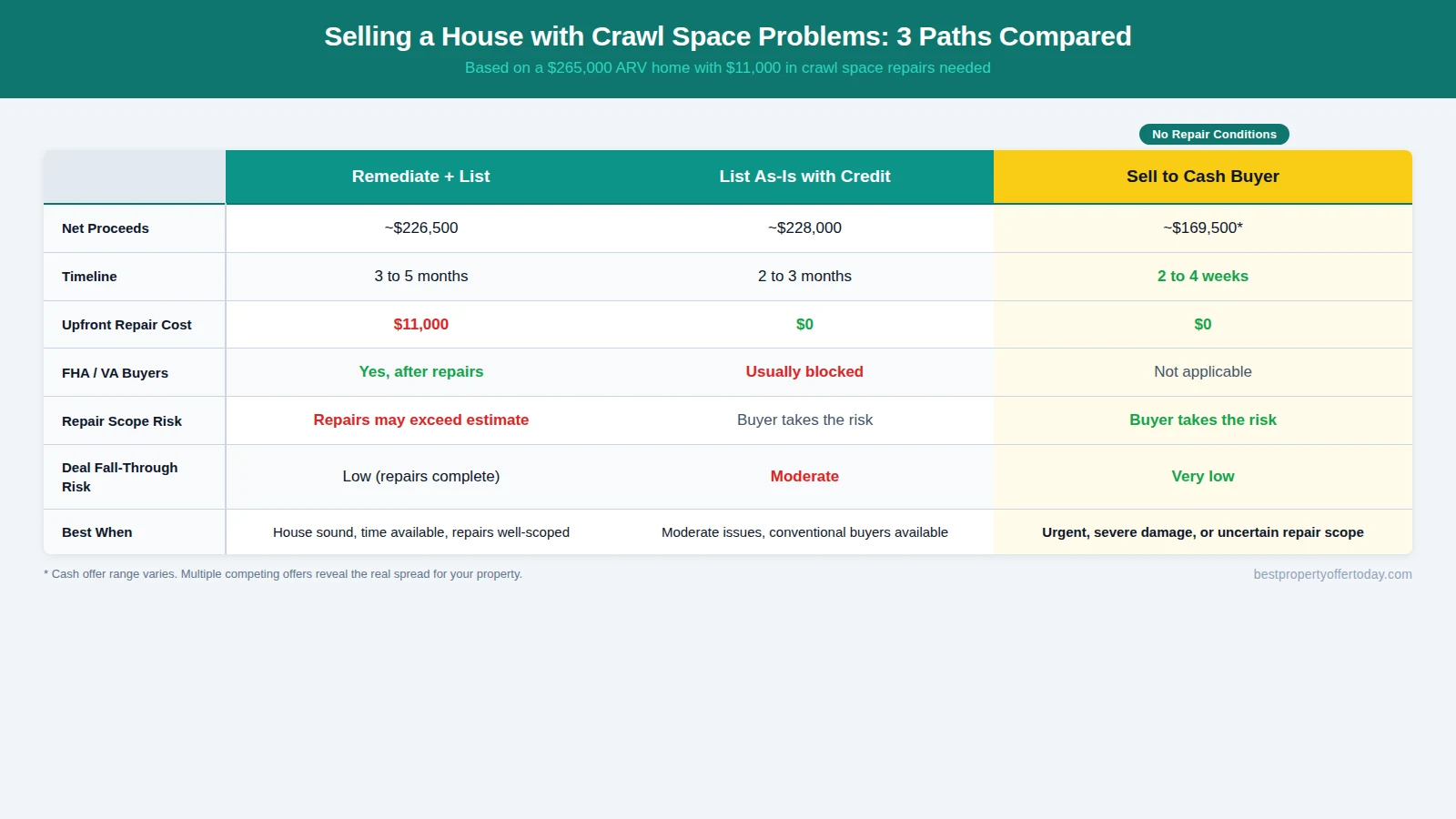
Suppose the house would be worth $265,000 in fully repaired condition. The crawl space has moisture damage, a failed vapor barrier, and several joists that need sistering. Three contractor quotes come back at $9,500, $11,000, and $13,500. You take the middle estimate: $11,000.
Path 1 (remediate, then list): You spend $11,000 on repairs. The house lists at $265,000 and accepts an offer at $258,000. Commission runs 5 to 6 percent ($13,000 to $15,600). Closing costs add roughly $2,000. Holding costs run about $1,500 per month while the work is done and the house is on market. If work takes six weeks and the listing runs another 45 days, you carry the house for roughly three months. Total deductions: repairs $11,000, commission $14,000, closing $2,000, holding $4,500. Net proceeds: roughly $226,500.
Path 2 (list as-is, offer $11,000 credit): The effective buyer cost becomes $254,000. You still pay commission on the gross sale price in most contracts, and you still carry the property until closing. FHA and VA buyers may not be able to use the credit because their appraisal condition must be resolved, not credited. Net proceeds land in a similar range to Path 1, but you avoid fronting the $11,000 in repair cash.
Path 3 (sell as-is to a cash buyer): Many cash buyers start from the 70 percent rule: 70 percent of after-repair value minus repair costs. On a $265,000 ARV with $11,000 in known repairs plus a $5,000 contingency buffer for unknowns, the target is roughly $265,000 x 0.70 minus $16,000, which comes to about $169,500. Actual offers vary. Institutional buyers add a service fee on top. Local investors may bid more or less depending on their cost of capital and local demand. Competing offers from multiple buyers will show you the real spread.
The difference between Path 1 and Path 3 is roughly $57,000 in this example. What a cash sale buys is speed, certainty, and not having to front $11,000 in repair costs before you know whether the final number will stay at $11,000. Whether that trade makes sense depends on your situation and your read on the scope risk.
How to Tell a Serious Cash Buyer from a Wholesaler
Not everyone who calls themselves a cash buyer has money to close. Wholesalers make offers and assign the contract to a third-party investor for a fee. Your sale then depends on someone else finding a buyer, and it can collapse days before the scheduled closing.
Red flags worth watching for:
- Earnest money under $1,000 on a six-figure transaction. A buyer who plans to close will typically put down $2,500 to $5,000 minimum.
- The buyer line on the contract reads “and/or assigns” or contains an assignment clause.
- A 30-day or longer inspection period on an as-is cash deal. A legitimate buyer does due diligence in days.
- Reluctance to show proof of funds in their own name.
- The offer drops after the “inspection” even though you accepted as-is.
For a full breakdown of what assignment clauses and other wholesaler signals look like in practice, the wholesaler explainer covers the mechanics in detail. And if you want a broader checklist for evaluating any cash buyer, this vetting guide walks through the specific documents and questions that separate real buyers from ones who will waste your time.
Disclosure: What You Must Tell Buyers
Selling as-is does not remove your disclosure obligations. In nearly every state, a seller must disclose known material defects. Crawl space moisture, mold, structural damage, and pest intrusion are all material defects. Failing to disclose them exposes you to post-closing liability even if the contract says “as-is.”
The as-is clause limits the buyer’s right to demand repairs. It does not limit your duty to answer the property disclosure form honestly. If you know about standing water, mold, or rotted joists, those go on the form.
The Honest Limit of a Cash Sale
A cash offer on a house with crawl space problems will almost always come in below what the house would sell for after remediation on the open market. The buyer is pricing in the repair cost, a contingency for what else they find once work starts, and a return on their capital.
If the crawl space problems are minor, the house is otherwise in good condition, and you have the time and money to remediate first, a traditional listing after repairs will almost always net more money. The net proceeds calculator can help you run both scenarios with your actual numbers.
A cash sale makes the most sense when the condition is severe, the repair scope is hard to pin down, the timeline is urgent, or the house has other problems that would complicate a financed sale regardless.
Frequently Asked Questions
Is it hard to sell a house with a bad crawl space?
It depends on severity. A failed vapor barrier and minor moisture is a price negotiation, not a deal-breaker. A crawl space with structural damage, active mold, and standing water will fail most FHA, VA, and USDA appraisals, removing the majority of financed buyers from your pool. In that scenario, cash buyers and investors who can handle the remediation themselves become your realistic market.
Do I have to fix the crawl space before selling?
No, unless local code enforcement has issued a repair order. You can sell in current condition with full disclosure. You must disclose known defects on the state property disclosure form regardless of whether you fix them. Selling as-is to a cash buyer is legal and common for properties with crawl space issues.
How much does crawl space encapsulation cost?
A full encapsulation with a reinforced vapor barrier, drainage board, and dehumidifier typically runs $7,000 to $18,000 depending on crawl space size and access. A basic vapor barrier only runs $1,500 to $4,000. Get three quotes and ask each contractor to specify exactly what they plan to install. “Encapsulation” can mean different things to different contractors, and the difference in scope is often the difference between a fix that lasts and one that fails in two years.
Will a cash buyer inspect the crawl space?
Most will. A legitimate cash buyer does a walkthrough and often brings a contractor to assess scope. What they will not do is require you to fix anything as a condition of closing. Their due diligence is for their own pricing, not for a lender’s minimum property standards. Expect the process to take days rather than weeks from a buyer who has done this before. Submit your property at the top of this page or call 804-361-7460 to receive competing offers from vetted buyers without having to find them yourself.