Selling a house with water damage is possible, but your three realistic paths have very different costs, timelines, and risks. The right one depends on the severity of the damage, whether a financed buyer can actually close on the property, and how much capital you can put in before a sale.
This guide covers how lenders respond to water damage, what disclosure law requires of you, and what each path nets on a real example so you can compare them before deciding.
Water Damage Categories That Change Which Buyers Can Close
Not all water damage is equal, and the category matters because it determines which buyer types can close at all.
Surface damage is stained drywall, discolored flooring, or water marks on ceilings. Remediation typically runs $1,000 to $5,000. A financed buyer can usually close on a property with cosmetic damage if it has been dried out and there is no active moisture or mold present.
Moderate damage involves wet insulation, damaged subfloor, rotted sheathing, or early mold growth. Costs run $5,000 to $20,000. FHA, VA, and USDA appraisers are required to flag visible mold and rotted framing as Minimum Property Requirement failures. That result blocks the loan at the appraisal stage, before the buyer can receive a mortgage commitment.
Severe damage is structural: saturated framing, compromised load-bearing members, foundation wall infiltration, or widespread mold that has spread behind walls. Costs can run $20,000 to $80,000 or higher. No government-backed lender will close on a property in this condition, and many conventional lenders will not either, depending on how the appraiser characterizes it.
What Disclosure Law Requires of You
Almost every state requires sellers to disclose known material defects, and water damage qualifies. The disclosure obligation does not disappear when damage has been repaired. If you fixed a burst pipe and replaced the subfloor three years ago, you are still required to disclose that it happened in most states.
The specific form varies by state. Virginia uses a Property Disclosure Statement (Form K440). Florida’s seller disclosure covers flooding, leaks, and moisture. California requires the Transfer Disclosure Statement, which asks directly about water intrusion, flooding, and drainage problems.
Selling as-is does not eliminate disclosure duties. As-is means you will not make repairs. It does not mean you can withhold material information. A buyer who discovers undisclosed water damage after closing has grounds for a civil claim regardless of any as-is clause in the contract.
The practical benefit of full disclosure: a seller who discloses accurately, documents any remediation, and prices to reflect the condition is in a much better legal position than one who hopes the buyer does not notice. Remediation paperwork, particularly a clearance test from a certified inspector, also reduces buyer uncertainty and can support a higher offer.
Why Water Damage Blocks Financed Sales
FHA, VA, and USDA loans require appraisers to flag active water intrusion, visible mold, rotted structural members, and drainage problems that direct water toward the foundation. Any of those findings can condition the loan on repairs before closing.
That puts the seller in a difficult position: make the repairs yourself, give the buyer a credit (which the lender then controls and caps), or watch the deal fall apart. Conventional lenders have more discretion, but most appraisers will still flag material moisture problems, and lenders can make the loan conditional on remediation.
Cash buyers skip the appraisal and lender layer entirely. There are no Minimum Property Requirements. They price the condition into their offer and close on the property as it sits. That is why the cash path becomes relevant the moment moderate or severe damage is present, even when it does not produce the highest number.
Three Paths for Sellers With Water Damage
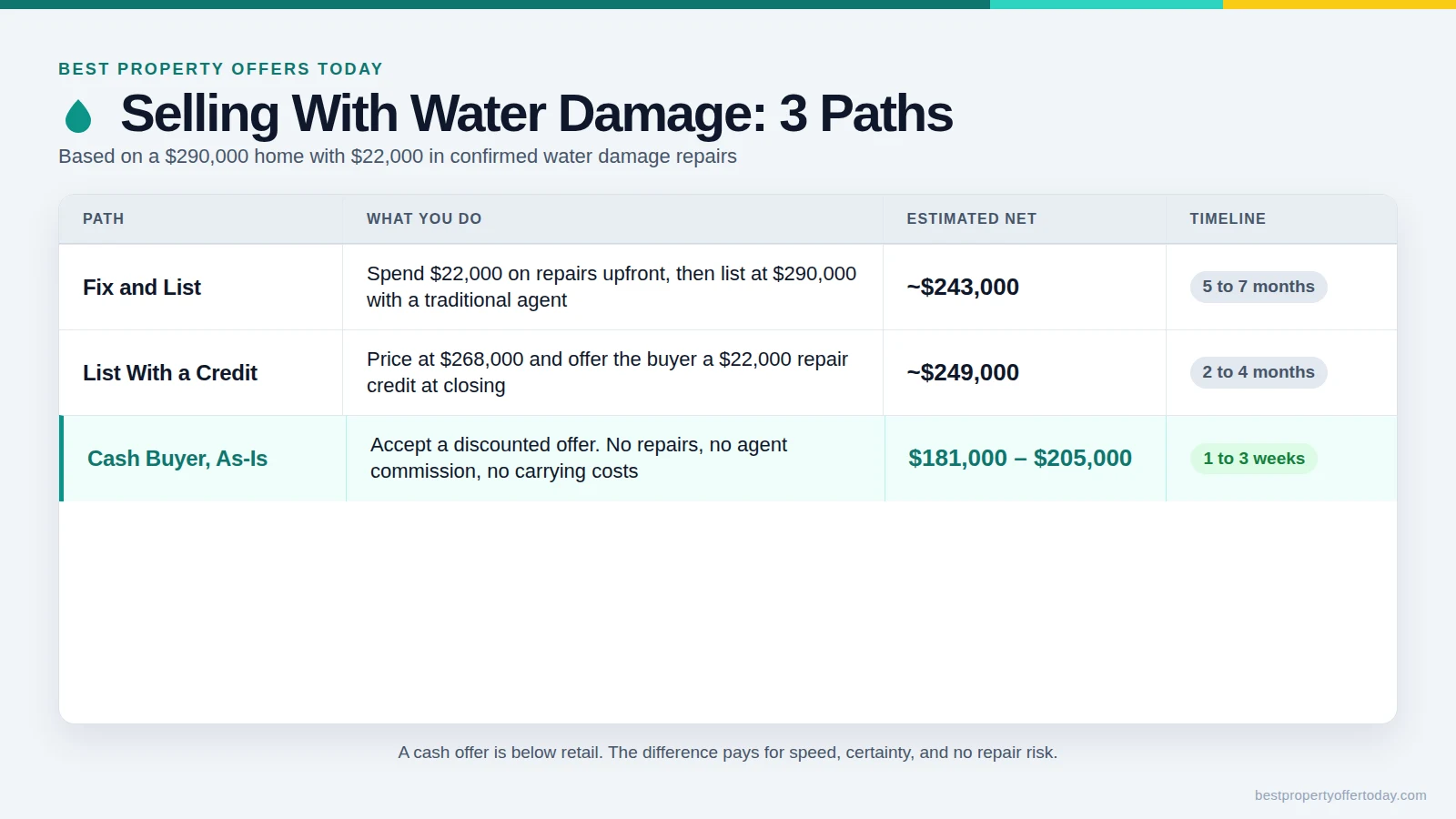
The comparison below uses a $290,000 ARV property with a confirmed $22,000 water damage repair estimate.
| Path | What you do | Estimated net | Timeline | Main risk |
|---|---|---|---|---|
| Fix and list | Spend $22,000 on repairs, list at market | ~$243,000 | 5 to 7 months | Repair scope expands once walls are open |
| List with a repair credit | Price at $268,000, offer credit to buyer | ~$249,000 | 2 to 4 months | Lenders cap credits; many financed buyers cannot close |
| Cash buyer, as-is | Accept discounted offer, no repairs | $181,000 to $205,000 | 1 to 3 weeks | Offer is below retail; spread between buyers can exceed $40,000 |
Use the net proceeds calculator to run your specific numbers before committing to a path.
The Worked Example: What Each Path Actually Nets
Take a house with a $290,000 retail value and confirmed water damage to the subfloor, insulation, and lower drywall in a finished basement. A licensed contractor estimates $22,000 to remediate and restore.
Fix and list. You spend $22,000 upfront, repairs take six weeks, and you list at $290,000. After a 5.5 percent agent commission ($15,950), seller closing costs ($3,000), and four months of carrying costs at roughly $1,400 per month ($5,600), your net is about $243,450. If the buyer’s inspector finds additional damage during due diligence and renegotiates, that number drops further.
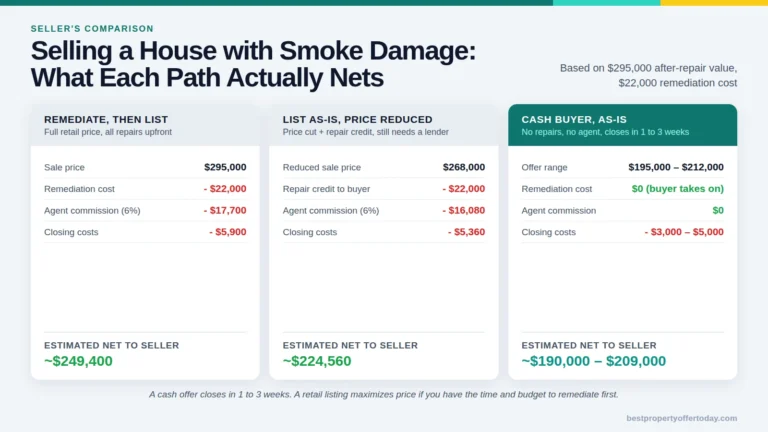
List with a credit. You price at $268,000 and offer a $22,000 repair credit. FHA limits seller credits to 6 percent of purchase price, which is $16,080 on this property. A conventional buyer with less than 25 percent down is capped at 2 to 3 percent. Only a buyer with a large down payment or a cash buyer can absorb the full $22,000 credit, and a cash buyer will generally prefer to negotiate a lower price rather than a credit. If you find a buyer who accepts the full credit, you net around $249,000 before adjustments.
Cash buyer, as-is. Most individual investors apply a version of the 70 percent rule: ARV multiplied by 0.70, minus repair costs. On this property, that is $290,000 times 0.70 minus $22,000, which puts the ceiling at about $181,000. A marketplace that routes the property to multiple buyers can surface competing offers, with a realistic range of $181,000 to $205,000 depending on which buyers are active in your market. You pay no agent commission, no carrying costs, and typically minimal closing costs. Your net is roughly the offer price.
The difference between the fix-and-list path and the cash path is $38,000 to $62,000. That gap is what you pay for speed, certainty, and the elimination of repair risk. If the $22,000 estimate expands to $38,000 once the walls are open, the advantage of Path A shrinks significantly.
What Cash Buyers Actually Look At With Water Damage
Cash buyers do not price all water damage the same. The variables that move an offer are scope (how many rooms and systems are affected), whether mold is present, whether structural members are compromised, and most importantly, whether the moisture source has been corrected.
An active leak that has not been fixed is a different risk profile from a past event that was fully dried and documented. Buyers who see active moisture or unresolved drainage price in the uncertainty of how far the damage has actually spread, because once a contractor opens the walls, the scope can change materially. That uncertainty often reduces an offer by more than the visible repair cost alone would justify.
Documentation consistently moves offers upward. A remediation report, a passing clearance test, and photographs of the affected area before and after drying all reduce a buyer’s perceived risk and support a higher number. If you had the damage professionally remediated, bring that paperwork to the first conversation.
Red Flags to Watch For After You Accept an Offer
A renegotiation request after inspection is normal when the inspection finds something genuinely new. A price cut request on damage you already disclosed, in detail, before the offer was made is a different pattern.
Watch for these:
- A full-price or near-market offer on an as-is listing, with a long inspection window, followed by a large reduction on the last day of the inspection period
- Assignment language in the contract (the buyer retains the right to transfer the contract to another party, which is the signature of a wholesaler, not a direct buyer)
- Earnest money below $1,000 on a six-figure transaction (making it essentially free to walk away; see what earnest money should look like in a cash sale)
- No proof of funds provided, or a document that does not match the offer amount
A legitimate cash buyer provides proof of funds without being asked, does not need assignment rights, and puts up earnest money proportional to the deal. Call 804-361-7460 to compare offers from vetted buyers who clear these standards.
Who Should Not Take a Cash Offer on Water Damage
A cash offer on a water-damaged house will be below what you would net after full repairs and a retail listing. That is not a flaw in the system. It reflects the buyer’s cost, timeline, and risk. Before accepting any cash offer, consider whether you are actually in a position to take the repair path.
If your water damage is surface-level only, you have the capital to fund repairs upfront, you can carry the property for five to seven months, and your market has enough active buyers to absorb a recently remediated home, the retail path will likely net you more money.
The cash path makes clear financial sense when repairs are substantial and your estimate is uncertain, when lender conditions have made financed buyers scarce for your specific property, when carrying costs and the timeline of a repair project are more than you can absorb, or when you need the equity out on a defined schedule. That is an honest set of conditions, not a universal recommendation.
Do you have to disclose water damage that has already been repaired?
Yes, in most states. Material defect disclosure requirements apply to the property’s history, not only its current condition. A past water event that was fully remediated is still a known material defect in most jurisdictions. Remediation documentation is actually an asset here: it proves the event was addressed professionally and reduces a buyer’s concern about what may still be lurking.
Can a financed buyer close on a house with active water damage?
Not through FHA, VA, or USDA. Those programs require appraisers to flag active water intrusion and visible mold as property condition failures that must be corrected before the loan closes. Conventional loans have more flexibility, but most appraisers will flag material moisture or mold on a conventional appraisal as well. A buyer with a large down payment and a lender who allows escrow holdbacks for repairs may be able to proceed, but that combination is uncommon. Most sellers with active damage find that financed buyers cannot get to closing.
Does homeowners insurance cover water damage when you are selling?
It depends on the source. Sudden and accidental damage from a burst pipe is typically covered. Gradual damage from a slow leak that was not reported, or a drainage problem that developed over months, is typically excluded as a maintenance issue. Flood damage from rising water requires a separate NFIP or private flood policy. If an insurance claim is open at the time of sale, the proceeds may be assignable to the buyer or may need to be disclosed as part of the transaction. Consult your insurer and an attorney before listing if there is an open claim.
What does water damage repair actually cost?
Surface remediation (drying, drywall replacement, flooring in one or two rooms) typically runs $1,000 to $8,000. Moderate damage involving subfloor replacement, insulation removal, and mold treatment runs $8,000 to $25,000. Severe structural damage, foundation waterproofing, or whole-floor remediation can exceed $50,000. These are national ranges. Costs vary by region and, critically, by how quickly the damage was discovered. Water that sat for more than 72 hours without treatment produces mold, which adds a separate remediation line to any repair estimate.