A flat roof on a house for sale narrows the buyer pool, creates lender friction, and often triggers an insurance problem that buyers discover at the last minute. None of that means the house cannot sell. It means you need to understand what each type of buyer will do with the roof before you price it.
Why flat roofs create friction for financed buyers
The problem is not the roof itself. It is the intersection of three systems that all flag flat roofs differently: lenders, insurers, and appraisers.
FHA and VA loans. HUD Handbook 4000.1 requires a roof to have at least two years of remaining useful life at the time of an FHA-insured loan closing. For VA loans, the appraiser applies a similar “adequacy of remaining life” standard. A flat roof that is aging, ponding, or visibly near the end of its service life will not pass that condition without either replacement or an engineer’s certification of remaining life. That certification is not free, and there is no guarantee the appraiser will accept it.
The result: FHA and VA buyers, who represent a significant share of the first-time buyer market, are effectively excluded until the roof is repaired or replaced.
Conventional loans. Fannie Mae and Freddie Mac guidelines require appraisers to note any condition affecting the safety, soundness, or structural integrity of the property. A flat roof with visible ponding, damaged membrane, or surface blistering will likely receive a condition flag. The lender can then require that deficiency to be corrected before closing, even on a conventional loan, leaving the seller in the same position either way.
Homeowners insurance. Insurers treat flat roofs as higher risk because water pools instead of draining. A pitched roof sheds water. A flat roof holds it, which increases the chance of membrane failure, seam separation, and interior moisture damage over time. Some carriers will insure a flat roof with a surcharge. Others will decline coverage entirely if the roof exceeds a certain age or material threshold. A buyer who discovers at the insurance step that their intended carrier will not cover the home will either renegotiate the price or walk away.
The flat roof materials that show up at closing
Not all flat roofs age the same way. The material affects how an appraiser and a cash buyer both estimate remaining life and repair cost.
EPDM (ethylene propylene diene monomer) rubber membrane. The most common residential flat roofing material. Typical service life is 20 to 25 years when properly installed and maintained. Inspectors look for surface bubbling, seam separation, and patching history as signs of age.
TPO (thermoplastic polyolefin). Common on newer installations and commercial-to-residential conversions. Service life of 15 to 20 years. White or light grey in color. Seams are heat-welded, which is more reliable than EPDM seam tape, but installation quality varies widely.
Modified bitumen. A rolled asphalt product, often installed in two layers (base sheet and cap sheet). Typical life of 15 to 20 years. More prone to cracking in cold climates. Inspectors look for alligatoring and granule loss on the cap sheet surface.
Built-up roofing (BUR, or tar and gravel). Multiple layers of bitumen and reinforcing fabric, topped with gravel ballast. Can last 15 to 30 years. The gravel makes visual inspection harder. FHA appraisers will note displaced ballast or exposed membrane.
Age alone is not the test. A 15-year-old EPDM roof that has been re-seamed, kept clean of debris, and has no interior water history is a different situation than a 12-year-old modified bitumen roof that has been patched three times and has a soft spot at the drain. The condition record matters as much as the installation date.
What flat roof replacement actually costs
Flat roof replacement runs roughly $5 to $10 per square foot installed, depending on material and region. TPO on a straightforward single-story section in a warm climate costs less than a full tear-off and EPDM re-roof on a mid-century modern with restricted roof access in a northern city.
For a house with a flat section covering 900 square feet:
- EPDM replacement: $4,500 to $7,200
- TPO replacement: $4,500 to $8,100
- Modified bitumen: $3,600 to $6,300
Full-flat-roof homes (some mid-century designs have no pitched sections at all) can run $15,000 to $30,000 for a complete re-roof. That is a different calculation than a ranch home or cape cod with a flat addition or sunroom, where only a portion of the overall roof is flat.
Three paths and what each nets: a worked example
Most sellers with a flat roof have three realistic options. The right one depends on how much time you have, whether the roof is still structurally sound, and whether the house has other deferred maintenance layering on top of the roof issue.
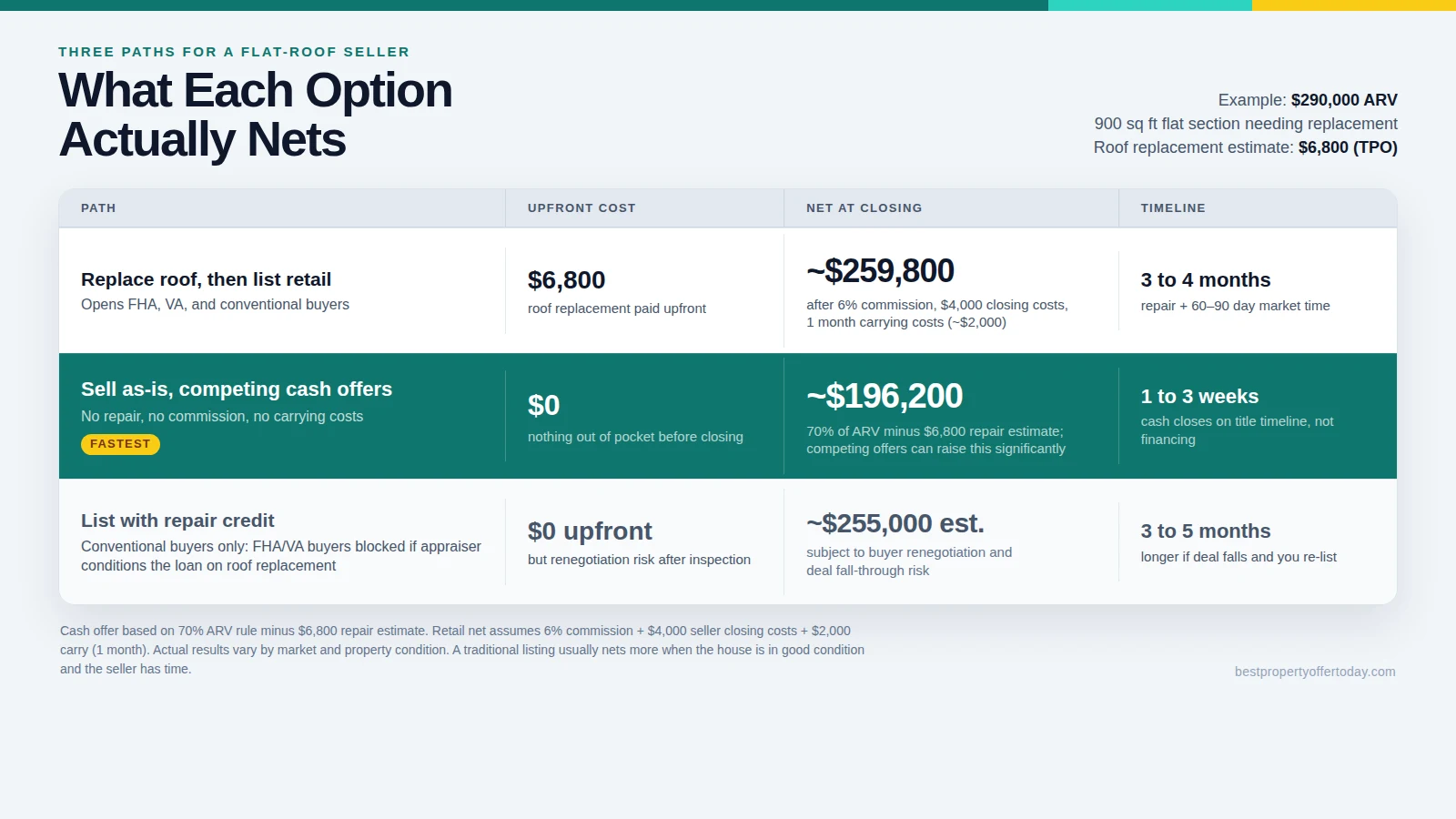
For the example below: the house has an ARV (after-repair value, what it would sell for retail in good condition with a replaced flat roof) of $290,000. The flat section is 900 square feet of EPDM, 17 years old, with visible ponding at one drain and a patched seam near the parapet. Replacement estimate: $6,800 for a TPO re-roof with tear-off.
| Path | Upfront cost | Net at closing | Timeline |
|---|---|---|---|
| Replace the roof, list retail | $6,800 | ~$259,800 | 3 to 4 months |
| Sell as-is to competing cash buyers | $0 | ~$196,200 (base); higher with competing offers | 1 to 3 weeks |
| List with repair credit | $0 upfront, renegotiation risk at inspection | ~$255,000 estimated | 3 to 5 months (longer if deal falls) |
Path 1 (replace and list): Pay $6,800 for the roof. List at $290,000. Subtract 6% commission ($17,400), seller closing costs of roughly $4,000, and one month of carrying costs (mortgage, taxes, utilities) around $2,000. Net at closing: approximately $259,800. Timeline: 3 to 4 months from repair start to closing check.
Path 2 (sell as-is to cash buyers): A cash buyer applying the standard 70% ARV rule prices the property at 70% of $290,000 minus the repair estimate: roughly $196,200. No commission, no repair outlay, no carrying period. Close in 1 to 3 weeks after offer acceptance. The limitation is that a single buyer gives a single number. When competing cash offers come in through a marketplace, the spread between the lowest and highest legitimate offer on the same flat-roof property often exceeds $20,000 to $30,000.
Path 3 (repair credit): List at $290,000, offer a $7,000 repair credit. The problem: if an FHA or VA buyer’s appraiser conditions the loan on the roof being replaced before funding, the credit does not satisfy that condition. The lender requires the physical repair to happen before closing, not a dollar credit at the table. That leaves only conventional buyers as realistic candidates, and any conventional appraiser who also conditions on the roof puts you back to replacing it anyway. Realistic net after one deal falling and a second attempt: roughly $255,000 assuming two rounds of negotiation and extended carry time.
The gap between Path 1 and Path 2 in this example is about $63,600. That is the cost of speed and certainty, not a fee or a trick. If the house is in otherwise good condition and you have the time, Path 1 nets more. A traditional listing usually produces a higher sale price for a seller who can wait.
What a cash buyer actually looks at on a flat roof
Cash buyers skip the lender appraisal condition, but they do not skip the roof. They are pricing a repair into their offer, which means they need to estimate what the repair will cost them.
Experienced buyers will check: ceiling stains on the rooms directly below the flat section, soft spots or deflection when the roof is walked, debris at drains blocking water flow, seam condition at roof edges and penetrations (where HVAC curbs, vent pipes, and skylights meet the membrane), evidence of previous patching, and whether interior OSB or plywood decking shows rot from long-term moisture intrusion.
A buyer who finds a flat roof with ponding, interior staining, and soft decking will price a full replacement plus a contingency for unknown moisture damage. One who finds a recently re-roofed TPO section with clean drains and no interior history will make a much smaller deduction, or none at all if the replacement is recent and documented with invoices.
Red flags from buyers on a flat-roof property
- A buyer makes a near-full-price offer and then cuts it substantially after “getting a roofing quote” during inspection. The flat roof is visible before any offer. An honest buyer prices it in from the start.
- An assignment clause in the purchase contract. This is the signature of a wholesaler, not a funded buyer. The person you are contracting with plans to sell that contract to someone else before closing, and if they cannot find a buyer, the deal collapses.
- A token earnest money deposit, such as $500 on a $290,000 transaction. Walking away costs them nothing.
- A request for a 30 or 45-day inspection window on a cash deal. Cash buyers typically need 7 to 14 days for due diligence. A long inspection window on a “cash” deal usually means the buyer is still trying to find financing or an end buyer.
- Proof of funds that is a screenshot of a brokerage account with no bank header, no date, and a figure that conveniently matches the purchase price. Ask for a letter on bank letterhead, dated within the last 30 days, showing liquid funds.
Disclosure duty on a flat roof
Selling as-is to a cash buyer does not eliminate the disclosure obligation. Selling as-is limits the duty to repair, not the duty to disclose. If you know the flat section leaks in heavy rain, that the primary drain backs up seasonally, or that there is a soft spot in the roof decking, you are generally required to disclose those conditions. A cash buyer prices disclosed defects into their offer. The risk of non-disclosure is a post-closing lawsuit that costs far more than the repair would have.
What happens if the flat roof fails appraisal on an FHA or VA loan?
The appraiser notes the deficiency and the lender issues a condition requiring the repair before closing. The seller has three options at that point: complete the repair at their own expense before the loan funds, negotiate with the buyer to cancel the contract, or convert to a different buyer (cash or conventional without the same appraiser condition). FHA and VA lenders will not fund with an outstanding appraisal condition on a safety or soundness item. There is no dollar credit work-around at the FHA or VA closing table.
Can a flat roof with remaining useful life still pass FHA?
Yes. A flat roof that is not leaking, not ponding, and has documented remaining service life can pass an FHA appraisal without requiring replacement. A roof certification from a licensed roofing contractor, stating the estimated remaining useful life, costs $150 to $400. Some appraisers will accept that certification and clear the condition. Others will require physical replacement. Getting the certification before listing costs little and gives you information about how buyers and appraisers will see the roof before you are under contract and on a deadline.
Does a new flat roof solve the insurance problem?
A new flat roof helps but does not always resolve the insurance issue entirely. Some carriers will insure a new TPO or EPDM membrane at standard rates. Others maintain a flat-roof surcharge regardless of the membrane age, because the geometry of the roof (flat, not pitched) is what they are pricing, not just the condition of the surface. Buyers should shop insurance before making an offer on a flat-roof property so there are no surprises at the insurance step. That insurer hesitation is part of why a flat roof narrows the buyer pool even when the membrane itself is brand new.
Will cash buyers negotiate on a flat roof?
Yes. A single buyer gives you a single number. When you submit to a marketplace and receive competing offers from multiple vetted buyers, you see the full range of what that flat roof is being priced at in the current market. Some buyers carry their own roofing crews and price the repair at their actual cost, which is below retail. Others add a larger uncertainty premium. The gap between the lowest and highest offer on the same flat-roof property is often $20,000 to $40,000. The first number you receive is rarely the best number you can get.
The honest take on who should accept a cash offer on a flat roof
If the flat section is small, recently installed, and the rest of the house is in good condition, a retail listing with conventional buyers is worth attempting. The repair cost is manageable and the buyer pool, while reduced compared to a pitched-roof home, still exists.
If the flat roof is failing, the house has additional deferred maintenance, and you cannot afford the repair or the carrying time, a cash offer is not a fallback option. It is the right tool for the situation. The offer will come in below retail. That is the cost of speed and certainty, not a sign that the buyer is taking advantage of you.
A traditional listing usually nets more for a seller with time and a house in otherwise good condition. If that describes your situation, do not take a cash offer because a buyer approached you first. Compare all three paths, run the numbers on your specific roof size and condition, and if you go the cash route, get competing offers. The difference between one offer and four on the same flat-roof property can be $30,000.
To see what the net looks like across all three paths for your specific property, use the calculator at /sell-my-house-calculator or call 804-361-7460. You can also read how to evaluate whether the buyer making the offer is legitimate at /blog/are-cash-home-buyers-legitimate, and how those buyers calculate what they actually pay at /blog/how-cash-buyers-calculate-their-offer.