An open permit on your house does not automatically block a sale, but it will stop most lenders from closing on a loan, and that narrows your buyer pool significantly. The path forward depends on what the permit covers, whether the work was actually completed, and how much time you have before you need to close.
Selling a house with open permits? Compare cash offers from buyers who price it in.
Enter your property address to get competing offers from verified cash buyers. No repairs, no agent fees, and you pick the closing date.
Prefer to talk? Call (804) 361-7460
What an Open Permit Is (and How It Differs from Unpermitted Work)
A permit is a formal government record that certain work requiring approval, a deck addition, an electrical panel upgrade, a structural change, was started. When the work is done, the contractor or homeowner schedules a final inspection. If the inspector approves the work, the permit closes. If the inspection never happens, the permit stays open indefinitely in the building department records.
That is different from unpermitted work, where no permit was ever pulled. With unpermitted work, there is no paper trail. With an open permit, there is a paper trail: a permit application, the scope of work, and the original contractor information. That actually makes open permits easier to resolve in many cases, because you know exactly what was supposed to be inspected.
Open permits are surprisingly common. Panel upgrades, basement finishes, deck additions, and water heater replacements are all frequently permitted but rarely inspected at final. A contractor who gets paid and moves on to the next job has little incentive to schedule a final inspection unless the homeowner specifically tracks it. The work may have been done well. The permit just never closed.
Why Open Permits Stop Most Lenders
FHA, VA, and USDA loans require an appraiser to note any visible issues with the property, and they routinely flag open permits when they appear in a title or permit search. Conventional lenders underwriting to Fannie Mae or Freddie Mac guidelines have some discretion, but many underwriters will not fund a loan until the permit is resolved, or until the seller provides documentation showing the work was completed and passed inspection.
The lender concern is straightforward. If a permit was pulled for work that was never inspected, no one has confirmed the work was done correctly. If a future owner, or their insurer, discovers a problem with that work, the open permit is evidence that the work was never approved. That creates liability the lender does not want sitting behind its collateral.
A cash buyer has no lender. That one difference means the permit becomes a negotiating item rather than a deal-breaker. A cash buyer will want to know what the permit covers, whether the work appears to have been completed, and what it would cost to close the permit. They price that risk into their offer rather than walking away from the transaction.
Does an Open Permit Have to Be Disclosed?
In almost every state, yes. A seller who knows about an open permit is required to disclose it as a material fact, even in an as-is sale. The as-is designation limits your obligation to make repairs. It does not limit your obligation to tell buyers what you know about the property.
Failing to disclose a known open permit can result in post-closing claims from the buyer, including rescission in serious cases. Disclose it in writing, include the permit number if you have it, and keep a copy of the disclosure. If you did not know the permit existed and could not reasonably have known, your disclosure obligation is limited to what you actually know. But once a title or permit search reveals it during the transaction, you know.
Note that a standard title search does not always catch open permits. Permits are filed with the building or zoning department, not the county recorder. A standard title search looks at recorder records. Some attorneys and title companies order a separate municipal lien or permit search as standard practice. Others do not unless asked. In some markets, particularly in the Northeast and Florida, permit searches are routine at closing. In others, they are optional, and a buyer can close on a property without ever knowing about an open permit. That buyer then inherits the responsibility for it. See also title problems that commonly delay a cash closing for a broader look at what a title search does and does not catch.
If you want to know your own permit status before listing, you can usually search your local building department records by address through the municipality website, or call the building department directly. Most jurisdictions will tell you what permits are open on a property over the phone.
Three Paths for Selling with an Open Permit
Most sellers have three practical choices. The right one depends on the nature of the work covered by the permit, the cost to close it, and how quickly the seller needs to complete the transaction.
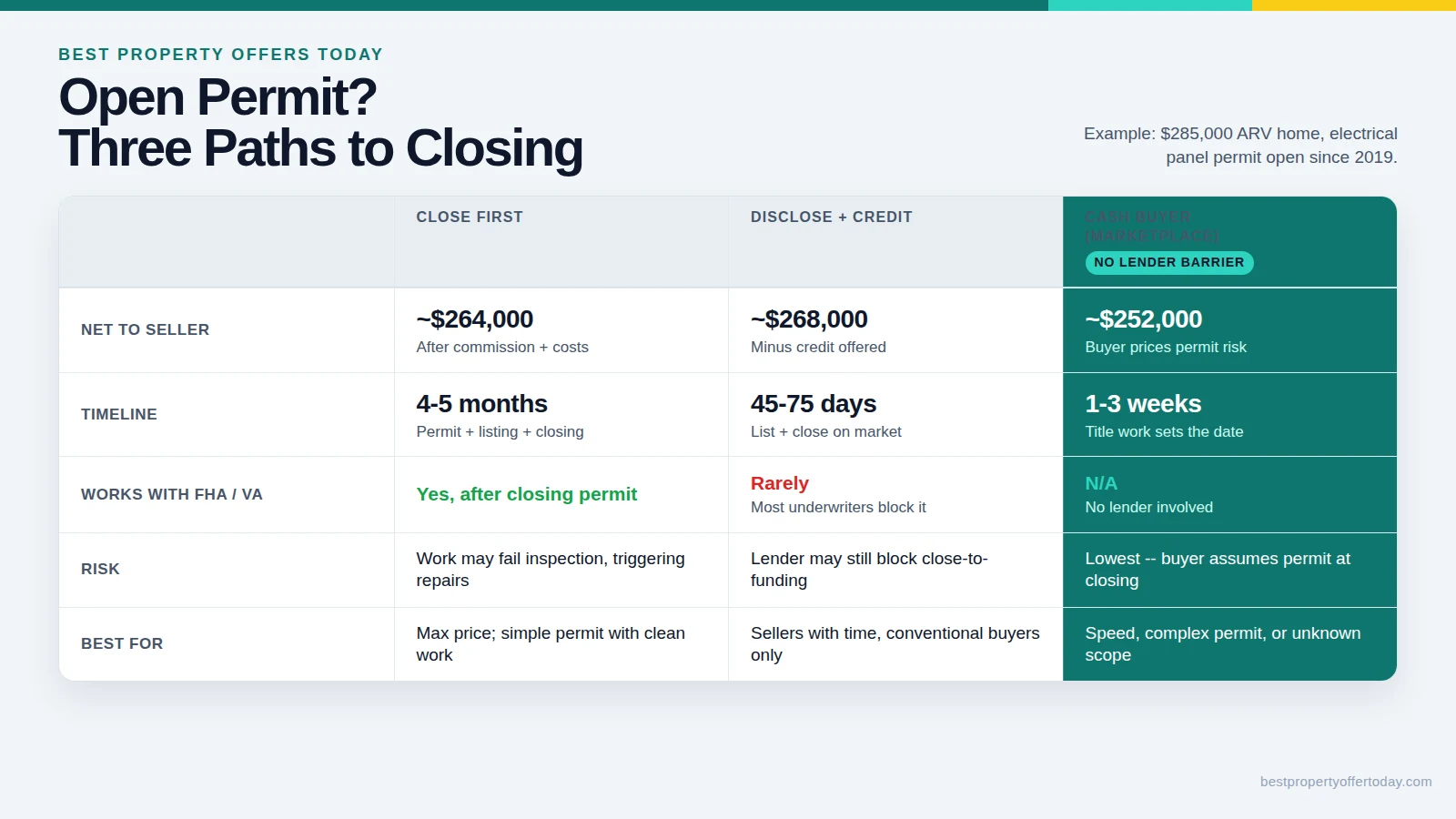
Close the permit before listing. Contact the building department with the permit number. In most jurisdictions, you can schedule a final inspection even on a permit that has been open for years. The building department does not usually care how long the permit has been open. They want the work inspected and on record. The inspector will assess whether the work as completed meets current code. If it does, the permit closes. If corrections are needed, you pay for them before the permit closes. For a simple water heater replacement or electrical panel upgrade, this is often straightforward and costs only the inspection fee plus minor corrections.
Disclose and offer a credit. You disclose the permit in your seller disclosure form and offer the buyer a credit toward closing the permit after closing. This works best with conventional buyers whose underwriter has flexibility, or with buyers paying cash. It generally does not work with FHA or VA buyers, whose underwriters may require the permit to be resolved before funding regardless of any credit the seller offers.
Sell to a cash buyer as-is. A marketplace can collect competing offers from vetted cash buyers who skip the lender layer entirely. They negotiate around the permit rather than being blocked by it. One request sent to multiple buyers creates competition on price even when the property has an issue that removes most financed buyers from consideration. You can review the competing offers side by side and choose the one that makes the most sense for your situation, with no obligation to accept any of them. Learn more about how to compare cash offers so the highest headline number is not the only thing you evaluate.
Worked Example: Electrical Panel Upgrade, Open Since 2019
A house with an ARV of $285,000. In 2019, the previous owner pulled a permit for a 200-amp panel upgrade. The contractor completed the work and was paid. The final inspection was never scheduled. The permit has been open for seven years.
Option A (Close First): The seller calls the building department, provides the permit number, and schedules a final inspection. The inspector finds the work is complete and correct except for two missing GFCI outlets in the kitchen. The seller pays an electrician $280 to install them and a $125 re-inspection fee. Total out-of-pocket: $405. The permit closes. The seller lists with an agent at 6% commission. After commission ($17,100) and roughly $2,500 in seller-paid closing costs, the net on a $285,000 sale is approximately $265,000. Total time from decision to proceeds: four to five months.
Option B (Disclose and Credit): The seller discloses the permit and offers a $1,500 credit. A conventional buyer submits an offer. The underwriter requires a certificate of completion from the building department before funding, which the open permit cannot provide. That deal falls through. A second conventional buyer makes an offer; his underwriter accepts a signed statement from a licensed electrician confirming the work is complete and code-compliant. The deal closes with the $1,500 credit deducted from proceeds. Net to seller after 6% commission and closing costs: approximately $264,000. Timeline: 45 to 60 days.
Option C (Cash Buyer Marketplace): The seller submits one request through a cash buyer marketplace. Three competing offers come back. The spread between the lowest and highest offer is $14,000, which is precisely why competition matters on a property with a complication. The highest offer is $267,000. The buyer is pricing in the cost to close the permit and a margin for unknown risk. No agent commission applies. Net to seller after minimal cash closing costs: approximately $265,000. Timeline: two weeks from accepted offer to closing.
Option A and Option C yield similar net proceeds in this example. Option A takes four to five months and carries the risk that the inspection uncovers a larger problem. Option C takes two weeks with no inspection surprise. Option B yields the least, and carries the highest risk of the deal falling through due to underwriter requirements.
What the Spread Between Cash Offers Tells You
In Option C above, the three offers varied by $14,000 on the same property. That spread reflects how each buyer is pricing the permit risk. Some have experience closing permits quickly and know the real cost. Others build in a larger contingency because the scope of the work is unclear to them. Getting competing offers forces that information to the surface, and you choose accordingly rather than accepting the first number presented.
For a permit covering simple mechanical or cosmetic work, the spread between offers should be narrow. For a permit covering structural work, an addition, or anything that required opening walls, expect a wider spread because buyers who cannot verify the scope will price more conservatively.
Red Flags to Watch for from Buyers
Not every buyer who overlooks an open permit is doing so reasonably. A few specific patterns are worth recognizing before you sign anything.
A buyer who does not ask about the open permit at all may be an investor planning to assign the contract before closing. Once the contract is assigned, the final buyer inherits the permit along with any liability attached to it. That is not your problem after closing, but it is worth knowing the type of buyer you are dealing with.
A buyer who raises the open permit late in the process, after the inspection contingency window has closed, is using it as a price renegotiation tool. The time to negotiate a permit credit is before the contract is signed, not in the week before the scheduled closing date.
A buyer who quotes a cost to close the permit that is significantly higher than your own research suggests is padding the number. Call the building department, get the scope from the original permit application, and contact a licensed contractor for an estimate before responding to any credit request. On a simple panel permit, the actual cost to close is rarely more than $500 to $1,000 unless the work was done incorrectly.
What Happens When the Original Contractor Is Gone
This is the most common complication with older open permits. The contractor who pulled the permit may have retired, gone out of business, or simply be unreachable after a decade or more.
Most building departments allow a homeowner to take over as permit holder and close it out. You contact the department, provide documentation that you are the current owner, and request a permit transfer. Then you schedule the final inspection yourself. In many jurisdictions, particularly for residential work, owner-builder provisions allow the homeowner to close the permit directly without a licensed contractor.
If the jurisdiction requires a licensed contractor to sign off and the original contractor is gone, you hire a new contractor to inspect the work, confirm it meets code, and in some cases pull a replacement permit. For work that was done correctly, this is an administrative cost, typically $300 to $800 for a contractor’s time and the new permit fee. For work that was done poorly or does not meet current code, you now have a repair obligation on top of the permit situation, and the cost range widens considerably.
If the permit involves structural work and the original contractor cannot be found, the building department may require a structural engineer to evaluate the completed work before the permit can close. That inspection runs $500 to $2,000 depending on scope, but it provides the seller with documented evidence that the work is structurally sound, which has real value when negotiating with cash buyers who are pricing in unknown risk.
The Honest Case for Considering a Cash Sale
A cash offer on a house with an open permit will often be lower than the net from a financed sale where the permit has been cleanly resolved. What you are trading for that difference is speed and certainty: the ability to close without resolving the permit first, without the risk of an inspection finding a larger problem, and without the risk of a financed buyer’s underwriter blocking the deal in the final week.
If you have time and the permit is simple, closing it before listing typically yields more money. That is the honest answer. If you do not have that time, if the permit covers work whose scope is unclear, or if you have already had one financed deal fall through because of the permit, getting competing cash offers through a marketplace keeps price competition alive when the financed buyer pool has largely left the table.
The free net proceeds calculator at sell-my-house-calculator can help you run the numbers on both paths before committing. Call 804-361-7460 with any questions about the process.
Does an open permit transfer to the buyer at closing?
Yes. After closing, the new owner becomes responsible for resolving any open permits on the property. The building department does not automatically track ownership changes. The permit remains open until someone schedules the final inspection. If you buy a house with an open permit and the final inspection reveals code violations, the correction cost comes out of your pocket as the new owner. Buyers who do not know to check for open permits inherit this responsibility without realizing it.
Will home insurance cover work done under an open permit?
It depends on the insurer and the specifics of the claim. Some insurers will cover a loss even if the work was done under a permit that was never finally inspected, on the grounds that the work was permitted and the lack of a final inspection is a procedural gap rather than evidence of defective construction. Others treat an uninspected permit as equivalent to unpermitted work and reduce or deny coverage for losses directly connected to that work. Read your policy language, or call your agent with a direct question before assuming coverage exists on any work that was permitted but never inspected.
Can you sell a house with open permits in Florida or California?
Yes, in both states. Neither Florida nor California prohibits the sale of a property with open permits. Florida requires disclosure of all known material facts affecting value, and an open permit qualifies as one. California has some of the most detailed seller disclosure requirements in the country, and those forms include questions about permit history. In both states, cash buyers can close regardless of permit status. The complication arises with financed buyers whose lenders require permit resolution before funding. In Florida particularly, title agents and closing attorneys commonly order a permit search as part of the closing process, so an undisclosed open permit is likely to surface even if the seller did not proactively disclose it.
How long does an open permit stay open?
Indefinitely, in most jurisdictions. Permits do not expire once they have been opened. They remain in the building department records until someone schedules the final inspection and the permit is formally closed, or until the jurisdiction officially voids the permit after a set period of inactivity. A few jurisdictions void inactive permits after a number of years, but this is not common. In most cases, a permit pulled in 2010 is still listed as open in 2026 unless the final inspection was completed. That is why a permit search sometimes surfaces work that is many years old and that the current seller has no knowledge of.
Ready to see real numbers for your house?
Enter your property address to get competing offers from verified cash buyers. No repairs, no agent fees, and you pick the closing date.
Prefer to talk? Call (804) 361-7460