Chinese drywall is not a cosmetic problem. If the house was built or renovated between 2001 and 2009 using imported Chinese gypsum board, the sulfur compounds it releases have likely corroded copper wiring, eaten through air-conditioning coils, and put the home outside the reach of every government-backed mortgage and most conventional lenders. Selling it means choosing a path: remediate before listing, negotiate a credit with a financed buyer who can obtain insurance, or sell as-is to a cash buyer who prices in the work.
This guide covers what each path actually costs, which sellers choose which, and the disclosure obligations most sellers do not know they have.
What Chinese Drywall Does to a Home
The drywall imported primarily from China during the post-hurricane building boom of 2001 to 2009 contains elevated concentrations of sulfur compounds. Two manufacturers produced most of the problem product: Knauf Plasterboard Tianjin and Taishan Gypsum, which marketed its product under the name TTP. At room temperature, the boards off-gas carbonyl sulfide, carbon disulfide, and trace hydrogen sulfide.
Those gases concentrate on metal surfaces, particularly copper and silver. In a house, that means:
- Copper electrical wiring corrodes, with visible black flaking at outlets and junction boxes
- Air-conditioning evaporator coils and refrigerant lines fail prematurely, often within two to four years of installation
- Copper plumbing develops pitting corrosion from the inside
- Smoke detector sensors and thermostats fail without an obvious cause
The CPSC, working with the EPA, CDC, and HUD, spent three years studying what could be done. Their conclusion, published in 2010, was that there is no effective method short of full removal. Encapsulating, sealing, or coating the boards does not stop the off-gassing. The only fix is tearing out all the affected drywall and replacing every copper system it damaged.
Why Lenders Will Not Finance It
HUD issued clear guidance: homes with confirmed Chinese drywall are ineligible for FHA insurance. That removes FHA loans, the most common entry-level mortgage. VA follows the same standard for loans it guarantees. USDA rural development loans are also excluded.
Conventional lenders are not legally required to follow, but most do. The practical reason is insurance: homeowners insurers began adding Chinese drywall exclusions after 2009, and a property that cannot be insured cannot be underwritten. A conventional lender who makes the loan takes on undisclosed risk if the drywall is later confirmed.
The result is that most financed buyers cannot purchase a home with confirmed Chinese drywall unless the seller either remediates first or provides a credit sufficient for the buyer to remediate before move-in. Neither is clean, because a lender typically requires the remediation to be complete and certified before funding.
What Full Remediation Actually Costs
The CPSC remediation protocol calls for removal of all Chinese drywall, followed by replacement of all copper wiring and electrical devices, all corroded copper plumbing, all HVAC components that contacted the off-gas, and then reinstallation of new drywall, insulation, and interior finishes. It is essentially a full gut renovation of the interior.
Costs vary by house size and how far the corrosion has progressed:
| House size | Low estimate | High estimate | What drives the high end |
|---|---|---|---|
| 1,200 sq ft | $72,000 | $150,000 | Multiple HVAC units, older wiring needing full replacement |
| 1,800 sq ft | $108,000 | $225,000 | Two-zone HVAC, extensive copper corrosion, custom finishes to match |
| 2,500 sq ft | $150,000 | $312,000 | Large footprint, high-end finishes, multiple AC systems |
These are installed costs for a licensed contractor following the CPSC protocol. DIY removal without replacing the affected systems does not clear the home for financing. Lenders require a certified inspector to confirm the protocol was completed before they fund.
One cost sellers often miss: the inspection itself. Before any buyer’s lender will move forward, the property typically needs a Chinese drywall inspection by a certified professional. Visual inspection runs $300 to $800. A full materials analysis with lab confirmation runs $1,500 to $3,000. Sellers who already know the drywall is present usually skip this. Sellers who suspect it but are not certain often need one to establish what they have.
Three Paths Sellers Actually Take
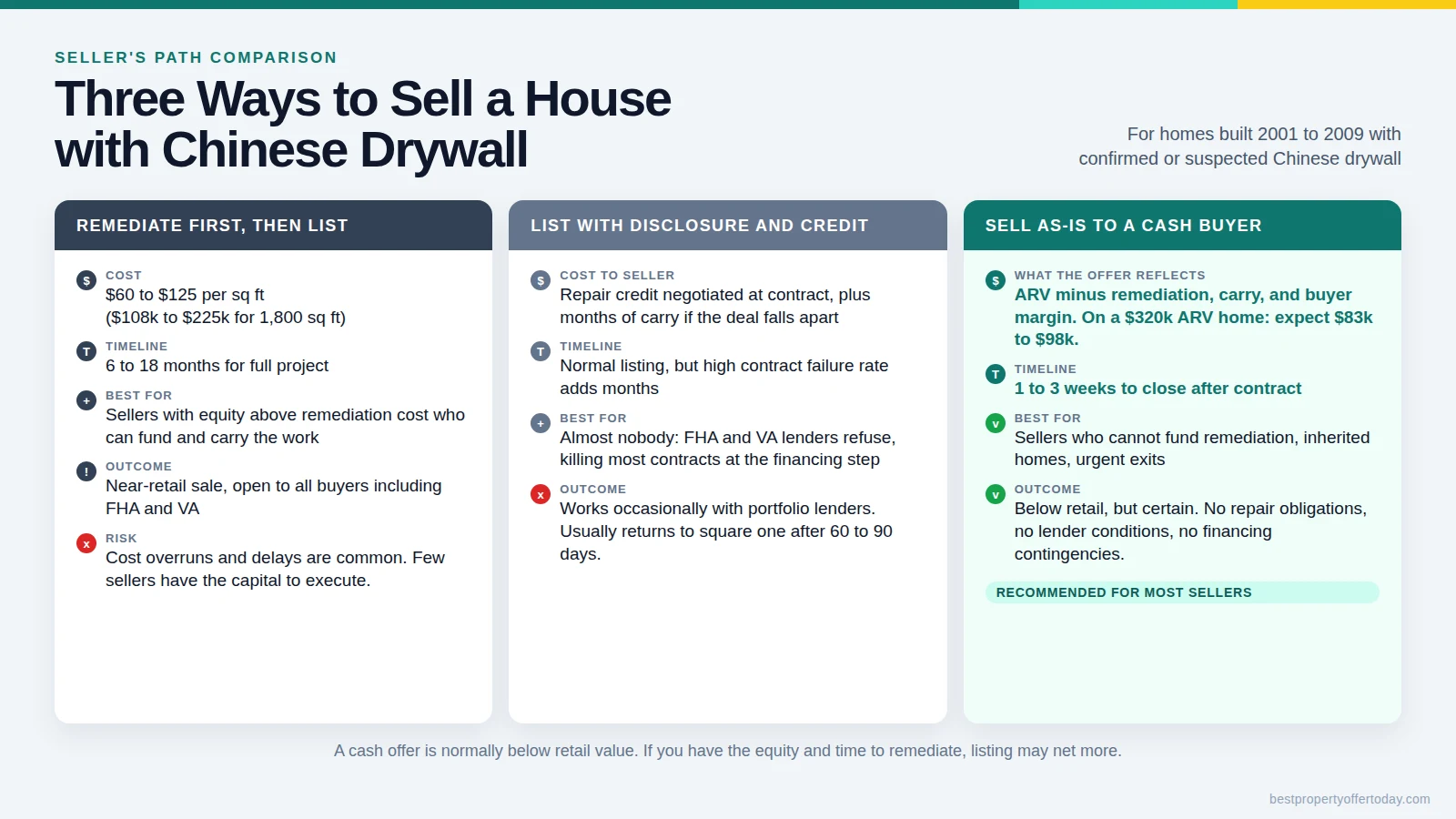
Given those numbers, here is how sellers typically approach the situation:
| Path | Who it works for | What it nets | Timeline |
|---|---|---|---|
| Remediate, then list | Sellers with equity above remediation cost who can fund the work and carry costs during the project | Near-retail value, but profit depends on whether remediation plus carrying costs stay below the value gain | 6 to 18 months |
| List with disclosure, credit to buyer | Sellers hoping to find a cash or portfolio buyer willing to handle remediation | Works occasionally; fails almost always when FHA or VA financing is involved because the lender refuses | Normal listing timeline, but high contract failure rate |
| Sell as-is to a cash buyer | Sellers who need to exit quickly, who are underwater on remediation relative to value, or who inherited the property | Below retail, but closes in 1 to 3 weeks with no repair obligations and no lender conditions | 1 to 3 weeks after contract |
What a Cash Buyer Actually Pays: A Worked Example
Here is how a cash investor approaches a 1,800 sq ft house in a Florida market where comparable move-in-ready homes sell for $320,000.
The investor starts with after-repair value, then works backward through their costs:
- ARV after full remediation and cosmetic updates: $320,000
- Full remediation cost for 1,800 sq ft: $130,000 to $165,000
- Carrying costs during the project, about 6 months of taxes, insurance, and financing: $12,000
- Closing costs on their eventual resale, at 3 percent: $9,600
- Required profit margin to take on a project of this complexity: $45,000 to $55,000
Working backward: $320,000 minus $165,000 minus $12,000 minus $9,600 minus $50,000 leaves a maximum purchase price of roughly $83,000 to $98,000.
A seller who paid $280,000 for this house faces a large headline loss. But the alternative is carrying a home that cannot be sold to a financed buyer, that insurance underwriters are excluding, and that is actively deteriorating as the copper corrodes further. Every year of delay raises the eventual remediation bill.
When sellers compare cash offers side by side rather than accepting the first one, the spread between the lowest and highest offer on the same Chinese drywall home can exceed $30,000. Cash buyers discount risk differently. Submitting to a marketplace that collects competing offers from multiple vetted buyers is the only way to see where the market actually sits on a specific property. Call us at 804-361-7460 if you want to know what the network is paying for Chinese drywall homes in your area.
Disclosure: What You Are Required to Say
Florida has more Chinese drywall cases than any other state, and its disclosure rules are the clearest. Florida law requires sellers to disclose all known material defects that would affect the property’s value or a buyer’s decision to purchase. Chinese drywall qualifies as a material defect under that standard. Sellers who know and do not disclose face fraud claims that survive the closing.
Most other states follow the same principle through their general seller disclosure statutes. If you have actual knowledge that the home contains Chinese drywall, you disclose it in writing before closing. That duty is not limited to items on a standard form. If the form does not ask about it and you know about it, it goes in the other known defects section or a written addendum.
Two things sellers often get wrong. First, selling as-is does not eliminate the disclosure duty. An as-is clause limits the obligation to repair, not the obligation to tell. Second, a cash buyer who purchases as-is may still have a misrepresentation claim if the seller concealed a known condition that the buyer could not have discovered through normal due diligence. See our guide to vetting cash home buyers for what due diligence actually covers from both sides of the table.
Red Flags to Watch for During the Contract Period
Not every investor who makes a cash offer on a Chinese drywall home is straightforward about the process. These are the behaviors worth watching:
- An offer that drops significantly after the inspection period ends, citing remediation cost estimates the buyer already had when they submitted the bid
- An assignment clause in the purchase agreement. This is how wholesalers work: they will not be the one closing, and the eventual buyer may have no experience with Chinese drywall remediation. Learn more about how assignment clauses work and why they matter before signing anything with one
- An unusually long inspection window, more than 15 days, on a house disclosed as-is with known Chinese drywall. A real investor with relevant experience can move faster
- Proof of funds that is vague, undated, or consists only of a bank account screenshot rather than a signed letter on bank letterhead
- Earnest money below one percent of the purchase price. On a house offered at $90,000, that is $900. Walking away from $900 is cheap. Low earnest money is how buyers preserve optionality at the seller’s expense
If any of these appear, ask for a corrected contract or take the next offer in the queue.
The Honest Limits of a Cash Sale
A cash offer on a Chinese drywall home will come in below what the house would sell for after full remediation. That is a mathematical certainty, not a negotiating position. The buyer prices in the remediation cost, the carrying period, and their required return. What the seller gets in exchange is speed, certainty, and no repair obligation.
If a seller has sufficient equity, cash reserves, and enough time to fund and manage a full remediation project, the traditional route usually nets more money. The decision is not about which path is inherently better. It is about which path the seller can actually execute given their financial position and timeline.
Our net proceeds calculator lets you run both scenarios with your own numbers. If the gap between remediate-and-list versus sell-as-is is modest after carrying costs, many sellers find the certainty of the cash path worth the difference. If the gap is $100,000 or more, the remediation path usually wins, but only for sellers who can see it through.
Can you sell a house with Chinese drywall without disclosing it?
No, not legally. Known Chinese drywall is a material defect and must be disclosed in writing before closing. Failing to disclose does not make the sale final. A buyer who discovers undisclosed Chinese drywall after closing can pursue fraud or misrepresentation claims, and courts in Florida and other heavily affected states have consistently found in buyers’ favor. Sell as-is if you need to. Disclose what you know.
How do I know if my house has Chinese drywall?
Four things to check. First, the build window: was the house built or substantially renovated between 2001 and 2009? The peak years were 2005 and 2006, when post-Katrina demand pulled large volumes of Chinese gypsum board into the Gulf Coast market. Second, look at metal electrical components for black corrosion: check outlet covers and the inside of the electrical panel. Third, ask whether the AC system has failed repeatedly in ways that contractors could not fully explain. Coil failure every two to three years in a house under ten years old is a warning sign. Fourth, is there a faint sulfur or rotten-egg smell in rooms that have been closed up? A certified inspector can confirm with air sampling and materials analysis.
Is the Knauf remediation settlement still available?
Knauf Plasterboard Tianjin entered a settlement agreement through MDL 2047, the class action consolidated in the Eastern District of Louisiana. The settlement fund paid for remediation of confirmed Knauf-brand Chinese drywall in qualifying homes. As of 2026, the claims period for that fund has closed. Taishan Gypsum cases went differently: a default judgment was entered, but collecting against a Chinese manufacturer has been practically difficult for most homeowners. If you believe your home may qualify under any pending construction defect litigation, consult an attorney in your state before deciding how to sell.
Does Chinese drywall only affect Florida homes?
Florida has the highest concentration by far because of the post-hurricane rebuilding volume in 2005 and 2006. The Gulf Coast states, particularly Louisiana and Mississippi, are the next most affected regions for the same reason. But the drywall moved nationwide. Homes in Virginia, the Carolinas, and parts of the Midwest were also built or renovated with it during the broader construction boom years of 2001 to 2007. If a house was built during that window and has never been inspected for Chinese drywall, it is worth a professional look before listing.