A vacant house costs money every month, and the longer it sits empty, the fewer conventional options remain. Insurance carriers start restricting or voiding coverage after 30 to 60 days. Some lenders will not approve purchase loans on properties classified as vacant. The carrying costs, including taxes, insurance, utilities, and maintenance, add up faster than most sellers expect.
None of this means a vacant house is unsellable. It means the path that makes sense depends on how long the house has been empty, what it is worth as-is versus after repairs, and how much monthly drain you can absorb while waiting for a conventional deal to close.
See what cash buyers would offer for your house
Enter your property address to get competing offers from verified cash buyers. No repairs, no agent fees, and you pick the closing date.
Prefer to talk? Call (804) 361-7460
What Happens to Your Insurance When a House Sits Empty
Most standard homeowner’s insurance policies include a vacancy clause. After 30 to 60 days with no one living in the property, the policy either voids specific coverage categories or cancels outright. The exact threshold is in your policy declarations, usually buried under “Conditions.” Check it before assuming you are covered.
To maintain coverage on a vacant property, you need a vacant dwelling policy. Expect to pay two to three times the cost of a standard occupied policy. A property that cost $110 per month to insure while occupied may run $200 to $320 per month vacant. The carrier is not being arbitrary. An empty house has no one to notice a slow leak before the ceiling collapses, no one to catch smoke before it spreads, and no one present to deter a break-in. The risk is documented and the price reflects it.
If you inherited the property and the original policy was in the decedent’s name, it may have already lapsed. Pull the declarations page and call the carrier before doing anything else. An uninsured vacant house with an open title situation is a liability, not just a carrying cost.
Why Financed Buyers Run Into Problems on Vacant Properties
FHA, VA, and many conventional loan programs require the property to meet minimum condition standards before a loan will fund. An appraiser who flags the property as vacant, deteriorating, or lacking utilities can issue conditions that block the loan even if the buyer is otherwise fully approved. Some programs will not finance properties classified as vacant by the county assessor at all.
The practical result: a motivated buyer with strong credit and a pre-approval letter can lose the deal not because of their finances, but because the lender refuses to fund on the property itself. This is more common than sellers expect. A cash buyer has no lender involved, so the lender’s classification of the property does not affect the transaction.
Before you list a vacant house conventionally, ask any agent you interview whether they expect financing issues. If the house has been vacant for more than 90 days and has visible deferred maintenance, the answer matters a great deal to your timeline.
The Monthly Carrying Cost: What You Are Actually Paying
Property taxes accrue whether the house is occupied or not. Insurance costs more when it is not. Utilities need to stay on at a minimum to prevent frozen pipes and pest infestation. The grass does not stop growing because the house is listed for sale.
A rough monthly carrying cost for a mid-sized house in a typical U.S. market:
- Property taxes: $200 to $500 per month, depending on jurisdiction and assessed value
- Vacant dwelling insurance: $150 to $350 per month
- Minimum utilities: $60 to $100 per month
- Exterior maintenance and lawn: $50 to $120 per month
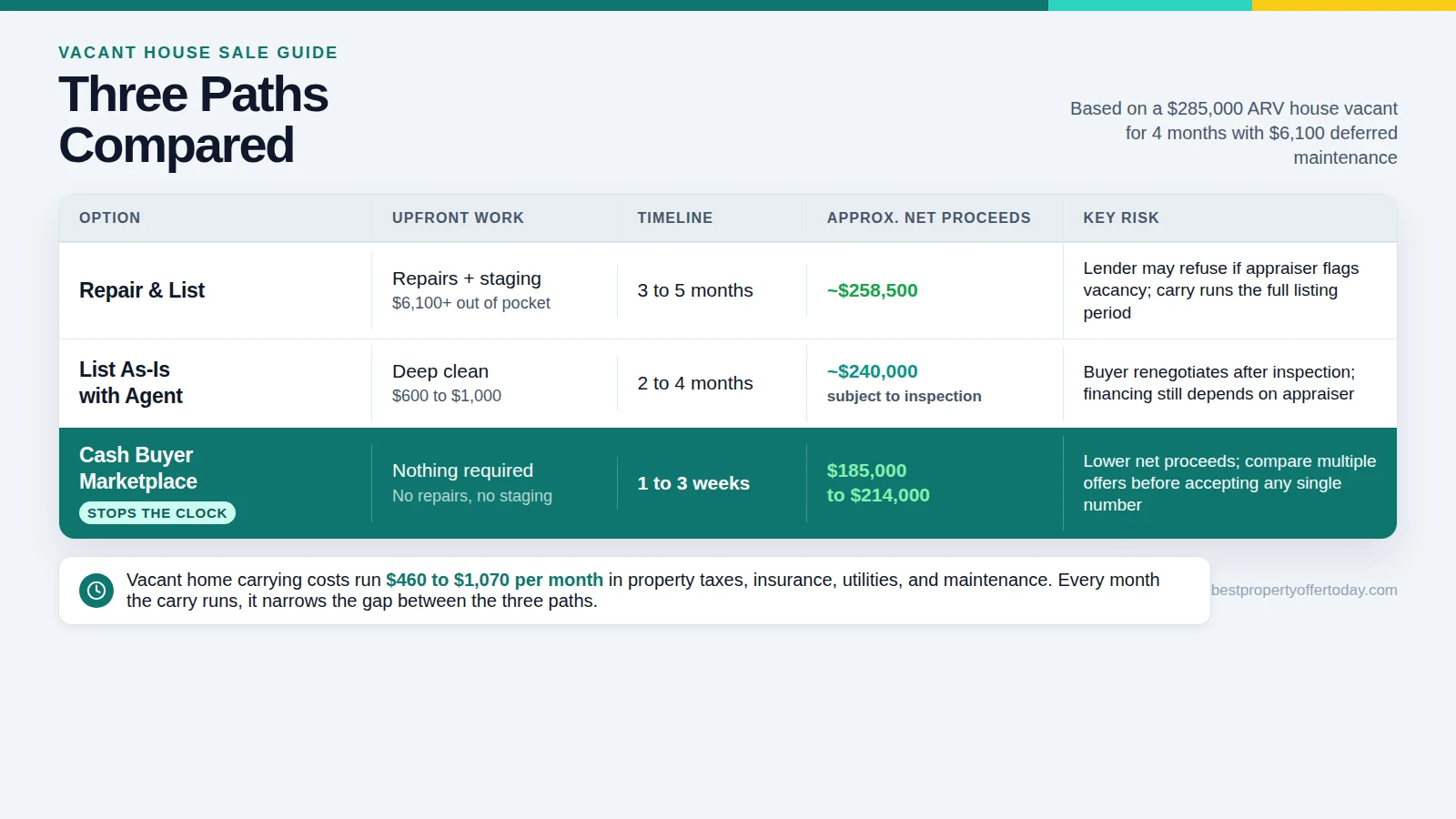
That puts monthly carry at $460 to $1,070. For a house that sits on the market for two months and closes 30 days after an offer, you are absorbing three months of carry before you net a dollar. If a deal falls through and you start over, another 30 to 60 days follows at the same rate.
Three Paths for Selling a Vacant House
| Option | Upfront work | Typical timeline to close | Best fit |
|---|---|---|---|
| Repair and list with an agent | Repairs, staging, cleaning | 3 to 5 months | House in repairable condition; seller has capital and time |
| List as-is with an agent | Deep clean, basic maintenance | 2 to 4 months | Seller accepts lower price; willing to absorb renegotiation after inspection |
| Submit to a cash buyer marketplace | Nothing required | 1 to 3 weeks | Seller needs to stop the carry quickly; financing is a known problem; house needs significant work |
Which path makes sense depends on the gap between repair cost and sale price, and on how much monthly carry you can absorb. You can run both scenarios with your actual numbers using our net proceeds calculator.
Worked Example: $285,000 ARV, Vacant Four Months
Say the house has an after-repair value of $285,000 and has been sitting empty for four months. It needs a water heater ($1,200), drywall repair from a slow roof leak that went unnoticed ($3,500), a deep clean ($600), and landscaping restoration ($800). Total deferred maintenance: $6,100 before anything cosmetic.
Path A: Repair and list. Out-of-pocket repairs: $6,100. Carrying costs during a 45-day listing plus a 30-day close: $1,900. Agent commission at 5.5% on $285,000: $15,675. Seller-paid closing costs: $2,800. Net proceeds: approximately $258,500.
Path B: List as-is. Buyers price in condition; offers come in around $255,000 to $265,000 before inspection renegotiation. Carrying costs during a 60-day listing plus 30-day close: $2,500. Agent commission at 5.5% on $260,000: $14,300. Seller-paid closing costs: $2,600. Net proceeds: approximately $240,000 to $245,000, with further reduction risk.
Path C: Cash offer through a marketplace. Cash buyers on a vacant house in this condition typically offer 65 to 75 percent of after-repair value. On $285,000 ARV, that range is $185,000 to $214,000. No repairs out of pocket. No commission. Minimal closing costs. Closing in one to three weeks ends the monthly carry immediately.
Path A produces the best number. Path C produces the worst. What the seller buys with that gap is the end of a $690-per-month drain, no capital outlay for repairs, no lender-approval risk, and a closing timeline measured in days rather than months. If the house has been vacant for six or eight months when you finally act, the gap between Path A and Path C narrows considerably, because the carry in Paths A and B has been accumulating the whole time.
If you are not sure whether a specific buyer is legitimate, see our guide on how to verify a cash home buyer.
Red Flags in Offers on a Vacant Property
Vacant houses attract buyers who expect a seller in a hurry. A few specific patterns to watch for before signing anything:
- Long inspection window on an as-is property. A real cash buyer inspecting a vacant house does not need 30 or 45 days. An extended window often means the buyer is looking for time to assign the contract to someone else
- An assignment clause. If the contract allows the buyer to transfer their position to a third party, you are dealing with a wholesaler. That is not automatically disqualifying, but you should know what you are signing before you do
- Earnest money under $1,000 on a $200,000 transaction. A $500 deposit makes walking away essentially free for the buyer. Ask for at least 1% of the purchase price, in escrow, not contingent on inspection approval
- Proof of funds that is a screenshot, not a bank statement. A balance screenshot can be produced in minutes. Ask for 60 days of bank or brokerage statements
For a full list of questions to run through before signing any cash sale contract, see our guide on what to ask a cash home buyer.
What to Do Before You Accept the First Offer
- Confirm your current insurance status. If the policy has lapsed for vacancy, you need to know before disclosing condition
- Run a preliminary title search to surface any open liens, unreleased mortgages, or probate holds
- Disclose what you know. Selling as-is limits the duty to repair, not the duty to inform the buyer of conditions you are aware of
- Collect more than one offer. A single cash offer on a vacant house is not a market price. Submitting to a marketplace that routes your request to multiple buyers gives you a basis for comparison
The Honest Caveat
A cash offer on a vacant house will almost always be below what you could net after repairs and a full conventional listing. That is the consistent tradeoff on every scenario on this site. If the house is in good condition and you have the capital and time to carry it through a traditional sale, that path will generally produce a better number. If the insurance has lapsed, the property has deferred maintenance that would stop a financed deal, or the monthly carry is already compounding past your budget, a cash sale stops the clock in a way that a listing cannot.
Does a house have to be occupied to sell?
No. A vacant house can be sold to any buyer. The complication is that some lenders will not fund a purchase loan on a property classified as vacant or deteriorating, which reduces the pool of buyers to those paying cash or using portfolio lenders who set their own standards.
How long before insurance stops covering a vacant house?
Most standard homeowner’s policies restrict or void coverage after 30 to 60 days of vacancy. The exact number is in your policy’s conditions section. Once you cross that threshold, you need a separate vacant dwelling policy to maintain meaningful coverage. Confirm this before listing.
Can a cash buyer close if the house has been vacant for years?
Generally yes. Cash buyers are not subject to lender minimum property standards. A house that has been empty for years may have accumulated delinquent property taxes or estate-related title issues that need to be resolved at closing, but those rarely prevent a cash transaction. They just require a clean title search before you go to contract.
What happens to overdue property taxes when you sell?
Any delinquent property taxes are paid from the seller’s proceeds at closing. The title company handles this on the settlement statement. If the taxes have already been sold to a third party as a lien, the mechanics are more involved. See our post on selling a house with a tax lien for how that changes the process.
Ready to see real numbers for your house?
Enter your property address to get competing offers from verified cash buyers. No repairs, no agent fees, and you pick the closing date.
Prefer to talk? Call (804) 361-7460