A PACE loan does not behave like a normal loan. The balance does not appear on a mortgage payoff statement the way a traditional lien does. It is billed through your property tax. And when you go to sell, it creates a complication most sellers do not see coming until a buyer’s lender kills the deal at underwriting.
The short version: most buyers who need financing cannot close on a property with an outstanding PACE assessment. Fannie Mae, Freddie Mac, FHA, VA, and USDA have all restricted or prohibited lending against PACE-encumbered properties. Cash buyers are not subject to those restrictions. That difference matters a great deal when you are trying to sell.
Selling a house with a PACE loan? Compare cash offers from buyers who price it in.
Enter your property address to get competing offers from verified cash buyers. No repairs, no agent fees, and you pick the closing date.
Prefer to talk? Call (804) 361-7460
What a PACE Loan Actually Is
PACE stands for Property Assessed Clean Energy. The program lets homeowners borrow money for energy improvements, such as solar panels, a new HVAC system, insulation, or windows, and repay it over 10 to 25 years as part of their property tax bill.
The local government or a county authority is the actual creditor. When payments stop, they can collect the same way they collect unpaid taxes: by placing a lien on the property. In most states, that lien has super-lien status, meaning it sits ahead of your first mortgage in the payment hierarchy.
The loan “runs with the property.” If you sell without paying it off, the obligation transfers to the buyer. That feature is exactly why lenders refuse to touch it.
The major PACE servicers you may recognize: Ygrene Energy Fund, GreenSky, Renew Financial, and HERO Program (which stopped new originations but still has an active portfolio). Florida and California hold the largest share of outstanding PACE balances in the country, but the programs exist in Missouri, Virginia, and roughly two dozen other states.
Why PACE Blocks Most Buyers at the Closing Table
Fannie Mae issued guidance in 2010 (Seller/Servicer Guide SEL-2010-10) prohibiting the purchase of mortgages on properties with PACE liens in first lien position. Because almost every conventional loan is sold to Fannie Mae or Freddie Mac after origination, lenders simply will not originate a conventional mortgage on a property carrying a senior PACE lien, unless the lien is paid off before or at closing.
FHA follows a similar restriction. Its 2016 guidance allowed PACE only where state law placed the PACE in a subordinate position, which is uncommon. VA and USDA take the same position. The practical result: a buyer who arrives with pre-approval for conventional, FHA, VA, or USDA financing will hit a hard stop at underwriting the moment a PACE assessment appears on the title report.
Some deals survive this if the seller agrees to pay off the PACE out of proceeds at closing. Many fall apart because the numbers do not work, or because neither the seller nor the buyer knew about the restriction when they went under contract.
Cash buyers bypass the lender entirely. There is no underwriting, no Fannie/Freddie requirement, no appraisal condition. A cash buyer looks at the property, looks at the PACE payoff balance, and factors both into the offer.
The Three Paths Out
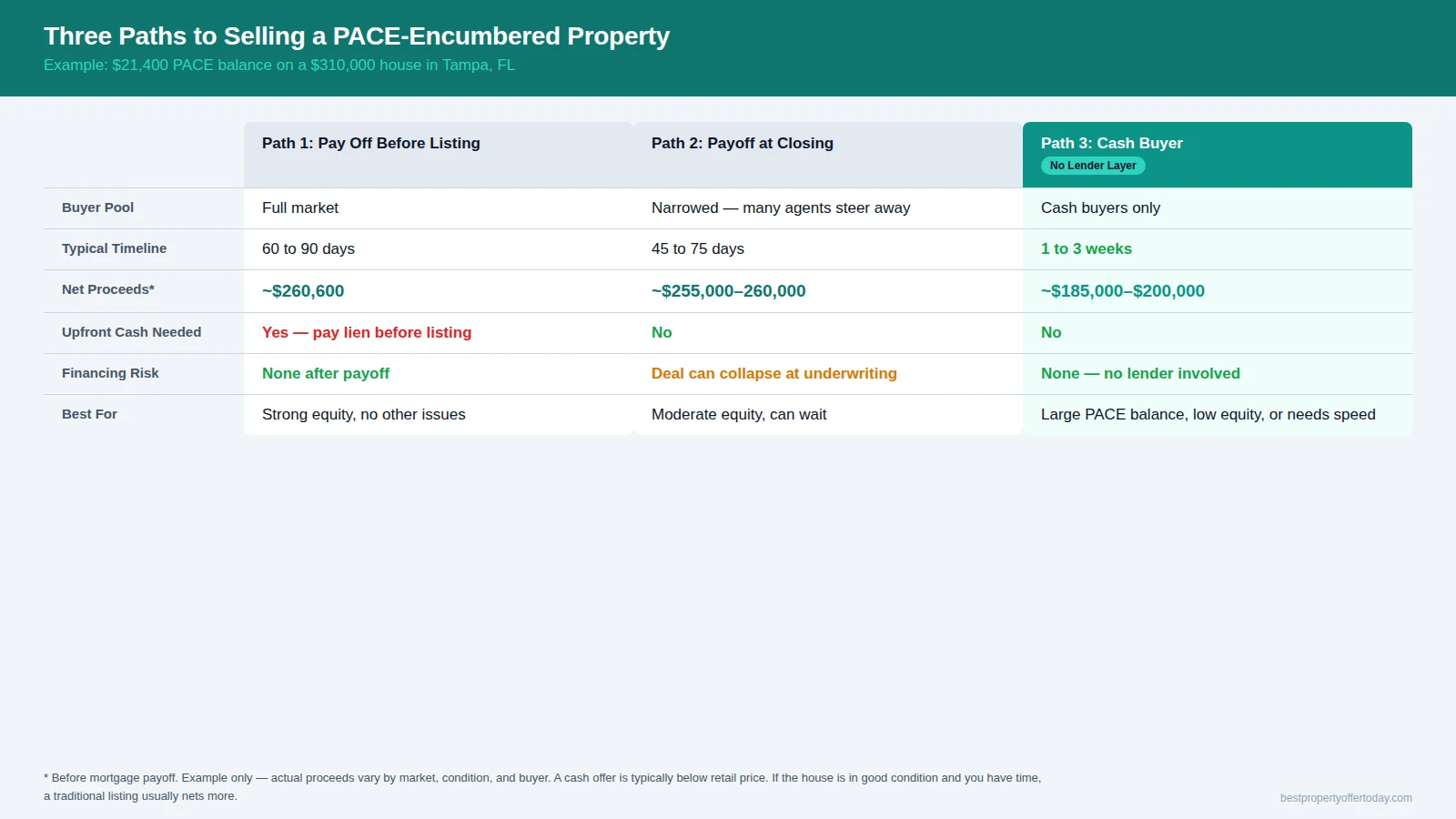
When you go to sell with a PACE balance outstanding, you have three realistic options.
Pay off the PACE before listing. Call your servicer, get a payoff quote, and pay the balance. This clears the lien from the property records. After that, any buyer with any financing can proceed normally. The downside is that some PACE programs carry prepayment penalties, and you need the cash to clear the lien before receiving any sale proceeds. The payoff quote is typically good for 30 days. Request it before you list, not after you are under contract and on a deadline.
Require payoff at closing and list normally. You list the property, disclose the PACE balance on the transfer disclosure statement, and structure the contract so the PACE is paid from your proceeds at closing. This works if the equity supports it. The limitation is buyer pool narrowing: many buyer’s agents steer their clients away from PACE-encumbered properties to avoid the complication, even when payoff is built into the deal. Expect fewer showings and more tire-kicking than a property with a clean title.
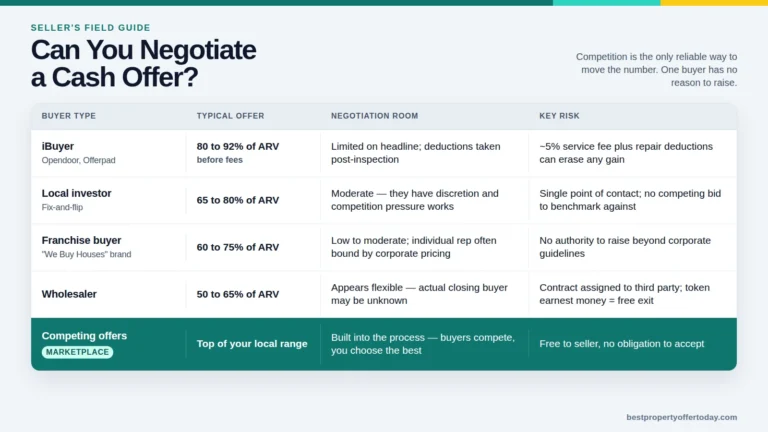
Sell to a cash buyer who prices in the lien. A cash buyer does not need lender approval. They request the PACE payoff statement along with the standard title search, factor the balance into their offer, and close without lender involvement. This is often the fastest path, especially when the PACE payoff would leave little or no equity under the other two options. Submit one request to a marketplace like this one and receive competing offers from multiple buyers, so you can compare what each will net you rather than relying on a single buyer’s assessment of how difficult your situation is.
Worked Example: What the Numbers Look Like
A house in Tampa, Florida has an after-repair value of roughly $310,000. The seller put PACE financing on it three years ago for a solar installation and a new air handler. The remaining PACE balance is $21,400.
Under a traditional listing, the seller would pay off the PACE at closing. At 3 percent commission on each side, plus title, transfer taxes, and minor repairs demanded after inspection, total transaction costs run around $28,000. Add the $21,400 PACE payoff. Net proceeds before the mortgage payoff: approximately $260,600. That assumes the deal closes and does not fall apart at the lender’s underwriting desk.
A cash buyer using the standard 70 percent ARV formula would start at around $217,000. They deduct the $21,400 PACE payoff and any additional repairs, arriving at an offer somewhere in the $185,000 to $200,000 range. Net proceeds to the seller before the mortgage payoff: $185,000 to $200,000, in one to three weeks, with no financing contingency and no lender to satisfy.
The gap is real: roughly $60,000 to $75,000 in this example. What the seller buys with that difference is speed, certainty, and the elimination of a financing risk that has derailed this category of sale repeatedly. Florida properties carrying PACE assessments sometimes sit 60 to 90 days on the MLS as buyers and their lenders work through the complication. At a carrying cost of $2,500 a month, that is $5,000 to $7,500 in additional holding cost the net proceeds figure does not reflect.
If a traditional listing is viable and the equity supports it, that path usually nets more. The honest question is whether the buyer pool, the carrying cost, and the financing risk are worth the difference on your specific property.
Disclosure: What the Law Requires
Florida and California, the two largest PACE markets, both require disclosure of PACE assessments before or at contract execution. Florida’s requirement was enacted in 2017 under Section 163.08 of the Florida Statutes. California requires disclosure on the Transfer Disclosure Statement. Missouri and other states with active PACE programs have varying requirements, but the general principle applies everywhere: failure to disclose a known assessment is a material omission.
Selling as-is limits your obligation to make repairs. It does not limit your obligation to disclose. The two are separate duties under real estate law, and the PACE programs in California and Florida have been the subject of consumer litigation precisely because sellers and their agents failed to understand the distinction.
Red Flags When a Buyer Claims to Assume the PACE
PACE assumption is rare and requires the servicer to approve a creditworthiness transfer in writing. If a buyer says they will “assume” the PACE but cannot produce a servicer approval letter, the lien stays attached with no guarantee the buyer will keep paying. In some states, the original seller retains exposure to unpaid assessments even after the sale. These are signs to slow down:
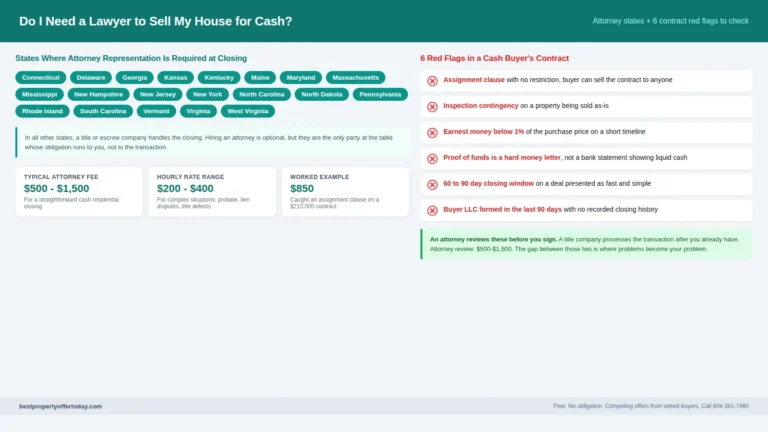
- Buyer claims to assume the PACE but cannot produce written servicer approval before contract execution
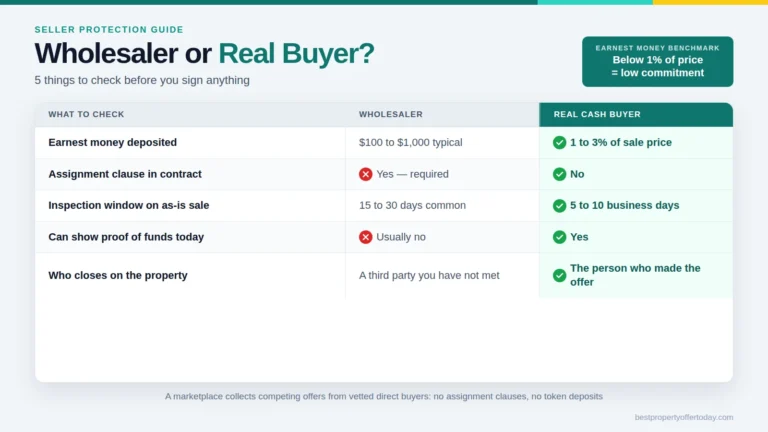
- Earnest money deposit of $500 to $1,000 on a $280,000 to $310,000 purchase
- Contract includes an assignment clause (“buyer or assigns”)
- Extended inspection period on a property being sold as-is for cash
- Offer arrives within hours of a Zillow inquiry, without any walkthrough or showing request
- Buyer requests a lengthy contract term to “larrange financing” on what was presented as a cash deal
A token deposit and an assignment clause together mean walking away costs the buyer nothing. That combination on an as-is sale with a known PACE complication is a wholesale deal, not a cash purchase. The buyer intends to resell the contract to another investor, not to close.
Questions to Ask Before You Sign
- Will the PACE be paid in full at closing, and will that be reflected in the settlement statement?
- If you are assuming the PACE, can you provide the servicer’s written assumption approval before we execute the contract?
- Is your offer contingent on financing? A true cash offer has no financing contingency.
- What is your earnest money deposit, and under what conditions is it forfeited to me if you cancel?
- Can you provide a bank statement or letter of credit as proof of funds within 24 hours?
- Who is your title company, and have they closed transactions with outstanding PACE assessments before?
These questions take five minutes on a phone call. A buyer who declines to answer them directly is communicating something about how serious they are.
When a Cash Offer Makes Sense and When It Does Not
A cash offer on a PACE-encumbered property makes the most sense when the PACE balance is large relative to the equity, when the property has additional issues that would narrow the financed buyer pool further, or when time is the constraint. If your PACE balance is $5,000 on a $400,000 house with strong equity and no other complications, paying it off before listing is probably worth it and the traditional route will net you more.
If the PACE balance is $25,000 on a property with deferred maintenance, a dated roof, or other issues that would trigger lender conditions anyway, the financed buyer pool is already thin. A cash buyer who prices in the whole picture may be a more realistic path to closing than a traditional listing that falls apart at the third deal attempt.
Use the net proceeds calculator to run both scenarios with your actual numbers before you decide. The comparison is worth doing before you list, not after you have been on the market for 60 days. If you want competing offers without committing to any of them, submit a request through Best Property Offers Today and see what cash buyers in your area actually think the property is worth with the PACE factored in. That number, compared to a listing agent’s estimate, is the information the decision requires.
Can a buyer get financing on a property with a PACE lien?
Rarely, without paying the lien off first. Conventional, FHA, VA, and USDA loans all carry restrictions against lending on properties with PACE assessments in a senior lien position. Some state programs allow subordinated PACE with lender approval, but those situations require specific servicer cooperation and are not common. Most buyers using traditional financing will require payoff at closing, or will walk.
Does a PACE loan show up on a title search?
It should, but not always reliably. PACE assessments are recorded as special tax assessments, not as traditional mortgages, so a title abstractor who is not specifically looking for assessment records may miss them. A thorough title company will catch it. Sellers with an outstanding PACE balance should order a preliminary title report before listing, not wait for the buyer’s title company to surface it at closing.
What happens to the PACE lien if the seller does not disclose it?
The buyer’s lender catches it at underwriting, the deal collapses, and the seller faces potential liability for the buyer’s due diligence costs. In states with explicit PACE disclosure statutes such as Florida and California, failure to disclose is a civil violation. Post-closing discovery, where the buyer finds the assessment after close, has led to claims for rescission and damages in both states. Disclosure is not optional and it is not mitigated by an as-is clause.
How much does it cost to pay off a PACE loan early?
Prepayment terms vary by servicer and program. Some PACE programs carry no prepayment penalty. Others have a fixed fee or a yield maintenance calculation that makes early payoff meaningfully more expensive than the remaining principal balance alone. Call your servicer before listing and ask for a full payoff quote that includes any prepayment charges. That quote tells you the real cost of the clean-title path and is the number you need before comparing it against a cash offer that prices the lien in.
Ready to see real numbers for your house?
Enter your property address to get competing offers from verified cash buyers. No repairs, no agent fees, and you pick the closing date.
Prefer to talk? Call (804) 361-7460