A balloon mortgage comes due on a fixed date, and that date does not negotiate. If you cannot refinance and cannot pay the lump sum, the note holder can call the loan and start foreclosure proceedings within a matter of weeks. For most homeowners in that position, the fastest clean exit is a sale. This is what that actually looks like.
Selling a house with a balloon mortgage? Compare cash offers from buyers who price it in.
Enter your property address to get competing offers from verified cash buyers. No repairs, no agent fees, and you pick the closing date.
Prefer to talk? Call (804) 361-7460
What a Balloon Mortgage Actually Is
A balloon mortgage is structured so that monthly payments are based on a 30-year amortization schedule, but the remaining principal balance becomes due in full at the end of a shorter term, typically 5 to 7 years. The monthly payment is lower than a conventional 30-year payment on the same amount, but the borrower has not come close to paying off the loan by the end of the term. The remaining balance, often 90 percent or more of the original loan, is the balloon payment.
Traditional lenders in the United States rarely offer balloon mortgages for primary residences today. The Dodd-Frank Act’s qualified mortgage rules made them unattractive for most originators. Where sellers run into them now is seller financing. FHA, VA, and USDA loans work very differently: unlike a balloon mortgage, they are generally assumable by a qualified buyer without triggering a payoff. See how to sell a house with an assumable mortgage for how that process works. A homeowner sells on terms, taking back a note instead of accepting a full cash payment at closing. The note is typically structured for 3, 5, or 7 years, with a balloon payment at the end so that the buyer has time to qualify for conventional financing. When the buyer cannot refinance by the balloon date, the original seller ends up holding an unpayable note. When the borrower is the one who needs to sell, the same deadline arrives from the other direction.
The Three Paths When the Payment Comes Due
Refinance before the due date
Refinancing replaces the balloon note with a conventional loan. This works if the borrower has sufficient equity, stable income, an acceptable debt-to-income ratio, and a lender willing to do the deal. Many homeowners discover that the qualifying standards that applied five or seven years earlier no longer apply to their current situation. Income dropped. The property appraised lower than expected. Rates rose enough that the new payment does not pencil out. Lenders do not refinance balloon notes as a favor. If refinancing were straightforward for you, it would not be in question.
Negotiate an extension or modification with the note holder
Some note holders will extend the balloon date or convert the note to a longer amortizing loan rather than foreclose. This is more common with private sellers who carried back financing than with institutional lenders. The note holder’s willingness depends on whether they want their money now or whether the monthly income and the property as collateral are still acceptable to them. Getting to that answer takes time you may not have. It is worth a direct conversation with the note holder before assuming the worst, but do not plan around an extension you do not yet have in writing.
Sell the property
At a conventional closing, any mortgage or note on the property is paid off from the sale proceeds before the seller receives the remainder. A balloon mortgage is no different. The title company collects a payoff statement from the note holder, wire transfers the balance at closing, and you receive what is left. The balloon does not need to be paid before listing. It is paid at closing, automatically, the same way a conventional mortgage is paid off.
Why the Timeline Is the Whole Problem
Selling a house the traditional way, through an agent at retail, takes 60 to 90 days on average after a buyer goes under contract. Add two to four weeks to find a buyer, and you are looking at 90 to 120 days from listing to close in a normal market. If your balloon payment is due in 60 days, a traditional listing does not solve the problem in time.
A cash sale does not involve a lender on the buyer’s side. No mortgage underwriting. No appraisal required by a bank. No financing contingency that lets a buyer walk when their loan falls through. The limiting factor on a cash closing is the title search and clearing anything that shows up: old liens, an unreleased mortgage, a probate matter. Under normal circumstances, a cash sale closes in 1 to 3 weeks. If the title is clean, the low end of that range is realistic.
That speed difference is what makes the choice concrete. If the balloon is due in 45 days, a traditional listing is not on the table as a practical option. The question becomes whether the difference in net proceeds between a cash offer and a retail sale is worth the difference in timing, or whether you have no meaningful choice at all.
What You Net: A Worked Example
Take a house worth $285,000 on the open market. The seller has a 7-year seller-financed note with $168,000 remaining, due in 60 days. The seller cannot refinance.
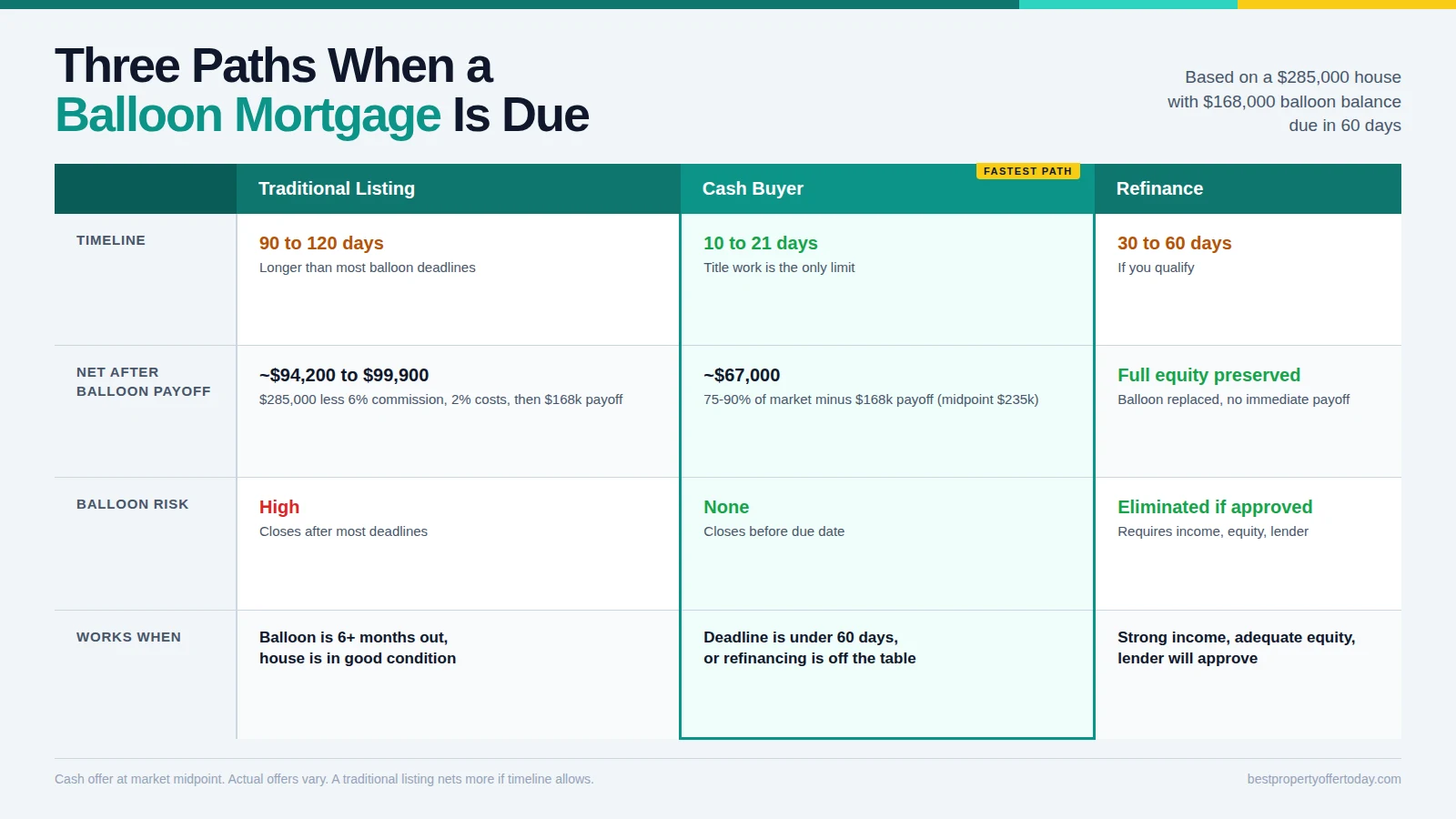
Path A: Sell through an agent at retail. At a full price of $285,000, the seller pays roughly 5 to 6 percent in agent commission ($14,250 to $17,100) plus seller-paid closing costs of 1 to 2 percent ($2,850 to $5,700), and assumes no buyer-requested repairs. Total deductions: roughly $17,100 to $22,800. Net before the balloon payoff: $262,200 to $267,900. After paying off the $168,000 balloon, the seller walks away with approximately $94,200 to $99,900. Time to close: 90 to 120 days. This path only works if the balloon date can be extended, or if 90 days falls before the due date.
Path B: Sell to a vetted cash buyer. Cash offers on a $285,000 house typically run 75 to 90 percent of market value depending on condition and the buyer’s model. On this house, that range is $213,750 to $256,500. Using the midpoint of $235,000: after paying off the $168,000 balloon, the seller nets approximately $67,000. The gap versus Path A is roughly $27,000 to $33,000. The difference buys a certain close in 10 to 21 days instead of 90 to 120, and it removes the refinancing risk entirely.
The question every seller with a balloon mortgage has to answer honestly: how much is a certain 21-day close worth compared to a probable 90-day close, given your specific balloon due date? For some that calculation goes toward the cash buyer. For others, if the balloon date is six months out and the house is in good condition, a traditional listing is still the stronger net. Use the net proceeds calculator to run your own numbers with your actual balloon balance and market value estimate.
Your Three Options: Side-by-Side
| Option | Typical timeline | Net proceeds (this example) | Balloon risk |
|---|---|---|---|
| Traditional listing | 90 to 120 days | ~$94,200 to $99,900 | High if due in under 90 days |
| Cash buyer | 10 to 21 days | ~$67,000 | None, closes before due date |
| Refinance | 30 to 60 days (if approved) | Balloon eliminated, equity preserved | None if lender approves |
The table assumes the worked example above. Your numbers will differ depending on actual market value, your balloon balance, and what buyers are offering in your specific market at the time you list.
Red Flags When Getting Cash Offers on a Balloon Property
Sellers with a hard deadline are obvious targets for buyers who plan to renegotiate after the inspection. Watch for these signals before signing anything:
- A token earnest money deposit, typically $500 to $1,000 on a $200,000 to $300,000 property
- An inspection window longer than 7 days on an as-is sale
- An assignment clause, which allows the buyer to sell the contract to a third party before closing
- A buyer who cannot or will not provide proof of funds before you sign
- A price that drops after inspection on a property you already disclosed the condition of and agreed to sell as-is
The pattern is the same across all these behaviors: the buyer pays little or nothing to control the property while they shop the contract to another buyer or wait for you to panic closer to the balloon date. Getting multiple offers before signing is the main protection. You cannot know whether $230,000 is a low offer or a reasonable one without at least two more data points from the same market.
See the earnest money guide for the specific amounts that signal a serious buyer versus someone keeping options open at your expense.
When a Cash Sale Is Not the Right Answer
A cash offer on this type of property will normally be below what a fully marketed retail sale would bring. The buyer is accepting the property without a financing contingency, closing in weeks, and taking on condition risk without a lender’s appraisal as a check. Those concessions cost the buyer money, and they price accordingly.
If the house is in good condition and the balloon is not due for another six months or more, a traditional listing will net more. That is true even accounting for carrying costs. Cash sales make sense for sellers whose options have narrowed: the deadline is real, refinancing failed, and the note holder will not extend. If none of those apply to your situation, a traditional listing is worth the extra time.
If you are unsure where you fall, compare offers before committing. That is the only way to know whether the offer on the table is at the aggressive end of the range or the reasonable one. We collect competing offers from vetted cash buyers across all 50 states. One request, free, no obligation to accept anything. Call us at 804-361-7460 or start the process using the form at the top of this page.
Ready to see real numbers for your house?
Enter your property address to get competing offers from verified cash buyers. No repairs, no agent fees, and you pick the closing date.
Prefer to talk? Call (804) 361-7460
Frequently Asked Questions
Can you sell a house if you have a balloon mortgage?
Yes. The balloon mortgage is paid off from the sale proceeds at closing, the same way a conventional mortgage is paid off. You do not need to pay it before listing or before accepting an offer. The title company handles the payoff as part of the closing disbursements, and you receive whatever is left after the balloon balance plus any other closing costs are deducted.
What happens if you cannot pay the balloon and cannot sell in time?
If the balloon payment date passes without a payoff, refinance, or extension, the note holder can declare the loan in default and begin foreclosure proceedings. The timeline varies by state. In judicial foreclosure states the process takes months and requires a court order. In non-judicial states it moves faster. At any point before the foreclosure is completed, a sale can still pay off the note and stop the process. The closer you get to foreclosure, the fewer buyers will touch the property, and the lower the offers will run. If you are within 90 days of a balloon you cannot pay, the time to explore a sale is now. See our foreclosure guide for what the timeline actually looks like in your state.
Does the cash buyer pay off the balloon mortgage at closing?
No, and yes in a practical sense. The buyer’s funds go to the closing. The title company uses those funds to pay off the balloon note as part of the disbursements, then sends you the net. The buyer never touches the balloon note directly. They are simply providing the cash that makes the payoff possible. From your perspective, the balloon is gone when the closing wires clear.
Will you owe capital gains tax on the proceeds after the balloon is paid off?
Possibly. The capital gains calculation is based on your sale price minus your adjusted cost basis, not on the proceeds after the balloon payoff. Paying off the balloon is not a tax-deductible event. Sellers who have owned and occupied the property as a primary residence for at least 2 of the last 5 years may be eligible to exclude up to $250,000 in gain from federal tax ($500,000 for married couples filing jointly). Investment properties and properties you have not lived in do not qualify for that exclusion. A CPA is the right person to consult on the specifics before you close, particularly if significant equity is involved.