An assumable mortgage lets a buyer take over your existing home loan, the remaining balance, and the interest rate. If your FHA, VA, or USDA loan carries a rate from 2020 to 2022, that rate is a genuine selling point: the savings over a new mortgage at current rates can run to hundreds of dollars a month for the buyer who takes it on.
But the assumption process is slower and more complicated than most people expect. It has a specific trap for veterans that rarely gets explained. And for some sellers, a cash sale closes faster and with less exposure than waiting out a 60-day assumption.
Here is what actually matters, without the sales pitch.
Selling a house with an assumable mortgage? Compare cash offers from buyers who price it in.
Enter your property address to get competing offers from verified cash buyers. No repairs, no agent fees, and you pick the closing date.
Prefer to talk? Call (804) 361-7460
Which Loans Are Actually Assumable
FHA, VA, and USDA loans are assumable. That covers a large share of homes purchased between 2018 and 2023.
Conventional loans backed by Fannie Mae and Freddie Mac are not assumable. They contain a due-on-sale clause, which requires the full loan balance to be paid when ownership transfers. The lender can call the loan due the day title changes hands, and that is not negotiable.
If you are not sure which loan type you have, your most recent mortgage statement or closing disclosure will say. The servicer can confirm in one call.
What the Seller Has to Do
Assumption does not happen automatically. The seller contacts the loan servicer, not the lender who originated the loan. Request the assumption packet: a set of documents and fees the servicer requires from both parties to begin the review.
The buyer then applies directly with the servicer, submitting income, credit, and debt-to-income documentation much as they would for a new mortgage. The servicer underwrites the buyer. If the loan is FHA, the assumption also requires HUD review. VA loans require VA approval on top of the servicer review.
That layered review is why assumption timelines run 45 to 90 days, and sometimes longer. Plan for 60 days as a baseline. If the servicer does not respond to your assumption request within two weeks of your first contact, treat that as a yellow flag: some servicers actively slow-walk assumptions, and a dragging process keeps your home off the market while nothing moves.
The Equity Gap: What It Is and How Buyers Bridge It
The buyer assumes your remaining loan balance. If your home sells for $310,000 and your loan balance is $195,000, the buyer has to cover the $115,000 gap separately. Options:
- Cash at closing. The buyer brings $115,000 to the table.
- A second mortgage. The buyer takes a separate loan to cover the gap. Not all lenders will write a second mortgage layered on top of an assumption, so the buyer choices narrow considerably.
- Seller financing for the gap. Uncommon but legally possible in most states if both parties agree.
The equity gap is the main reason assumption transactions fall through. Buyers who like the low rate discover they cannot bridge the gap and walk away. Before you invest time in the assumption process, verify that your buyer has a credible plan for the gap, in writing, before you go under contract. Use our net proceeds calculator to understand what each path actually puts in your pocket.
Worked Example with Real Numbers
A veteran purchased a home in 2021 with a VA loan. Rate: 2.875%. Remaining balance: $195,000. The home is now worth $310,000.
A buyer who assumes the loan inherits the $195,000 at 2.875%. Monthly payment on that balance: approximately $808. If the same buyer took a new $195,000 mortgage at a 2026 rate of 6.9%, the monthly payment on that same amount would run roughly $1,286. The assumption saves approximately $478 per month on that portion of the debt.
To complete the purchase, the buyer also needs to cover the $115,000 equity gap. If they finance it at current rates, a second mortgage on $115,000 adds approximately $760 per month. Total monthly outlay under the assumption: about $1,568.
A straight new mortgage at 6.9% on the full $310,000 purchase price would run approximately $2,043 per month.
The assumption still saves around $475 per month in this scenario. For a buyer who has the cash or the second-mortgage qualification to bridge the gap, that is real money, and sellers can legitimately use it as a marketing point in their listing.
The VA Entitlement Trap Most Veterans Do Not Know About
This is the detail most sellers with VA loans do not know, and that most real estate agents do not explain clearly.
When a non-veteran assumes your VA loan, your VA entitlement stays tied to that loan until it is fully paid off or refinanced. Your entitlement does not come back to you at the closing table.
That means you cannot use your VA benefit to buy another home with no money down until the assumed loan clears. If you plan to purchase again using a VA loan, this matters.
There is a way out. If the buyer is a qualified veteran and they substitute their own VA entitlement for yours at closing, your entitlement is released. This is called substitution of entitlement, and it must be explicitly arranged before closing. The VA requires both parties to complete a request for substitution, and the loan must be formally transferred on VA records. Without that substitution, your entitlement stays attached, possibly for the full remaining loan term.
A buyer who declines to substitute entitlement when you raise it, or who cannot explain their own entitlement status, is worth scrutinizing carefully before you proceed.
Release of Liability: Do Not Skip This
When a buyer assumes your mortgage without a formal release of liability, your name technically remains on the debt. If the buyer later defaults, the lender can come after you.
The correct document is a novation, issued by the servicer after the assumption closes. It replaces you with the buyer as the sole obligor. Some servicers issue it automatically as part of the assumption process. Others require you to request it explicitly, and a few require a separate application.
Confirm in writing, before the transaction closes, that the servicer will issue a novation on this assumption. If the servicer will not commit to it in writing, talk to a real estate attorney about your exposure before you proceed. This is not a formality to skip: sellers who skipped it and whose buyers later defaulted have found themselves in collection proceedings years after the sale.
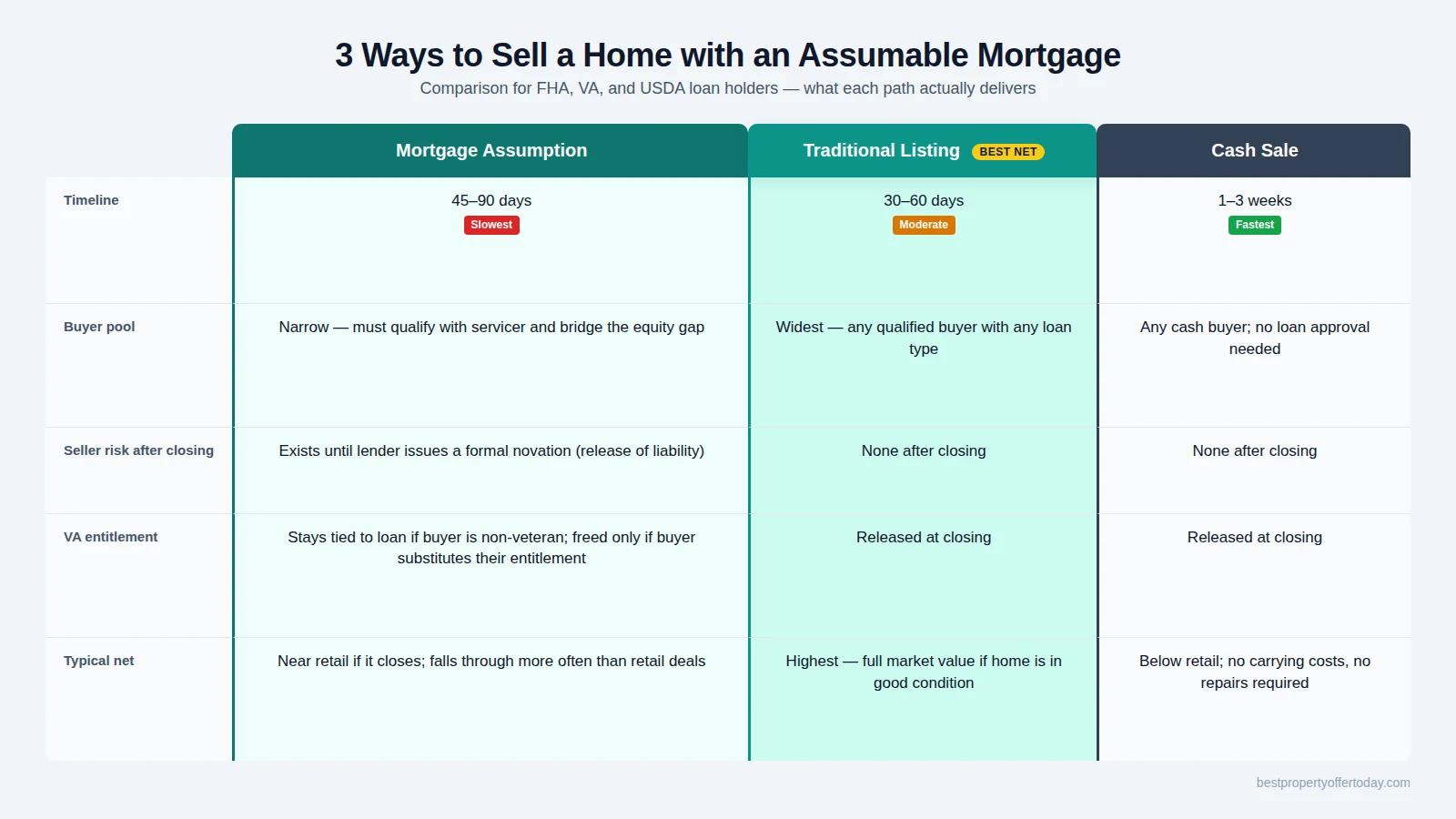
Three Paths Side by Side
| Path | Typical timeline | Buyer pool | Seller residual risk |
|---|---|---|---|
| Mortgage assumption | 45 to 90 days | Narrow: must qualify with servicer, must bridge equity gap | Exists until novation issued |
| Traditional listing | 30 to 60 days once under contract | Widest: any qualified buyer with any loan type | None after closing |
| Cash sale | 1 to 3 weeks | Any cash buyer, no loan approval | None |
The traditional listing gives you the widest buyer pool and the highest probable net. The assumption is a compelling option when rates make it genuinely attractive to buyers who can bridge the equity gap. The cash sale closes fastest with no approval process, no entitlement exposure, and no waiting for a servicer who may take 90 days to process paperwork.
If your situation involves time pressure, a complicated title, or you hold a VA loan and do not want to risk entitlement issues, a cash sale removes the most moving parts. Getting competing cash offers first lets you know what that path actually nets before you commit to a 90-day assumption timeline.
Red Flags When a Buyer Wants to Assume Your Loan
These are worth watching for before you go under contract:
- No credible plan for the equity gap. If a buyer cannot explain how they are bridging the gap in writing, the assumption will not close.
- The servicer does not send an assumption packet within two weeks of your contact. Some servicers actively delay these, and a stalling servicer keeps your home off the market while nothing progresses.
- The buyer is not a veteran and will not substitute entitlement, and you have a VA loan you plan to use again.
- No written commitment from the servicer about issuing a release of liability at closing.
- The purchase contract does not name a specific assumption approval deadline. Without one, the transaction can drag for months.
- The buyer has not been formally pre-screened by the servicer before you accept their offer. Servicer underwriting is a separate process from standard mortgage pre-approval, and a buyer who has not started it yet is early in the process.
Vetting a buyer properly before you accept an offer on an assumption deal is worth more time than it takes. See proof of funds guidance for sellers for how to evaluate what a buyer provides.
The Honest Comparison: When a Cash Sale Makes More Sense
A cash offer is typically below the fully marketed retail price. That is the trade for speed, certainty, no carrying costs, and no loan contingency. If your home is in good condition and you have 60 to 90 days available, a traditional listing will almost always net more than a cash sale.
The assumption path, if it closes, will generally put you closer to retail. The question is whether you have the time, the buyer with both the servicer qualification and the gap financing, and the patience for a process that can slow to a stop if the servicer is slow or the buyer cannot bridge the gap.
Many sellers with assumable mortgages do best by listing with the assumable rate as a prominent feature, reviewing all offers including cash offers, and choosing based on what each actually nets after accounting for timeline, carrying cost, and fall-through risk.
BPOT is a marketplace: we collect competing cash offers from vetted buyers at no charge to the seller, with no obligation to accept anything. Request offers here to know your cash floor before you decide which path to take.
Ready to see real numbers for your house?
Enter your property address to get competing offers from verified cash buyers. No repairs, no agent fees, and you pick the closing date.
Prefer to talk? Call (804) 361-7460
Frequently Asked Questions
Can a seller refuse to allow a buyer to assume the loan?
You can refuse to sell to a specific buyer, same as any sale. But if your loan is FHA, VA, or USDA and the buyer qualifies with the servicer, the loan itself is assumable by contract with the government agency. You cannot modify that feature out of the loan. What you control is who you sell to and at what price, and whether you accept an assumption offer or a different type of offer.
Does the buyer have to live in the home after assuming it?
For FHA loans, yes. The buyer must certify the property as their primary residence, and HUD requires this as a condition of approving the assumption. USDA loans carry similar occupancy requirements. VA loans do not strictly require owner-occupancy for assumptions, but the VA prefers it, and investment property assumptions draw closer scrutiny and sometimes additional conditions.
What does the assumption process actually cost the buyer?
FHA charges a maximum assumption fee of 0.5 percent of the loan balance, capped at $900 for single-family properties. VA charges up to 0.5 percent of the loan balance as a funding fee for assumptions. The servicer may charge its own processing fee, typically $500 to $1,500. The buyer also pays for a title search and may pay title insurance, though the lender policy is not required when there is no new lender involved.
What if the loan is behind on payments when the buyer wants to assume it?
Technically the assumption is still possible, but the past-due balance must be resolved at or before closing. Some servicers will roll arrears into the assumed balance; others require the full past-due amount paid in cash before they will process the assumption. If the loan is in active default or the servicer has started foreclosure proceedings, the assumption timeline becomes unpredictable and may not be workable at all. In that situation, a cash sale that closes in 1 to 3 weeks is often the only path that moves fast enough to stop the clock.