Selling in a 55+ community works differently from any other home sale. The pool of people who can legally buy your home is smaller by law, the HOA usually needs to approve the new owner before closing, and many lenders apply additional scrutiny to age-restricted properties. If you understand those three constraints before you list, you can price correctly and choose the right exit.
See what cash buyers would offer for your house
Enter your property address to get competing offers from verified cash buyers. No repairs, no agent fees, and you pick the closing date.
Prefer to talk? Call (804) 361-7460
What Makes a 55+ Community Legal Under Fair Housing Law
The Fair Housing Act prohibits age discrimination in housing, with one specific statutory exception. The Housing for Older Persons Act of 1995, known as HOPA, allows communities to restrict occupancy to residents 55 and older if three conditions are met:
- At least 80 percent of occupied units must have at least one resident age 55 or older
- The community must publish and follow written policies demonstrating an intent to operate as housing for persons 55 and older
- The community must verify resident ages through records it maintains and updates at least every two years
If a community fails to maintain the 80 percent occupancy threshold, it loses its HOPA exemption and can no longer enforce the age restriction. Communities that have let their records lapse can also lose protection, even if the actual occupancy is compliant. This matters for sellers: when you list, the community needs to confirm it still qualifies and that the incoming buyer meets the threshold. A buyer who does not qualify cannot purchase the unit, regardless of whether they are paying cash or bringing a mortgage.
The result is that you are always selling to a subset of the broader market, by operation of law.
How Age Restrictions Shrink the Buyer Pool
In a standard neighborhood, any adult with money or financing can make an offer. In a 55+ community, the buyer must be at least 55, and at least one person in each occupied unit must meet that threshold. It does not require that every adult in the household qualify, but the qualifying resident must be an owner or primary occupant, not simply a family member passing through.
This restriction has a real effect on days on market. The buyer pool is narrower before the first showing happens. Three factors move the effect up or down:
- Location: 55+ communities in Sun Belt retirement corridors (Arizona, Florida, the Carolinas) have deep local buyer pools that offset the restriction. Communities in markets without strong retiree migration see the gap more sharply
- Price point: homes under $250,000 in age-restricted communities tend to move faster, because the pool of cash-ready buyers age 55 and older is proportionally larger at that price
- Season: listings in late fall and winter in northern markets compete with buyers who are under contract on Florida and Arizona properties, leaving fewer active shoppers for northern 55+ homes
The flip side: 55+ communities tend to have lower turnover than general neighborhoods. When a comparable home does sell, prices are supported, because the competing inventory is thin. You are trading days-on-market pace for price stability.
The HOA Approval Process and What It Adds to Your Timeline
Most 55+ communities require the HOA to approve any transfer before closing. The process typically takes two to four weeks and involves:
- Buyer application with proof of age for every adult resident (government-issued ID, passport, or birth certificate)
- Background check on adults who will occupy the unit
- Credit review in some communities (not universal)
- Board vote at the next scheduled meeting, which may meet only once a month
If the board meets monthly and the buyer’s application arrives the week after a meeting, the approval wait alone is three to four weeks. That is true whether the buyer is paying cash or financing. Cash removes the lender delay but does not remove the HOA delay.
Call the HOA before you list and ask two questions: how often does the board meet, and what documents does the application require? If you are targeting a specific closing date, those answers determine whether it is achievable.
Delinquent dues on the account also need to be cleared before most HOAs will approve a transfer. The stacking of dues, penalties, attorney fees, and interest can be larger than sellers expect. See our post on selling a house with delinquent HOA dues before listing if you have any balance outstanding.
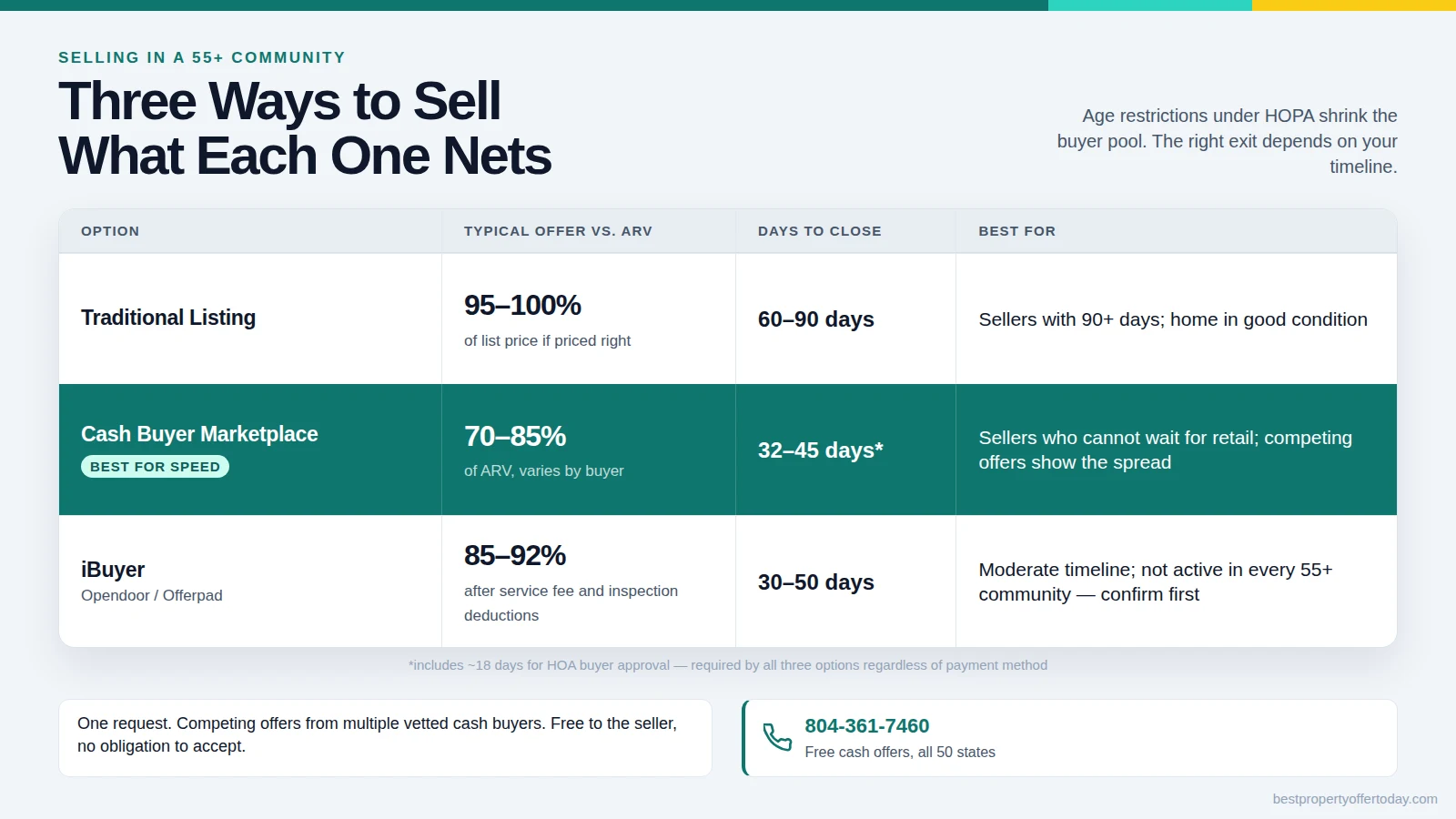
Three Ways to Sell and What Each One Nets
| Option | Typical offer vs. ARV | Time to close | HOA approval | Best for |
|---|---|---|---|---|
| Traditional listing | 95-100% of list price if priced right | 60-90 days from listing | Required, adds 2-4 weeks | Sellers with 90+ days, home in good condition |
| iBuyer (Opendoor, Offerpad) | 85-92% after service fee and inspection deductions | 14-30 days from acceptance | Still required | Sellers with moderate time who want certainty; iBuyers are not active in every 55+ community |
| Cash buyer marketplace | 70-85% of ARV, varies by buyer | 7-21 days after HOA approval | Still required | Sellers who cannot wait 60-90 days, or whose home needs repairs |
One specific note on iBuyers: both Opendoor and Offerpad have pulled back from age-restricted communities in several markets. Their automated valuation models have difficulty pricing properties where the buyer pool is structurally constrained, and they need a resale timeline that works in a narrower market. Before requesting an iBuyer offer, confirm they are currently active in your specific community, not just your zip code.
A Worked Example: $310,000 Home, Three Paths
A seller in a 55+ community in Arizona has a two-bedroom home with a likely retail value of $310,000. The home is in good condition. The seller needs to close within 60 days to move closer to family.
Path 1: Traditional listing. Lists at $305,000. After 45 days on market, a buyer offers $295,000. Net proceeds after 6 percent agent commission ($17,700), $4,000 in closing costs, and $1,500 in minor repairs: approximately $271,800. Total timeline including HOA approval: about 72 days. The seller makes the 60-day target, but only if the HOA approves within two weeks and there are no delays.
Path 2: iBuyer. Opendoor is not active in this community. Offerpad provides a preliminary offer of $279,000, subject to inspection. After inspection, Offerpad reduces to $268,000 citing an aging HVAC. The seller accepts. Net proceeds after Offerpad’s 5 percent service fee ($13,400), $4,500 in adjustment deductions, and $2,200 in closing costs: approximately $247,900. Closing: 24 days after HOA approval.
Path 3: Competing cash offers through a marketplace. The seller submits one request and receives three offers in 48 hours: $247,000, $258,000, and $261,000. Taking the highest, with no repairs and no agent commission, net proceeds after roughly $2,500 in shared closing costs: approximately $258,500. The HOA approval takes 18 days. Total time from request to close: 32 days. The seller closes with nearly four weeks to spare.
Path 1 nets the most when it works cleanly. Path 3 nets about $13,300 less than Path 1 but closes 40 days faster and eliminates the risk of a buyer’s financing falling through. Use the net proceeds calculator to run your own numbers with your actual costs before deciding.
What Happens When You Inherit a 55+ Home and You Are Under 55
This is the question that most articles on 55+ communities do not answer clearly. If you inherit a home in a 55+ community and you are 40 years old, what can you do with it?
HOPA permits occupancy by a surviving spouse who does not qualify by age, and by a person who was living in the dwelling as a co-occupant when the qualifying resident died. The key is occupant: the law protects people who were already residing there, not heirs who acquire the property from outside.
If you inherited the home but were not living there, most communities will not allow you to move in as a primary resident, because doing so would add an under-55 occupant to the census that determines HOPA compliance. You are also unlikely to get HOA approval to rent the unit to another under-55 household.
The practical result for most under-55 heirs: sell it to a qualified buyer. A cash buyer from a marketplace is usually the fastest path here, because inherited property often comes with competing timelines among heirs, carrying costs, and no appetite for a 90-day retail listing. For the mechanics of what happens when multiple heirs have different views, see our post on selling an inherited house when siblings disagree.
Red Flags When a Cash Buyer Approaches You in a 55+ Community
The same warning signs that apply to any cash transaction apply here. Two patterns come up more often in 55+ community sales specifically:
- A buyer who never mentions HOA approval: Anyone who has bought in age-restricted communities knows the approval step adds two to four weeks. A buyer promising a seven-day close without raising the HOA is either inexperienced or leaving something out
- An assignment clause: Some wholesalers write contracts with an assignment clause, planning to find a qualified 55+ end buyer after they have you under contract. If the ultimate buyer is not found or is not approved by the HOA, the wholesaler can walk, and you have lost three to six weeks. Ask for a non-assignable contract or a meaningful earnest money deposit that is forfeited on HOA disapproval
- An inspection window longer than ten days on an as-is deal: A genuine cash buyer who understands 55+ community pricing has already accounted for condition in the offer. A ten-plus-day inspection window on an as-is cash deal is often an exit ramp, not a due-diligence step
For the full framework on evaluating how much earnest money a serious cash buyer should put up, see our post on earnest money in a cash sale.
The Honest Limits of a Cash Sale Here
A cash offer on a 55+ community home will typically land at 70 to 85 percent of retail value. The difference is what you pay for speed, certainty, and no repairs. If you have the time and the home is in good condition, a traditional listing almost always nets more. That is true in an age-restricted community the same as anywhere else.
The variable specific to 55+ properties is the extended days-on-market risk in a narrow buyer pool. A retail buyer’s financing can still collapse at week eight, putting you back to day one of the listing. In a smaller pool, finding a second buyer takes longer than finding the first. That is the scenario where the certainty of a cash sale earns its discount.
When you use a marketplace to collect competing offers, you see the spread across multiple buyers in that 70 to 85 percent range. The difference between the lowest and highest cash offer on the same house can be $15,000 or more, which is exactly the information a single direct buyer will never give you. For more on how to compare those offers without being misled by headline price, see how to compare cash offers side by side.
Ready to see real numbers for your house?
Enter your property address to get competing offers from verified cash buyers. No repairs, no agent fees, and you pick the closing date.
Prefer to talk? Call (804) 361-7460
Frequently Asked Questions
Is it harder to sell a home in a 55+ community?
Harder than selling in an equivalent all-ages neighborhood, in the sense that the buyer pool is legally constrained and the HOA adds an approval step. How much harder depends on your location, your price point, and the time of year. In a Sun Belt retirement market with strong in-migration, the effect is minor. In a northern market with seasonal demand and no retiree influx, it can add weeks to the marketing period.
Do houses in 55+ communities hold their value?
Generally yes, with variation by market. Communities in high-demand retirement corridors have appreciated at rates comparable to all-ages neighborhoods over the past decade. Communities in stagnant local markets underperform, and the constrained buyer pool amplifies that underperformance. The ownership structure also matters: fee-simple communities (you own the land) behave like standard real estate. Land-lease communities (you own the home, rent the land) are more volatile, because rising lot rent is a cost buyers discount out of their offers.
Do I get a special capital gains break because I am selling at 55 or older?
No. There is a persistent misconception about a 55-and-older capital gains exclusion. That exclusion, a one-time $125,000 break for sellers 55 and older, was repealed in 1997 when the Taxpayer Relief Act replaced it with the current rules. The current exclusion, $250,000 for single filers and $500,000 for married couples filing jointly, applies to any primary residence regardless of your age. If you have lived in the home as your primary residence for at least two of the last five years, the exclusion applies. Your age is not a separate factor under current law. Consult a tax professional for your specific situation.
Can someone under 55 buy my house?
Not if the community is operating under HOPA and approving that buyer would bring the under-55 occupancy above 20 percent. The HOA will not approve the transfer. The buyer must be at least 55, or the household must include at least one resident 55 or older who is also an owner or primary occupant. A younger buyer cannot take title and rent to a qualifying 55+ tenant to satisfy the requirement, because HOPA requires the age-qualifying resident to be an owner or primary occupant, not a subtenant of an under-55 owner.