Yes, you can sell a house with black mold. The mold does not change your legal right to sell. What it changes is the buyer pool, the offer you can expect, and what you are required to tell every buyer before they sign. There are three realistic paths: remediate before listing, list as-is and disclose, or sell to a cash buyer who buys without a lender. Which path fits depends on the extent of the contamination and how much time you have.
Selling a house with black mold? Compare cash offers from buyers who price it in.
Enter your property address to get competing offers from verified cash buyers. No repairs, no agent fees, and you pick the closing date.
Prefer to talk? Call (804) 361-7460
What Black Mold Actually Is
The term "black mold" almost always refers to Stachybotrys chartarum, a slow-growing species that produces mycotoxins when it grows on wet cellulose: drywall, wood framing, and ceiling tiles that have stayed damp for seven to ten days or more. It is dark green to black and has a slimy texture.
Here is what most sellers do not know: many other mold species also appear dark. Aspergillus niger, Cladosporium, and Alternaria all look black to the eye. A visual inspection cannot tell them apart. Lab testing through spore sampling or surface swabs can. When a buyer or home inspector says "that looks like black mold," that is a color observation, not a species identification.
This matters for two reasons. First, remediation protocol depends on what you actually have. Second, a confirmed Stachybotrys test result is a material fact you must disclose in writing. A visual observation that turns out to be Cladosporium is a different legal situation. Commission the test so you know exactly what you are dealing with before you decide on a path.
For a broader look at general mold issues in a home sale, that post covers the full range of mold types and what buyers and lenders typically require across a sale.
How Black Mold Blocks a Financed Sale
A financed sale with visible mold stalls at the appraisal. Under FHA guidelines in HUD Handbook 4000.1, appraisers are required to flag visible mold as a property condition that must be corrected before closing. VA and USDA appraisers follow the same standard. The underwriter then conditions the loan on a certified remediation letter from a licensed professional. Until that letter arrives, the loan does not close.
This is not a matter of convincing the buyer to accept the condition. The lender sets the requirement, not the buyer. Even when a buyer wants the house and accepts the mold, the lender blocks the deal until remediation is complete and certified. That adds two to eight weeks to the closing timeline, and the buyer can walk during that window.
Conventional lenders operate with more discretion, but most appraisers still flag visible mold under general habitability standards. The practical result is the same: the deal stalls pending remediation.
Cash buyers have no appraiser and no underwriter. They make an offer based on their own assessment of the property. That is why a cash buyer can close on a mold-contaminated house when a financed buyer cannot.
What You Are Required to Disclose
Disclosure rules vary by state, but the core principle is consistent: you must disclose known material defects. Black mold qualifies as a material defect in every state that uses that standard.
California lists mold specifically in the Transfer Disclosure Statement. Texas requires sellers to disclose all known defects on the Seller’s Disclosure Notice. Florida does not mandate a specific form, but sellers have been successfully sued under the state’s active concealment standard, established in Johnson v. Davis (1985), when they knew about a defect and said nothing.
The concept that catches sellers off guard is "constructive knowledge." You do not have to personally know mold is present to be held liable for not disclosing it. If a reasonable inspection would have found it, courts have held sellers responsible. Mold in a crawl space you never inspected is not necessarily a safe harbor.
The practical point: disclose what you know, accurately, in writing. Concealment does not remove the mold. It converts your exposure from a reduced sale price into potential fraud liability, with no clean cut-off date in some states.
Three Paths for Sellers
Every seller with a black mold problem has the same three options. The right choice depends on extent of contamination, your timeline, and whether you have cash available to spend before closing.
| Path | Timeline to close | Upfront cost | Typical offer | Best for |
|---|---|---|---|---|
| Remediate first, then list | 60 to 120 days | $1,500 to $30,000+ | Near full market value | Class 1 or 2 contamination; seller has time and cash |
| List as-is with full disclosure | 45 to 90 days | Inspection and testing only | 10 to 20% below market | Moderate mold; conventional or cash buyer pool |
| Sell to a cash buyer | 7 to 21 days after offer | None | 15 to 25% below ARV | Urgent timeline; Class 3 or 4 contamination; lender-blocked deal |
The honest caveat: a cash offer will be below what a fully marketed retail sale would produce on a clean house. What the seller exchanges for that lower number is speed, no remediation cost, no lender delay, and no buyer walkout risk. If the house is in otherwise reasonable condition and you have the time and capital to remediate, the retail path usually produces a better net. The gap narrows the more severe the contamination gets.
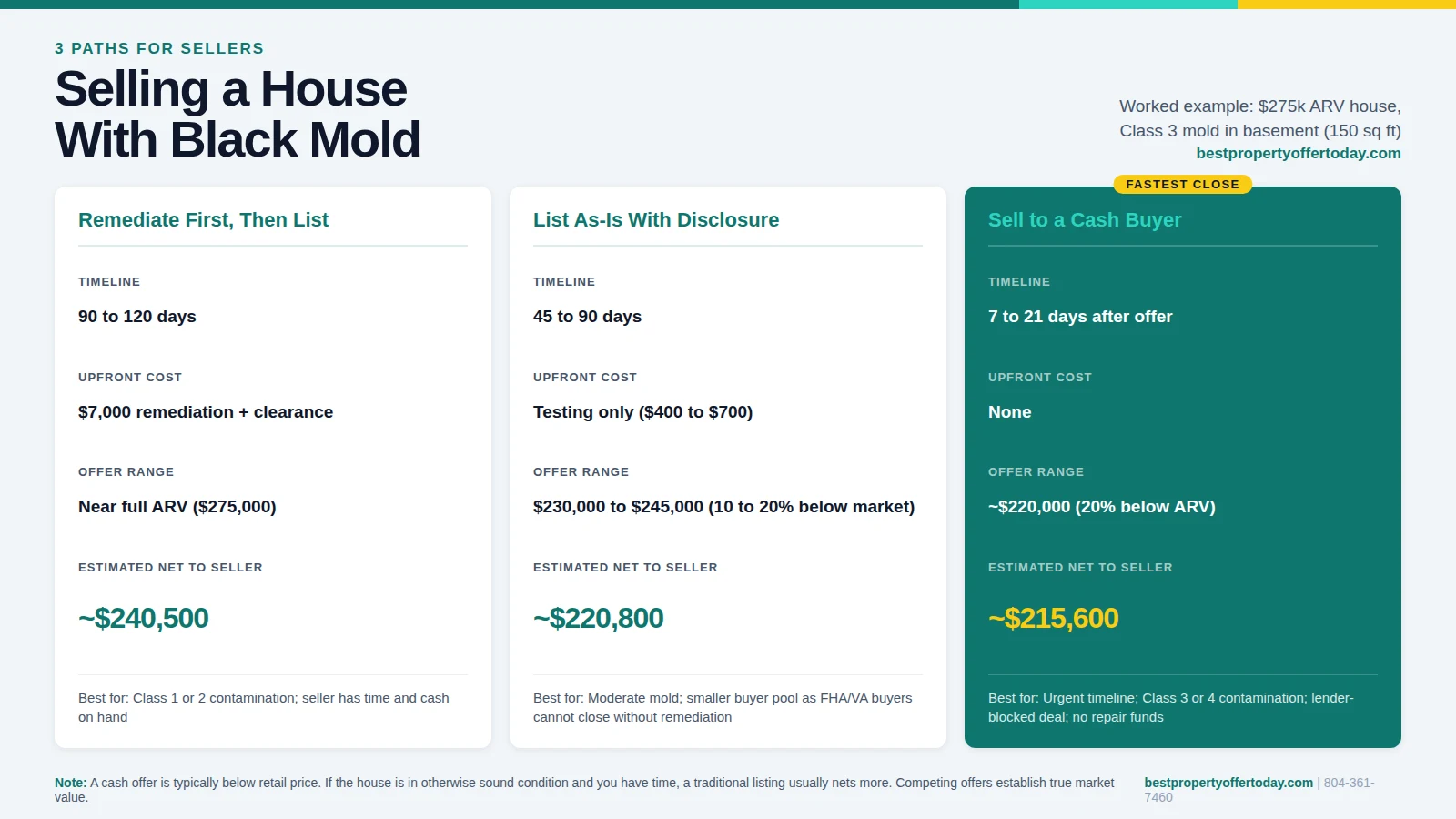
Worked Example: $275,000 ARV, Class 3 Mold in the Basement
Take a house with an after-repair value of $275,000. The basement has roughly 150 square feet of contamination on the foundation walls and rim joists. Under IICRC S520, the professional remediation standard, that is Class 3: more than 100 square feet, requiring full containment, negative air pressure, HEPA vacuuming, antimicrobial treatment, and clearance air testing before the area is released.
Path 1: Remediate first. A Class 3 remediation on 150 square feet typically costs $4,000 to $8,000, plus $400 to $700 for clearance air testing. Call it $7,000 total. After remediation, the house lists near full ARV. At 6% commission plus 2% closing costs, the seller nets roughly $247,500 before the remediation spend. Net after all costs: approximately $240,500. Total calendar time from decision to closing: 90 to 120 days.
Path 2: List as-is with disclosure. With the mold disclosed, a realistic as-is offer comes in at $230,000 to $245,000. FHA and VA buyers cannot close without remediation first, so the practical buyer pool shrinks to conventional and cash buyers. At $240,000 with 8% in total costs, net is around $220,800. No upfront spend, but the offer is lower and the timeline is not faster if buyers insist on inspections.
Path 3: Cash buyer. At 20% below ARV, a cash offer on this property lands around $220,000. No agent commission. Closing costs of 1 to 2%. Net is approximately $215,600 to $217,800. Closing takes 1 to 3 weeks after the offer. No remediation cost, no lender condition, no buyer walkout.
The gap between paths 1 and 3 is roughly $22,000 to $25,000 in this example, plus the carrying costs of 90 to 120 extra days. For a Class 4 situation where the framing must be removed and replaced, remediation alone can exceed $20,000, which closes most of that gap before the sale even begins.
Red Flags From Cash Buyers on Mold Deals
Not every cash buyer operates honestly. Mold properties attract a subset who make strong initial offers, then use the inspection period to renegotiate aggressively. Here is what to watch for before you sign.
- A long inspection window on an as-is deal. Five to seven business days is standard for a genuine cash buyer. A 15 or 20-day window usually means they are shopping the contract to other investors or arranging financing they said they did not need.
- Token earnest money. A serious buyer on a property priced above $200,000 puts down at least $2,000 to $5,000. A $500 deposit means walking away costs them nothing.
- An assignment clause. If the contract says the buyer can assign rights to a third party, you are selling to whoever they flip the contract to, not the person who made the offer.
- A price cut after the "mold inspection." Some buyers agree to your disclosed price, complete their inspection, and then send a revised lower offer citing the mold report. On a disclosed as-is sale, the mold is already priced in. This is a test of how desperate you are.
Before signing anything, vet the buyer: ask for proof of funds dated within 30 days, check their company registration, and look for completed transactions. A legitimate buyer will not object to any of those requests.
When you have offers in hand, the number to compare is net to seller after all costs, not the headline price. The side-by-side offer comparison guide walks through how to normalize offers so you are comparing the same thing across buyers.
If you want to see what competing offers actually look like on your property, you can submit one request here and receive offers from multiple vetted buyers within 24 to 48 hours. The service is free and there is no obligation to accept anything. Use the net proceeds calculator to run the numbers before you decide. Questions before you submit: 804-361-7460.
Ready to see real numbers for your house?
Enter your property address to get competing offers from verified cash buyers. No repairs, no agent fees, and you pick the closing date.
Prefer to talk? Call (804) 361-7460
Frequently Asked Questions
How much does black mold remediation cost?
Remediation cost follows the IICRC S520 classification of the contamination. Class 1, up to 10 square feet, runs $500 to $1,500 and usually involves surface cleaning with antimicrobials. Class 2, from 10 to 100 square feet, costs $1,500 to $6,000 and requires containment and HEPA equipment. Class 3, over 100 square feet, is $3,000 to $12,000. Class 4, where contamination has penetrated structural framing or sheathing and those materials must be cut out and replaced, runs $10,000 to $30,000 or higher depending on the scope. Clearance air testing adds $300 to $700 on top of remediation. Get at least two quotes from licensed remediation contractors, not general handymen, before committing to any estimate.
How much does black mold devalue a house?
An unremediated mold problem typically reduces the effective sale price by 15 to 25 percent below ARV, with the discount widening for larger contamination areas or structural involvement. A fully remediated house with clean clearance documentation and a licensed contractor’s report can often sell near full market value, though some buyers discount slightly even after remediation. The smallest price impact comes when the moisture source has been corrected, the remediation was done by a licensed contractor, and the clearance report is available at listing.
Can I be sued after selling a house with black mold?
Yes, if you knew about the mold and failed to disclose it. The risk does not end at closing. Florida’s constructive knowledge doctrine, California’s TDS requirements, and similar standards in most states extend liability beyond the sale date. The question is not only what you told the buyer but what a reasonable inspection would have found. If mold was visible or accessible and you said nothing, the buyer can bring a misrepresentation or fraud claim. Full written disclosure at the time of sale is the most reliable protection available. Concealment creates more legal exposure than any price reduction from disclosure would have.
What is Class 4 mold contamination?
Class 4 is the most severe classification under IICRC S520. It means mold has penetrated into structural materials: wall framing, floor joists, roof sheathing, or subfloor. Surface cleaning cannot address it. The contaminated wood must be physically removed and replaced. Sellers who see references to "Stage 4" or "Level 4" mold from non-certified inspectors are usually encountering the same concept. Class 4 is the scenario where the gap between a retail sale and a cash sale is smallest, because remediation alone can exceed $20,000, and that cost eats most of the price difference before the sale even begins.