Selling a Stigmatized Property: What Sellers Actually Need to Know
Stigmatized properties sell. The buyer pool is smaller, some financing-dependent buyers walk after disclosure, and the discount varies by state law and the nature of the event. What determines your outcome is understanding three things: what your state requires you to disclose, how that shapes your realistic buyer pool, and what each exit path actually nets. The answers below are specific enough to put numbers to your decision today.
See what cash buyers would offer for your house
Enter your property address to get competing offers from verified cash buyers. No repairs, no agent fees, and you pick the closing date.
Prefer to talk? Call (804) 361-7460
What “Stigmatized” Means Under Real Estate Law
A stigmatized property has no physical defect that reduces its structural value. The stigma is psychological: something happened on or near the property that affects how buyers perceive it, and that perception can lower what buyers are willing to pay.
Courts and state statutes have addressed four categories: death on the premises (natural causes, suicide, or homicide), serious criminal activity (a former meth lab, an organized crime incident), paranormal reputation (a property publicly known as haunted), and proximity to a registered sex offender or high-profile crime scene.
Physical contamination is different and treated more strictly. A former meth lab with residual chemicals is a defect, not just a stigma. It carries remediation requirements and mandatory disclosure regardless of which state you are in. The two categories are not interchangeable in the law, and mixing them up in a contract can expose you to liability.
What Your State Requires You to Disclose
Disclosure rules vary significantly by state, and the variation matters more than most sellers expect. Here are four states that illustrate the range:
California has the most specific rule. Under Civil Code Section 1710.2, a seller must disclose a death on the property if it occurred within the past three years, regardless of cause. After three years, the seller cannot lie if a buyer directly asks, but has no affirmative duty to volunteer the information. Agents in California must answer honestly if directly asked even when the three-year window has passed.
Texas takes the opposite position. Property Code Section 5.008 specifically exempts psychological stigmas from the disclosure list. A seller in Texas has no legal duty to disclose a death, homicide, or suicide. Active deception is still prohibited, but silence is not misrepresentation under state law.
New Jersey falls in the middle. Under N.J.S.A. 46:3-45 through 48, a seller does not have to volunteer information about a murder or suicide. If a buyer or the buyer’s agent asks directly, the seller must answer honestly. The agent has no duty to bring it up unprompted.
Virginia exempts deaths and crimes from required disclosure under Code 55.1-702. As in Texas, the seller cannot actively deceive, but silence is not a legal violation.
The practical takeaway: in states without mandatory disclosure, you have more pricing flexibility because you are not legally required to announce the event. In states like California with a mandatory window, the disclosure is baked into every offer you receive during that period. Pricing it in upfront is usually cleaner than dealing with post-disclosure renegotiation after a buyer has emotionally committed.
These summaries describe the statutes; real estate contracts and local agency regulations add layers. Consult a real estate attorney before you list or sign anything. The specific language of your contract and state code controls, not a blog post.
How Stigma Changes Your Buyer Pool
Most retail buyers using financing have two hurdles: their lender’s appraisal and their own comfort. A death or crime history does not affect an appraisal unless it is physically visible (crime-scene damage, remediation work) or the public record makes it immediately findable. What it does affect is buyer psychology at offer time and after the inspection period begins.
In practice, this plays out three ways. Some buyers ask for a price reduction after learning about the history. Others withdraw during the inspection contingency window, which in most markets is a free exit within 10 to 14 days of going under contract. Others close at the agreed price, particularly in markets where supply is tight and buyers have been outbid repeatedly.
Cash buyers are different for one mechanical reason: no lender to satisfy. No appraisal condition, no underwriter reviewing the property history, and no financing contingency. A cash buyer who is comfortable with the stigma can close without any third party weighing in. That is why investors and cash buyers are the dominant buyers for stigmatized properties, not because they are more relaxed about dark histories, but because they have fewer structural barriers between signing and closing.
Three Paths: What Each One Actually Nets
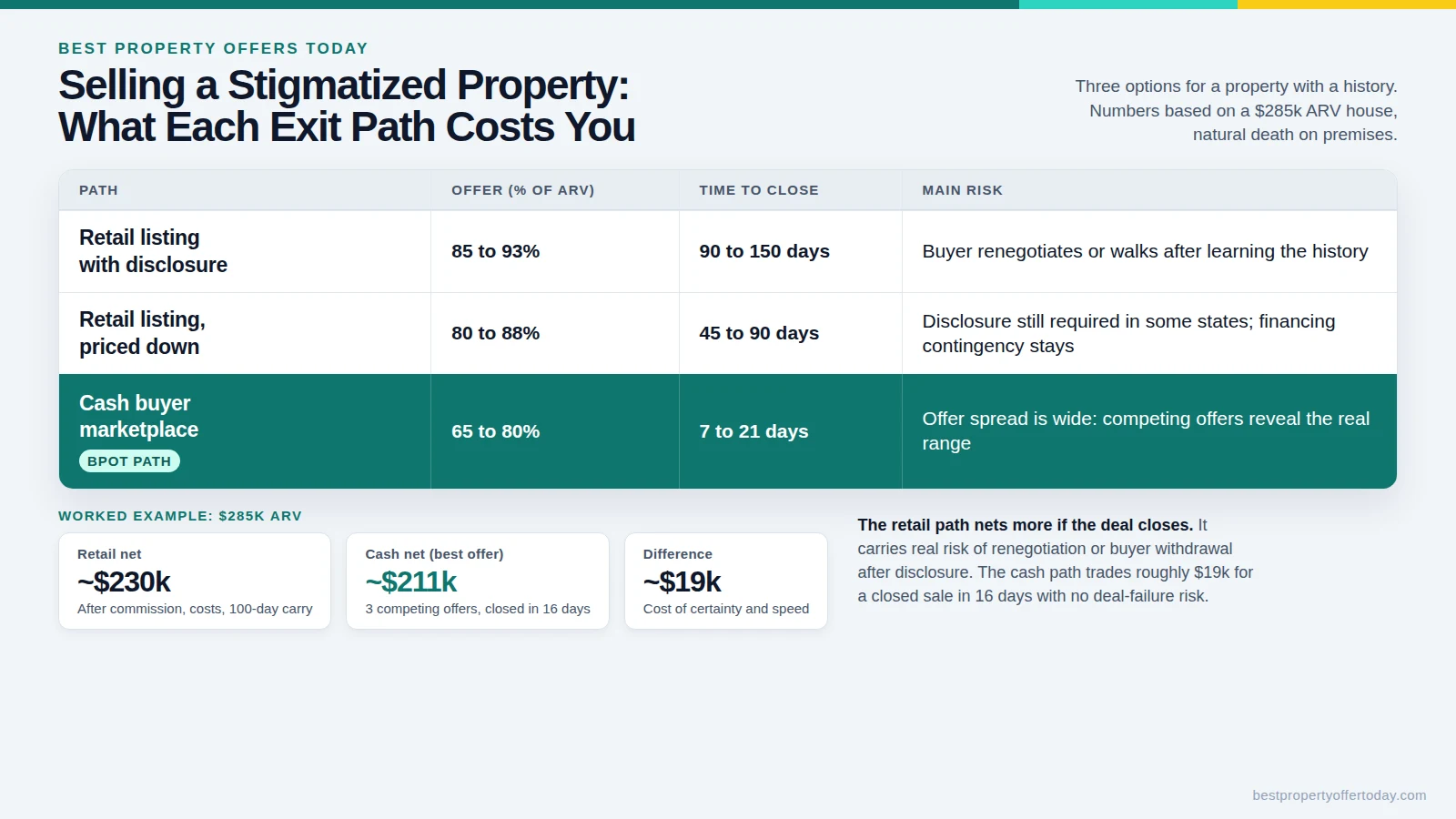
The right path depends on how urgently you need to close, how the stigma is likely to be received in your local market, and what your state requires you to say. Here is how the three main options compare:
| Path | Typical offer | Timeline | Main risk |
|---|---|---|---|
| Retail listing with full disclosure | 85 to 93% of ARV | 90 to 150 days | Buyer renegotiates or walks after learning the history |
| Retail listing priced to reflect stigma | 80 to 88% of ARV | 45 to 90 days | Must still disclose if required; financing contingency stays |
| Cash buyer via marketplace | 65 to 80% of ARV | 7 to 21 days | Wide offer spread; vetting the buyer matters |
The cash offer is typically lower. That is the honest trade-off. What it buys you is speed, certainty, no carrying costs during a long market hold, and no deal collapse after a buyer changes their mind or their lender asks questions. If the house is in good condition and you have time, a traditional listing usually nets more. The cash path is for sellers who need a closed deal more than a maximum number.
Worked Example: A Death on the Premises in a No-Disclosure State
A seller in Arizona (no mandatory disclosure for death) owns a house with an after-repair value of $285,000. The previous owner died of natural causes in the bedroom two years ago. The house is in good structural condition: no damage, no contamination, nothing a physical inspection would flag.
Retail path: Lists at $285,000. After 80 days on market, an offer comes in at $265,000. The buyer’s agent discovers the death history from neighbors during the inspection period. The buyer requests a $10,000 price reduction. Final sale price: $255,000. After 5.5 percent commission ($14,025) and $4,500 in seller-paid closing costs, net to seller is $236,475. The hold took 100 days at roughly $1,800 per month in carrying costs (mortgage, taxes, utilities, maintenance), adding another $6,000. Total effective net: approximately $230,475.
Marketplace path: Submits one request and receives three competing offers within 48 hours. Offers range from $186,000 to $213,000. The highest offer is $213,000 from a buyer who regularly closes estate and probate properties in that market. Standard closing costs of $2,100 apply. Net to seller: $210,900. Closes in 16 days with no carrying costs beyond those 16 days.
The retail path nets roughly $19,000 to $20,000 more in this scenario, assuming the buyer does not walk entirely after learning the history. If the first deal falls through and re-listing starts the clock over, the gap closes fast. The net proceeds calculator can run your specific numbers, including your mortgage payoff, local commission rates, and estimated carry time.
Use competing offers from a marketplace like Best Property Offers Today to establish your market floor, even if you ultimately decide to list retail. You will know what the cash exit costs you, in actual dollars, before you commit to a 90-day listing.
What Cash Buyers Actually Price When They See a Stigmatized Property
Cash buyers use the same after-repair value formula regardless of stigma, but they build in an additional discount for three reasons: resale uncertainty (they will eventually need to find a retail buyer who is comfortable with the history), time risk (the resale may take longer than a comparable property), and negotiation protection (they expect sellers to push back and leave room for it).
The discount for a natural death is typically smaller than for a homicide. A property associated with a high-profile crime can carry a significantly larger discount because the public record is easy to find and the eventual resale buyer pool narrows further. Academic research on this question shows natural-death discounts averaging 2 to 5 percent; homicide properties have shown discounts of 15 to 25 percent in markets where the event was publicized.
When you submit a request through a marketplace, you are not accepting the first number you see. You are establishing what multiple independent buyers will pay for the same property. That range is useful even if you decide not to sell: it tells you where the retail price needs to be to attract a buyer who does not know the history, and it quantifies what the stigma discount actually is in your specific market.
Red Flags When a Cash Buyer Contacts You First
Some buyers specifically target stigmatized properties because they know sellers are under pressure and may accept a low offer without testing the market. These patterns are worth flagging:
- An assignment clause in the contract. This means the buyer intends to sell your contract to another buyer before closing. They are a wholesaler, not a direct buyer. The buyer they assign to may not be comfortable with the stigma, and the deal can collapse at the last moment.
- Token earnest money. Five hundred or a thousand dollars on a $200,000 purchase. Walking costs them nothing if they find anything inconvenient. See the full post on how much earnest money is enough in a cash sale.
- A very long inspection or due diligence window. A legitimate cash buyer on an as-is purchase does not need 30 days to inspect a property with no physical defects. A long window is a low-cost option to find a retail buyer to assign to.
- A price that drops after the “inspection” on a property with no structural issues. The stigma was priced in at the offer stage. A post-inspection cut on an as-is sale is a bait-and-switch. For more on buyer vetting, see how to tell whether a cash buyer is legitimate.
Questions to ask before you sign: Is this offer directly funded by you, or will it be assigned? What is the earnest money amount, and is it non-refundable after a fixed date? How many stigmatized or estate properties have you closed in the past 12 months? Do you require a formal physical inspection, or is this truly an as-is transaction?
Ready to see real numbers for your house?
Enter your property address to get competing offers from verified cash buyers. No repairs, no agent fees, and you pick the closing date.
Prefer to talk? Call (804) 361-7460
Frequently Asked Questions
Does a death in a house lower its value?
Academic studies show modest discounts of 2 to 5 percent for most natural deaths, rising to 15 to 25 percent for high-profile violent crimes. The discount is larger in markets with strong supply and smaller in markets where buyers compete hard for inventory. The specific history matters more than the broad category.
Can a financed buyer get a loan on a stigmatized property?
Yes, as long as the appraisal comes in at or above the purchase price and the physical condition passes the lender’s requirements. The stigma itself does not appear on an appraisal if there is no visible damage. FHA and VA loans require the property to meet livability standards; a stigma without physical damage does not trigger those conditions. Where lenders get complicated is when the stigma is well-publicized and comparable sales are hard to find.
How long does a stigmatized property take to sell?
Retail: stigmatized properties typically spend between 50 and 150 days on market, depending on the degree of stigma and local supply. Cash sale: 7 to 21 days is normal, limited by title work rather than buyer hesitation. The harder the stigma is to disclose at a retail price, the more the timeline gap matters to the total cost of selling.
Do I have to disclose if a previous owner, not me, was involved?
In states with mandatory disclosure, the duty typically attaches to the property, not to whether you were the owner at the time of the event. California’s three-year rule runs from the date of death, not from when you acquired the property. Know when the event occurred relative to your ownership date before assuming the disclosure window has passed. When in doubt, ask an attorney rather than assuming silence is safe.
To get competing cash offers on a stigmatized property with no obligation and no fee, call 804-361-7460 or submit your address at Best Property Offers Today. Offers typically come back within 24 to 48 hours.