Lead pipes do not automatically stop a home sale. What they do is narrow your buyer pool, change which buyers can close, and shift how much you net at the table. The right path depends on which kind of lead you have, what it costs to fix, and whether you have the time and money to do it before listing.
Selling a house with lead pipes? Compare cash offers from buyers who price it in.
Enter your property address to get competing offers from verified cash buyers. No repairs, no agent fees, and you pick the closing date.
Prefer to talk? Call (804) 361-7460
Two kinds of lead pipe problems, and why they are different
Not all lead pipe issues work the same way. There are two separate problems, and conflating them leads to bad decisions.
Lead service line. This is the pipe running underground from the city water main to the house, usually terminating at the meter or at the point where it enters the foundation wall. These were standard in homes built before the 1950s, though some were installed through the mid-1980s. The homeowner typically owns the section from the property line to the house. The water utility owns the rest.
Interior lead pipes and solder. Homes built before 1986 may have interior plumbing with lead solder at the joints, even if the visible pipes are copper. Some older properties have full lead interior pipes. These are inside the walls and affect water quality directly.
These two problems carry different replacement costs, different lender responses, and different disclosure requirements. Treat them separately when you are deciding what to do before listing.
What year houses do you have to worry about lead pipes
Pre-1950 homes are most likely to have full lead service lines and lead interior pipes. Homes built between 1950 and 1986 often have lead solder at copper pipe joints even when the pipes themselves are copper. Homes built after 1986 are unlikely to have lead plumbing because the Safe Drinking Water Act Amendments of 1986 banned lead solder and lead pipe in new construction.
The service line is a separate question from the interior. Even a house built in 1960 with updated interior copper plumbing may still have an original lead service line running from the meter to the foundation. The two checks are independent.
How to find out if you have a lead service line
Start with your water utility’s service line inventory. The EPA’s Lead and Copper Rule Improvements (LCRI), finalized in 2024, require water systems to publish a full inventory of service line materials and to replace all lead service lines within 10 years. Many utilities have already published searchable databases by address.
If the inventory lists your line as “unknown,” inspect it yourself at the point where the service line enters the foundation. Lead pipe is dull gray, soft enough to scratch with a key, slightly flexible, and heavier than plastic. Copper is bright or greenish and rigid. Galvanized steel is gray, rigid, and magnetic. If you are uncertain, a licensed plumber can confirm the material at the entry point in under an hour.
Interior lead solder is harder to identify without lab testing. A water quality test from a certified lab (typically $20 to $100) will detect elevated lead levels at the tap if solder or interior pipes are leaching into the water. For more on selling a house with galvanized pipes, that post covers the similar identification and lender-objection mechanics in detail.
What lenders and appraisers are doing about it now
Lead paint has a clear federal disclosure requirement under the Residential Lead-Based Paint Hazard Reduction Act. Lead pipes do not, at the federal level. But the lending picture is shifting.
FHA appraisers are trained to flag visible signs of deferred maintenance that affect health and safety. Lead service lines increasingly appear in appraisal reports as conditions requiring remediation before FHA loans can close. VA appraisers follow similar guidance. Conventional lenders have more flexibility, but an appraiser who flags a lead service line creates a condition the lender can choose to enforce.
The practical result: some financed buyers will not be able to close on a house with a known lead service line unless the seller replaces it, the buyer’s lender agrees to escrow for the cost, or the buyer switches to a lender who does not flag it. Cash buyers have no lender layer. They can close on the property exactly as it sits, with the lead service line disclosed and priced into the offer.
Disclosure: what the law actually requires from sellers
The federal lead paint disclosure law covers lead paint and lead paint hazards. It does not cover lead pipes. This surprises sellers who assume the two are treated the same way.
What does apply is state material defect disclosure law. Every state requires sellers to disclose known material defects that affect value or habitability. A known lead service line is a material defect in every jurisdiction. Selling as-is limits your obligation to repair. It does not limit your obligation to disclose.
Some cities with active lead service line replacement programs, including Chicago, Milwaukee, Pittsburgh, and Newark, have added local ordinances that require sellers to disclose the service line material at sale or at the time of transfer. If you are in one of those markets, check the current local requirement before listing.
One thing worth saying plainly: a seller who knows about a lead service line and does not disclose it carries liability past closing. Buyers who discover it afterward have grounds for rescission and damages. The disclosure conversation is uncomfortable. The post-closing litigation is worse.
What replacement actually costs
Lead service line replacement runs between $5,000 and $15,000 for a typical residential property, depending on the depth of the line, soil conditions, sidewalk permit requirements in your municipality, and whether any curb-to-property-line work falls under a utility program the city will cover.
Some municipalities with established replacement programs offer partial subsidies, particularly for lower-income homeowners. Detroit, Chicago, and Newark have all run programs that covered the utility side at no cost and offered low-interest financing for the private side. Check with your water utility before assuming you bear the full cost.
Interior pipe replacement is more expensive because it involves opening walls. Full interior re-plumbing for a typical three-bedroom house runs from $10,000 to $30,000. Lead solder alone is a smaller concern at sale. A filter certified to NSF/ANSI 53 at the tap resolves the exposure risk and is typically acceptable to buyers and lenders if solder is the only issue.
Three paths and what each one nets
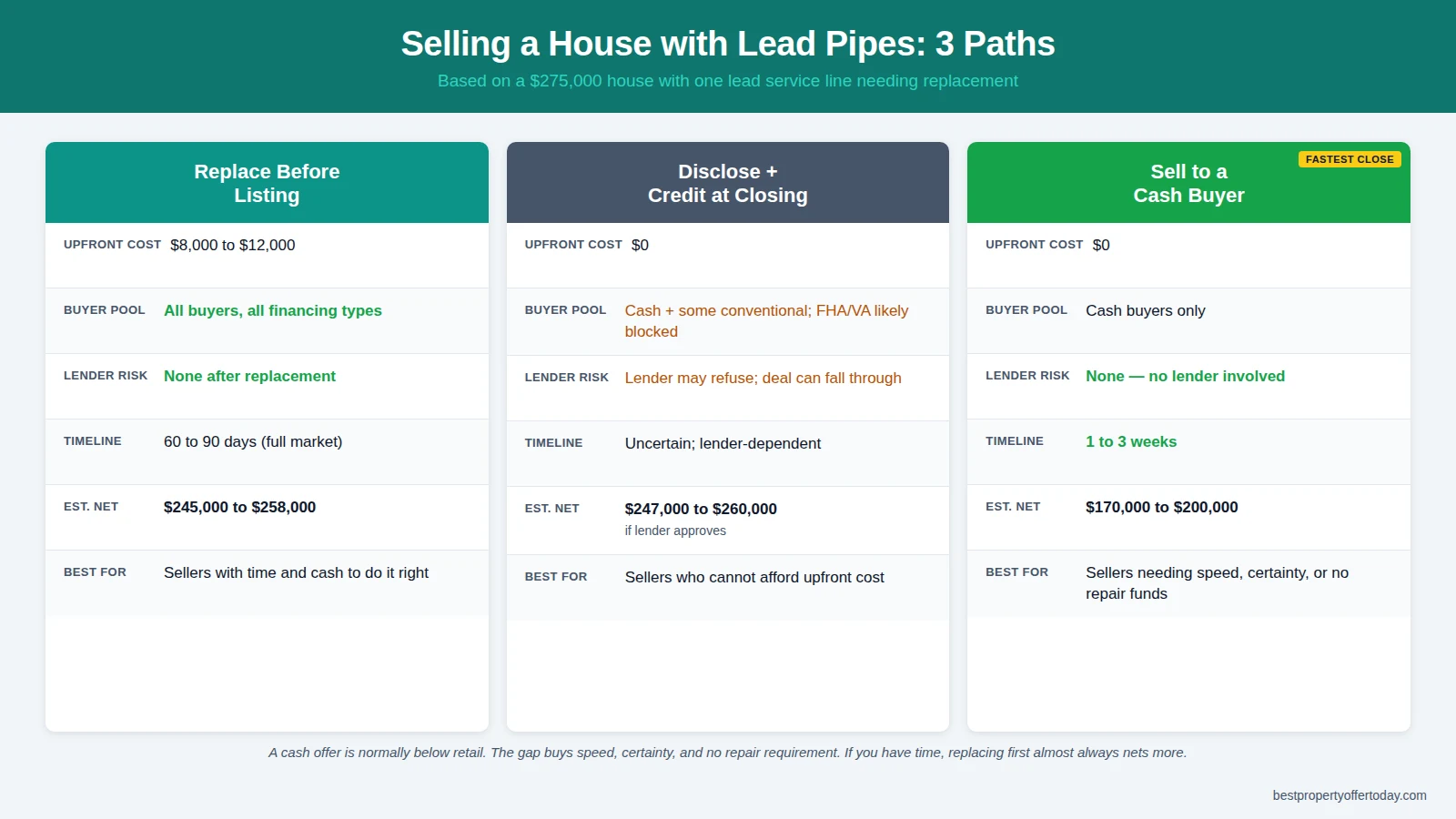
Here is what each option looks like on a $275,000 house with a lead service line that needs replacement and no other major defects.
| Path | Upfront cost | Buyer pool | Estimated net |
|---|---|---|---|
| Replace before listing | $8,000 to $12,000 | All buyers, all financing types | $245,000 to $258,000 |
| Disclose, offer credit at closing | $0 | Cash plus some conventional; FHA/VA likely blocked | $247,000 to $260,000 if lender approves |
| Sell to a cash buyer as-is | $0 | Cash buyers only | $170,000 to $200,000, closing in 1 to 3 weeks |
The numbers show the tradeoff. Replacing before listing costs real money but opens up the full buyer pool and typically recovers most or all of that cost in the sale price. A closing-cost credit can work but depends on finding a financed buyer whose lender will close, which is not guaranteed on a property with a disclosed lead service line. A cash buyer closes without conditions but prices the risk and repair cost into the offer.
A cash offer is normally below a fully marketed retail price. What you are trading is the gap between $200,000 and $258,000 in exchange for certainty, speed, and no requirement to spend money you may not have on a service line you cannot see. For some sellers that trade is worth it. For others, with time and money available, the replacement path nets more. Neither is wrong. They serve different situations.
Use the net proceeds calculator at /sell-my-house-calculator to compare what each path actually leaves in your pocket after the sale.
Red flags when cash buyers make an offer on a lead pipe property
Not every cash offer is straightforward. These are the warning signs on a lead-pipe deal specifically. For a fuller guide to how to tell if a cash buyer is legitimate, that post covers the full vetting checklist.
- The offer arrives as-is, then drops $15,000 to $20,000 “after the walkthrough” despite your disclosure
- Earnest money is $100 to $500 on a house worth over $200,000
- The contract includes an assignment clause, meaning they can sell your contract to a third party before closing
- The inspection period runs 10 or more days on what they described as an as-is purchase
- They ask you to get contractor estimates for the service line “so we can lock in the price” after signing
A buyer who disclosed the lead service line in their offer already knows the replacement cost. Their number accounts for it. If the offer drops after disclosure, that is a price renegotiation dressed up as a discovery. It is the most common tactic on properties with known defects.
How cash buyers price a lead pipe property
Most start with the after-repair value (ARV) of the house, apply a percentage, then deduct estimated repair costs. Lead service line replacement typically deducts $8,000 to $15,000 from the formula, sometimes more if the buyer expects the city to impose a full replacement order during their hold period. Interior re-plumbing deducts more. The spread between competing offers on the same property can be $30,000 or more, because different buyers estimate repair costs differently and build different profit margins in.
How cash buyers calculate their offer explains the full ARV and 70-percent rule mechanics if you want to run the numbers yourself before the first call. The key point: if you submit the property to multiple buyers, that spread narrows. Buyers who know other offers exist tend to price more aggressively.
That is the marketplace angle. A single cash buyer already knows you have limited options. Multiple competing buyers have to earn the deal. The difference between those two situations is typically the difference between the low end and the high end of that $30,000 spread.
Does a lead service line lower my asking price?
It limits your buyer pool before it necessarily lowers your price. FHA and VA buyers may be blocked entirely, which reduces competition and tends to push offers down. Replacing the line before listing removes that constraint and usually recovers most of the replacement cost in the final sale price.
Can I sell without disclosing the lead pipes?
Not if you know about them. State material defect disclosure laws require disclosure of known material defects. A lead service line you are aware of is a known material defect. Non-disclosure creates liability that follows you past closing, including potential rescission and damages if the buyer discovers it afterward.
What if the city orders me to replace the lead service line?
Municipal replacement orders generally attach to the property, not the owner. If you receive notice that the city is replacing the utility side and billing you for the private side, that obligation exists whether or not you sell. A buyer purchasing the property takes that obligation on. Disclose the notice to any buyer. A cash buyer will typically absorb it in their offer. A financed buyer’s lender may require resolution before closing.
Should I replace the lead service line before or after listing?
Before, if you can. Replacing before listing opens the full buyer pool, removes the lender objection entirely, and typically recovers most or all of the cost in the sale price. Replacing after going under contract is possible but adds a contingency that can delay or kill the deal. If the house is otherwise in good condition and you have time, the pre-listing replacement path almost always nets more than a credit or a cash-buyer discount.
Call 804-361-7460 or start at the offer request form to submit the property details and collect competing offers from vetted buyers. The service is free, there is no obligation to accept, and offers typically come back within 24 to 48 hours.
Ready to see real numbers for your house?
Enter your property address to get competing offers from verified cash buyers. No repairs, no agent fees, and you pick the closing date.
Prefer to talk? Call (804) 361-7460