Oil heat is not a dealbreaker. In parts of the Northeast, roughly half the homes on a given street run on it. But it creates friction in the sale process, and that friction hits hardest when a buyer brings financing. Knowing where the friction lives, and what it costs to remove it, is what gives a seller real options.
Selling a house with oil heat? Compare cash offers from buyers who price it in.
Enter your property address to get competing offers from verified cash buyers. No repairs, no agent fees, and you pick the closing date.
Prefer to talk? Call (804) 361-7460
Why Financed Buyers Hesitate
The hesitation is not about the heat itself. Oil furnaces and boilers are reliable. A well-maintained oil system can run for 25 to 30 years. The problem is the lending layer that sits between a buyer’s offer and the closing table.
FHA, VA, and USDA loans require that the appraiser note the condition of the heating system. For underground storage tanks, most lenders require an inspection or certification confirming there is no contamination. Even aboveground indoor tanks can trigger a flag. A conventional lender’s underwriter may require documentation that a tank passes visual inspection if the appraisal notes it as aged or showing corrosion.
What this means in practice: a buyer who is pre-approved for $340,000 can lose their approval because the appraiser flagged a 25-year-old oil tank. The deal does not die immediately, but it goes into a renegotiation loop. Those loops cost time and usually cost the seller money.
Insurance is a separate layer. Some carriers charge higher premiums for homes with oil heat, particularly for tanks over 15 to 20 years old. A few decline to cover the property or add an exclusion for tank leaks. A tank that an insurer refuses to cover is a tank a financed buyer cannot close on.
Aboveground vs. Underground Tanks: Different Problems
Most homes heated by oil have an aboveground indoor tank, typically a 275-gallon steel tank in the basement or utility room. These are common, relatively straightforward to inspect, and do not carry the environmental liability that underground tanks do.
If your home has or had an underground storage tank (UST), the situation is different. Lender requirements are stricter, disclosure duties are broader, and remediation costs if contamination is found can run into the tens of thousands. The mechanics of selling a home with an underground tank are covered separately in our guide to selling a house with an underground oil tank.
For aboveground indoor tanks: the main concerns are age, condition, and whether the tank has a secondary containment pan or spill kit. Tanks over 20 years old often face insurance scrutiny. A reputable oil service company can perform a visual inspection for $150 to $300, and that inspection report can head off lender flags before they stall a deal.
The Conversion Question
The most common question sellers ask is whether to convert before listing. The answer depends on three things: whether a gas main runs to the street, what conversion actually costs in your area, and how long you can wait.
Converting from oil to natural gas requires a gas service line from the main to the house, a new furnace or boiler, and often an upgrade to the flue. Total cost typically runs $8,000 to $15,000 in areas where gas is available at the street. If a gas main does not run to your road, extending service can add $3,000 to $8,000 or more, and the utility company may require a minimum number of customers to justify that extension at all.
Converting to a heat pump system instead runs $12,000 to $25,000 depending on the size of the house and whether supplemental electric heat strips are needed for colder climates. Heat pumps work well above roughly 20 degrees Fahrenheit and lose efficiency below that, which is why the Northeast remains a mixed market for them.
Neither conversion is a guaranteed return. Buyers may value a newer system, but they generally do not pay dollar for dollar for seller improvements they did not ask for. The more useful question is not “will I get the money back” but “does this removal of friction actually change how many buyers can finance this house.”
What Happens to the Oil in the Tank at Closing
This catches sellers off guard consistently. The oil remaining in the tank is personal property. The seller owns it and either takes it (which requires pumping it out and disposing of it properly) or the buyer pays the seller for the remaining fuel at the prevailing delivery price.
Standard practice is a tank reading at or just before closing, with the buyer crediting the seller for the remaining fuel at the current market rate per gallon. At roughly $3.50 to $4.50 per gallon and a 275-gallon residential tank, that credit runs $200 to $900 depending on how full the tank is. Put it on the settlement statement as a standard adjustment and it rarely causes a dispute.
What causes disputes is ignoring it and discovering mid-escrow that neither party has addressed it. Add it to the purchase and sale agreement or handle it in the final walkthrough. It is a small number, but small numbers that are not nailed down become big arguments when both sides are stressed three days before closing.
Three Paths: A Worked Example
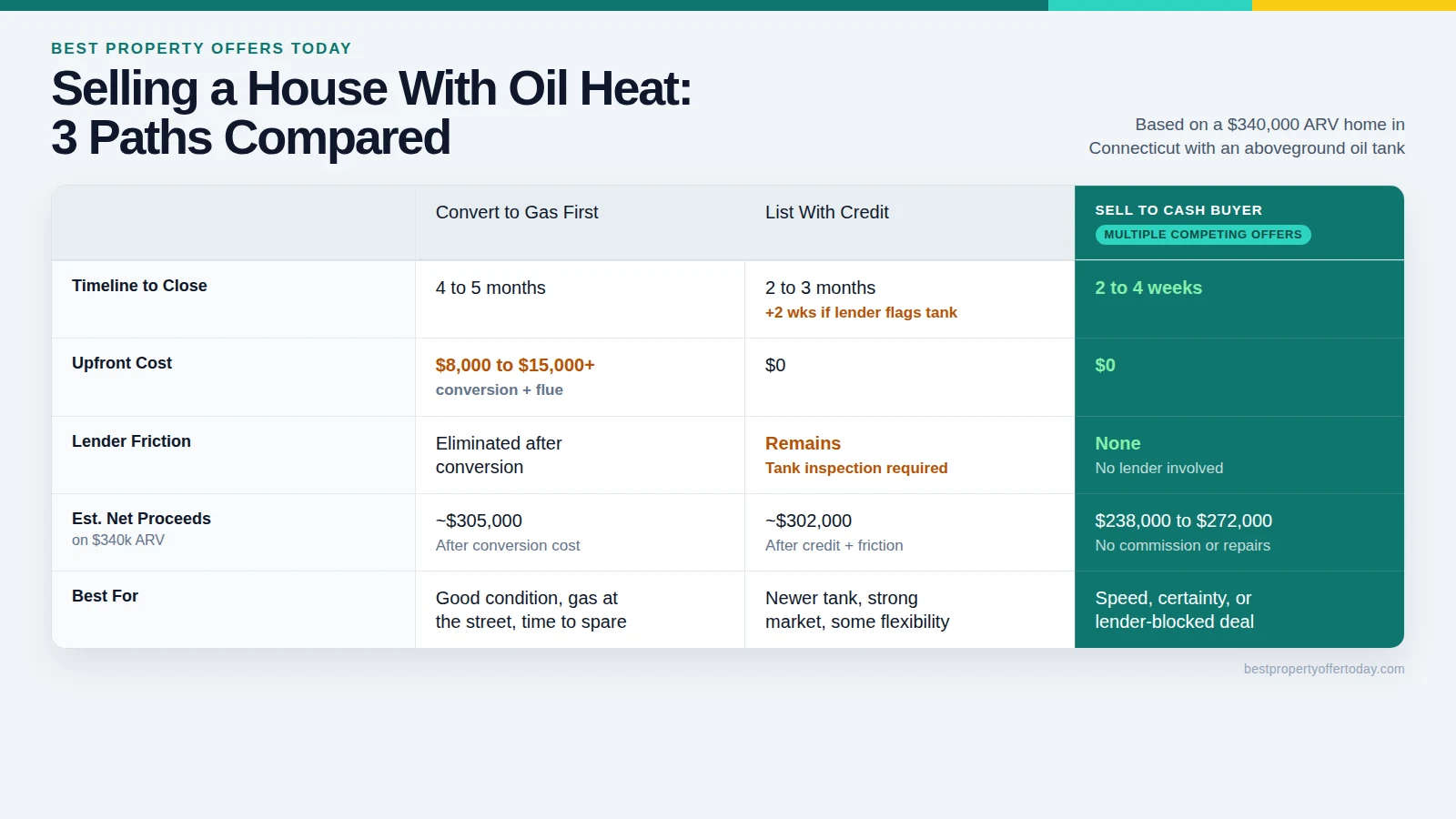
Here is how the numbers play out on a house in Connecticut, ARV (after-repair value) $340,000, currently heated by oil, with a 20-year-old aboveground indoor tank.
Path 1: Convert Before Listing
The gas main runs to the street. A licensed HVAC contractor quotes $11,000 for conversion: new line, new high-efficiency gas boiler, flue liner. Work takes six weeks. The house then lists at $340,000.
At closing: sale price $340,000, agent commission 5% ($17,000), seller closing costs roughly 2% ($6,800), net before conversion $316,200. Subtract the $11,000 conversion cost: approximately $305,200 net. Timeline from decision to close: four to five months.
Path 2: List With a Conversion Credit
The house lists at $340,000. The agent recommends offering a $10,000 conversion credit to attract buyers. An offer comes in at $335,000 with the credit included, effective price $325,000.
At closing: 5% commission ($16,250), 2% closing costs ($6,500), net approximately $302,250. Faster than Path 1, but lender friction remains. The buyer’s FHA lender flags the aging tank and requires a tank inspection. The inspection comes back clean but adds two weeks and $400 in costs. The buyer’s attorney asks the seller to cover the inspection cost. That is a negotiation nobody planned for.
Path 3: Sell to a Cash Buyer
Cash buyers skip the lender layer entirely. They do not need an appraiser to sign off on the tank. They price the condition into their offer rather than requiring a repair or credit.
At 70% to 80% of ARV, the offer range runs $238,000 to $272,000 on this house. No commission, no closing costs on the seller’s side, no conversion cost. The difference from Path 1’s net is roughly $33,000 to $67,000. That gap is what the seller pays for speed, certainty, and the removal of lender friction.
When multiple cash buyers compete for the same property through a marketplace, offers tend to cluster toward the upper end of the range rather than the floor. A single buyer has no reason to bid above 70%. Four buyers competing for the same deal do. That difference in outcome is specific to a marketplace model and is not available when calling a single buyer directly. Run the numbers on your house at our net proceeds calculator.
Compare your options carefully before signing anything. Our guide to comparing cash offers side by side walks through how to normalize net proceeds, earnest money, closing timeline, and assignment risk so you are comparing the same thing across different buyers.
Red Flags From Cash Buyers on Oil-Heated Homes
Not every cash buyer operates honestly. Oil-heated homes attract some buyers specifically because a motivated seller facing lender friction may accept terms they would not otherwise. These are the patterns to watch for.
A token earnest money deposit, under 1% of the purchase price, means walking away costs them nothing. On a $250,000 offer, $500 in earnest money is not a signal of commitment.
A long inspection period on an as-is cash deal. Cash buyers who price condition into their offer do not need three weeks to inspect. A 21-day inspection window on an as-is transaction often means the buyer is marketing the contract to end buyers and needs time to find one. That is a wholesale deal, and the original offer price may bear no relation to what eventually closes. Our guide to identifying wholesalers covers the assignment clause mechanics in detail.
A price reduction after the inspection period on a deal already priced as-is. The buyer knew the tank situation when they made the offer. A price cut after inspection on a property that was clearly disclosed as-is with an oil system is a bait-and-switch. Walk away and call the next buyer.
Questions to Ask a Cash Buyer Before Signing
- Are you the end buyer, or will you assign this contract to another party?
- How much earnest money are you putting down, and is it non-refundable after the inspection period?
- Do you require a tank inspection, or are you pricing the condition of the system into your offer?
- Have you bought other oil-heated homes in this area?
- What closing timeline are you quoting, and what could extend it?
Vetting the buyer is as important as vetting the offer. The guide on whether cash home buyers are legitimate covers proof of funds, earnest money norms, and what a real closing looks like vs. a contract assignment.
The Honest Limits of a Cash Sale
A cash offer on an oil-heated home is typically below what the same home would net through a fully marketed retail sale with a newer or converted heating system. The gap is real. What the seller trades for it is speed, the removal of the lender friction loop, and certainty that the deal does not collapse because an appraiser flagged a 20-year-old tank at the worst possible moment.
If the house is in otherwise good condition, the oil system is relatively new, and the seller has four to five months to run the conversion and a traditional listing, the retail path will generally net more. Cash buyers are the right answer when time, condition, or seller circumstances make the retail path impractical, not because they offer more money. That is a distinction an honest marketplace can make, and a direct buyer cannot.
Call 804-361-7460 to request competing cash offers through the marketplace with no obligation to accept any of them.
Ready to see real numbers for your house?
Enter your property address to get competing offers from verified cash buyers. No repairs, no agent fees, and you pick the closing date.
Prefer to talk? Call (804) 361-7460
Frequently Asked Questions
Does oil heat significantly hurt the sale price?
It depends on the buyer pool. In the Northeast, oil heat is common enough that informed buyers expect it and factor it into their offers. In areas where oil heat is rare, it narrows the buyer pool sharply because buyers assume conversion is expensive and may not know local costs. The practical hit is not the heat itself but the lender friction it creates with FHA, VA, and USDA financing, and the insurance scrutiny on aging tanks.
Can you sell a house with an underground oil tank?
Yes, but the process is different from selling with an aboveground tank. Lender requirements are stricter, disclosure duties vary significantly by state, and contamination liability can be significant if soil testing reveals a leak. The full mechanics of that situation are in our guide to selling a house with an underground oil tank.
Can oil heat affect homeowner insurance at the time of sale?
Yes. Some insurers charge higher premiums for homes with oil heat, particularly for tanks over 15 to 20 years old. A few decline coverage or add a tank leak exclusion. This creates a gap: a buyer who is otherwise qualified may be unable to close if their insurance underwriter refuses to cover the property. A tank that cannot be insured is a tank a financed buyer cannot close on. It is worth asking an insurance agent about coverage before listing so there are no surprises in the final two weeks of escrow.
Should I get the tank inspected before listing?
For aboveground tanks: a pre-listing inspection for $150 to $300 from a licensed oil service company can prevent a lender-ordered inspection from stalling your deal mid-contract. A clean report gives you something to show buyers and their lenders. If the inspection reveals a problem, you are better off knowing before listing than discovering it after the buyer’s lender flags it, when negotiating leverage shifts entirely to the buyer.