Selling a Hoarder House: Costs, Disclosure, and Your Options
A hoarder house can be sold. The question is whether you clean it out first or hand it over as it stands, and that decision turns on two things: how severe the condition is and what you can prove is wrong with the structure underneath the clutter. This post covers what disclosure law actually requires, why most financed buyers cannot close without cleanup, what a cleanout realistically costs, and how those numbers change what each path nets you.
See what cash buyers would offer for your house
Enter your property address to get competing offers from verified cash buyers. No repairs, no agent fees, and you pick the closing date.
Prefer to talk? Call (804) 361-7460
What Makes a House a Hoarder House
The clinical definition does not matter to a buyer or a title company. What matters is whether the condition creates a legal disclosure obligation, blocks a lender’s appraiser, or makes the house physically dangerous to show.
A rough working scale: a home is in the mild range when clutter is confined to specific rooms, the main exits and utilities are accessible, and nothing smells. It crosses into moderate territory when floor space in multiple rooms is impassable, animal waste is present, or pests are visible. Severe hoarding means the structure itself may be compromised, sanitation conditions are hazardous, and standard health and fire safety requirements are almost certainly violated.
Mild cases are largely a cosmetic problem. Moderate and severe cases create legal and financial complexity that most sellers underestimate.
What You Must Disclose, Even in an As-Is Sale
Selling as-is limits your obligation to repair. It does not limit your obligation to disclose known defects. That distinction matters a great deal for hoarder houses, because the hoarding may have caused damage that is not visible until the clutter is removed.
If you know, or have good reason to believe, that accumulated moisture caused mold growth under boxes or behind walls, you must disclose it in most states. The same applies to pest infestations, compromised flooring or subfloor, non-functioning fixtures, water damage from roof leaks that developed while access was blocked, and any code violations the property has accumulated.
The practical risk: sellers who clear out a hoarder house, discover defects they did not previously know about, and then sell without disclosing those defects are in a much worse legal position than sellers who disclose upfront. Finding the problem creates the obligation to report it. Cleaning first without documenting what you find is the more dangerous sequence, not the safer one.
Some states, including California, require that defects be disclosed even if the seller believes the buyer already knows about them. The safe approach is to document conditions during the cleanout, photograph what you find, and disclose in writing before contract execution.
Why Most Financed Buyers Cannot Close
FHA, VA, and USDA loans require an appraisal that doubles as a property condition review. Appraisers working on government-backed loans will note conditions that make a home unlivable or unsafe, and those notes become repair conditions the seller must cure before the loan closes.
In a moderate or severe hoarder house, those conditions almost always include blocked emergency egress, evidence of pests, signs of water intrusion, and failing fixtures. Conventional loans follow similar rules when automated underwriting flags a property as distressed. The result is that the buyer’s lender places a hold on funding until repairs are completed and reinspected.
This is not a technicality. It means that most buyers who rely on financing cannot close on a hoarder house until the cleanup is done. Cash buyers skip the lender layer entirely. That is the mechanical reason they are the dominant buyer type in this category.
What Cleanup Actually Costs
The range is wide because hoarding severity determines which services are needed.
Standard junk removal, with no biohazard component, runs $1,500 to $5,000 for a moderate case and $5,000 to $15,000 for a full house with multiple packed rooms. Dumpster rental, if you do the labor yourself, runs $400 to $800 per 20-yard container. A heavily hoarded three-bedroom house may require three to five containers.
When animal waste, human waste, or other biohazard material is present, standard junk removal companies will not handle it. A certified biohazard remediation crew runs $2,000 to $6,000 for a contained room and $8,000 to $25,000 for a whole-house biohazard cleanout. This is non-negotiable in severe cases. Attempting to bypass it by simply covering the odor creates disclosure and habitability problems that surface at inspection.
After cleanup, additional repair costs depend on what the clutter was hiding. Mold remediation: $2,000 to $6,000 for a contained case, more for structural penetration. Flooring replacement: $4 to $12 per square foot installed. Pest treatment and damage repair: $1,500 to $8,000 depending on species and extent. Repainting after smoke or odor saturation: $3,000 to $7,000 for a full house.
A moderate case that requires standard cleanout, pest treatment, floor repair in two rooms, and paint runs $12,000 to $20,000 upfront before the house is market-ready. A severe case with biohazard cleanup and structural repair can run $30,000 to $60,000.
Three Paths and What Each One Actually Nets
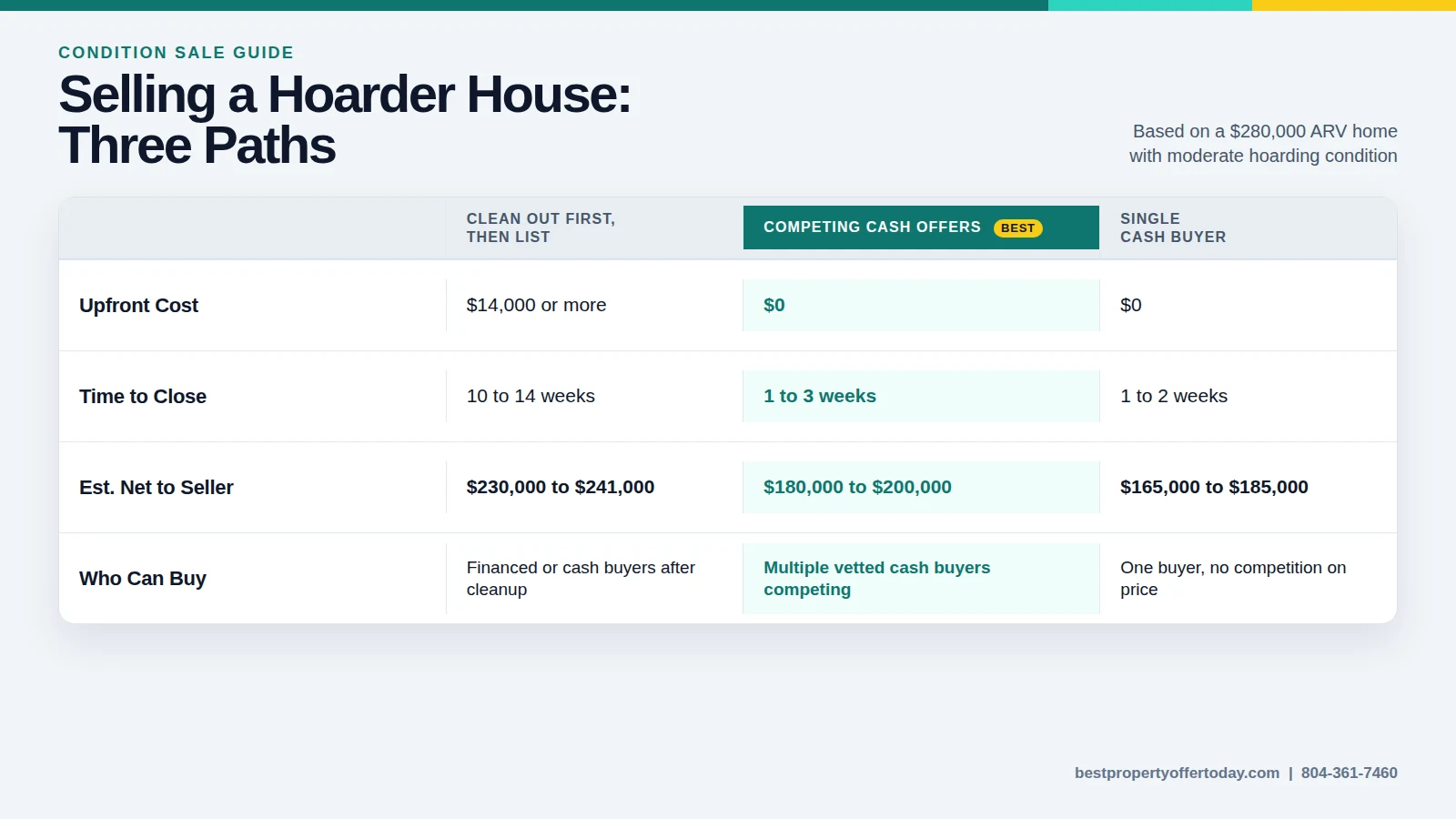
The right path depends on condition severity, your available capital, and how much time you have. Here is how the numbers work on a house with an as-repaired market value of $280,000 and a moderate hoarder condition requiring about $14,000 in cleanup and cosmetic repairs.
| Path | Upfront cost | Time to close | Est. sale price | Est. net to seller |
|---|---|---|---|---|
| Clean out, then list with agent | $14,000 | 10 to 14 weeks | $265,000 to $275,000 | $230,000 to $241,000 |
| Sell as-is via competing cash offers | $0 | 1 to 3 weeks | $180,000 to $200,000 | $180,000 to $200,000 |
| Sell as-is to single cash buyer | $0 | 1 to 2 weeks | $165,000 to $185,000 | $165,000 to $185,000 |
Path 1 nets more in the best case, but that estimate assumes the cleanup uncovers no additional defects and the market cooperates. Each week the house sits carries costs: property taxes, insurance, utilities, any mortgage payments. At $1,200 per month in carrying costs, ten weeks adds another $3,000 to the implicit cost of that path.
Path 2 produces lower headline numbers but no upfront capital requirement and no carrying period. For a seller managing an estate, coordinating from a distance, or simply unable to absorb a $14,000 outlay before closing, that difference is not abstract.
Path 3, a single cash buyer, is the fastest but provides the least leverage. With one offer, you have no way to know whether the number is competitive. Submitting to multiple buyers through a marketplace and letting them compete closes most of that gap without adding complexity for the seller.
One honest caveat: a cash offer on a hoarder house will be below what the same house would net after a full cleanup and retail listing. What you buy with that difference is speed, no upfront capital outlay, and certainty. If you have the time and capital to execute Path 1, it typically nets more. Many sellers in this situation do not have both. You can use our net proceeds calculator to run your own numbers before making a decision.
To get competing offers without committing to any of them, start at bestpropertyoffertoday.com. One request goes to multiple vetted buyers. You compare side by side and decide. There is no fee and no obligation to accept.
Red Flags From Buyers to Watch
Hoarder houses attract a subset of cash buyers who specialize in taking advantage of urgency. These are specific, checkable warning signs.
- Earnest money below $2,000 on a property priced over $100,000. Token deposits mean the buyer can walk for free when they find a better deal
- An inspection period longer than ten days on a property being sold as-is. As-is means you are not repairing anything. A long inspection window on an as-is deal is a contract backdoor, not due diligence
- An assignment clause, or language that allows the buyer to substitute another purchaser. This means the person who signed your contract may never actually close. A new buyer shows up at the last minute, often with a lower price
- A price reduction after inspection. If you agreed to sell as-is and disclosed the condition honestly, an inspection result is not grounds for renegotiation. Any buyer who attempts this after contract execution is signaling that the original offer was not real
- No verifiable proof of funds, or proof of funds from an entity you cannot find online. Ask for a bank statement or letter dated within the past 30 days, from an institution you can verify
These flags matter more in a hoarder sale than in a standard sale because the condition creates urgency, and urgency is exactly what a bad actor needs to manipulate a price. If you are unsure whether a buyer is legitimate, the vetting guide at /blog/are-cash-home-buyers-legitimate explains what to check.
Ready to see real numbers for your house?
Enter your property address to get competing offers from verified cash buyers. No repairs, no agent fees, and you pick the closing date.
Prefer to talk? Call (804) 361-7460
Frequently Asked Questions
Can you sell a hoarder house without cleaning it out first?
Yes. Cash buyers purchase hoarder houses as-is, contents included. The price reflects their estimate of cleanup and repair costs. You do not need to clear a single box before closing. What you do need to do is disclose any structural or system defects you are aware of, even if they are not currently visible through the clutter.
Does hoarding-related damage have to be disclosed even in an as-is sale?
Yes. As-is means the buyer takes the property in its current condition. It does not exempt the seller from disclosing known material defects. If you know the hoarding caused mold, pest damage, or structural deterioration, that must be disclosed in writing in almost every state. Discovering damage during a cleanout and then not disclosing it is the riskiest position a seller can be in.
How do cash buyers calculate their offer on a hoarder house?
Most start from the after-repair value, the price the house would fetch once fully renovated, and work backward. The standard formula deducts repair costs and a margin for profit and risk. For a hoarder house, the buyer’s repair estimate includes not just structural work but cleanup costs, which they typically estimate on the high side because they cannot see what is under the clutter. That is why competing offers on the same hoarder house can vary by $20,000 or more. One buyer quotes generous cleanup costs; another who has bought similar properties before quotes tighter. The only way to find out which number is realistic is to get more than one offer. The mechanics behind this are explained in more detail at /blog/how-cash-buyers-calculate-their-offer.
Should I do a partial cleanout before getting offers?
Possibly, but only if you can expose the structure without spending significant money. Removing enough clutter to show that floors are intact, that there is no water damage in the main areas, and that the mechanicals work reduces the uncertainty buyers are pricing. Buyers discount for things they cannot see. Letting them see that the worst assumptions are wrong can recover more than the cleanup costs. A full cleanout only makes sense if you have the capital to complete it and the time to wait for a retail buyer.