Meth contamination ends most conventional deals before they start. FHA, VA, and USDA lenders will not insure a property with known contamination, and many conventional lenders follow the same rule. That leaves three realistic options: remediate and then list, disclose and sell with a credit, or sell to a cash buyer as-is. Each path has a real cost, a real timeline, and a real floor on what you can net. This post lays all three out.
Selling a house with meth contamination? Compare cash offers from buyers who price it in.
Enter your property address to get competing offers from verified cash buyers. No repairs, no agent fees, and you pick the closing date.
Prefer to talk? Call (804) 361-7460
Why meth contamination blocks a financed sale
When a lender orders an appraisal, the appraiser notes visible or disclosed defects. If meth contamination is disclosed, most FHA and VA appraisers are required to flag it as a health and safety hazard. The underwriter then conditions the loan on a clearance certificate from a licensed remediator. No certificate, no loan commitment. No loan commitment, no closing.
Conventional lenders are less uniform, but they face the same liability. If a lender closes on a property later found to be contaminated, the loan can become unenforceable in some states. Most underwriters have learned to treat disclosed contamination the same way FHA does.
The practical result is that your buyer pool collapses to two categories: cash buyers and a narrow slice of conventional buyers willing to escrow the remediation cost and complete it after closing. That second group is small and usually wants a steep discount to absorb the risk.
Disclosure: what you must say and what happens if you do not
Most states treat meth contamination as a material defect that must be disclosed if known. Several states have passed specific meth contamination laws that go further. Colorado requires sellers to disclose any property that has been used as a meth lab regardless of whether remediation occurred. Utah maintains a database of properties that have been tested and confirmed contaminated. Oregon, Washington, Montana, Tennessee, and Arizona each have disclosure statutes with specific testing and notification requirements.
Even in states without a specific meth statute, the general duty to disclose material facts covers it. A buyer who discovers contamination after closing can sue for rescission or damages, and courts have generally treated sellers who knew and stayed silent harshly. The duty survives an as-is sale. Selling as-is limits the obligation to repair, not the obligation to disclose.
If a prior tenant was responsible and you did not know about it at the time of purchase, that matters. Document when you learned, how, and what steps you took. That paper trail becomes your defense if a question comes up after the sale.
The three paths
Path 1: Remediate first, then list
Professional meth remediation involves removing contaminated materials (carpets, insulation, drywall in heavy-use areas), HEPA vacuuming all surfaces, chemical cleaning, and vapor barrier installation where needed. The process ends with clearance testing by an independent industrial hygienist using ASTM E2252 surface-wipe sampling. That clearance certificate is what lenders and informed buyers need to see before they proceed.
Cost for a property with meth use or smoking (the more common situation): $3,000 to $12,000 depending on square footage, ventilation type, and how long contamination built up. Former cooking labs run higher, $25,000 to $80,000 or more, because chemical precursors penetrate drywall and subfloor and often require gut renovation of affected areas.
Timeline: three to five days for a small property with limited contamination; two to three weeks for heavier cases. Add typical market time and a four to six week escrow on top of that. Total from today to close: three to five months.
This path usually nets the most money, but you front the remediation cost with no guarantee of the eventual sale price, and you carry the property through the whole process.
Path 2: Disclose and list as-is with a credit
Some sellers list at or near full market value, disclose the contamination, and offer a repair credit equal to the remediation estimate. The problem is that this only works with buyers who can get financing, and lenders generally will not close until the work is done. The buyer needs to be pre-approved for a renovation loan, or the lender needs to agree to escrow funds for post-closing remediation, or the buyer needs to be a cash buyer who will handle it themselves.
What you typically see in practice: the property sits longer, the eventual buyer is either a cash buyer (who discounts more than the credit) or a renovation investor (same result). The credit route works best when contamination levels are low, remediation is straightforward, and the buyer pool in your market is active enough to find someone willing to take it on.
Path 3: Sell to a cash buyer as-is
Cash buyers skip the lender layer entirely. There is no appraisal condition, no underwriter review, no waiting for a clearance certificate. The buyer prices the contamination into the offer, closes in one to three weeks, and handles remediation themselves.
The trade-off is price. Cash buyers on contaminated properties typically work from 60 to 70 percent of after-repair value and then deduct their remediation estimate on top of that. The deduction reflects not just the cost but the risk of additional work once they open the walls.
What you give up is the gap between what a fully marketed, remediated house would sell for and what a cash buyer pays today. What you get is speed, certainty, no remediation project to manage, and no ongoing carrying costs.
Worked example: a $280,000 house with meth contamination
Assume the property is a three-bedroom with meth smoking contamination, not a former lab. After-repair value is $280,000. Surface wipe testing found contamination at 1.2 micrograms per 100 square centimeters, above the EPA guidance threshold of 0.1 and above most state action levels.
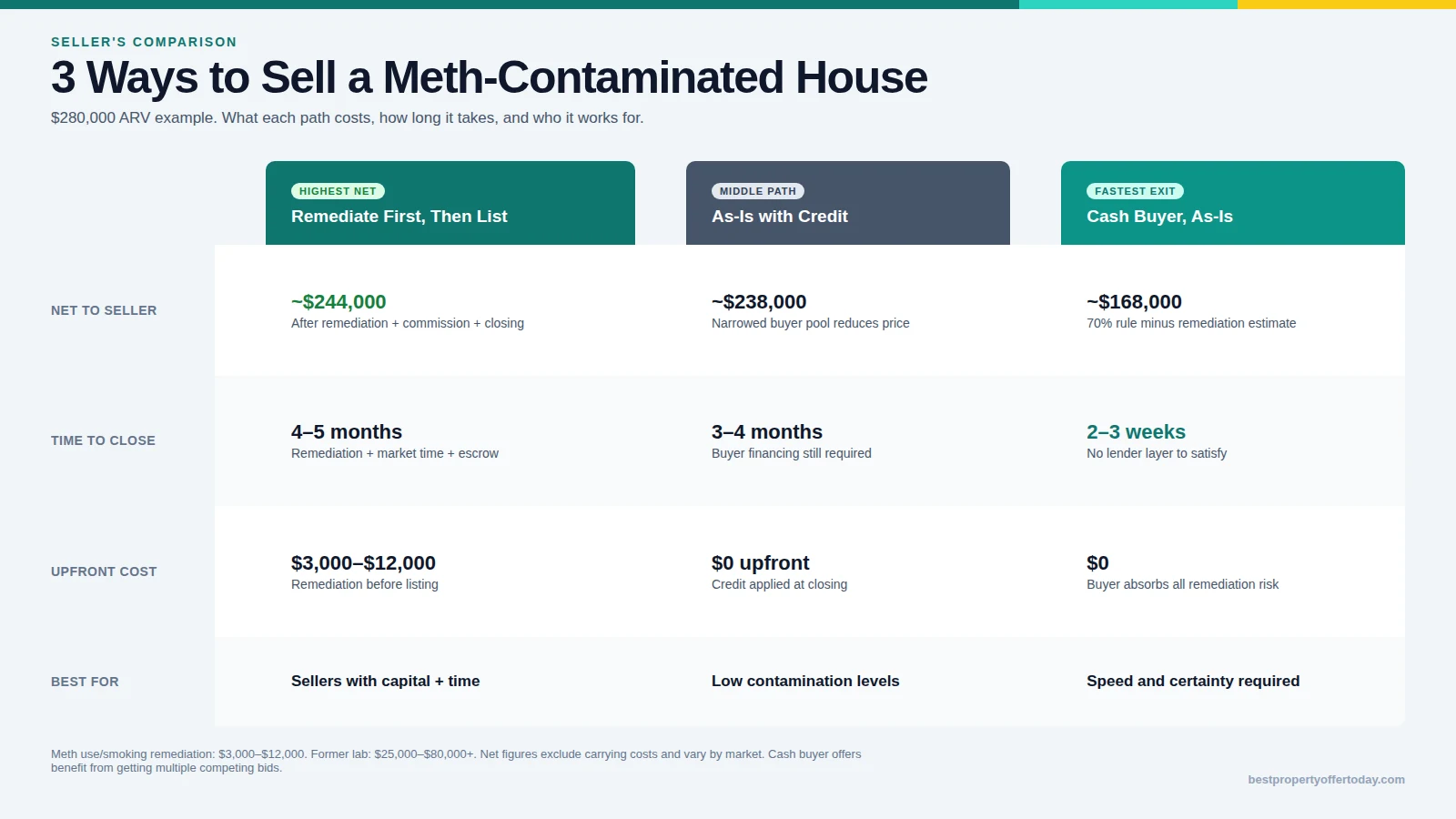
| Path | Estimated net to seller | Time to close | Key risk |
|---|---|---|---|
| Remediate, then list | ~$244,000 | 4 to 5 months | Market softens; remediation uncovers more |
| As-is with credit | ~$238,000 | 3 to 4 months | Buyer financing falls through |
| Cash buyer, as-is | ~$168,000 | 2 to 3 weeks | Offer spread; multiple bids required |
These are ranges, not guarantees. The remediate-and-list figure deducts $9,000 remediation, $16,800 agent commission, $5,600 seller closing costs, and roughly three months of carrying costs from the $280,000 sale price. The as-is credit figure assumes a reduced sale price plus ongoing negotiation risk. The cash buyer figure uses approximately 70 percent of ARV less the buyer’s remediation deduction.
The honest summary: a traditional sale after remediation nets you roughly $76,000 more than a cash sale on this example property. The gap is what you pay for speed and certainty. Neither answer is universally right. It depends on your holding costs, your financial timeline, and how much remediation work you want to manage.
Use the net proceeds calculator to run your own numbers with your actual costs and market value.
Does homeowners insurance cover meth cleanup?
Standard homeowners insurance almost never covers meth remediation. Most policies include a pollution or contamination exclusion, and insurers have successfully applied it to meth. The argument that meth is a sudden and accidental occurrence sometimes comes up when the contamination was caused by a tenant you did not know about, but this is disputed coverage and carriers resist it on principle.
If you have a landlord policy or a dwelling fire policy with broader coverage, review the contamination exclusion language specifically. Some specialty environmental policies exist for investment property owners, but standard residential coverage does not get you there. Do not count on a claim payout before deciding which path to take.
Testing: what sellers should know before they list
Surface wipe sampling under ASTM E2252 is the standard test method. A certified industrial hygienist takes wipe samples from multiple surfaces and sends them to an accredited lab. Results come back in three to five business days. Cost for initial testing: $300 to $600, depending on the size of the property and the number of samples taken.
Some states require testing to be done by a state-certified contractor. Utah requires testing before any sale if there is reason to believe the property was used for meth. Colorado requires disclosure of past lab activity regardless of whether testing has been done.
Testing before listing is usually worth doing even if not required. It gives you a documented contamination level, it shows which areas need remediation, and it removes the buyer’s leverage to demand a larger discount based on a worst-case assumption. A seller who arrives at a negotiation with a dated test report and a remediation estimate is in a stronger position than one who does not know their own numbers.
Red flags from buyers on contaminated properties
Some buyers specialize in contaminated properties and are legitimate. A few are not. Vetting a cash buyer matters on any sale, but it matters more here because the contamination gives an opportunistic buyer extra leverage to renegotiate after you have committed. Watch for:
- A long inspection window (more than 14 days) on an as-is cash deal
- Earnest money below 1 percent of the offer price
- An assignment clause that lets the buyer transfer the contract to a third party before closing
- A price reduction request after the initial offer, citing a “new” test result that matches what you disclosed upfront
- Vague proof of funds, or a letter not dated within the last 30 days
A legitimate cash buyer on a contaminated property can explain their offer math. They will know what ASTM E2252 says and what remediation costs in your area. If a buyer cannot tell you how they calculated their offer, they may be a wholesaler planning to assign the contract to someone else before closing.
Questions to ask before you sign
- What is your planned use: rehab and resell, hold as rental, or immediate owner-occupy?
- Can you show me your proof of funds, dated within the last 30 days?
- Does your contract include an assignment clause?
- What remediation estimate are you working from, and can I see it?
- What happens to the closing date if testing reveals additional contamination areas after you open the walls?
Can you sell a property with meth contamination without testing first?
Yes in most states, but selling without testing creates disclosure risk. If you know or have reason to know the property was used for meth, you have a duty to disclose it. Testing before listing gives you a documented baseline, helps buyers and lenders understand what they are dealing with, and protects you if a contamination claim comes up after closing. A current test report is a better defense than “I did not know.”
Is a former meth lab different from a property where meth was used?
Yes, and the difference matters financially. A former lab involves chemical precursors from the cooking process, which penetrate drywall, insulation, and subfloor at concentrations many times higher than use-only contamination. Remediation costs for a former lab start at $25,000 and can reach $80,000 or more, because remediation often requires gut renovation of affected areas and soil testing around any exterior dump sites. Properties where meth was smoked or used but not cooked typically run $3,000 to $12,000 to remediate. The same disclosure rules apply to both. The DEA’s National Clandestine Laboratory Register lists addresses of confirmed former lab sites, which is searchable by any buyer or their agent.
How do you find a buyer for a meth-contaminated property?
Cash buyer networks are the most direct path. Submitting one request to a platform that collects competing offers from multiple vetted buyers lets you see what different investors will pay without negotiating with each one separately. Getting at least three offers on a contaminated property is worth the time, because the spread between the highest and lowest bid on the same house is often $20,000 to $40,000. Offers typically come back within 24 to 48 hours and there is no obligation to accept any of them. Call 804-361-7460 with questions.
Does meth contamination dissipate on its own over time?
Slowly, yes. Meth residue does volatilize over time, and properties that have been ventilated for years show lower surface levels than recently contaminated ones. But natural dissipation rarely brings a property below state action levels without active decontamination. Some states do not credit passive time against disclosure requirements. If a test from two years ago showed contamination, most lenders and many buyers will want current results before proceeding.
One honest note before you decide: a cash offer on a contaminated property is almost always below what a fully marketed, remediated house would fetch. If the contamination is minor and you have the time and capital to remediate, the traditional listing route will typically net you more. The cash buyer path exists for sellers who need certainty, speed, or who cannot front the remediation cost. Both are legitimate choices depending on your situation.
Ready to see real numbers for your house?
Enter your property address to get competing offers from verified cash buyers. No repairs, no agent fees, and you pick the closing date.
Prefer to talk? Call (804) 361-7460