Deed restrictions run with the land. When you sell, the buyer inherits them, whether the sale is financed or all-cash. What changes with a cash buyer is not whether the restriction survives, it does, but whether a lender’s underwriter sees it and uses it as grounds to kill the loan approval.
Many sellers assume a cash offer makes the restriction disappear. It does not. The restriction stays in the title. The cash buyer simply skips the step where a lender’s underwriter reviews the title commitment and decides whether to fund around it.
What a Deed Restriction Is
A deed restriction is a private recorded agreement that limits what a property owner can do with the land. It lives in the recorded deed, or in a declaration referenced by the deed, and it binds every future owner, not just the original buyer.
Common types include:
- Use restrictions: single-family residential only, no commercial activity, no short-term rentals
- Architectural controls: minimum square footage, approved exterior materials, fence height limits
- Subdivision restrictions: no further division of the parcel into smaller lots
- Agricultural restrictions: rural parcels limited to farming or grazing use only
- Age-restricted communities: occupancy limited to residents aged 55 or older under the federal Housing for Older Persons Act (HOPA)
Deed restrictions differ from zoning. Zoning is a government rule; deed restrictions are private agreements. A property can comply with local zoning and still violate a deed restriction. Both apply at the same time.
They also differ from HOA rules. Some subdivisions have both. The deed restriction is typically the older, broader limitation written at the time of original development. HOA rules are layered on top and enforced by the association. When no HOA exists, deed restrictions remain enforceable by neighboring lot owners who benefit from them. There is no management company involved and no dues to miss. Any neighbor with standing can seek a court injunction against a violation.
How a Deed Restriction Surfaces During a Sale
It appears in the title search. Every lender requires a title search before funding; a reputable cash buyer runs one before closing. The title company lists restrictions as exceptions in Schedule B of the title commitment. These exceptions are not covered by title insurance: the policy insures against unknown claims, not known conditions disclosed in the commitment.
Many sellers discover a restriction they never knew about at this stage. That does not eliminate the disclosure duty. Once you know about the restriction, you must tell any buyer in writing before they go under contract.
The practical point: do not wait for the title search. If you have any reason to suspect a restriction exists, pull the recorded deed from the county recorder before you list. County recorder websites in most states let you search by address for free. Give buyers a copy of the recorded document in the showing packet. Buyers who discover a restriction for the first time at the title stage are more likely to walk than buyers who knew about it going in. It reads as a surprise you were hiding, even when you were not. See also our post on title problems that delay a cash closing for a broader look at what a title search can surface.
Why It Affects Financed Buyers More Than Cash Buyers
A lender’s underwriter reviews the title commitment as part of the loan approval. An appraiser must certify that the property’s use is legal and conforming to its intended purpose. When a deed restriction limits use in a way that conflicts with the buyer’s plans, the underwriter can decline to fund.
Three common friction points:
- A use restriction prohibiting commercial activity: the buyer plans to run a licensed daycare from the home. The underwriter flags the restriction. The lender declines to fund.
- An age-restricted community: FHA loans require that at least 80 percent of occupied units house one resident aged 55 or older. If the community does not qualify under HOPA, buyers cannot use FHA financing. This shrinks the buyer pool significantly on properties priced for first-time buyers.
- A no-subdivision restriction: not a problem for a buyer who wants to hold the lot intact, but it surfaces in the appraisal if the highest-and-best-use analysis assumed subdivision potential. The appraiser may reduce value accordingly.
A cash buyer has no lender in the transaction. No underwriter reviews the title commitment on their behalf. A good buyer’s attorney will still read the restriction and ask questions, but there is no loan approval step where the restriction can kill the deal from the financing side.
The restriction still binds the cash buyer after they close. They cannot violate it without facing the same enforcement risk as any owner. What a cash sale eliminates is the financing obstacle, not the legal obligation.
Three Paths Forward
Sellers with deed restrictions have three realistic options.
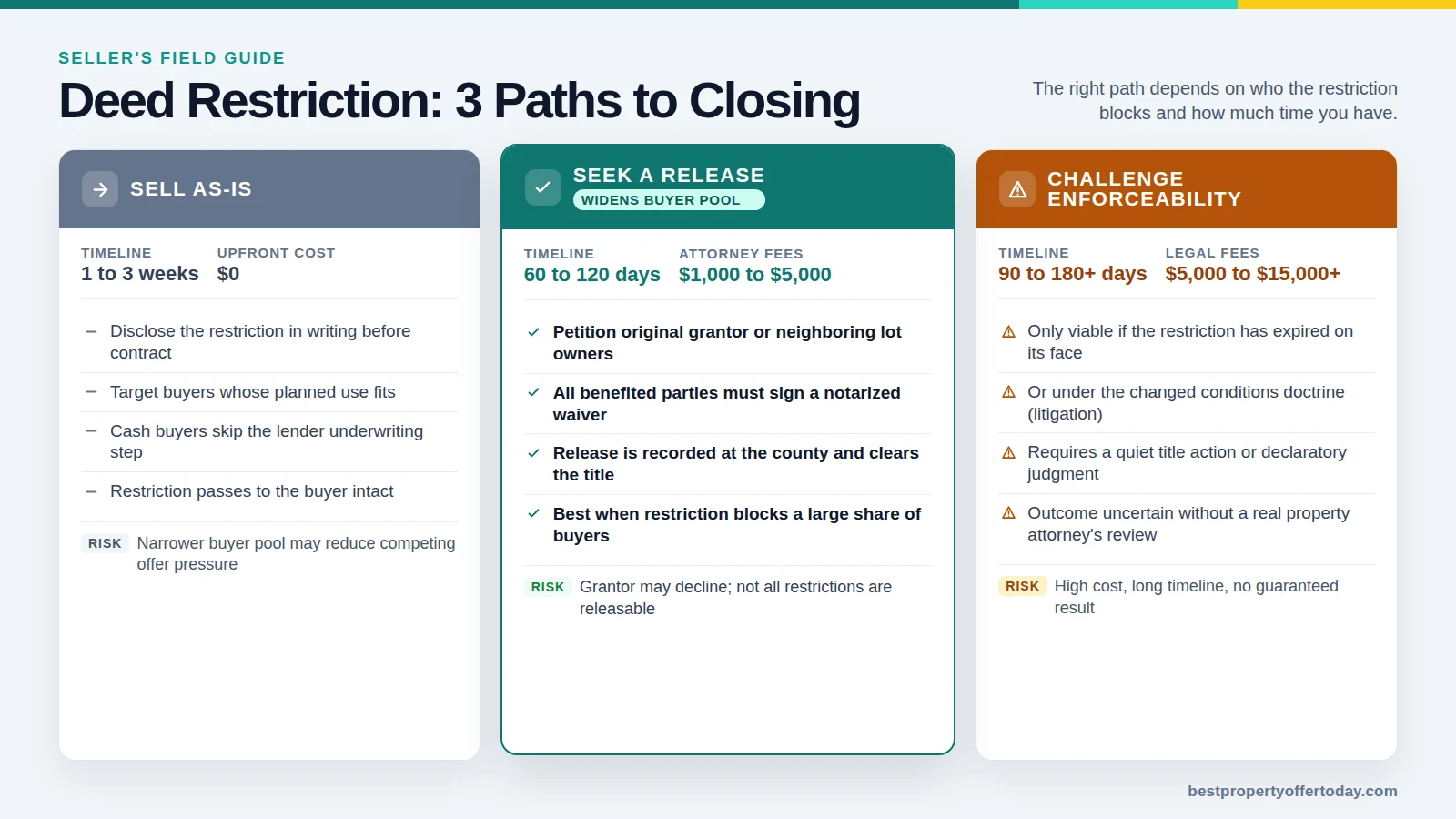
Sell with the restriction in place. Disclose it fully, price to it, and target buyers whose intended use is compatible. If the restriction prohibits commercial activity, buyers who want a primary residence are not affected by it. For them, the restriction is invisible. This is the fastest path and costs nothing upfront. It may limit the buyer pool, which limits competing offer volume and may lower the price range you see.
Seek a release or modification before listing. Options depend on the restriction’s origin. If the original developer or grantor still exists as a legal entity, they may release it for a fee. If the restriction benefits neighboring lot owners, getting all of them to sign a notarized written waiver works in most states. The release is then recorded at the county, and the restriction is cleared from the chain of title. Attorney fees for a release typically run $1,000 to $5,000 and the timeline is 60 to 120 days. Worth pursuing when the restriction is narrowing the buyer pool enough that the price gap exceeds the cost of removing it.
Challenge enforceability. Some restrictions include sunset clauses. Language such as “for a period of 25 years from the date of recording” means the restriction expired on its face. A quiet title action can clear it from the record. Some restrictions become unenforceable under the changed conditions doctrine: if the character of the neighborhood has changed so completely that the restriction no longer serves its original purpose, courts have occasionally declined to enforce them. This requires litigation, not a simple request, and is state-specific. Attorney fees run $5,000 to $15,000 or more, and the outcome is not guaranteed without a real property attorney’s assessment of your specific situation.
How Each Buyer Type Handles a Deed Restriction
| Buyer type | Does restriction affect financing? | Restriction passes to new owner? | Timeline |
|---|---|---|---|
| Financed retail buyer | Yes: underwriter reviews the title commitment | Yes | 30 to 60 days, with fall-through risk if lender flags it |
| iBuyer | Yes: same underwriting chain | Yes | 2 to 4 weeks (may decline to offer on affected properties) |
| Local cash investor | No | Yes | 1 to 3 weeks |
| Competing cash offers via marketplace | No | Yes | Offers in 24 to 48 hours, closes in 1 to 3 weeks |
A Worked Example: The $285,000 House That Two Buyers Priced Differently
The house appraised at $285,000. It sat in a 1960s subdivision carrying a deed restriction recorded in 1961: no lot may be subdivided, and no structure may be used for commercial purposes.
A financed buyer made an offer at $278,000. During the inspection period, the buyer’s plans came up: they intended to run a licensed home therapy practice from the property. Their lender’s underwriter pulled the title commitment, saw the commercial-use restriction, and declined to fund. The buyer could not secure an exception. The deal fell through at day 32, after the seller had already turned away two other inquiries.
The seller came back to the marketplace. A cash investor reviewed the same restriction during a seven-day inspection window. The restriction posed no problem for their plan: they intended to rent the property as a primary residence. They offered $218,000, roughly 76 percent of the appraised value. The discount was not because of the restriction specifically. It reflected the narrower buyer pool: a property that rules out commercial and short-term rental use has fewer high-value buyers competing for it, and that lower competition shows up in the offer numbers.
The seller netted $218,000 instead of $278,000. The gap is real and it matters. It represents the cost of a property that a significant segment of financed buyers could not close on, plus the cost of going back to market after a 32-day fall-through. A traditional listing targeting residential-only buyers might have produced a higher result if the seller had time. They did not. For that seller, at that point, the cash path was the right answer.
What You Must Disclose
In virtually every state, sellers must disclose known material facts about a property. A deed restriction is material: it limits what the buyer can do with the land they are buying. Disclosure duties survive an as-is sale. Selling as-is limits your obligation to repair; it does not limit your obligation to tell the buyer what you know. This is the same principle that governs selling a house with code violations: the obligation to disclose is separate from the obligation to fix.
The practical steps:
- Get the recorded restriction from the county recorder (usually searchable online, often free)
- Include a full copy in the disclosure package, not just a reference to it
- Get the buyer’s written acknowledgment that they received and reviewed it before signing the purchase agreement
- Keep that acknowledgment until well after closing
Do not assume the title search will handle it. The title search will find the restriction, but it finds it after the buyer is already under contract, often past their inspection contingency window. A buyer who learns about a restriction at the title stage is more likely to renegotiate or walk than one who knew about it before making the offer.
Red Flags to Watch for from Buyers
Some buyers attempt to push disclosure problems onto the closing table or beyond. Watch for these:
- A buyer who says “don’t worry, we will handle the restriction after closing.” After closing it is their restriction to live with, but your disclosure liability survives. If you knew and did not disclose, the buyer’s willingness to try to work around it after the fact does not protect you from a later claim.
- A buyer proposing a very long inspection or feasibility period. Some buyers want time to research restriction enforceability before committing. That is legitimate for a complex property, but a 45-day feasibility window on a standard as-is cash deal is not normal. Seven to 14 days is standard.
- An assignment clause with no end-buyer identified. If the restriction makes the property harder to resell, a wholesaler who assigns the contract may not be able to find an end buyer who can close. You may end up back on the market in a worse position than before. See our post on how to tell a real cash buyer from a wholesaler for more on this dynamic.
- A token earnest money deposit. On a property where the restriction is known and already priced in, low earnest money means backing out costs them nothing. The earnest money post covers what a serious deposit looks like in a cash sale.
When a Cash Sale Is the Right Answer
A cash offer on a deed-restricted property is typically below what a fully marketed traditional listing would net if buyers with compatible intended use were willing and able to close. What the cash sale provides is certainty and speed: no financing contingency that the deed restriction can kill, no waiting 45 days for a loan that never funds.
If the house is in good condition, the restriction affects only a narrow category of buyers, and you have time to list it, a traditional agent targeting compatible buyers may produce a better net. If the restriction has already killed one or more financed deals, or if you need to close on a fixed timeline, the cash path is the more reliable exit.
Our net proceeds calculator at sell-my-house-calculator can help you model the difference between a cash offer and a listed sale, accounting for carrying costs, commissions, and repair concessions. Getting competing cash offers costs nothing and carries no obligation to accept. Call 804-361-7460 with questions about your specific situation.
Does a deed restriction lower my home’s value?
It depends on what the restriction limits and how much demand exists for uses outside it. A single-family residential restriction in a neighborhood where everyone wants a single-family home affects almost nothing. The same restriction on a lot in a rapidly commercializing corridor may cut the market value significantly, because commercial buyers and developers cannot bid.
Do I have to disclose a deed restriction to a cash buyer?
Yes. The disclosure duty is not tied to whether the buyer is using financing. It is tied to whether the restriction is a material fact, and it is. A cash buyer who discovers after closing a restriction you knew about and did not disclose has the same legal remedies as any other buyer.
What if I did not know about the restriction when I bought the house?
Not knowing when you purchased does not eliminate the duty to disclose once you discover it. If the restriction surfaces during the title search when you are selling, you know about it now. From that point on, you must disclose it to any buyer before they go under contract.
Can a cash buyer be blocked from purchasing a deed-restricted property?
Not by the deed restriction itself. Deed restrictions limit use, not who can purchase. Some age-restricted communities require board approval of new residents, but that is an HOA rule added on top of the deed restriction, not the restriction itself. A deed restriction alone does not give anyone the right to block the sale. The buyer simply takes title subject to the restriction and must comply with it after they own the property.