An easement on your property does not prevent a sale. Easements run with the land, which means they transfer automatically to every future owner. The buyer inherits the easement, the underlying obligation does not disappear at closing, and in most cases the sale proceeds without any special procedure. The complications come in specific situations: when a lender’s appraiser flags it, when the easement limits the property in ways that affect value, or when a buyer discovers it for the first time and panics.
Understanding which type you have, what you owe in disclosure, and how different buyers respond to it will help you price correctly and avoid a late-stage renegotiation.
Selling a house with an easement? Compare cash offers from buyers who price it in.
Enter your property address to get competing offers from verified cash buyers. No repairs, no agent fees, and you pick the closing date.
Prefer to talk? Call (804) 361-7460
Types of Easements and How Common They Are
Most residential properties carry at least one easement, and many carry two or three. The type determines almost everything about how the sale goes.
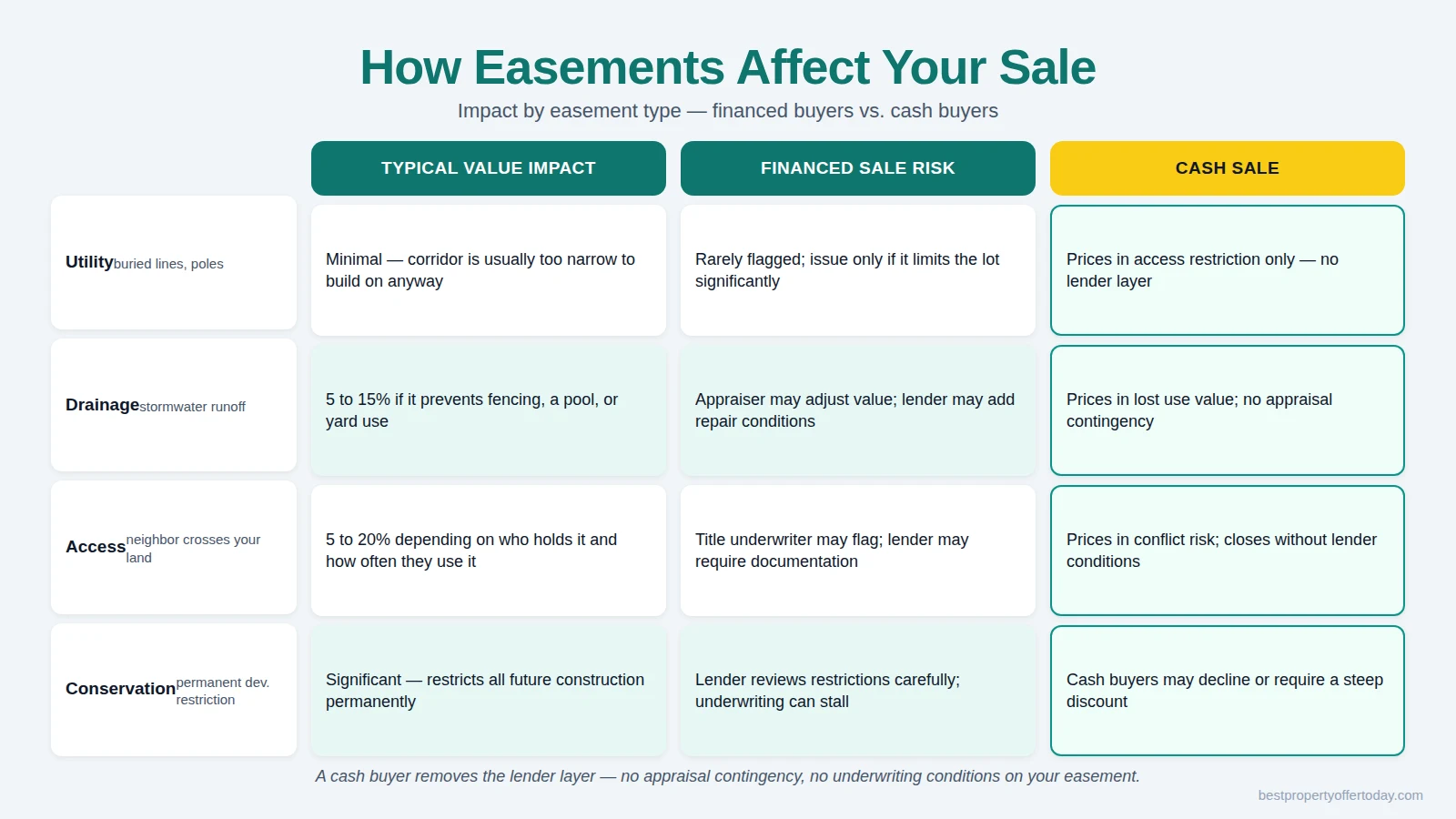
Utility easements give a power company, gas utility, or municipality the right to access a strip of your land to maintain buried lines or overhead equipment. They are the most common type and, for most buyers, the least concerning. A buried gas line running along the back edge of the property rarely affects daily life. The limitation is what you cannot build on or over the easement corridor.
Drainage easements give a municipality or a neighboring property the right to direct stormwater runoff across your land. These are more impactful than utility easements because they can run through the middle of a yard, restrict landscaping, and in some cases prohibit fencing. They are also harder to work around because the limitation on use is physical, not just financial.
Access or ingress/egress easements give another property owner the right to cross your land to reach theirs. These are the most disruptive to potential buyers because they involve another person physically using your property. If you have a written easement granting a neighbor the right to drive across your driveway to reach a back parcel, that agreement survives the sale and every future sale.
Conservation easements permanently restrict development in exchange for a tax benefit claimed by a prior owner. These are recorded with the county and bind all future owners. If your property has one, the restrictions follow it indefinitely.
Private road easements occur when your access to a public road runs across land owned by someone else. See Selling a house on a private road for how that situation works in a sale.
Do You Have to Disclose an Easement?
Yes, in virtually every state. Seller disclosure laws require you to report known easements on the property. The standard seller disclosure form in most states includes a direct question about easements, deed restrictions, and encumbrances.
The more important point is that disclosure is not optional in a practical sense either: a buyer’s title search will find every recorded easement regardless. Recorded easements are a matter of public record. The title company’s commitment will list them all, and the buyer will see them before closing whether you mention them or not. Failing to disclose a known easement does not hide it; it creates liability if the buyer later argues you concealed a material fact.
Unrecorded easements, specifically prescriptive easements and easements by implication that arise from long-term use rather than a written agreement, are harder to detect and more complicated to disclose. If you are aware of a neighbor who has used a path across your land for years, disclose it. If you are uncertain whether such use creates a legal right, an attorney can give you a clearer answer before you list.
How Much Does an Easement Actually Devalue Your Property?
There is no universal number, because the devaluation depends on what the easement prevents the buyer from doing with the land. A utility easement running along a back fence line, in a strip too narrow to build on anyway, may have no measurable effect on value. A drainage easement cutting through the center of a backyard that would otherwise fit a pool can reduce value by 5 to 15 percent of what that yard use was worth, not the entire house.
Appraisers use a paired-sales approach: they find comparable sales with and without similar easements and measure the spread. In practice, few appraisers have enough paired data in a local market to do this precisely. The result is that appraisers often apply a judgment adjustment, or note the easement and leave the pricing to the market.
Access easements granting a third party the right to cross the property draw a larger discount because they affect the buyer’s enjoyment directly. Buyers and their agents price in the inconvenience, the potential for conflict with the easement holder, and the fact that the easement cannot be modified without the easement holder’s agreement.
The most useful way to think about it: the devaluation equals the premium a buyer would have paid for the property without the constraint, minus the premium they are willing to pay with it. That gap is what your price needs to account for.
When a Financed Sale Gets Complicated
Most easements do not trigger appraisal conditions on conventional loans. Utility and drainage easements on single-family residential properties are so common that appraisers and lenders treat them as standard. Problems arise in specific situations:
- The easement significantly reduces the usable area of the lot, and the appraiser adjusts value downward far enough to create an appraisal gap
- The easement prohibits fencing, and the buyer’s lender requires a fence for a pool safety condition
- FHA and VA loans apply somewhat stricter standards to lot utility; if an easement eliminates most of the yard, an FHA appraiser may note it as a negative condition requiring resolution
- An access easement creates evidence of adverse possession risk, which a title underwriter may flag, requiring the seller to provide documentation or accept a title exception
When a financed buyer’s lender requires a repair or modification related to the easement, and the easement prevents it, the deal can unravel. This is the practical gap that a cash buyer closes.
How Cash Buyers Handle Easements Differently
A cash buyer removes the lender layer entirely. There is no appraisal contingency. No FHA or VA underwriter reviewing the lot’s usable area. No lender requiring a condition that the easement makes impossible to satisfy.
Cash buyers price the easement into their offer by calculating what it limits: reduced yard utility, a neighbor’s access right, or a strip that cannot be built on or fenced. That adjustment is the discount off a property without the easement. The trade is certainty of closing versus a somewhat lower offer, which is the same trade any as-is cash sale involves.
On a marketplace, you submit one request and receive competing offers from multiple vetted cash buyers. Their offers will reflect their individual judgments of what the easement costs in use value. That competition tends to push the offers toward a reasonable market rate for the encumbered property. Request competing cash offers here to see what the market will pay.
Three Paths for Sellers With an Easement
The right path depends on the type of easement, whether it affects financed buyers, and how much the restriction affects price.
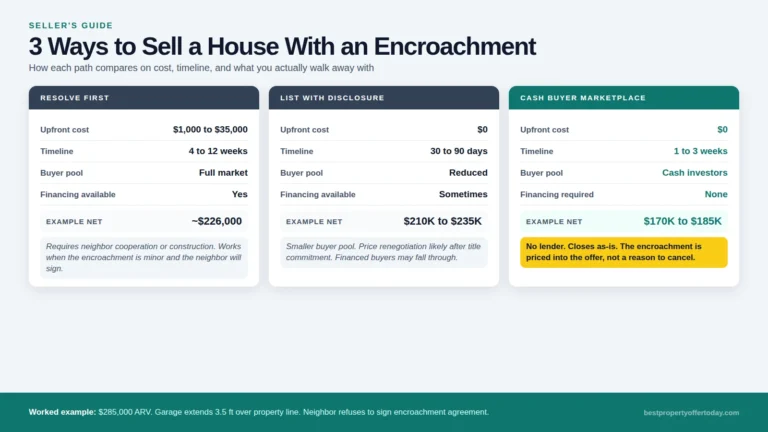
Path 1: Disclose and list at a market-adjusted price. For standard utility and drainage easements that do not affect daily use, the most common approach is full disclosure and a price that reflects the restriction. A good agent will pull paired sales to support the adjustment. If comparable properties with similar easements sell within 5 percent of unrestricted properties, the adjustment is small and the full market of financed buyers remains available.
Path 2: Negotiate a release or modification before listing. An easement can be extinguished by written agreement with the easement holder, recorded with the county. If the easement is held by a neighbor who no longer uses it, you may be able to negotiate a release, sometimes for a payment. This is worth considering before listing if the easement is creating significant buyer hesitation and the release cost is less than the discount you would otherwise absorb. An attorney should draft the release and confirm it is properly recorded.
Path 3: Sell as-is to a cash buyer. When the easement makes financing difficult, when the release is not achievable, or when listing with the restriction would produce a long time on market and repeated re-negotiations, a cash sale fixes the price upfront and avoids the lender complications. The net proceeds calculator can help you compare what each path nets after agent fees, carrying costs, and any price adjustments.
Worked Example: A Drainage Easement and What It Cost
A seller listed a single-family home in the mid-Atlantic with an ARV of $315,000. The property carried a 20-foot-wide municipal drainage easement running across the rear third of the backyard. The easement prohibited fencing and structures within the corridor, eliminating the ability to enclose the yard or add a pool.
Three financed offers fell through: two from buyers who needed a fenced yard, and one because the buyer’s lender required a fence as an insurance condition. A fourth buyer was a local investor who priced the easement’s impact at $22,000 below the ARV and offered cash at $293,000. Closing took 16 days.
A competing cash offer from the same request came in at $287,000. The spread between the two cash offers was $6,000 on a $315,000 home. That $6,000 spread is why competing offers matter on an encumbered property: one buyer priced the easement’s impact at $22,000, the other at $28,000. Collecting both numbers and negotiating from a position of comparison produced a final sale at $297,000, which was $10,000 higher than the first offer the seller would have accepted.
Red Flags to Watch for After Accepting an Offer
Most renegotiation attempts on easement-encumbered properties arrive after the buyer’s attorney review or inspection period, not before. Watch for:
- A buyer who expressed no concern about the easement during negotiations but raises it as a price-reduction justification after contract execution
- A request to reduce the price specifically because of the easement after the inspection period begins, when the easement was disclosed before the offer was made
- An offer with a long inspection window, minimal earnest money, and a cash-or-assignment structure, which often signals a wholesaler rather than an end buyer
- A request that you sign a new or expanded easement as a condition of closing, particularly from a buyer who represents a neighbor or adjacent property owner
See what happens if a cash buyer backs out for what your contract rights are if a buyer uses the easement as a pretext to walk after the inspection deadline.
The Honest Caveat
A cash offer is almost always below a fully marketed retail price. An easement narrows the pool of financed buyers, which is a real cost, but that pool is not zero. If your easement is a standard utility strip along the back of the lot, the financed market remains largely available and a traditional listing will likely net more. The cash path earns its discount when the easement creates enough financing complications that repeated deal failures cost more in time, carrying costs, and negotiation effort than the spread between the cash offer and the retail price. Use the calculator to run the comparison with your specific numbers before deciding.
Ready to see real numbers for your house?
Enter your property address to get competing offers from verified cash buyers. No repairs, no agent fees, and you pick the closing date.
Prefer to talk? Call (804) 361-7460
Frequently Asked Questions
Does an easement show up on a title search?
Recorded easements always show up on a title search. The title company’s commitment will list every recorded encumbrance, and the buyer will see them before closing. Unrecorded prescriptive easements (created by long-term use) may not appear in the search, but they are still legally binding in most states if the use has been open, continuous, and hostile to the owner’s exclusive use.
Who pays property taxes on an easement?
The underlying landowner pays property taxes on the land covered by an easement. The easement holder gets the right to use the land but does not own it and does not pay taxes on it. Your property tax bill will not change because an easement crosses your lot.
Can you build on a utility easement?
The restrictions depend on what the recorded easement says. Most utility easements prohibit permanent structures above or within a defined setback of buried lines. Fencing with removable gates and landscaping are often permitted, but you should read the recorded document before placing anything in the corridor. Building a permanent structure on a utility easement gives the utility company the basis to force removal at the owner’s cost.
Can you remove an easement before selling?
Yes, if the easement holder agrees. An easement can be extinguished by a written release signed by the easement holder and recorded with the county. Utility easements held by municipalities are rarely released because they continue to serve a public function. Access easements and private easements can sometimes be released by negotiation, often for a payment. An attorney should handle the drafting and recording to confirm the release is enforceable and does not leave a shadow on the title.