Private roads are common in rural areas, older suburbs, and any neighborhood where the municipality never adopted the road. For most daily purposes, it makes no difference. For selling, it introduces one specific problem: most lenders require a recorded road maintenance agreement before they will fund a buyer’s loan. That one missing document can stop a sale that otherwise looks fine on paper.
See what cash buyers would offer for your house
Enter your property address to get competing offers from verified cash buyers. No repairs, no agent fees, and you pick the closing date.
Prefer to talk? Call (804) 361-7460
Why Lenders Care About Private Roads
When a buyer finances a home on a public road, the lender knows the road will be maintained regardless of what happens to the property. When the road is private, the lender has no such guarantee. If the road deteriorates and becomes impassable, the property loses access and value. The lender’s collateral is at risk.
FHA, VA, and conventional lenders (Fannie Mae and Freddie Mac guidelines) all require the same basic document: a recorded private road maintenance agreement. That agreement must:
- Name all property owners who use the road
- Spell out how maintenance costs are divided
- Be notarized and recorded at the county recorder’s office
- Run with the land, meaning it binds future owners too
Without this document on record, FHA will not insure the loan. VA will not guarantee it. Fannie Mae will not buy it from the originating lender. The buyer’s financing fails unless they can switch to a portfolio lender or pay cash.
This is not a technicality that gets missed. The title search will show that the road is private. The underwriter will ask for the agreement. If it does not exist, the lender will condition the approval on it, and someone needs to create one before closing.
Getting Your Neighbors to Sign
Creating a maintenance agreement is not complicated in theory. An attorney drafts the document, all the property owners who use the road sign it, a notary witnesses the signatures, and someone records it at the county recorder’s office for a nominal fee, usually $25 to $75.
In practice, getting every affected neighbor to cooperate is the real problem. A private road shared by four households needs all four to agree. One holdout prevents recording. One neighbor who has moved away, is in a dispute with the others, or simply does not respond is enough to block the whole thing.
Attorney fees to draft and negotiate the agreement typically run $500 to $1,500. If a neighbor disputes the terms or the ownership boundaries, legal costs can rise well beyond that. The process generally takes four to twelve weeks, though it can take longer when ownership is unclear.
If the road is shared and in poor condition, the agreement process may surface expectations about who funds repairs. Road repairs for a gravel or paved private road shared by four households often run $3,000 to $8,000 total. The negotiation over who pays can delay or derail the agreement even when every neighbor in principle wants one.
What Sellers Are Required to Disclose
Whether or not a maintenance agreement exists, most states require sellers to disclose material facts about road access. A private road with no recorded access easement is a material fact. A road with a known drainage problem, an active ownership dispute, or deferred maintenance that affects passability is a material fact.
Selling as-is limits the duty to repair, not the duty to disclose. If you know the road floods twice a year and has not been graded in a decade, that information goes in the disclosure regardless of which sale path you choose. For more on title problems that delay a cash closing, including road access issues, that post covers the mechanics of how these surface during escrow.
Three Paths for a Seller
Most sellers in this situation have three realistic options. The right one depends on timing, the state of the road, and how cooperative the neighbors are.
Path 1: Create the agreement, then list
This opens the property to the full buyer pool, including FHA and VA buyers, who are often the most competitive at moderate price points. The cost is the attorney fee plus any road repair contribution the neighbors agree on. The time cost is four to twelve weeks before the listing is ready.
The risk is straightforward: neighbors refuse, stall, or attach conditions that make the agreement impossible to record. If that happens, you have spent time and money and are back to one of the other two options.
Path 2: List and disclose the road status
Without a recorded agreement, the listing will not qualify for FHA, VA, or standard conventional financing. The buyer pool narrows to portfolio loan buyers and cash buyers. Narrowing the pool puts downward pressure on price. The seller typically discounts $10,000 to $25,000 from comparable sales with no private road issues, depending on how difficult the neighbors appear and how visible the road situation is to buyers who do their own research.
Time on market tends to run longer because the pool is smaller. Any buyer who attempts financing will discover the restriction and either need to restructure or walk.
Path 3: Sell to a cash buyer
A cash buyer needs no lender. There is no underwriter to condition the loan on a recorded maintenance agreement. The buyer takes the property as-is, including the road status, and the title company confirms that the right of access is legally valid.
What cash buyers do require is a legal right of access to the property. If the only access is informal custom with no recorded easement at all, that is a title issue distinct from the maintenance agreement issue, and the title company will flag it. Most private road situations involve a recorded easement or a deeded right-of-way, even if no maintenance agreement exists. That is usually enough for a cash buyer to proceed. For background on how buyers vet these situations, this guide on verifying a cash buyer’s legitimacy explains what a credible buyer checks before submitting an offer.
The trade-off is price. A cash offer on a property without a maintenance agreement will reflect the buyer’s cost and risk of dealing with the road going forward. Offers typically land at 70 to 85 percent of market value. A house in good condition where the private road is the only complication tends to command the upper end of that range.
Worked Example: $275,000 Market Value
Consider a house worth $275,000 on a private road shared by four households, with no existing maintenance agreement. The road needs minor grading: estimated $3,000 total, or $750 per household if split evenly.
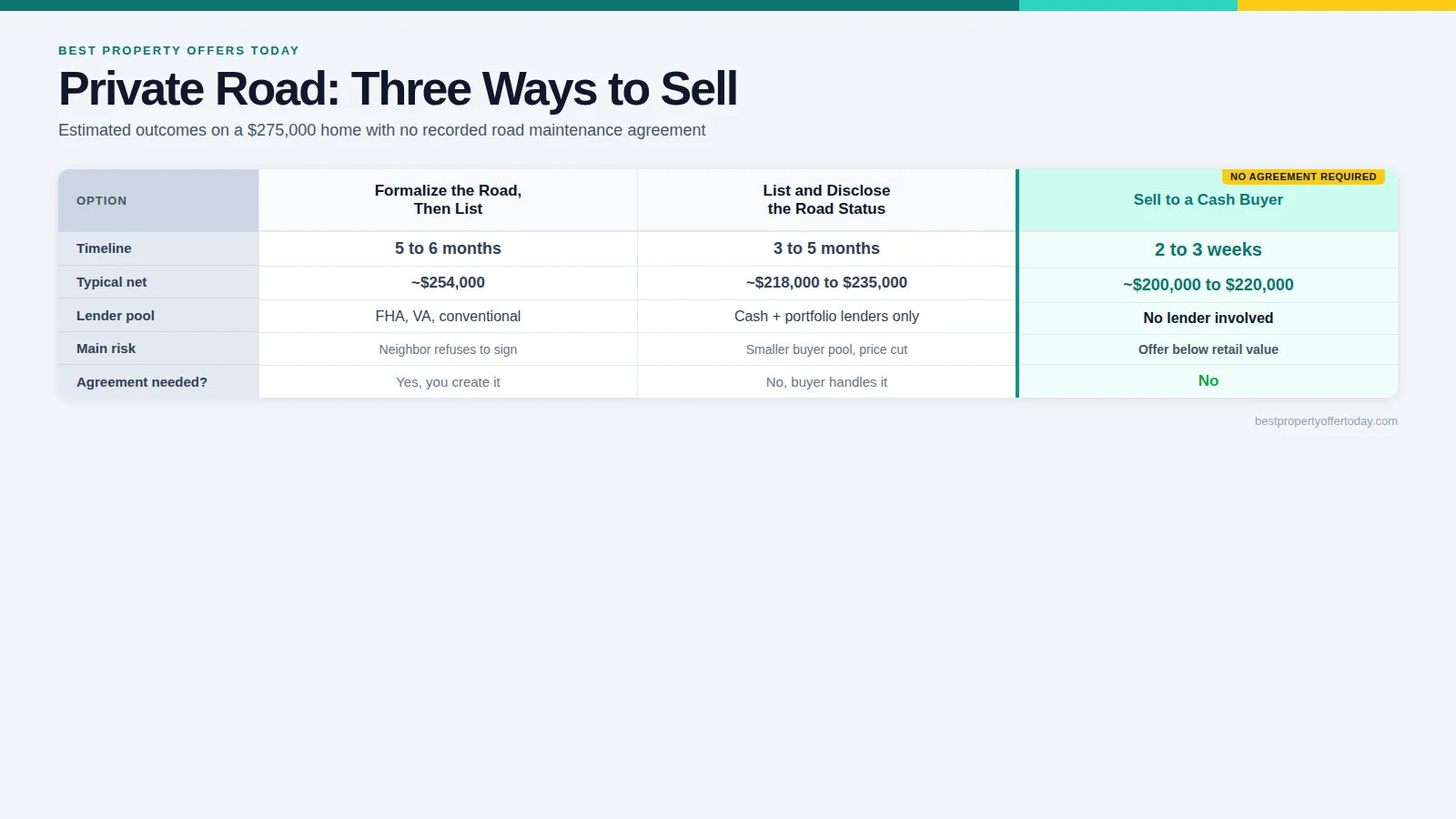
Under Path 1, the seller spends $1,000 on attorney fees, $750 on the road repair share, and waits ten weeks for the agreement to be recorded. The listing then closes in another 45 days. Commission at 5.5 percent is $15,125. Seller-paid closing costs add $3,500. Net to seller: approximately $254,600, on a timeline of five to six months total.
Under Path 3, a cash buyer offers $218,000 (79 percent of market value). No repairs, no commission, no attorney fees. Closing in two to three weeks. Net to seller: $218,000, but the carrying cost savings are real. At $1,800 per month in holding costs, the five months saved equals $9,000, narrowing the real-dollar gap to approximately $27,600.
That gap is real. What the seller pays for with a cash sale is speed and certainty. The agreement process fails when a neighbor refuses. A listing after a failed agreement attempt takes even longer, because the property accumulates days on market. If time or certainty is the priority, the math on a cash sale is better than the headline numbers suggest.
You can run your specific numbers through the net proceeds calculator to see how the three paths compare for your situation.
Red Flags from Buyers on Private Road Properties
Some buyers use a private road situation as a basis for reducing the offer after the inspection period, even when the road was disclosed upfront. Watch for these signals before accepting any offer:
- Token earnest money under $1,000 on a $200,000 or higher offer: walking away costs them nothing
- Long inspection windows of 30 or 45 days on an otherwise straightforward transaction
- Assignment clauses in the contract, which allow the buyer to transfer their rights to a different purchaser before closing
- A revised, lower offer submitted after the inspection period begins, citing road concerns that were disclosed before the first offer was made
For a full breakdown of how to read earnest money amounts, this post on earnest money in cash sales explains what a serious buyer puts down and what token deposits signal. Any buyer who is surprised by private road status after you disclosed it at the time of listing is not ready for this transaction. A buyer who revisits the road as a renegotiation lever is likely to revisit it again even if you accept the adjusted number.
Questions to Ask Before You Sign
Before accepting any offer on a private road property, ask the buyer these directly:
- Are you paying cash, or does your offer include a financing contingency?
- Have you reviewed the title search and confirmed a recorded easement for road access?
- Are you aware there is no recorded private road maintenance agreement, and do you accept the property in that condition?
- What is your earnest money amount, and when does it become non-refundable?
- Does your contract include an assignment clause?
The answers tell you quickly whether the buyer has done their homework or is in early stages of pricing a future renegotiation.
The Honest Limits of a Cash Offer on a Private Road Property
A cash offer below retail is not a trick. It reflects the buyer absorbing a real cost and a real risk: future road maintenance without a formal cost-sharing agreement, and the possibility that one neighbor eventually disputes access. That risk has a dollar value, and the buyer prices it in.
If you have cooperative neighbors and enough time to create the agreement, a traditional listing is likely the better financial outcome. If a neighbor has refused to participate, the timeline is compressed, or the road itself is problematic enough to narrow the financed buyer pool anyway, a cash offer provides certainty that a traditional listing cannot.
Getting competing offers from multiple cash buyers is the only way to know whether the spread between a cash sale and a traditional listing is worth the certainty premium for your specific situation. A marketplace that collects offers from vetted buyers gives you real numbers to compare rather than estimates. Call 804-361-7460 or request competing offers at bestpropertyoffertoday.com.
Does a private road always block FHA financing?
Not always. If a recorded maintenance agreement already exists and is on file at the county recorder’s office, FHA financing is available. If it does not exist, the buyer must either create it during the transaction or switch to a different loan type. Some FHA-approved lenders will make an exception for rural properties where a formal agreement is impractical, but this requires explicit lender sign-off and is not a reliable assumption.
Can a buyer create the maintenance agreement during escrow?
Yes, and this is done. The purchase contract includes a contingency requiring a recorded agreement before closing. The buyer funds the attorney and the seller coordinates the signatures. The risk is the same as always: one holdout neighbor blocks the process. If the contingency cannot be cleared, the buyer typically has the right to cancel and recover their deposit.
What if only one household uses the private road?
A road used by a single household requires only an agreement between the two adjacent property owners. The lender’s requirement is the same: recorded, notarized, binding on future owners. With only two parties, negotiation is simpler, but both still need to cooperate and sign.
Does a cash buyer still need to confirm road access is legal?
Yes. A cash buyer skips the lender’s maintenance agreement requirement but does not skip the title search. The title company will confirm that the property has a legal right of access. That right typically shows as a recorded easement or a deeded right-of-way. If the only access is informal custom with no recorded legal basis, that is a title defect that the cash buyer’s title company will want addressed before closing. The maintenance agreement and the access easement are two separate documents solving two separate problems.
Ready to see real numbers for your house?
Enter your property address to get competing offers from verified cash buyers. No repairs, no agent fees, and you pick the closing date.
Prefer to talk? Call (804) 361-7460