Owned solar panels are not a liability the way a leased system is, but they are not automatically an asset either. How they affect your sale depends on one question: how were they paid for? Paid off in full, financed with a solar loan, or financed through a PACE assessment each creates a different closing situation and a different pool of buyers.
This post covers the owned-panel scenarios. If your situation is a solar lease or a power purchase agreement, that is a separate structure with different complications. We have a full guide on selling a house with a solar lease.
Selling a house with solar panels? Compare cash offers from buyers who price it in.
Enter your property address to get competing offers from verified cash buyers. No repairs, no agent fees, and you pick the closing date.
Prefer to talk? Call (804) 361-7460
The three types of solar ownership
Before anything else, figure out which category you are in. The answer changes everything that follows.
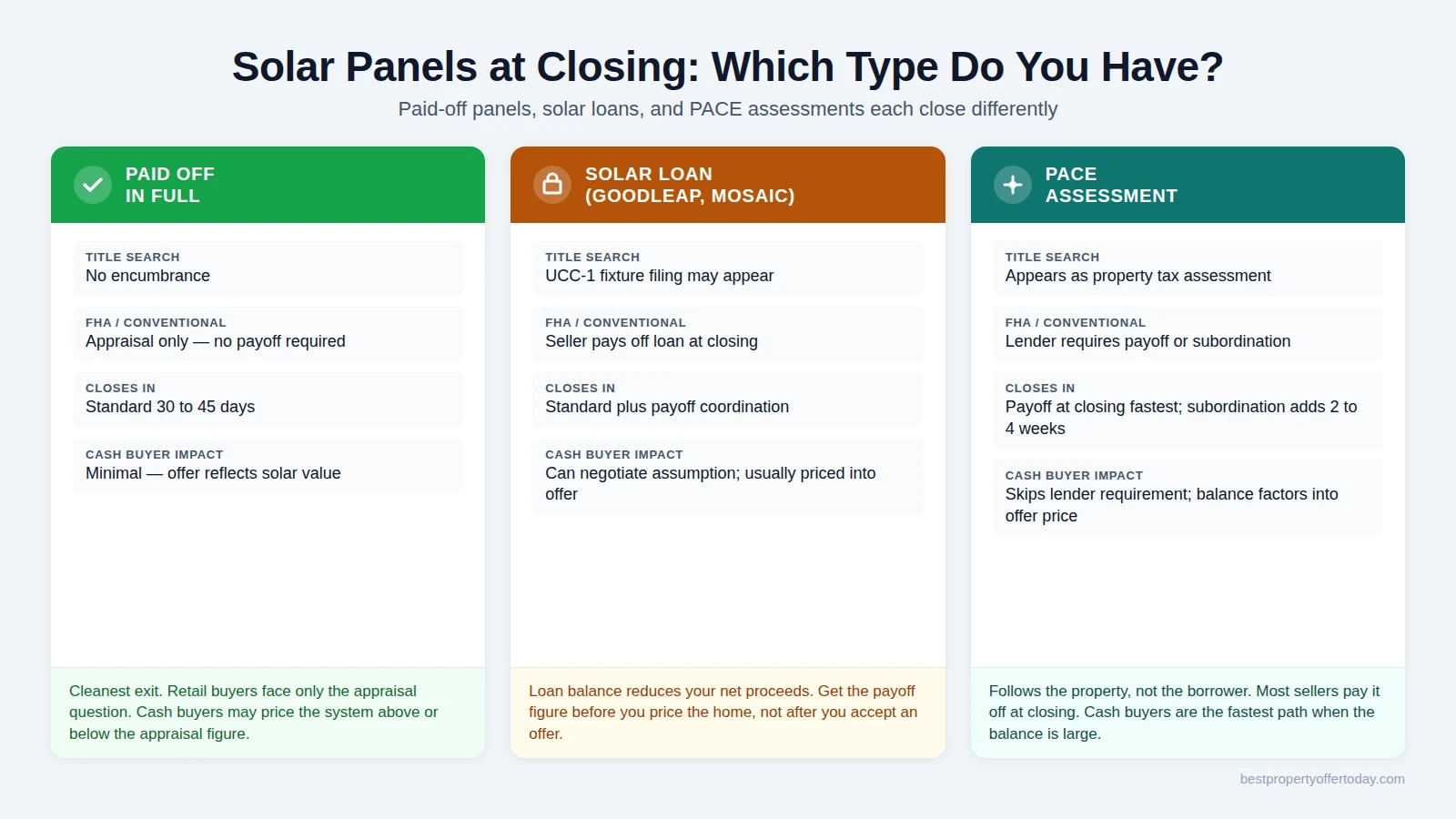
Paid off in full. You own the panels outright. No lender, no monthly payment, no encumbrance on title. The buyer gets the panels as part of the house. This is the cleanest exit. The only complication is the appraisal, which we cover below.
Solar loan (GoodLeap, Mosaic, Sunrun, Sunnova, Dividend). You borrowed money to install the system. Most solar loans are personal or secured loans attached to the borrower rather than the property. They almost never transfer to the buyer. You will usually pay them off at closing from your proceeds.
PACE loan (Property Assessed Clean Energy). This is the one that catches sellers off guard. A PACE loan is not a conventional loan. It is a special tax assessment that runs through your property tax bill and attaches to the property itself. The obligation follows the house, not the borrower. It shows up in a title search, and it creates a specific problem for every buyer who needs a mortgage.
How solar loans work at closing
If you have a solar loan from GoodLeap, Mosaic, Sunrun, or a similar company, the loan almost certainly needs to be paid off at closing. Most buyers' lenders will not allow the buyer to assume it. It is not structured as an assumable product.
The title company will flag it if a UCC-1 fixture filing was recorded against the property. Even if no UCC-1 exists, the payoff obligation is yours to resolve. You request a payoff letter from the solar lender, and the title company includes it in the closing settlement statement the same way it includes a mortgage payoff.
If the outstanding balance is $25,000 and your home nets $280,000 in sale proceeds, you walk away with $255,000 after the solar payoff, before other closing costs. What matters is knowing the balance before you price the house, not after you accept an offer. Sellers who discover the balance at closing lose negotiating ground and sometimes lose the deal.
One exception: a cash buyer who is willing to assume the loan as a negotiated term. Nothing prevents that structure. It is rare, but it happens when the remaining balance is small and the buyer values the reduced electric bill more than the payoff headache.
What PACE loans mean for your sale
PACE programs exist in roughly half the states, with the heaviest concentrations in California, Florida, and Missouri. The mechanics vary by program, but the core structure is the same: the solar installation cost is repaid through your property tax bill over 10 to 25 years, at interest rates typically between 6 and 10 percent.
Because PACE is an assessment tied to the property, the buyer inherits the obligation unless it is paid off at closing. For a retail buyer using a mortgage, this creates a specific lender problem.
Fannie Mae, Freddie Mac, and FHA all require that PACE obligations be either subordinated to the mortgage or paid off before closing. Getting a PACE obligation subordinated requires the PACE program administrator to agree in writing that the mortgage holder has payment priority in a foreclosure. Not all programs will agree to this, and the ones that do have their own approval timelines, often two to four weeks. In practice, most sellers pay off the PACE balance at closing rather than chase subordination.
Cash buyers are not bound by those lender requirements. A cash buyer can take the PACE assessment along with the house, treating the remaining balance as part of their acquisition cost and adjusting their offer accordingly. Whether that produces a better net for you than paying it off and going retail depends on the remaining balance, the time you have, and what competing offers actually look like. You can use the net proceeds calculator to model both paths. For a full breakdown of the three options, disclosure requirements, and worked numbers, see the guide on selling a house with a PACE loan.
Why solar panels are hard to appraise
The appraisal valuation is the main friction point for sellers with fully owned, paid-off systems.
For commercial solar, appraisers use an income approach: what does this system save or earn, and what is that cash flow worth? For residential solar, most appraisers use a cost approach: what did the system cost, minus depreciation and functional obsolescence. The result often undervalues the real energy savings the buyer will see.
A 10 kW system installed in 2020 for $28,000 might be assigned a depreciated value of $11,000 to $14,000 on a 2026 appraisal. If you priced at $320,000 expecting buyers to see the full solar value, and the appraisal comes in at $305,000, you have an appraisal gap to negotiate. The most common outcomes are a price reduction, the buyer covering the gap in cash, or the deal falling through.
Cash buyers do not need an appraisal to match a purchase price. They set their own value on the system. Some buyers who plan to hold a property as a rental will pay more for owned solar than an appraiser would assign. Others price it at near zero. Requesting competing offers from multiple cash buyers exposes that variation, and the spread on the same solar-equipped home can easily run $15,000 to $25,000 across buyers.
Worked example: three paths on a $310,000 home
A single-story home in Phoenix, built in 2010, with a 12 kW solar system installed in 2021. The system cost $34,000 and was financed through a PACE program. In 2026, the remaining assessment balance is $22,000 and runs through 2036. The home's ARV without the solar adjustment is approximately $310,000.
Path 1: Pay off the PACE at closing and list retail. Seller pays $22,000 from closing proceeds. The title is now clear. The solar system adds an appraised value of roughly $13,000. Adjusted list price: $318,000. Conventional buyer pool with no PACE friction. Time to close: 35 to 50 days. After PACE payoff, commission (5.5 percent), title, and miscellaneous seller costs: net approximately $276,000.
Path 2: List retail with the PACE in place. Buyers using FHA or Fannie/Freddie-backed financing face a lender requirement: subordinate the PACE or pay it off. Most buyers' lenders will not subordinate. Buyer pool narrows to cash buyers and buyers willing to pay off the balance outside of closing. Fewer offers, longer market time. After typical selling costs and negotiated price concession of $8,000 to $12,000: net approximately $264,000 to $268,000.
Path 3: Sell through a cash buyer marketplace. Cash buyers skip the PACE lender requirement. They price the remaining $22,000 assessment into their offer, along with their own view of the solar system's value. Competing offers in this scenario ranged from $258,000 to $277,000. No commission, no staging, closes in 14 to 21 days after title. Net range: $258,000 to $277,000.
The honest version: if the seller has the liquidity to absorb the PACE payoff at closing and can wait 35 to 50 days, the retail path typically produces the highest net. The cash route produces the fastest close and avoids the PACE friction, but a well-conditioned home with a motivated retail buyer at the right price will usually net more than a cash offer. For sellers who cannot fund the payoff from other sources, or whose buyer pool has stalled, a cash marketplace offer is the practical exit.
The ITC recapture rule sellers miss
The Investment Tax Credit allowed homeowners who installed solar panels to deduct 30 percent of the installation cost from their federal taxes. The recapture rule applies if you sell the property within five years of claiming the credit.
The recapture is proportional by year. Sell in year two: 80 percent of the credit is recaptured. Year three: 60 percent. Year four: 40 percent. Year five: 20 percent. After five full years, no recapture applies.
On a $30,000 installation, the credit was $9,000. Selling in year two triggers a $7,200 tax liability. That does not appear on the closing statement. It shows up when you file your taxes for the year of the sale. Factor it into your actual net proceeds before you commit to a price.
What to check before you list
Pull these items before your first conversation with a buyer or agent:
- The original financing agreement, confirming whether it is a personal solar loan, a PACE program, or a paid-off purchase
- The current payoff balance or remaining PACE assessment, plus the interest rate and term
- Whether a UCC-1 fixture filing was recorded against the property
- The installation date and whether you claimed the ITC on your federal return
- The monitoring agreement and whether it transfers to the buyer
- The current net metering status with your utility and whether the grandfathered rate transfers
Two of those items deserve extra attention. On net metering: in most states, the net metering contract follows the service address when the utility account transfers, but the grandfathered rate does not always follow. California's transition from NEM2 to NEM3 is the most visible example. A buyer who assumes they are getting the old favourable rate may be unpleasantly surprised at their first utility bill. Disclose the current rate schedule rather than the savings figure from when the system was installed.
On monitoring: most solar systems come with a 25-year panel warranty and a 10 to 15-year inverter warranty. Confirm these are transferable and pass the documentation to the buyer at closing.
Ready to see real numbers for your house?
Enter your property address to get competing offers from verified cash buyers. No repairs, no agent fees, and you pick the closing date.
Prefer to talk? Call (804) 361-7460
Frequently asked questions
Can a buyer require the seller to remove the solar panels?
A buyer can negotiate anything before a contract is signed. Panel removal typically costs $1,500 to $3,500, plus patching the roof penetrations. Sellers rarely agree to it; buyers who strongly object to solar ownership sometimes request it as a contract condition on a take-it-or-leave-it basis. Once a contract is executed with no panel removal clause, the panels stay with the house.
Do solar panels make a home sell faster?
In high-electricity-cost markets with buyers who understand the economics, paid-off solar panels attract serious interest. In other markets, they are neutral or occasionally a complication for buyers who do not want the maintenance responsibility. The age of the system and remaining warranty matter more than the solar panels as a headline feature. A 15-year-old system with an inverter approaching end of life is a negotiating liability, not an asset.
What happens to my net metering agreement when I sell?
Net metering agreements are tied to the service address. When the utility account transfers to the new owner, the agreement typically continues, but the grandfathered rate may not. Check with your utility. For buyers in states with recent rate schedule changes, confirm in writing what rate the new owner will receive, because the difference between an old and a new rate schedule can be several hundred dollars per year.
How much does a solar system actually add to the sale price?
The Lawrence Berkeley National Laboratory's research has found a national average premium of roughly 3 to 4 percent for homes with owned solar, but that average covers a wide range. In high-electricity-cost states like California, Arizona, and Hawaii, the premium is real and appraisers sometimes recognize it. In lower-cost electricity markets, the premium can be near zero. The appraisal is the controlling number for buyers using financing. What cash buyers offer is a separate data point, and the two can diverge significantly on the same property.