A failing retaining wall changes your sale in a specific way: it shrinks your buyer pool. FHA and VA lenders require the wall to be repaired before closing. Conventional lenders vary, but an appraiser who flags it as a structural concern can kill a deal even after you are under contract. Cash buyers skip the lender layer entirely, which is why most sellers with a serious wall problem end up choosing between a repair project and a cash offer.
Selling a house with retaining wall problems? Compare cash offers from buyers who price it in.
Enter your property address to get competing offers from verified cash buyers. No repairs, no agent fees, and you pick the closing date.
Prefer to talk? Call (804) 361-7460
Why Retaining Walls Fail
A retaining wall holds back a slope. The force pressing against it is not just gravity but water. Soil saturated after rain weighs two to three times more than dry soil, and that pressure has nowhere to go when drainage fails. Most walls are built with weep holes or gravel backfill to release that pressure. When they clog or were never installed correctly, the wall starts to lean.
Timber walls, including railroad tie walls, have a natural lifespan of 20 to 30 years. Once they start to rot at the base, leaning accelerates. Concrete block walls are more durable but crack under frost heave in cold climates. Poured concrete walls are the most stable but the most expensive to replace. The material tells you the likely repair path before an engineer visits.
Signs that a wall is failing: a visible forward lean of more than one inch per foot of height, horizontal cracking along the face, soil or gravel spilling through or around the base, and missing or clogged weep holes. A home inspector will note all of these. If they appear in the inspection report, every buyer’s lender will see them too.
What Lenders Actually Require
FHA and VA appraisers work from a checklist of Minimum Property Requirements. A retaining wall that is visibly failing, leaning, or threatening the grade near the foundation will be flagged as a condition that must be corrected before the lender will approve the loan. That is not a negotiable point with the lender. The buyer cannot accept the wall “as is” on FHA or VA financing regardless of what the purchase contract says.
Conventional loans are more lender-specific. A lender following Fannie Mae guidelines will require an appraiser to comment on structural issues that affect market value or safety. A minor crack in a block wall 40 feet from the house may not trigger a condition. A six-foot timber wall leaning over the back yard almost certainly will.
The practical result: a failing retaining wall can eliminate the 15 to 20 percent of buyers using government-backed financing before they even make an offer, and it puts every other deal at risk of falling apart at appraisal.
Who Owns the Wall?
This question comes up whenever a wall sits near a property boundary, and the answer is not always the owner whose yard the wall is holding up. In most US jurisdictions, the property that benefits from the retained soil is considered responsible for maintaining the wall. That is typically the uphill property owner. Local ordinances, recorded easements, shared maintenance agreements, and HOA documents can shift that responsibility or make it joint.
Before listing, get the property survey and pull any recorded easements from your title documents. If the wall is within a few feet of the property line and you are uncertain who owns it, a title search or a call to the local building department can clarify the record. Disclosing a shared or disputed wall as a known condition is safer than staying silent on it. An undisclosed defect that surfaces after closing creates a different legal exposure than one that was disclosed upfront.
Disclosure in an As-Is Sale
Selling as-is limits your obligation to repair. It does not limit your obligation to disclose. In most states, a seller who knows of a material defect must disclose it to buyers regardless of the sale terms. A retaining wall that you know is failing is a material defect. Leaving it off the disclosure statement does not make it undiscoverable. It shows up on the inspection report, and if the buyer later argues you concealed it, you are in a worse legal position than if you had disclosed it upfront.
The practical approach: note the wall’s condition on the disclosure form, attach any engineer or inspector reports you have, and let buyers price accordingly. Surprises after the inspection kill deals. Known issues allow buyers to decide whether they want to proceed.
Three Paths: What Each One Actually Nets
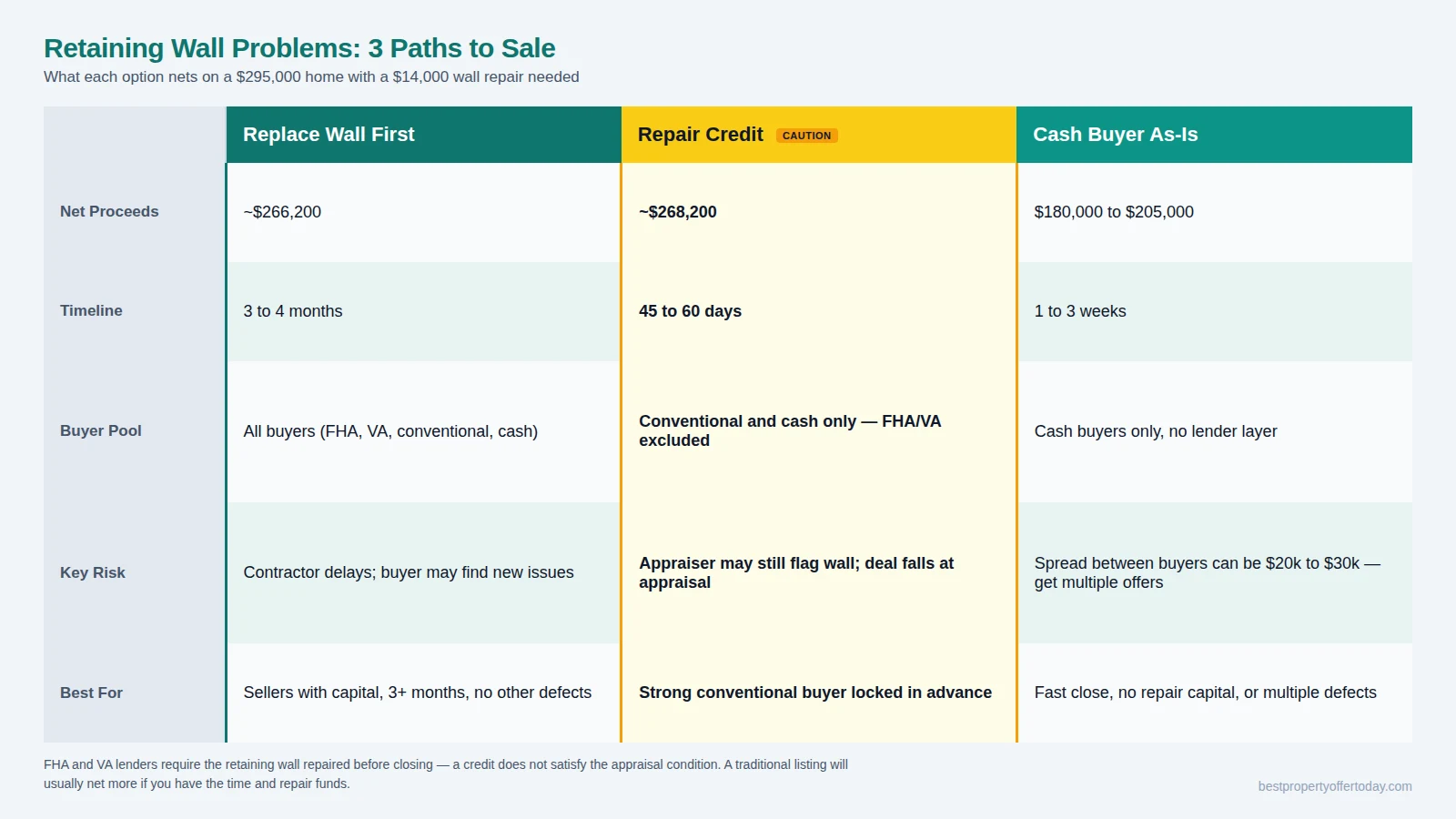
Take a house with an after-repair value of $295,000 and a 40-foot railroad tie wall that is leaning and rotting at the base. An engineer quotes $14,000 to replace it with a concrete block wall.
| Option | Gross price | Major costs | Estimated net | Timeline |
|---|---|---|---|---|
| Replace wall, then list | $295,000 | $14,000 wall + $8,900 commission + $5,900 seller closing costs | ~$266,200 | 3 to 4 months |
| List with $12,000 repair credit | $295,000 | $12,000 credit + $8,900 commission + $5,900 costs | ~$268,200 | 45 to 60 days |
| Cash buyer as-is | $185,000 to $210,000 | Minimal (lower commission or flat fee, reduced closing costs) | $180,000 to $205,000 | 1 to 3 weeks |
The credit option looks close to repair-and-list on paper. The problem is that FHA and VA buyers cannot use a repair credit to satisfy an appraisal condition. They need the wall fixed before closing, not money toward fixing it afterward. A $12,000 credit works only for conventional buyers, which narrows the pool before the deal even starts. If the conventional buyer’s appraiser also flags the wall, the deal stalls anyway.
The cash buyer path produces a lower headline number. What the seller buys with the difference is certainty and speed: no lender to satisfy, no appraisal condition to negotiate around, no carrying costs while waiting for a contractor and then a closing. For a seller who cannot fund the repair out of pocket or who needs to close in weeks rather than months, the tradeoff is real.
One important reason to collect competing offers through a marketplace rather than accepting the first cash offer you receive: the spread on wall repair pricing between individual buyers can be $20,000 to $30,000 on the same property. One buyer deducts exactly the repair estimate. Another prices in permitting, grading work, and a contingency margin. See how to read and compare those offers at our side-by-side comparison guide before deciding which to accept.
What a Structural Engineer Report Costs and What It Gets You
A structural engineer evaluation of a retaining wall typically runs $300 to $600 and produces a written report with a recommended repair approach and a cost range. That report does three things for a seller.
First, it gives you a real number to anchor the repair credit or evaluate cash offers. Without it, everyone is guessing at the deduction, including you.
Second, it demonstrates to buyers and lenders that you took the problem seriously. A disclosed defect with an engineering report attached is easier for a conventional lender to process than an undocumented leaning wall.
Third, it limits your post-closing exposure. If the report was shared with all buyers at listing, an argument that you concealed the defect is much harder to sustain.
If the report recommends immediate stabilization to prevent further movement, take that seriously. A wall that continues to lean during the listing period can worsen, change the repair estimate, and give a buyer grounds to renegotiate after inspecting.
Red Flags From Cash Buyers
Not every cash offer is from a buyer who intends to close. Four patterns to watch for before signing anything:
- An earnest money deposit under $1,000 on a $150,000+ contract. What constitutes serious earnest money on an as-is deal is different from a financed transaction, but token deposits cost nothing to walk away from.
- An inspection window longer than 14 days on an as-is deal. A prepared cash buyer should already know what they are buying.
- An assignment clause anywhere in the contract. This is a signal that the “buyer” may be a wholesaler who plans to sell the contract rather than close on it themselves.
- A price reduction after the inspection visit on a property that was fully disclosed upfront. On a disclosed, as-is property, that is a renegotiation tactic. Being prepared for it in advance makes it easier to hold position or walk away.
If you are not sure whether a specific buyer is legitimate, how to vet a cash buyer covers what documentation to ask for and what answers to trust.
The Honest Bottom Line
A cash offer on a house with a failing retaining wall will be below what you would net with a fully marketed retail sale after the wall is repaired. That gap exists because the buyer is pricing in the repair, the permits and carrying costs they will deal with, and a margin for things they cannot see yet.
If the house is in otherwise good condition and you have the time and money for the repair, fixing the wall first and listing it traditionally will almost always net more. That is worth saying plainly, because pretending otherwise costs you trust before the conversation even begins.
Where a cash sale makes sense: the repair cost is more than you can fund out of pocket, the wall is one of several defects narrowing your buyer pool, or you need to close on a timeline the repair-and-list path cannot match. Use the net proceeds calculator to compare what competing cash offers net against the repair-and-list scenario on your specific property before committing to either path. Call 804-361-7460 with questions.
Does a failing retaining wall have to be repaired before selling?
Only if the buyer is using FHA or VA financing. Those loans require a failing retaining wall repaired before closing as a condition of the appraisal. Conventional buyers and cash buyers can purchase with the wall in its current condition, though conventional lenders have discretion to require repairs if an appraiser flags a safety concern.
What does retaining wall replacement actually cost?
It depends on the material and linear footage. Replacing a railroad tie wall with a new timber wall typically runs $150 to $250 per linear foot. Upgrading to concrete block runs $200 to $350 per linear foot. A 40-foot wall replacement is commonly $8,000 to $16,000. Engineered walls on steep slopes with drainage work can reach $30,000 or more.
Do I have to disclose a leaning retaining wall in an as-is sale?
In most states, yes. Selling as-is limits your obligation to fix known defects, not your obligation to disclose them. A material defect you know about should be noted on the disclosure form. Nondisclosure exposes you to post-closing claims even in as-is transactions.
Can I sell with just a repair credit instead of fixing the wall?
A repair credit works only for buyers whose lenders do not require the wall fixed before closing. FHA and VA buyers are excluded because their appraisers require the condition resolved, not reimbursed. With a credit, you are selling to a subset of conventional buyers, which is a smaller pool and often produces lower offers than a fully repaired listing.
Ready to see real numbers for your house?
Enter your property address to get competing offers from verified cash buyers. No repairs, no agent fees, and you pick the closing date.
Prefer to talk? Call (804) 361-7460