A lis pendens does not prevent you from selling your house. It does, however, stop most buyers before they reach closing. The notice puts a cloud on your title that most lenders will not lend against, and most title insurance companies will not insure over. Your buyer pool narrows to cash buyers who are willing to assess the underlying lawsuit and decide whether they can take on the risk.
If the house is in good condition and you have time to wait, resolving the lawsuit first and then selling on the open market will almost always net you more money. If you cannot wait, or if the litigation has no clear end date, a cash sale is often the only realistic path to closing. The trade-off is a below-market offer. What you get in return is a closed sale without more months of carrying costs and legal fees piling up.
Selling a house with a lis pendens? Compare cash offers from buyers who price it in.
Enter your property address to get competing offers from verified cash buyers. No repairs, no agent fees, and you pick the closing date.
Prefer to talk? Call (804) 361-7460
What a Lis Pendens Actually Does to Your Title
Lis pendens is Latin for “suit pending.” When someone files one, they record a document at the county courthouse telling the world: there is a lawsuit concerning this property, and whoever buys it takes ownership with knowledge of that lawsuit.
The lis pendens is not itself a lien. It does not encumber title the way a judgment lien or mechanic’s lien does. What it does is create a cloud: a flag that tells every title examiner, every lender, and every title insurer that the ownership or condition of this property is being contested in court. For a broader look at title complications that stop sales, see our post on title problems that delay a cash closing.
That cloud has two practical consequences for a sale:
- Lenders will not issue a mortgage on a property with an active lis pendens. No lender’s title policy means no loan.
- Most title insurance companies will not issue an owner’s policy that covers the pending litigation. A buyer who closes without that coverage inherits the risk of whatever the lawsuit produces.
The Three Types of Lis Pendens and Why the Distinction Matters
Not all lis pendens filings carry the same risk. A cash buyer who knows the difference will evaluate your property very differently depending on which type you are dealing with.
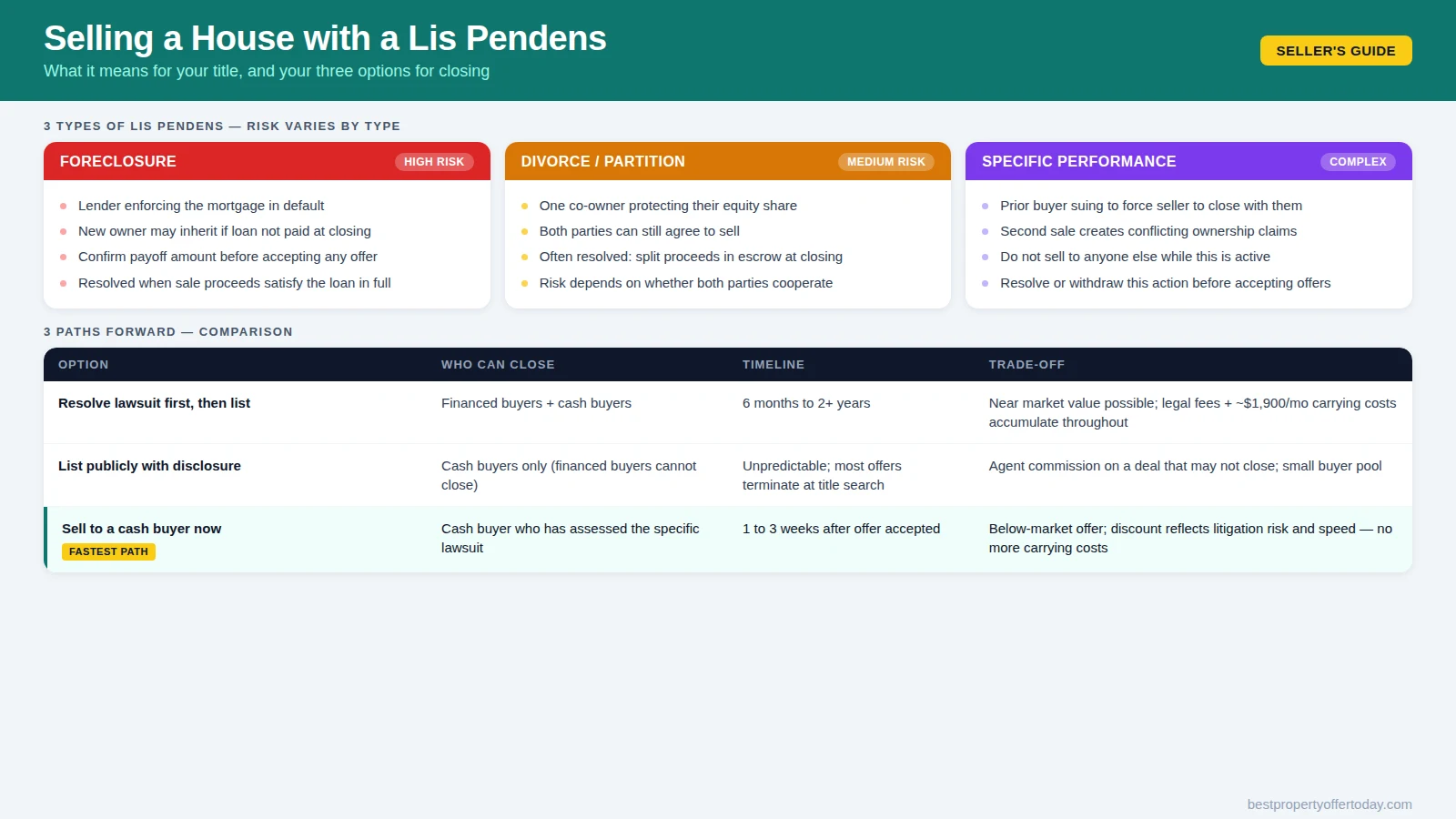
Foreclosure lis pendens. Filed by a lender when the homeowner is in default. The lawsuit is about enforcing the mortgage, and if it concludes in the lender’s favor, ownership changes. This is the highest-risk type for a cash buyer, because the outcome directly affects who owns the property after closing. The buyer needs to know the payoff amount and confirm that the sale price can satisfy the mortgage at closing. If it can, the lender’s attorney provides a release at closing and the title clears.
Divorce or partition lis pendens. Filed by one spouse or co-owner to prevent the other from selling without their consent, or to force a division of the property. The underlying claim is about who controls the equity, not about whether an outside party has a claim against the property. Cash buyers generally view this as lower risk when both parties are motivated sellers, because the dispute can often be resolved at closing by splitting proceeds in escrow according to a settlement or court order.
Specific performance lis pendens. Filed by a buyer who claims the seller backed out of a signed contract and who wants a court to force the sale specifically to them. This is the most complicated type for a seller, because a second sale while the specific performance action is active creates conflicting claims on the property. Most cash buyers will not proceed until this is resolved or withdrawn.
Why Financed Buyers Almost Always Walk Away
The chain breaks at the lender, not at the buyer. A financed buyer may want the property and be willing to wait, but their underwriter will flag the lis pendens during title review. No lender will issue a loan commitment with an active lis pendens outstanding, because there is no way to guarantee the lawsuit will not produce a claim against the property after closing.
This is not a policy choice that individual banks make. It is a requirement from secondary market investors such as Fannie Mae and Freddie Mac, whose guidelines require clear, marketable title at closing. Without those investors, most lenders cannot fund the loan.
The practical result: your open-market listing will attract buyers who make offers, get the lis pendens flagged in their title search, and then terminate. That cycle can add months to your timeline without bringing you closer to closing.
What Cash Buyers Actually Take On
A cash buyer has no lender to satisfy, which removes the biggest barrier. They still need to understand what they are accepting when they close with an active lis pendens.
If the lawsuit concludes after they buy, the judgment or order may bind the new owner. A foreclosure judgment does not automatically disappear because the property changed hands. The buyer acquired the property with notice of the pending action, and courts in most states will hold them to that notice.
Experienced cash buyers handle this in a few ways. On a divorce lis pendens where both spouses are selling, the buyer may require that the net proceeds be held in escrow and disbursed according to a settlement agreement, resolving the underlying dispute at closing. On a foreclosure lis pendens, the buyer may require that the payoff amount be sufficient to satisfy the mortgage at closing. On a specific performance action, most experienced buyers simply will not close until a release is filed.
Getting competing offers from multiple cash buyers matters here not just for price but because different buyers have different experience with lis pendens situations. One who has handled these before will assess the specific lawsuit and give you a realistic number. One who has not will either pass or price in a larger discount for uncertainty. You can use the net proceeds calculator to compare what different offer levels actually leave in your pocket after payoffs and closing costs. Call 804-361-7460 if you want to discuss your situation before submitting.
Three Paths Forward: A Comparison
| Option | Who can close | Timeline | Trade-off |
|---|---|---|---|
| Resolve the lawsuit first, then sell | Financed and cash buyers | 6 months to 2 years or more | Potentially near-full market value; legal fees and carrying costs accumulate the whole time |
| List on the open market with disclosure | Cash buyers only; financed buyers cannot close | Unpredictable; most offers terminate after title search | Agent commission on a deal that may not close |
| Sell to a cash buyer who handles the lis pendens at closing | Cash buyer who has assessed the specific lawsuit | 1 to 3 weeks after offer accepted | Below-market offer; the discount reflects litigation risk and speed |
A cash offer is normally below a fully marketed retail price. What the discount buys you is a closed sale: no more carrying costs, no more months of litigation running against the property. Whether that trade-off is worth it depends on how long the lawsuit is likely to run and how much the property costs you each month while it does.
A Worked Example
A house has a current market value of $290,000. The owners are divorcing. One spouse filed a lis pendens to prevent a sale without court oversight. Both want to sell, but the filing is required by their attorneys to protect each party’s share until the divorce is finalized.
Path one: wait for the divorce to finalize. The litigation has been ongoing for eight months. Attorneys estimate another six months at minimum. Carrying costs run $1,900 per month in mortgage, taxes, and insurance. Six more months: $11,400. Legal fees projected through resolution: $8,000. The house then sells for $285,000 with a 6 percent agent commission, or $17,100. Net to both parties combined: roughly $248,500.
Path two: accept a cash offer now. A cash buyer who handles divorce lis pendens situations regularly requires that proceeds be split in escrow per the attorneys’ instructions. When both parties are cooperative and the dispute is financial rather than about ownership itself, competitive cash offers on a $290,000 property typically land between 78 and 85 percent of market value. At 82 percent: $237,800. No commission, no additional carrying costs, no extended legal fees. Net to both parties: roughly $231,000 after title fees.
The gap is about $17,500. Both spouses stop paying into the property the day they close. If the litigation runs a full extra year instead of six more months, the carrying cost difference closes that gap almost entirely. Whether speed or maximum value is the better outcome depends on the specifics of the lawsuit and how reliably the attorneys can predict the timeline.
Disclosure Requirements
Selling as-is does not eliminate your disclosure obligation. A pending lawsuit that affects title is a material fact in every state, and a seller who conceals it faces a fraud claim from the buyer after closing.
Most seller’s disclosure forms have a section for pending legal actions or encumbrances. Fill it in. Your title company will find the lis pendens in the title search regardless, but the written disclosure establishes that you were forthcoming from the start, which protects you in any later dispute. If you are unsure whether a specific type of lawsuit requires disclosure in your state, that is a question for a real estate attorney, not a real estate agent. See our guide to when you need a lawyer in a cash home sale for more on what a legal review costs and what it catches.
Red Flags from Buyers
Not every buyer who approaches a lis pendens property intends to close. Several signals indicate a buyer who either does not understand what they are taking on or who plans to use the lis pendens as leverage to renegotiate after you have committed.
- Token earnest money. A buyer offering $500 on a $290,000 purchase can walk for almost nothing. A serious buyer who has assessed the litigation risk will commit real earnest money.
- Long inspection window on an as-is purchase. A 30-day inspection period on an as-is contract is not for inspection. It is time to renegotiate or walk without penalty.
- No questions about the specific lawsuit. A buyer who does not ask what the underlying action is about either has not done their homework or does not intend to close.
- Assignment clause in the contract. This allows the buyer to transfer the contract to a third party before closing. The person making the offer may not be the one intending to close. See our guide to how to identify a wholesaler versus a real buyer for the exact contract terms to watch for.
- Post-offer price cut after the title search. If you disclosed the lis pendens upfront and the buyer still submitted an offer, they should not be surprised when the title search confirms it. A price reduction at that stage is a standard bait-and-switch move.
Questions to Ask a Cash Buyer Before You Sign
- Have you purchased properties with an active lis pendens before?
- Do you need a title insurance policy to close, or will you proceed without one?
- What is your specific plan for handling the lis pendens at closing: release, escrow, or indemnification?
- Are you closing with your own funds or with a private lender?
- What earnest money are you putting up, and under what circumstances would you walk?
- Are you assigning this contract or closing in your own name or entity?
A buyer who answers these questions specifically and consistently has dealt with this situation before. One who hedges or defers every answer is unlikely to reach closing. For a fuller checklist that applies to any cash sale, see our guide to questions to ask a cash home buyer before you sign.
Ready to see real numbers for your house?
Enter your property address to get competing offers from verified cash buyers. No repairs, no agent fees, and you pick the closing date.
Prefer to talk? Call (804) 361-7460
Frequently Asked Questions
Can a lis pendens be removed before a sale closes?
Yes. The most common method is an expungement motion, which asks the court to vacate the lis pendens on the grounds that the underlying lawsuit does not actually affect title. If the court agrees, the lis pendens is removed from the record and the title clears. The plaintiff can also withdraw it voluntarily when the underlying dispute settles. Attorney fees for expungement typically run from $1,500 to $5,000 depending on how contested the motion is. California has a statutory expungement procedure that is faster and more predictable than most states.
Does a lis pendens expire on its own?
In most states, a lis pendens stays on record until the lawsuit is resolved and a release is recorded, or until a court orders it removed. It does not expire automatically. A few states impose time limits on lis pendens effectiveness, and California requires renewal if the lawsuit is not actively prosecuted. In most jurisdictions, though, the lis pendens follows the property indefinitely until someone takes action to clear it.
What happens to the lis pendens after you sell?
The lawsuit continues. Selling the property does not end the underlying litigation, and a buyer who purchases with notice of the lis pendens takes on the risk that the lawsuit will produce an order affecting the property. If the lawsuit is resolved in the plaintiff’s favor, that resolution can bind the new owner. This is why experienced cash buyers require either that the lawsuit be settled at closing, that proceeds cover the potential judgment, or that the offer price reflects the litigation risk they are accepting.
Can you sell if the lis pendens is from a foreclosure?
Yes, but the mechanics are specific. The foreclosing lender must be paid off at closing for clear title to transfer. If your net proceeds from the sale cover the payoff amount plus closing costs, the lender’s attorney provides a release at closing and the title clears for the new owner. If the payoff exceeds what the property is worth, you are in short sale territory, which requires lender approval and a different process. Our post on short sale versus cash sale covers that situation in detail.