A confirmed sinkhole on your property eliminates most financed buyers. FHA, VA, and conventional mortgage lenders treat active sinkhole activity as a structural defect that requires remediation before they will fund any loan. Your realistic buyer pool narrows to people who can pay cash, which changes the dynamics of a sale in ways that a seller needs to understand before they accept the first offer that comes in.
Selling a house with a sinkhole? Compare cash offers from buyers who price it in.
Enter your property address to get competing offers from verified cash buyers. No repairs, no agent fees, and you pick the closing date.
Prefer to talk? Call (804) 361-7460
What Sinkhole Classification Actually Means
Engineers and insurers use specific terms, and the one on your report determines how hard the sale will be.
Sinkhole activity means geotechnical testing found evidence of ongoing dissolution or subsidence beneath the structure. This is the classification that stops most mortgage applications cold. Lenders will not approve a loan until a licensed geotechnical engineer certifies that the remediation is complete and the structure is sound.
Confirmed sinkhole is the same finding reported through an insurance claim. In Florida, where sinkholes are most common due to the state’s karst limestone geology, the insurer is required to send out an engineer when a sinkhole claim is filed. If the report comes back as confirmed, the insurer must offer remediation or a cash payout. Which path you chose, and whether remediation was completed, will surface in the insurance records at closing.
Repaired sinkhole with a completion certificate is the cleanest outcome, but it still carries a stigma. A licensed geotechnical engineer’s letter certifying the repair reopens the property to financed buyers. The problem is that the sinkhole history stays in the records, and comparable sales show the discount. In sinkhole-concentrated areas of central Florida, repaired sinkhole homes typically sell for 10 to 25 percent below comparable homes with no sinkhole history, even with a clean certificate in hand.
Other affected states include Alabama, Missouri, Kentucky, Tennessee, Texas, and Pennsylvania. Disclosure rules vary, but in every one of them, a seller who knows about sinkhole activity must disclose it. The as-is clause limits what you are obligated to fix. It does not limit what you are obligated to tell a buyer.
Why Mortgage Lenders Will Not Close
FHA loan guidelines require an appraiser to flag any evidence of structural movement, settlement, or subsidence. A confirmed sinkhole triggers a required repair condition on the appraisal, and the loan will not fund until the condition is cleared by a licensed engineer. VA loans follow the same standard. USDA mirrors FHA on property condition. Fannie Mae and Freddie Mac guidelines for conventional loans require properties to be structurally sound and free of conditions affecting safety or livability, which an active sinkhole fails.
A buyer who says they can get financing on a confirmed sinkhole without a remediation certificate is mistaken. The appraisal process will surface the issue even if the buyer’s lender misses it on intake.
This matters for your pricing strategy. With financed buyers unable to proceed, you are competing only within the cash buyer market. A single cash buyer knows this. They know you cannot take their offer to a financed bidder as leverage. Without a second offer to compete against them, they have little reason to move from their opening number.
Three Paths and What Each One Nets
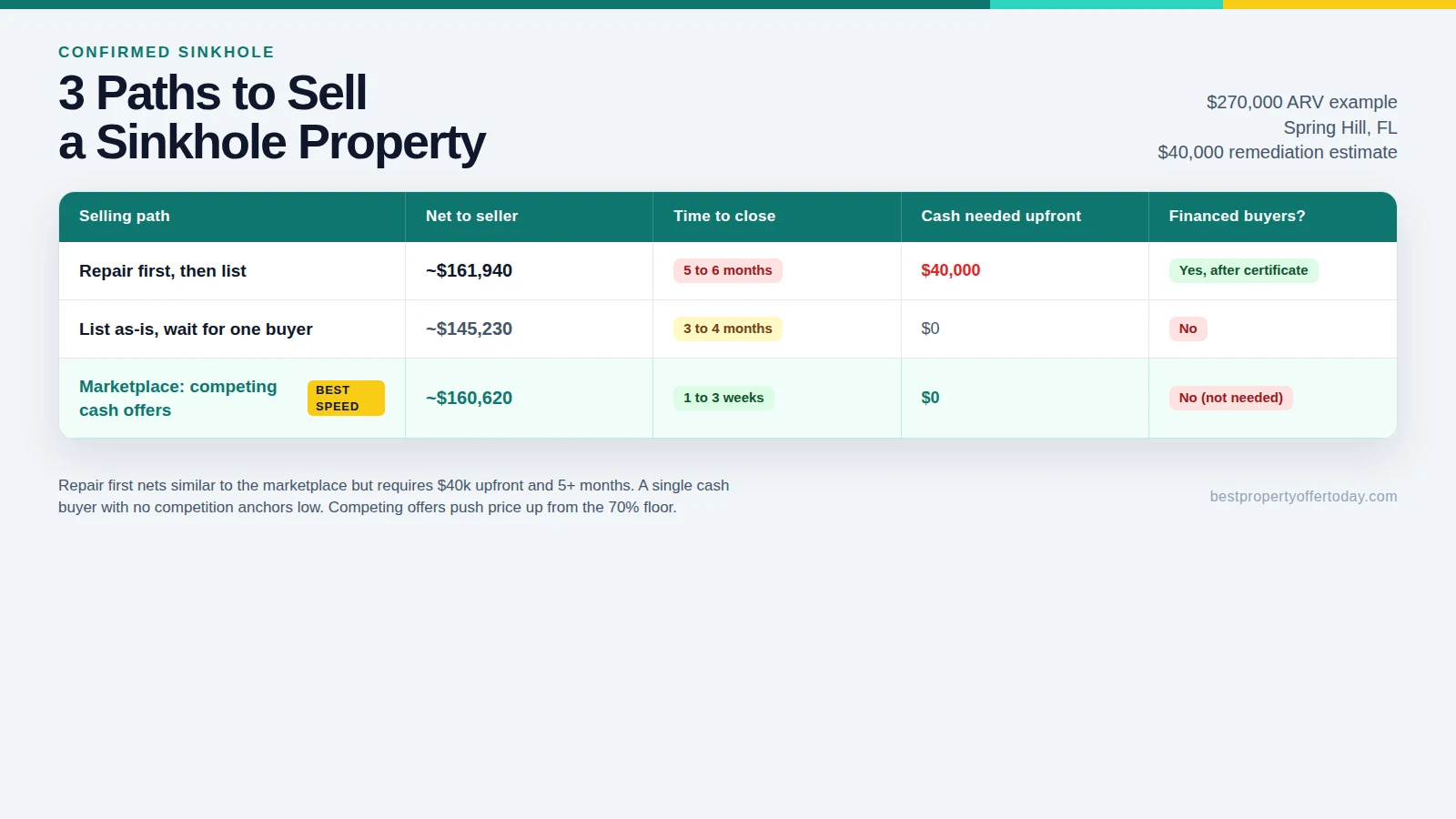
The worked example below uses a three-bedroom home in Spring Hill, Florida, with an after-repair value of $270,000, a confirmed sinkhole, and a geotechnical remediation estimate of $40,000. Spring Hill is one of the most sinkhole-active areas in the country and is a useful benchmark for cash-sale dynamics on this type of property.
Path 1: Remediate first, then list
You pay $40,000 out of pocket for compaction grouting and the engineer certificate. That unlocks the financed buyer pool, but the sinkhole history creates a stigma discount in comparable sales. At roughly 17 percent below ARV, the property lists at $224,000.
| Item | Amount |
|---|---|
| Remediation cost (grouting + certificate) | -$40,000 |
| Sale price after stigma discount | $224,000 |
| Agent commission (5.5%) | -$12,320 |
| Seller closing costs (1%) | -$2,240 |
| Carrying costs (5 months at $1,500/mo) | -$7,500 |
| Net to seller | ~$161,940 |
This works if you have the $40,000 available, are comfortable managing a repair project, and the rest of the home is in good enough condition to hold its price through a listing period. It gives you the widest buyer pool but does not give you anything close to the full ARV.
Path 2: List as-is on the open market
You disclose, price accordingly, and wait. Financed buyers cannot proceed, so you are marketing to retail cash buyers: end-users or investors willing to buy without a remediation certificate. Most of the investors who respond will be using the same 70 percent rule and repair cost arithmetic as any other cash buyer. After 70 to 90 days, the best offer that materializes is $152,000 from a local investor who has no competing bids to consider.
| Item | Amount |
|---|---|
| Best offer after 80 days on market | $152,000 |
| Agent commission (seller side) | -$0 |
| Closing costs | -$1,520 |
| Carrying costs (3.5 months at $1,500/mo) | -$5,250 |
| Net to seller | ~$145,230 |
The lower net on this path is not because cash buyers in general offer less. It is because a single buyer with no competition has no incentive to move from their opening number. You have no alternative to show them.
Path 3: Collect competing offers through a marketplace
When multiple vetted cash buyers see the same property at the same time and know they are competing, the dynamic changes. Investors who specialize in sinkhole remediation, local buyers with existing contractor relationships, and regional investors who know the Spring Hill market all submit offers simultaneously. Competition pushes the best offer above the 70 percent floor.
With an ARV of $270,000 and a $40,000 repair estimate, the floor from the 70 percent rule is about $149,000 ($270,000 x 0.70 minus $40,000). Competing offers typically push the best number above that. In this example, the winning offer comes in at $163,000.
| Item | Amount |
|---|---|
| Best competing cash offer | $163,000 |
| Commission | $0 |
| Closing costs (title + transfer) | -$1,630 |
| Carrying costs (close in 2 weeks) | -$750 |
| Net to seller | ~$160,620 |
The net on Path 3 is close to Path 1 (repair first) without the $40,000 upfront cost or the five-month wait. For sellers who do not have the cash for remediation or who cannot carry the property through a repair and listing period, this is often the only realistic path that does not involve accepting whatever one investor decides to offer. Run your own numbers first at the net proceeds calculator.
Buyer Types and a Sinkhole Property
| Buyer type | Will they close on confirmed sinkhole? | Typical offer | Timeline |
|---|---|---|---|
| Retail buyer (financed) | No, without remediation certificate | N/A | N/A |
| iBuyer (Opendoor, Offerpad) | Rarely. Most decline structural defects | N/A | N/A |
| National cash franchise | Some will, with deeper discounts | 55 to 65% of ARV less repair | 1 to 3 weeks |
| Local cash investor (single buyer) | Yes, if comfortable with the risk | 65 to 70% of ARV less repair | 1 to 3 weeks |
| Marketplace (competing offers) | Yes. Multiple investors bid simultaneously | 68 to 75% of ARV less repair | 1 to 3 weeks |
iBuyers explicitly exclude properties with known structural defects in their acquisition criteria, and confirmed sinkhole activity falls into that category. Do not spend time submitting to Opendoor or Offerpad for a confirmed sinkhole property. They will decline after their virtual inspection or not respond to the request at all.
Red Flags from Cash Buyers on Sinkhole Properties
Sinkhole properties attract buyers who know the seller has limited options. Watch for these:
- Token earnest money. A buyer who deposits $500 on a $160,000 transaction has nothing to lose by walking after their engineer report. On a cash transaction, 1 to 2 percent of the offer price is the reasonable range. See how much earnest money is enough in a cash sale.
- An assignment clause. A buyer who reserves the right to assign the contract to a third party is a wholesaler finding their end buyer after you have signed. That adds risk and typically lowers the final number. Read what a wholesaler is and how to spot one before you sign anything.
- A long inspection window on an as-is deal. Ten to fifteen business days is reasonable for a sinkhole property where the buyer needs to bring in their own geotechnical engineer. Thirty or forty-five days keeps you locked in while the buyer shops your property to other investors.
- A price reduction after their engineer report. The most common tactic: an acceptable opening offer, then a revised number based on the buyer’s own repair estimate. Ask before signing whether their offer is contingent on their engineering inspection and whether they will share that report before renegotiating.
- No proof of funds. A serious cash buyer for a sinkhole property should show a bank statement or institutional fund letter equal to or greater than the offer price. See what proof of funds from a cash buyer should actually look like.
Questions to Ask Before You Sign
- Have you purchased sinkhole properties before? In which areas?
- Is your offer contingent on your own engineering inspection?
- Will you share your engineer’s report before any price revision?
- What is your earnest money deposit and what are the forfeiture conditions?
- Does your contract include an assignment clause?
- Can you provide proof of funds today, before contract execution?
- What is your closing timeline from executed contract?
When a Cash Sale Is Not the Right Answer
A cash offer on a confirmed sinkhole property will come in below the retail value of the same home without that history. That reflects real costs the buyer is absorbing: engineering work, remediation, carrying costs, and the stigma discount when they eventually resell.
If the sinkhole has already been remediated, you have an engineer certificate, and the house is otherwise in good shape, a traditional listing to financed buyers will typically net you more than a cash sale. The repair is done, the certificate is in hand, and the full buyer pool is available to you. The stigma discount is real, but at least you are competing in the full market.
The cash path makes the most sense when the remediation has not been done, you do not have the cash to pay for it upfront, carrying costs are mounting, or you cannot manage a repair project before closing. Speed and certainty have real dollar value. Measure that value against your specific carrying costs and timeline before you decide.
Do I have to disclose a sinkhole when selling?
Yes. Sellers who know about sinkhole activity are required to disclose it under Florida law and similar statutes in other affected states. Concealment is not realistic: a prior insurance claim appears in insurance records, and the buyer’s homeowner’s insurance application will surface it. Non-disclosure exposes you to a lawsuit for rescission and damages after closing.
Can a cash buyer close on a sinkhole property in two weeks?
Yes, if the title work is clean. A cash transaction has no appraisal and no loan approval process, so the sinkhole itself does not extend the timeline. The limiting factor is title: clearing any outstanding liens, reviewing the insurance claim history, and confirming mortgage payoffs. A seller who has their original sinkhole investigation report, insurance claim documentation, and any remediation records ready in advance helps the title company move faster.
What does compaction grouting actually cost?
The range is wide: from around $10,000 for a small, shallow sinkhole to $100,000 or more for a deep or large feature beneath an occupied structure. Most residential sinkhole remediations in Florida fall between $20,000 and $60,000, depending on the depth, the diameter, the soil type, and the proximity to the foundation. A single engineering estimate does not tell you enough. Get two or three bids from licensed geotechnical contractors before committing to a repair-first path.
Will homeowners insurance cover sinkhole damage?
In Florida, insurers are required to offer sinkhole coverage, but many have stopped writing it or have made it optional under the “catastrophic ground cover collapse” policy language, which sets a higher threshold for the damage required before a claim pays out. If you have sinkhole coverage and a confirmed sinkhole, contact your insurer immediately. If the claim is paid out as a cash settlement and you did not use the funds for remediation, disclose that to the buyer and the title company. The disposition of insurance proceeds is a material fact in the transaction.
If you want to see what competing cash buyers would offer on your property, you can submit one request and compare offers at no cost or obligation. Call 804-361-7460 or submit your property details here.
Ready to see real numbers for your house?
Enter your property address to get competing offers from verified cash buyers. No repairs, no agent fees, and you pick the closing date.
Prefer to talk? Call (804) 361-7460