Yes, you can sell a house with PFAS contamination. The harder question is which buyers can actually close on it, because most cannot. Here is what that means for your exit options and what each path is likely to net.
Selling a house with PFAS contamination? Compare cash offers from buyers who price it in.
Enter your property address to get competing offers from verified cash buyers. No repairs, no agent fees, and you pick the closing date.
Prefer to talk? Call (804) 361-7460
What PFAS Contamination Means for a Home Sale
PFAS stands for per- and polyfluoroalkyl substances. There are more than 12,000 compounds in the family. The ones that matter most in residential property transactions are PFOA and PFOS, which the EPA formally designated as hazardous substances under CERCLA in April 2024.
Contamination typically reaches residential properties one of three ways: a private well that draws from groundwater near a military base where AFFF firefighting foam was used, a site near an airport or industrial facility that released PFAS into the soil or groundwater, or farmland where municipal biosolids (sewage sludge) were applied as fertilizer. The contamination is not visible and has no taste or smell. The only way to know it is there is to test for it.
The EPA established maximum contaminant levels (MCLs) for drinking water in June 2024: 4 parts per trillion (ppt) for PFOA and PFOS individually. Any reading above those thresholds triggers the same response from most lenders: they will not close.
What Lenders Actually Require
FHA, VA, and USDA loans all require a water quality test when the property uses a private well. A PFAS reading above the EPA MCL fails that test, and the loan dies at the appraisal stage. No cure, no close.
Conventional lenders have been moving in the same direction. After the EPA’s 2024 hazardous substance designation, Fannie Mae and Freddie Mac updated environmental guidance to flag PFAS-positive wells as a material risk. Many conventional underwriters now require a clean water test on well-served properties in counties with known PFAS contamination history. The lender-eligible buyer pool for a PFAS-positive property has shrunk considerably in the past two years.
iBuyers are not an easy alternative. Opendoor and Offerpad both conduct environmental reviews before purchase. A property with a known PFAS issue, or located within a quarter mile of a known contamination site, is typically declined or priced at a discount that approximates what a local cash investor would offer anyway.
Disclosure: What the Law Requires
Selling as-is does not change your duty to disclose. It limits your duty to repair. Those are two different obligations.
If you know your well tests above the EPA MCL, that is a material fact in every state with seller disclosure laws, which is virtually all of them. A material fact is anything that would influence a buyer’s decision to purchase or the price they would pay. PFAS contamination clears that bar in every state that has adopted general material fact disclosure requirements.
Some sellers reason that if they never test, they cannot be required to disclose. That position has been challenged in court. Sellers who had reason to know, based on proximity to a known contamination site or prior notice from a utility district, have faced liability even without a formal test result. If your property sits near a military base, an airport, or an industrial site that has appeared in EPA PFAS enforcement actions, have the well tested before listing so you know what you are dealing with before buyers commit their time and money.
As of 2026, Maine, Michigan, Vermont, and several other states have added PFAS-specific language to their seller disclosure forms. Most other states reach the same result through the general material fact standard, but the statutory language is evolving quickly.
Three Exit Paths and What Each Nets
There are three realistic options for a seller with confirmed PFAS contamination.
Path 1: Remediate First, Then List
Remediation options range in cost and in what they actually fix. A reverse osmosis filter under the kitchen sink ($300 to $1,500) reduces PFAS in drinking water at one tap but does nothing for showering, bathing, or the water heater. A whole-house granular activated carbon (GAC) system handles all water entering the house and runs $3,000 to $6,000 installed, but requires filter replacement on a schedule. Neither option eliminates the contamination in the well, so a lender’s water test on the raw well sample may still fail.
The only remediation that reliably re-opens the full buyer pool is connecting to a municipal water supply. Costs depend on how far the nearest water main runs: $10,000 to $30,000 is a realistic range covering the hookup, tap fee, road crossing, and interior plumbing changes. Some utility districts cover part of this cost through PFAS remediation programs tied to EPA enforcement actions near military installations.
Timeline from decision to list: typically three to six months, accounting for utility district approvals, excavation, inspection, and water quality certification.
Path 2: List With Disclosure and Offer a Credit
Disclose the PFAS test result, price the property below comparable clean homes, and offer a remediation credit at closing. This path works only if the buyer can close without a lender, or if the lender does not require a well test, which is increasingly uncommon for properties with private wells in affected regions.
The practical buyer pool for Path 2 is: cash retail buyers who waive financing and accept the environmental condition, and local investors. That is a narrow pool in most markets, and it concentrates on the same buyers available in Path 3, with the added friction of a longer listing period and multiple withdrawn offers.
Path 3: Sell As-Is to a Cash Buyer
Cash buyers skip the lender layer entirely. There is no appraisal condition, no water quality test requirement, and no underwriting review. The buyer prices the environmental risk into their offer and closes in one to three weeks.
Getting competing offers reveals what the actual market is for the property in its current condition, rather than what one investor quotes you on the phone. You can request competing cash offers here at no cost and with no obligation to accept any of them. See our guide to vetting cash buyers before signing anything.
Worked Example: A Property with a Contaminated Well
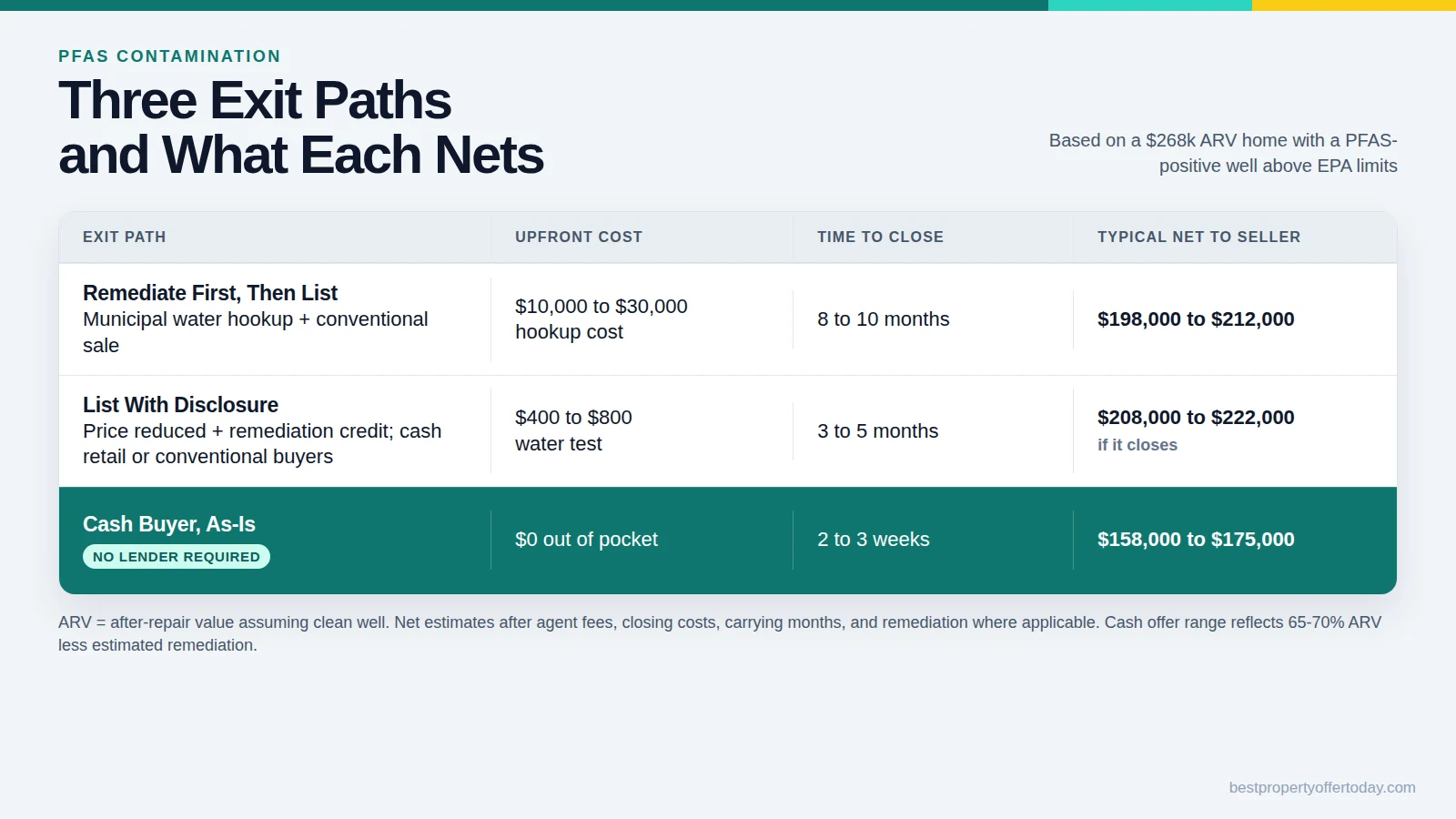
Three-bedroom ranch in a rural county 12 miles from a former industrial site with a documented PFAS release. Good structural condition, 1,500 square feet, private well. Well water tests at 22 ppt for PFOA, above the EPA’s 4 ppt MCL. ARV (after-repair value, assuming clean well): $268,000.
| Path | Upfront Cost | Time to Close | Estimated Net to Seller |
|---|---|---|---|
| Remediate (municipal hookup), then list | $10,000 to $30,000 | 8 to 10 months total | $198,000 to $212,000 |
| List with disclosure and credit | $400 to $800 for water test | 3 to 5 months | $208,000 to $222,000 (if it closes) |
| Cash buyer, as-is | $0 out of pocket | 2 to 3 weeks | $158,000 to $175,000 |
The difference between the first two paths and the third is roughly $40,000 in gross proceeds on this example. What the third path buys is speed, certainty, and no requirement to fund remediation upfront. Use our net proceeds calculator to run your own numbers with your actual carry costs and repair estimates.
An honest note: a traditional sale or a remediate-first path almost always produces a higher number if you have six to twelve months, the capital to fund the hookup, and a utility district willing to extend service. The cash path makes sense for sellers who cannot wait, cannot fund remediation upfront, or who have already watched financed buyers walk away after the lender’s environmental review blocked the loan.
What Cash Buyers Look at When PFAS Is Involved
Not every cash buyer will purchase a PFAS-affected property. The ones who will look at four things:
- The lab test result, in writing, with the lab name, testing date, and specific compound readings
- Distance to the nearest municipal water main (the primary cost driver for remediation)
- Whether the contamination source has been formally remediated by a responsible party under an EPA or state consent order (sometimes relevant to future value and insurance)
- County or state PFAS remediation program eligibility, which can reduce the buyer’s eventual remediation cost and therefore support a higher offer
Buyers who skip these questions and then ask for a large price reduction after an extended inspection period are using the environmental issue as a renegotiation lever. That is the most common form of bait-and-switch in this category of sale. If you see a contaminated property handled with a long inspection window and a vague offer, that pattern should give you pause before signing. For more on how to evaluate cash buyer offers before you commit, see our guide to selling a house with well water problems, which covers the lender mechanics in detail.
Red Flags From Buyers
- An as-is cash offer that includes a 60-day inspection period with no stated timeline for environmental review
- No earnest money, or a deposit under $1,000 on a transaction above $150,000
- An assignment clause, meaning the buyer plans to sell the contract to a third party before closing, which introduces uncertainty about whether the eventual buyer has experience with contaminated properties
- A buyer who cannot name a specific remediation contractor or provide a cost estimate, suggesting they are guessing at the discount rather than pricing it
Questions to Ask a Cash Buyer Before Signing
- Have you closed on PFAS-affected properties before, and in what county or region?
- Will you require any environmental testing before closing, or is this a no-test purchase?
- Is this a direct purchase, or do you plan to assign the contract to another buyer?
- What is the earnest money deposit amount, and when does it become non-refundable?
- Does your offer price already account for the remediation estimate, or will that come up again after the inspection?
Ready to see real numbers for your house?
Enter your property address to get competing offers from verified cash buyers. No repairs, no agent fees, and you pick the closing date.
Prefer to talk? Call (804) 361-7460
Frequently Asked Questions
Does PFAS contamination make a house unsellable?
No. PFAS contamination narrows the buyer pool to cash buyers and those without a lender requirement for a clean well test, but those buyers do close. The price will be lower than a comparable clean property, reflecting the remediation cost and the reduced demand. The property is sellable, though not at full market value without remediation.
Do I have to test my well before selling?
No test is universally required by state law before listing a property. But if the home is near a known PFAS source and you do not test, the buyer’s lender will often require one mid-contract, and a positive result at that stage kills the loan and wastes months. Testing before listing gives you accurate information before you price the property and before buyers commit time and money to a transaction that cannot close.
Can PFAS be fully remediated from a property?
Connecting to a municipal water supply eliminates the drinking water exposure for future residents and satisfies lender requirements. It does not clean the soil or the aquifer. For most residential sellers, the municipal water connection is the practical definition of remediated for purposes of a conventional sale. Full soil and groundwater remediation is a Superfund-scale undertaking typically carried out by the responsible party, not the homeowner.
What is the typical price impact of PFAS on a home?
Academic research on residential sales near known PFAS sites has found price discounts in the 7 to 15 percent range for properties within a mile of a confirmed contamination source, with larger discounts when the well itself tests positive. Individual properties with PFAS-positive wells in areas without nearby public water access have sold at 25 to 40 percent below comparable clean properties, based on published case data from Michigan and North Carolina court and regulatory records. The spread between buyers is wide: getting multiple offers through a marketplace tends to surface the highest price available in a narrow pool.