You owe more on your mortgage than your home is worth. Selling means coming to the closing table short, or waiting for lender approval, or walking away with nothing. Those are the real options, and each one has a cost. This post lays them out with actual numbers so you can compare.
Selling a house with negative equity? Compare cash offers from buyers who price it in.
Enter your property address to get competing offers from verified cash buyers. No repairs, no agent fees, and you pick the closing date.
Prefer to talk? Call (804) 361-7460
What negative equity means for a sale
Negative equity, or being “underwater,” means your mortgage balance is higher than your home’s current market value. It happens most often after a local market correction, when a seller bought near the top with a low down payment, or after a cash-out refinance reduced the cushion to zero.
Here is the core problem: a sale only transfers title if the proceeds are enough to pay off every lien against the property. The mortgage is a lien. If your home sells for $265,000 but you owe $285,000, the title company cannot close the deal without someone covering that $20,000 gap. Either you bring cash to the table, or your lender agrees to accept less than the full balance.
That is what makes an underwater sale different from a normal one. The buyer’s offer price is not the whole story. What matters is whether the net proceeds cover the payoff.
Why a standard cash offer does not automatically fix it
Getting competing cash offers is a valuable first step, because the offers tell you exactly what the market will pay. If you thought you were underwater but the highest offer clears your mortgage, the problem resolves at closing. Many sellers overestimate how far underwater they are, particularly in markets where values have partially recovered since the dip.
When the offers confirm a genuine shortfall, a cash buyer who submits an offer at market value cannot close the transaction unless you bring the difference or the lender agrees to a short payoff. Cash purchases skip the appraisal and the loan process, but they do not skip the title clearance. The mortgage lien still must be paid off or released.
This is not a reason to skip the competing-offers step. Knowing the actual market value is the foundation of every decision below.
Four paths for selling an underwater home
1. Bring cash to closing
If the shortfall is small relative to your savings, covering it out of pocket is the cleanest option. No lender approval needed, no credit damage, and the sale closes on a normal 1 to 3 week timeline. The math is straightforward: take the mortgage payoff amount, subtract the expected net sale proceeds, and that gap is what you owe at closing.
This path makes the most sense when the shortfall is a few thousand dollars and the alternative is continuing to carry a property you want out of.
2. Short sale
In a short sale, your lender agrees to accept less than the full balance and release the mortgage lien. The lender takes the loss in exchange for avoiding a foreclosure process, which is more expensive for them.
The requirements: you generally need to demonstrate a documented financial hardship (job loss, divorce, medical cost, payment increase from an adjustable rate). The lender reviews the submission, orders their own appraisal or broker price opinion, and decides whether to approve the discount. This process typically takes 45 to 120 days after a buyer’s offer is submitted.
What the short sale does not eliminate: a potential deficiency judgment. Most states allow lenders to pursue you for the forgiven balance, particularly on non-purchase loans and after cash-out refinances. California and a handful of other states have anti-deficiency statutes that limit this, but the majority do not. Forgiven mortgage debt may also be treated as taxable income under IRS rules; the Mortgage Forgiveness Debt Relief Act has been extended multiple times but check current law with a CPA before assuming you are protected.
Credit impact: a short sale typically drops a credit score by 100 to 150 points and stays on the report for 7 years, though the actual drop depends on the starting score and other account history. That is roughly equivalent to a foreclosure, though lenders generally treat a short sale more favorably when evaluating a future mortgage application.
3. Deed-in-lieu of foreclosure
Instead of a sale, you transfer the deed directly to the lender in exchange for release from the mortgage obligation. No buyer is involved. The lender gets the property without the cost and time of a foreclosure proceeding; you get out from under the loan without a lengthy court process.
Lenders will typically only accept a deed-in-lieu if you have already tried to sell the property and cannot generate a sufficient offer. They want confirmation the market will not support the full payoff. Expect a 30 to 90 day negotiation period. Credit impact is similar to a foreclosure and similar to a short sale in most cases. You receive no proceeds.
4. Subject-to or novation sale
A small segment of real estate investors specializes in purchasing properties by taking over the existing mortgage rather than paying it off. The buyer agrees to make your monthly payments going forward; the loan stays in your name until refinanced or paid off.
This can get a seller out from under monthly payments even when the mortgage balance exceeds market value. No lender approval is required because the loan does not change. The major risk to the seller: if the buyer stops making payments, the lender calls the loan delinquent and it shows on your credit. Many mortgages also include a due-on-sale clause that lets the lender demand full repayment if the property is transferred without their consent. Some lenders enforce this; many do not, particularly when payments continue on time.
Subject-to transactions require an attorney’s review. Any investor who pressures you to skip that step is not someone to close with.
Worked example: a $265,000 house with a $285,000 mortgage
A seller bought in 2022 at $310,000 with five percent down. The balance today is $285,000. After a local market correction, comparable sales put the home at $265,000. The gap is $20,000.
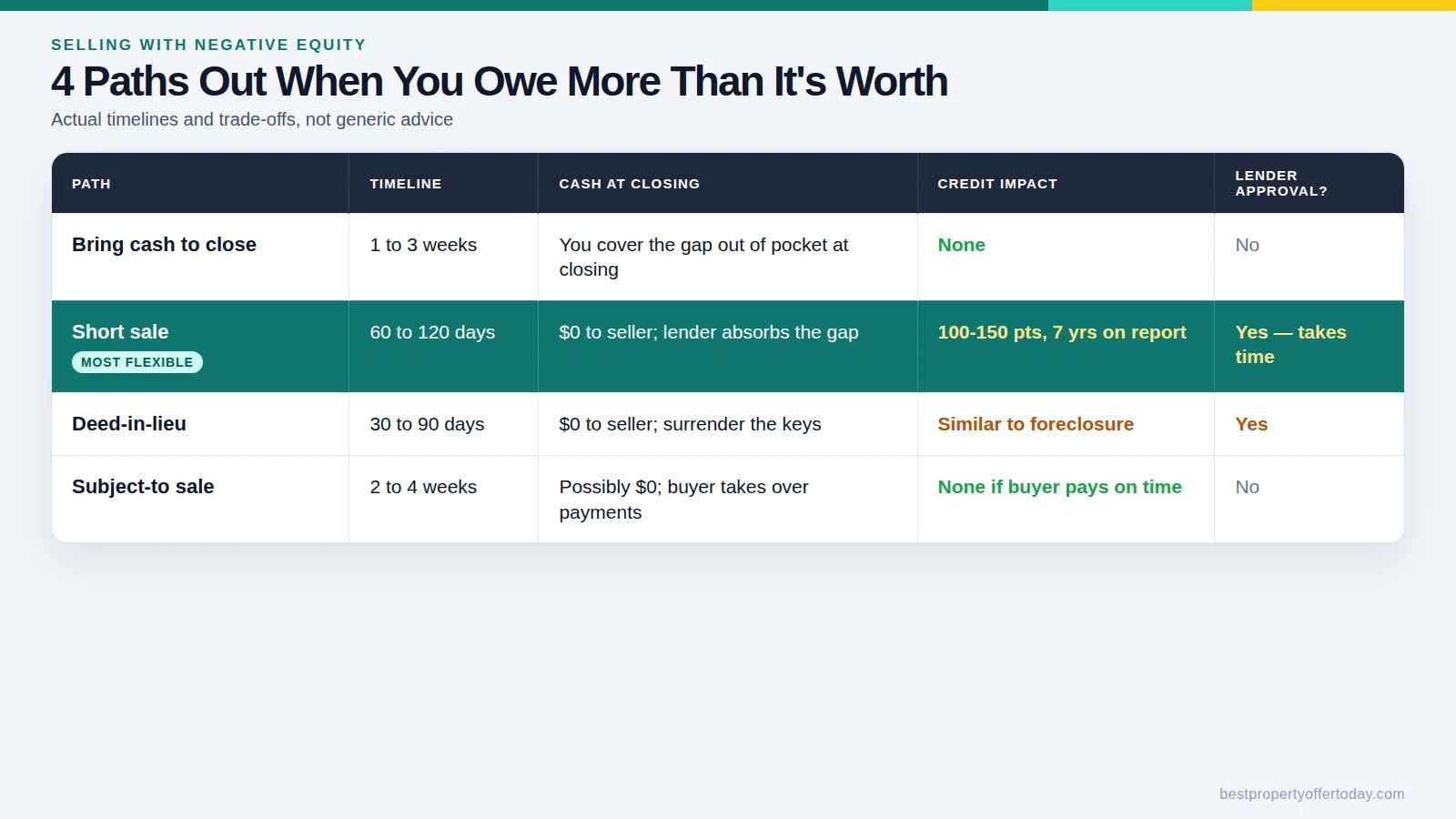
| Path | Timeline | Cash at closing | Credit impact | Lender approval required |
|---|---|---|---|---|
| Bring cash to close | 1 to 3 weeks | Bring $20,000 to 23,000 (gap plus closing costs) | None | No |
| Short sale | 60 to 120 days | $0 to seller (lender absorbs the gap) | 100 to 150 points, 7 years on report | Yes |
| Deed-in-lieu | 30 to 90 days | $0 to seller | Equivalent to foreclosure | Yes |
| Subject-to | 2 to 4 weeks | Possibly $0, possibly a small payment for equity | None if buyer pays on time; serious if not | No |
If comparable sales had come back at $290,000 instead of $265,000, the picture changes entirely. The seller would net around $5,000 after the mortgage payoff and closing costs rather than bringing cash to the table. This is why getting actual competing offers before assuming the worst is a productive first step.
What to expect at closing when there is a shortfall
In a standard closing, the title company collects the buyer’s funds, pays off the mortgage lien, and distributes the remainder to the seller. When a shortfall exists and the seller is covering it out of pocket, the instructions to wire the difference come a few days before closing. The title company will specify the exact amount once the final payoff statement arrives from the lender, which is good for a specific number of days and then expires.
In a short sale, the lender issues a short sale approval letter that specifies the minimum acceptable net proceeds and any conditions. The letter typically expires in 90 to 120 days, so a buyer needs to close inside that window. If the buyer backs out after the approval is granted, the whole submission process generally needs to restart with any new buyer.
Red flags when a buyer targets underwater sellers
Sellers with negative equity are a known target for predatory structures. These are specific, checkable warning signs:
- A “subject-to” investor who refuses to put the terms in a written contract before you sign anything
- A buyer who says the lender’s short sale approval is optional or can be worked around
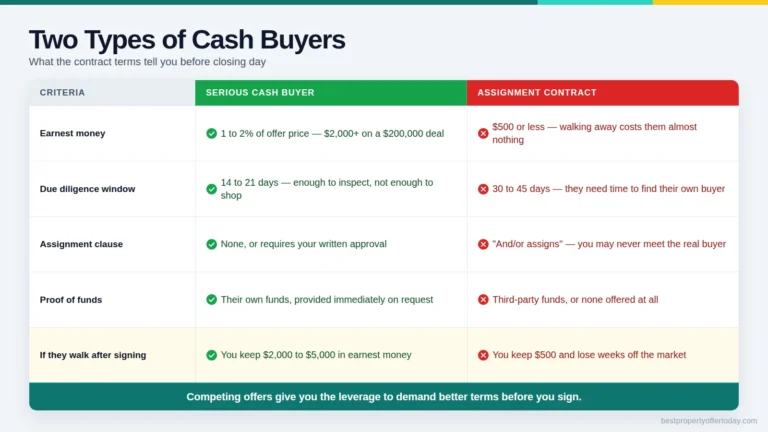
- An earnest money deposit of $500 or less on a $250,000 transaction, combined with a 30 to 45 day inspection window on an already-as-is sale
- A contract with an assignment clause, meaning the buyer reserves the right to sell the contract to a third party before closing
- Any promise of a specific net-to-seller amount before an actual lender payoff statement has been pulled
- A buyer who asks you to stop communicating with your lender during the transaction
Questions to ask before signing anything
- Have you pulled the current mortgage payoff statement, or are you estimating?
- If this is a short sale structure, how many similar short sales have you closed with this lender?
- What happens to the earnest money if the lender declines the short sale approval?
- Does your state allow deficiency judgments after a short sale, and is that addressed in the contract?
- If you are doing a subject-to purchase, will you sign a performance deed or other instrument that protects me if you stop making payments?
- What is your timeline for the lender’s approval process, and what happens if the approval letter expires before closing?
The honest limits of selling underwater
A cash sale through a marketplace gives you competing offers fast and reveals the actual market value within 24 to 48 hours. If the offers clear your mortgage, the problem is solved. If they do not, you have a real number to take to your lender when requesting short sale approval, which is more credible than a broker’s estimate.
What a marketplace cannot do is make a lender forgive a balance they have not agreed to forgive. Competing offers reflect market value. They do not change the amount you owe.
If you have genuine negative equity and a specific reason you need to sell, the right sequence is: get the competing offers to establish value, then take that documentation to your lender and begin the short sale or deed-in-lieu conversation. Those two tracks run in parallel, not in sequence.
One more honest note: if the house is in good condition and you are not in financial hardship, the simplest path is often to hold it. Values recover. If the gap is $15,000 to $20,000 and you can carry the payment, waiting 18 to 24 months often closes most or all of that gap in stable markets.
Use our net proceeds calculator to run your own numbers before committing to any path. And if you want to see what the market will actually pay, you can request competing offers from vetted cash buyers at no cost and no obligation. The number comes back in 24 to 48 hours. That alone is worth knowing.
Can you sell a house if you owe more than it is worth?
Yes, but the sale requires either the seller covering the difference out of pocket or the lender agreeing to release the mortgage lien for less than the full balance. The standard path for the second option is a short sale, which requires lender approval and typically takes 60 to 120 days.
Does a short sale hurt your credit as much as a foreclosure?
In terms of point drop, a short sale is roughly equivalent to a foreclosure, usually 100 to 150 points depending on starting score. The practical difference is that lenders who review future mortgage applications tend to treat a short sale more favorably than a foreclosure, and the waiting period before getting a new conventional loan is often shorter after a short sale.
Can a cash buyer help if I have negative equity?
A cash buyer can tell you exactly what the market will pay, which is the first thing you need to know. If their competing offers clear your mortgage balance, the transaction is straightforward. If there is a shortfall, the cash buyer’s offer becomes your documentation for the short sale conversation with your lender. Some cash buyers also specialize in subject-to or short sale transactions and can guide that process.
What is a deficiency judgment and should I worry about it?
A deficiency judgment is a court order requiring you to pay the difference between what the lender accepted in a short sale and what you originally owed. Most states allow this, with the notable exceptions of California (for purchase-money loans) and a few others with anti-deficiency statutes. If your loan was a refinance or a home equity line, anti-deficiency protection is narrower. This is a real risk and worth confirming with a local real estate attorney before agreeing to a short sale.
Ready to see real numbers for your house?
Enter your property address to get competing offers from verified cash buyers. No repairs, no agent fees, and you pick the closing date.
Prefer to talk? Call (804) 361-7460