Selling a parent’s house when they can no longer sign for themselves is one of the more stressful positions a family member can be in. A power of attorney can authorize you to close the deal. But the document has to say the right things, the title company has to accept it, and you have to stay on the right side of a prohibition that many POA agents do not know exists until a closing is derailed by it.
Selling a house with power of attorney? Compare cash offers from buyers who price it in.
Enter your property address to get competing offers from verified cash buyers. No repairs, no agent fees, and you pick the closing date.
Prefer to talk? Call (804) 361-7460
What Type of Power of Attorney Works for Real Estate
Not every POA document authorizes real estate transactions. A general power of attorney typically covers financial matters broadly, but many title companies and state statutes require the document to specifically name real estate as an authorized category. Some states, including California, require that the grant of real estate authority use statutory language from the state’s POA act.
Three types are relevant here:
- General POA: covers broad financial and legal authority, but may not specifically authorize real estate transfers in all states
- Special or limited POA: written for a single transaction; names the specific property, the terms, and the authorized timeframe; title companies prefer this because the scope is unambiguous
- Durable POA: the critical one when a parent has dementia or suffered a stroke; a standard POA becomes invalid when the principal loses capacity, while a durable POA survives incapacity and remains valid through it
Why Durable Is the Word That Matters Most
A regular (non-durable) power of attorney terminates automatically when the principal becomes incapacitated. This is the scenario that catches families off guard: the parent signs a POA, then develops Alzheimer’s six months later, and the agent discovers the document is now legally void at the moment it is most needed.
A durable POA contains language such as “this power of attorney shall not be affected by the subsequent incapacity of the principal.” Some states also recognize a springing durable POA, which does not become effective until incapacity occurs. Title companies are more cautious with springing POAs because the trigger event (incapacity) must be certified, usually by a licensed physician.
More than 30 states have adopted the Uniform Power of Attorney Act (UPOAA), which standardizes durable POA language and makes the document more portable across state lines. The principal’s state of domicile governs which act applies, not the state where the property sits.
What the Title Company Actually Requires
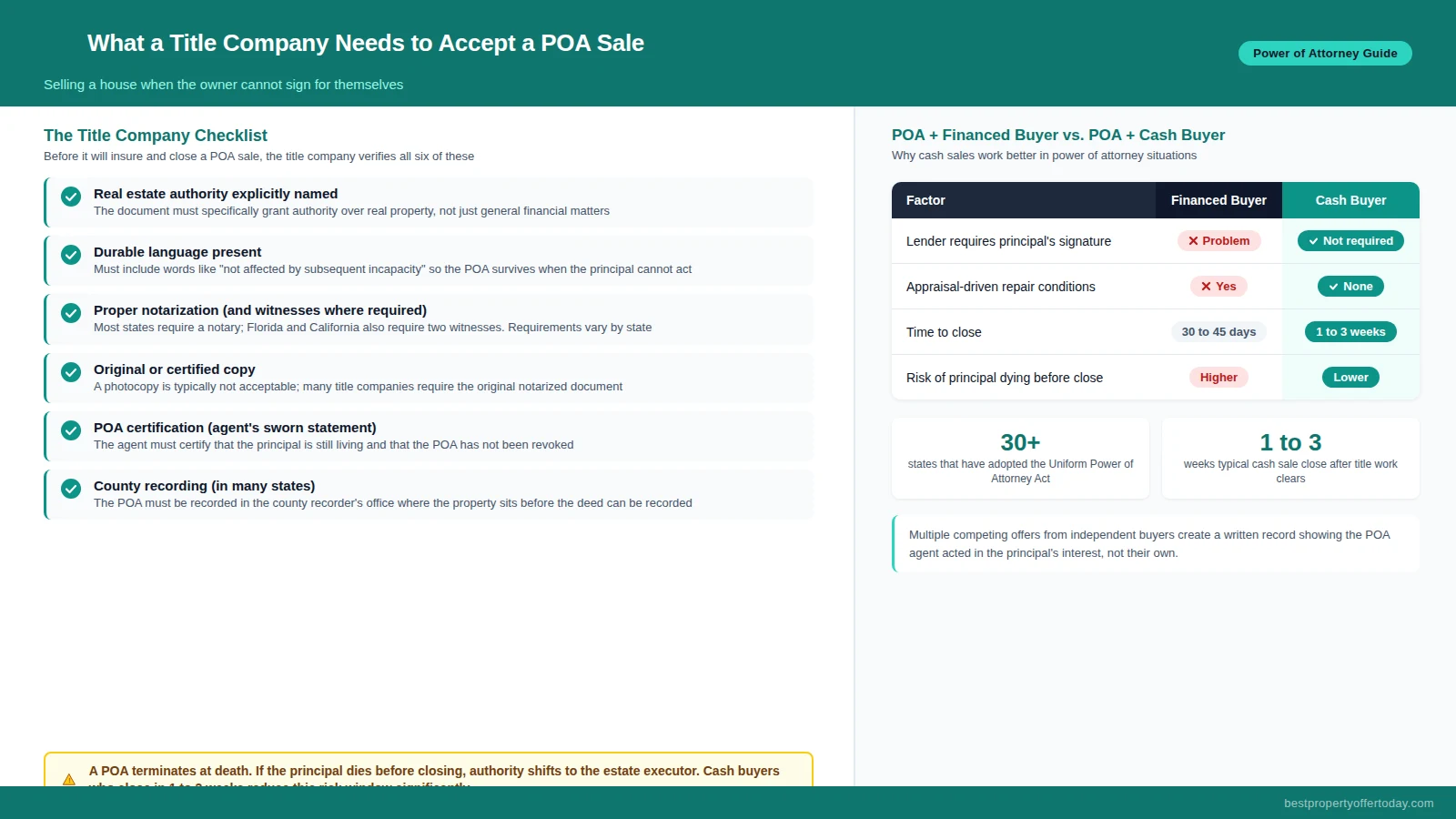
This is where most POA sales stall. The title company must be satisfied before it will insure the transaction and disburse funds. What they typically ask for:
- The original POA document, or a certified copy
- A POA certification: a sworn statement from the agent that the principal is still alive and the POA has not been revoked
- Recording the POA in the county recorder’s office where the property is located (required in many states before a deed signed under POA can be recorded)
- Explicit real estate authority language in the document itself
- Notarization meeting the state’s requirements (California and Florida require two witnesses plus a notary; most other states require only a notary)
Title companies have the right to decline a POA even if it technically meets the minimum statutory standard. In practice, a special POA written for the specific transaction tends to generate less pushback than a general POA drafted years earlier by a different attorney for a different purpose.
The Self-Dealing Prohibition
A POA agent cannot use the authority to sell the principal’s house to themselves, to a close family member, or to an entity the agent controls. This is the self-dealing prohibition, and violating it creates grounds for the transaction to be voided and potentially exposes the agent to civil or criminal liability for breach of fiduciary duty.
This comes up in practice more than you might expect: a child with POA considers buying the parent’s house at below-market value, reasoning that the family money stays in the family. The title company will refuse to close it. And even if it did, an interested party (another sibling, a creditor, or a Medicaid recovery unit) can challenge the transaction in court.
The practical implication for a POA agent is to avoid any situation where their financial interest conflicts with the principal’s. Accepting a competing offer from an independent buyer at the highest verifiable price is the cleanest way to demonstrate that the agent acted in the principal’s interest, not their own.
Competing Offers as Documented Proof of Good Faith
When multiple independent buyers submit offers on the same property, the agent has a written record showing the market tested the price and the sale reflected genuine demand. This matters because POA transactions are more vulnerable to later challenge than transactions signed by the principal directly.
Having three or four competing cash offers from vetted buyers is not just useful for getting the highest price. It is a paper trail that demonstrates the agent did not simply accept the first convenient offer or sell to a connected party. If a sibling or a creditor later questions the sale, the agent can show the offers, the comparison, and the basis for the decision. Our guide to comparing cash offers side by side explains what to normalize before choosing: net proceeds to the seller, not headline price, plus earnest money, close timeline, and assignment risk.
At Best Property Offers Today, one request goes to multiple vetted buyers who compete. The seller, or their authorized agent, reviews the offers side by side and decides. There is no obligation to accept any offer. Submitting your request is free.
Why Cash Sales Suit POA Situations
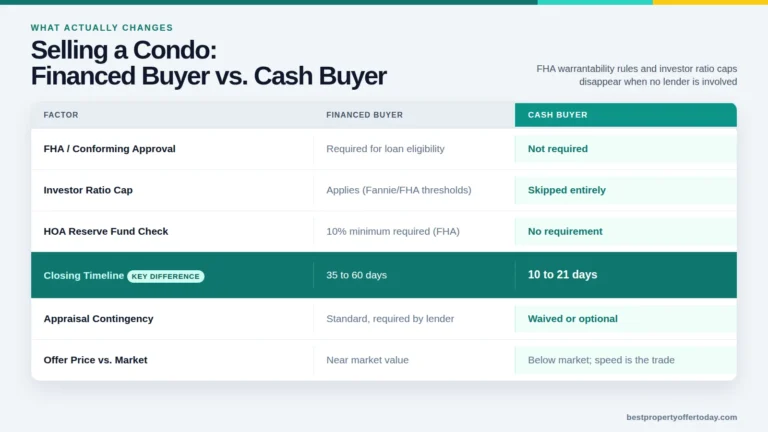
A financed sale creates complications that multiply when a POA agent is running the transaction. The lender typically requires the principal to appear for closing, provide updated identification, or certify the POA again at a later date. When the principal is hospitalized, in memory care, or deceased, none of those steps are possible.
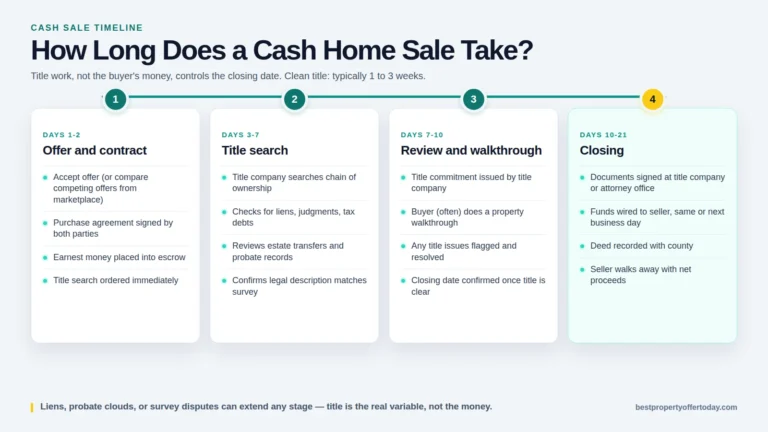
A cash sale eliminates the lender requirement entirely. The title company still needs to accept the POA, but there is no underwriter, no appraisal condition, and no loan officer asking for a fresh signature from someone who cannot give one. Cash closes in 1 to 3 weeks, which matters when carrying costs (the monthly mortgage, property taxes, utilities, and insurance on an empty house) are running against an estate or a Medicaid spend-down.
Worked Example: Selling a Parent’s House Under Durable POA
A parent in memory care owns a house in North Carolina worth approximately $310,000. The adult child holds a durable POA that specifically grants real estate authority and was recorded with the county register of deeds when it was executed.
The child submits the property to a cash buyer marketplace. Four offers come in ranging from $248,000 to $271,000. The child accepts $271,000, which represents about 87 percent of the estimated retail value.
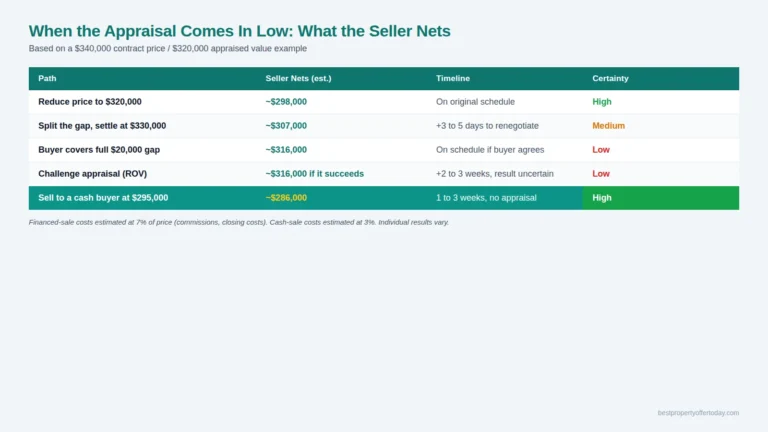
A traditional listing at $310,000, after six percent commission ($18,600), closing costs ($4,650), and carrying costs for three months at $1,800 per month ($5,400), nets approximately $281,350 on a good outcome. That assumes no repair requests after inspection, full price at closing, and no price renegotiation.
The cash buyer does not require a lender appraisal. The title company reviews the recorded durable POA, confirms the principal is still living, and accepts a POA certification signed by the child. Closing takes 16 days. The proceeds go into an account controlled by the child as fiduciary for the principal’s care expenses. Use the net proceeds calculator to run your own numbers with the actual commission, repair credits, and carrying months that apply to your situation.
The 87 percent figure is real. A cash offer is normally below a fully marketed retail price. The parent’s interest is weighed against the cost and time of a traditional listing, and a cash sale is not automatically the worse choice once carrying costs, the principal’s care costs, and the difficulty of managing showings for an occupied or aging property are factored in. If the house is in good condition and the principal has time, a traditional listing usually nets more. But many POA situations do not have that option.
What Happens If the Principal Dies Before Closing
A power of attorney terminates at death. If the principal dies after a sale contract is signed but before closing, the POA agent no longer has authority to sign the closing documents. Authority shifts to the estate: the executor or personal representative named in the will, or the court-appointed administrator if there is no will.
This is not a rare scenario. It happens most often in situations where the principal was already seriously ill. A cash buyer with a 10-day close is at lower risk of this outcome than a buyer whose 45-day financing period extends the exposure window. If the principal’s health is declining, contracting with a buyer who can close quickly reduces the chance of a mid-sale death that requires restarting the authorization chain.
Related situations where the authorization chain is different: if the property is held in a trust, the trustee signs based on the trust agreement, not on a personal POA. If the principal has already died and probate is involved, that is a different process entirely.
What Earnest Money Tells You About a Buyer
A POA agent accepting an offer is accepting it on someone else’s behalf, which raises the stakes for choosing the right buyer. Earnest money is one signal worth scrutinizing. A serious cash buyer on a $270,000 transaction typically deposits $3,000 to $8,100 (one to three percent). A token deposit of $500 or $1,000 on a house in that price range signals that the buyer is treating the contract as an option they can walk away from at no real cost.
Our post on earnest money in a cash sale gives the ranges by price bracket and explains what the contract should say about when the deposit is refundable, which matters when a POA agent needs a clean, predictable close.
Ready to see real numbers for your house?
Enter your property address to get competing offers from verified cash buyers. No repairs, no agent fees, and you pick the closing date.
Prefer to talk? Call (804) 361-7460
Frequently Asked Questions
Does a POA agent need court approval to sell a house?
Generally no, as long as the POA document grants real estate authority and the title company accepts it. Court approval is required when the seller is a ward under a guardianship or conservatorship, which is a different arrangement from a voluntary POA. If the principal was never able to execute a POA before losing capacity, the family has no choice but to pursue guardianship, which can take three to six months through the court system.
Can a POA agent sell a house if siblings object?
Yes, in most cases, unless a court issues an order preventing it. A sibling who disagrees with a sale can petition a court for an injunction or challenge the POA itself, but absent a court order the agent with a valid POA has authority to proceed. The practical protection for the agent is acting transparently: accepting competitive market offers, keeping records, and not selling to a connected party. Multiple competing offers document that the agent acted on the market, not on personal interest.
Can you sign at closing on behalf of the principal if you live out of state?
Yes. The agent signs the deed as “John Smith, as attorney-in-fact for Jane Smith.” Physical presence at the property’s location is not required. Many title companies now accommodate remote or mail-away closings, and the agent needs to sign in front of a notary in their own location, not necessarily in the state where the property sits.
Where does the sale money go after closing?
To the principal, not to the agent personally. The proceeds belong to the principal and should go into an account the agent manages as fiduciary: for the principal’s care if they are still living, or into the estate if the principal has died. The agent cannot take a commission or a fee above what the POA document explicitly authorizes. Using sale proceeds for personal expenses is conversion, which is a form of financial elder abuse in most states.