Condos can be sold to cash buyers, and in certain buildings, a cash sale is not just faster but practically necessary. FHA warrantability requirements, investor ratio caps, and lender-driven inspection conditions knock buyers out of the pool before they ever submit an offer. When a building fails those tests, the buyer pool for a traditional listing can be thin enough that a cash offer ends up close to what a financed deal would bring anyway. This post covers what a cash buyer actually changes for condo sellers, what it does not change, and what a realistic offer looks like before you agree to anything.
See what cash buyers would offer for your house
Enter your property address to get competing offers from verified cash buyers. No repairs, no agent fees, and you pick the closing date.
Prefer to talk? Call (804) 361-7460
Why Lenders Make Condos Hard to Sell
When a lender finances a condo purchase, they are approving two things: the borrower and the building. FHA, Fannie Mae, and Freddie Mac each publish standards a condo project must meet before any loan in that building qualifies for their backing. Buildings that fail these standards are non-warrantable, and non-warrantable means a narrower buyer pool.
The main disqualifiers:
- Owner-occupancy ratio below 50 percent (FHA requires half the units to be owner-occupied)
- Reserve fund below 10 percent of the annual budget
- Any single entity owning more than 10 percent of units
- Active litigation against the HOA or the building
- Commercial space exceeding 35 percent of total floor area
Fannie Mae and Freddie Mac follow similar rules, with their own investor concentration thresholds and reserve requirements. A building that cannot get FHA or conforming approval can still be sold, but the buyer needs a portfolio loan or jumbo financing, which typically carries a rate 0.5 to 1 percent above a conforming loan. That higher rate reduces what buyers qualify to borrow, narrows the pool further, and can keep your unit on the market longer than the building’s condition would otherwise require.
Many sellers find out about the warrantability problem when a buyer’s loan is declined in underwriting. At that point, the listing goes back on the market with a “back on market” flag, and the next buyer starts asking why.
What Changes When a Cash Buyer Is Involved
A cash buyer has no lender in the transaction, so warrantability is irrelevant. It does not matter whether the building is FHA-approved, whether the reserve fund is underfunded, or whether the investor ratio has crossed Fannie Mae’s threshold. Those are lender problems, and a cash buyer has none of them.
Beyond warrantability, here is what else disappears:
- No appraisal contingency unless the buyer specifically requests one
- No FHA inspector citing habitability deficiencies in common areas
- No wait for the lender to order and review the condo project questionnaire
- No loan commitment deadline creating a hard exit date that benefits the buyer
On timeline: a warrantable condo with a motivated retail buyer typically closes in 35 to 50 days. A non-warrantable building with a portfolio loan can stretch to 60 days or more, partly because fewer lenders handle them and the approval process is slower. A cash sale closes in 10 to 21 days once title is clear, limited by the title search and scheduling, not by financing.
What a Cash Buyer Cannot Skip
Removing the lender does not remove everything. These items apply to every condo sale regardless of how the buyer pays:
HOA right of first refusal. Some condo CC&Rs give the homeowners association the right to match any accepted offer within a set window, typically 30 to 60 days. If yours includes this clause, the HOA reviews the terms and decides whether to step in. Most associations do not have the reserves to exercise it, but the clock still runs. Check your governing documents before you accept any offer, cash or otherwise.
Board or owner approval of the buyer. Some condo associations require the buyer to be approved by the board before closing. This is more common in older urban buildings. If your building has this requirement, it applies to cash buyers the same as anyone else, and the timeline accounts for the approval window.
Special assessment disclosure. If the board has voted on a special assessment, or if one is reasonably foreseeable given the building’s known issues, disclosure is required in most states even on an as-is sale. A cash buyer who discovers an undisclosed assessment after closing has grounds to pursue recission or damages. Known assessments belong on the table before the contract is signed.
HOA transfer fee. This is typically $200 to $500 and is paid at closing. Some associations also charge a move-in fee for the buyer. These are line items on the settlement statement regardless of payment method.
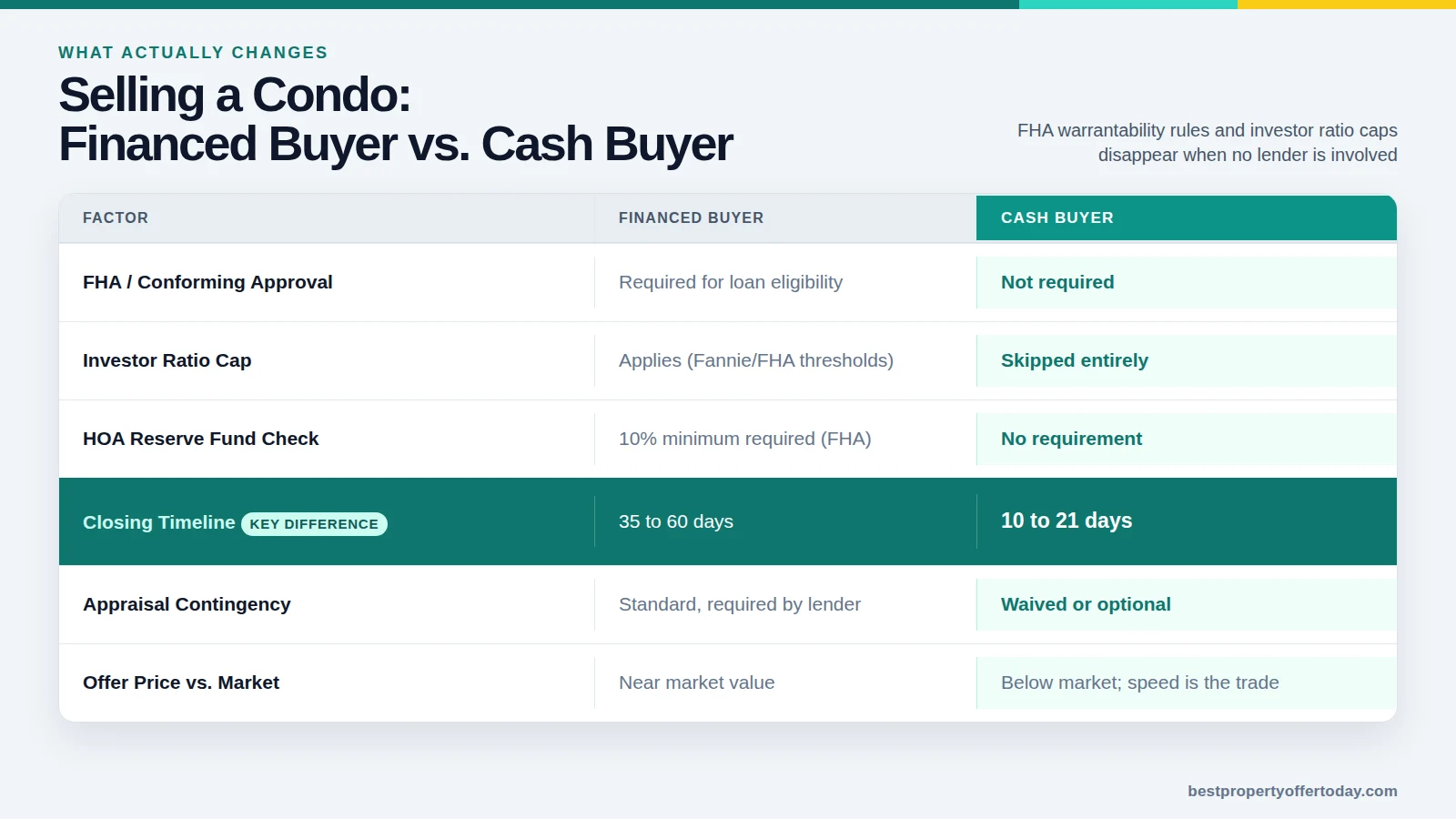
Retail vs. Cash Sale: Side-by-Side for Condos
| Factor | Financed buyer | Cash buyer |
|---|---|---|
| FHA warrantability required | Yes, for FHA loans | No |
| Conforming loan approval required | Yes, for Fannie/Freddie backed loans | No |
| Investor ratio cap affects deal | Yes | No |
| Reserve fund adequacy required | Yes (FHA: 10% minimum) | No |
| HOA right of first refusal | Applies if in CC&Rs | Applies if in CC&Rs |
| Board buyer approval | Applies if required by HOA | Applies if required by HOA |
| Typical closing timeline | 35 to 60 days | 10 to 21 days |
| Appraisal contingency | Standard | Waived or optional |
| Offer price relative to market | Near market value | Below market value |
What a Cash Offer on a Condo Actually Looks Like: A Worked Example
Take a two-bedroom condo listed at $265,000 in a 44-unit building where 22 units are investor-owned. That 50 percent investor ratio puts the building outside FHA approval and right at the edge of Fannie Mae’s threshold. Portfolio loans are available, but typically at 0.5 to 0.75 percent above a conforming rate, which translates to roughly $80 to $125 more per month on a $200,000 loan.
The seller lists at $265,000 and receives two offers over five weeks: one at $258,000 with a financing contingency and 50-day close, and one at $252,000 with a 30-day close. The lower offer’s loan falls through in underwriting when the lender declines the building. The deal relists. The $258,000 buyer returns at $252,000 with a portfolio lender on the second attempt. The final close takes 61 days from the original listing date. After seller closing costs of roughly $3,500 and the HOA transfer fee of $500, the seller nets approximately $248,000.
Compare that to requesting competing offers through a marketplace. Two cash buyers respond within 48 hours: one at $207,000 and one at $214,000. The seller accepts the higher offer. After the same closing costs and transfer fee, the net is approximately $210,000. That is about $38,000 less than the retail deal.
What the seller bought with that $38,000 difference: a guaranteed close, no financing contingency, no carrying costs for two additional months on a condo with HOA dues between $400 and $600 per month, and no second run at a lender approval. For a seller who has already moved out or who cannot float two housing payments, that trade may be worth making. For a seller with time and a warrantable building, it probably is not.
Use the net proceeds calculator to run your own numbers with your actual carrying costs and timeline before making any decision.
Who Should and Should Not Take a Cash Offer on a Condo
A cash offer is not the right answer for every condo seller, and the building’s warrantability status matters more here than it does for single-family homes.
If your building is fully warrantable, financed buyers can get conventional rates, and the market is active, a traditional listing will almost certainly net more. The warrantability issue does not apply, so the main advantage of a cash sale is speed, not access.
If the building is non-warrantable, your effective buyer pool may already be limited to investors and portfolio loan buyers. In that case, the gap between a cash offer and a retail deal is narrower than it looks. A seller in a 60 percent investor building might find the best retail offer and the best cash offer within 8 to 12 percent of each other, not the 20 to 30 percent gap you would see on a warrantable single-family home.
The honest baseline: a cash offer on a condo is typically 10 to 20 percent below what a fully marketed sale would bring. If the condo is in good condition, the building is warrantable, and the seller has time, a traditional listing usually nets more. If the building has warrantability problems, if the seller is on a deadline, or if the unit has deferred maintenance that would surface in an appraisal condition, the cash-to-retail gap often closes.
Red Flags When Reviewing a Cash Offer on a Condo
Not every offer that calls itself “cash” is straightforward. These patterns are worth watching for before you sign anything:
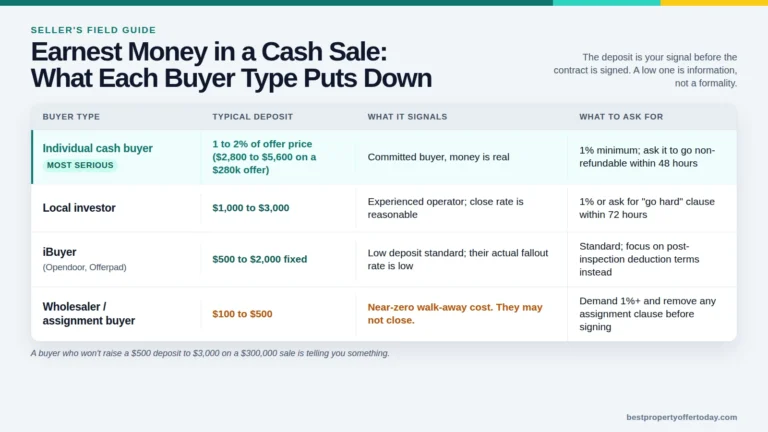
- Earnest money below 1 percent of the offer price: a $1,000 deposit on a $210,000 offer means walking away costs the buyer almost nothing
- An assignment clause: the buyer can sell your contract to a third party before closing
- Long inspection window on a stated as-is purchase: 7 to 10 days is reasonable, 21 to 30 is not
- Price cut after a brief review or inspection period: a renegotiation tactic on an as-is deal
- No hard outside closing date in the contract: vague timelines benefit the buyer, not the seller
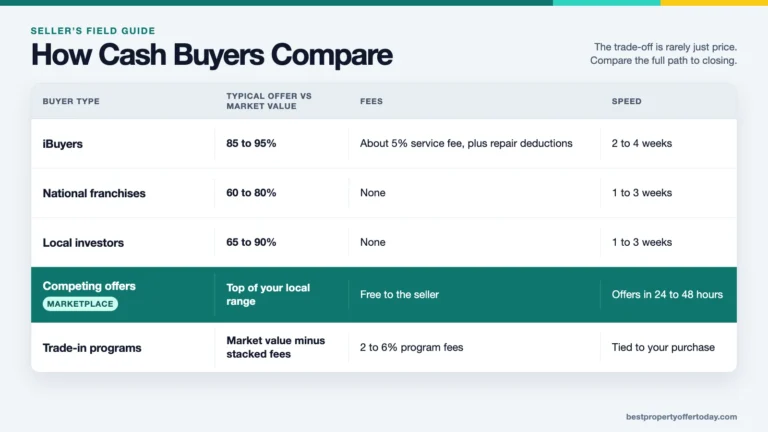
Requesting competing offers through a marketplace gives you a comparison point. If two or three buyers are bidding on the same unit, it is harder for any one of them to run the renegotiation play after acceptance. Here is how to evaluate competing cash offers accurately, including what to normalize before comparing headline prices.
Before signing with any single cash buyer, review the buyer vetting checklist at are cash home buyers legitimate. It covers the specific documents to request and what they prove.
Can an HOA block a cash sale entirely?
Not in most cases. An HOA right of first refusal lets the association match the offer within a set window, not block the sale outright. If the HOA declines to match, or if the governing documents contain no such clause, the sale proceeds. Board approval requirements apply to the buyer, not to the payment method, and disapproval must generally be non-discriminatory and justified under the association’s written policies. An HOA that attempts to prevent a sale without documented cause can face legal liability.
Do condos get lower cash offers than single-family homes?
Often yes. Cash buyers factor in the monthly HOA fee as a carrying cost when calculating their hold period or investment return. A buyer using the 70 percent rule on a condo with $500 per month in HOA dues will adjust the offer down to account for that expense. The adjustment is typically $5,000 to $12,000 relative to a comparable single-family home, depending on the fee level and the buyer’s projected hold time. High HOA fees, upcoming special assessments, and known building issues reduce what a cash buyer is willing to offer.
What documents does a cash buyer need from the condo association?
Even cash buyers typically request the condo questionnaire, meeting minutes from the past two years, the current budget and reserve study, the CC&Rs and bylaws, and documentation of any pending or voted-on special assessments. Some buyers also ask for the building’s master insurance certificate and the management company contact. Having these documents ready before you solicit offers speeds the process. The HOA management company should be able to provide most of them within three to five business days.
How do I know if my condo building is FHA-approved?
HUD maintains a searchable database of FHA-approved condo projects. Approval expires every three years and must be renewed by the HOA. Many older approvals have lapsed because the association did not file for renewal. If your building is not in the database, or if the approval expired, you are already working with a narrower financed buyer pool. That context matters when evaluating any offer: a cash buyer’s lower price needs to be compared against the realistic retail price in a non-warrantable building, not against the price you would get if lenders had no restrictions.
To request competing cash offers through the marketplace, start at the offer form. Offers typically come back within 24 to 48 hours with no obligation to accept any of them. The service is free to the seller.
Ready to see real numbers for your house?
Enter your property address to get competing offers from verified cash buyers. No repairs, no agent fees, and you pick the closing date.
Prefer to talk? Call (804) 361-7460