When two people own a property as tenants in common and one wants to sell, the one who wants out cannot simply list the house. No real estate agent can close a sale without every owner’s signature on the deed. What the owner who wants to sell can actually do depends on how the other owner responds, and on how long they are prepared to wait.
Three paths exist: negotiate a buyout, file a partition lawsuit, or sell your fractional share directly to a cash investor. Each has a different cost, a different timeline, and a different outcome for the remaining co-owner relationship. None of them is fast, and the one with the best payout is usually the one that requires the most cooperation from the person who does not want to sell.
See what cash buyers would offer for your house
Enter your property address to get competing offers from verified cash buyers. No repairs, no agent fees, and you pick the closing date.
Prefer to talk? Call (804) 361-7460
What Tenants in Common Means for a Sale
Tenants in common means each owner holds a fractional, separately transferable interest in the same property. Two siblings who inherited their parents’ house are typically tenants in common. So is a business partner who went in on a rental property, or an ex-partner whose name is still on the deed after a split.
Each co-owner can sell or transfer their own percentage interest without the other’s consent. What they cannot do is sell the whole property, because they do not own the whole property. For a deed to transfer the full house to a buyer, every person on title must sign. That signature requirement is what creates the deadlock.
Tenants in common differs from joint tenancy with right of survivorship. Under joint tenancy, one owner’s death automatically transfers their interest to the surviving co-owner. Under tenants in common, each owner’s share is a separate asset that can be inherited, sold, or pledged independently. That flexibility is why it is common on inherited property, investment property, and unmarried co-purchases.
The Three Paths When a Co-Owner Will Not Sign
Path 1: Negotiate a buyout
If the other owner wants to stay in the property, they can buy your share at fair market value. You get out, they keep the property, and no court is involved. This is the fastest path and the one that typically nets you the most money. It requires the other owner to have the cash or the ability to refinance into a loan that includes your payout.
The number to negotiate from is your share of the equity, not your share of the sale price. Equity is what is left after the mortgage is paid off and the costs of a hypothetical sale are deducted. On a $310,000 house with a $160,000 mortgage balance and estimated closing costs of $15,000, the net equity is $135,000. On a 50/50 ownership split, your share is $67,500. That is the starting number for the negotiation, not $155,000.
Get an independent appraisal ($400 to $600) before you start the conversation. If you rely on an online estimate and the other owner disputes it, you will lose time. A certified appraisal by a licensed appraiser gives both sides a neutral baseline and tends to settle the value argument quickly.
Path 2: File a partition action
A partition action is a civil lawsuit that asks a court to end a co-ownership. It is filed in the county where the property is located. Courts can order one of two outcomes: partition in kind (physically dividing the property) or partition by sale (the court orders the property sold and the proceeds split by ownership percentage).
For a single-family home, courts almost always order a sale. You cannot put a fence through a house. The sale typically runs through a court-appointed commissioner or referee, proceeds are distributed according to recorded ownership percentages, and attorney fees for both sides come out before the split. That last part is what surprises most people: if both co-owners lawyer up and the case is contested, those fees reduce what both of them take home.
What partition actually costs in real numbers: court filing fees run $300 to $500 depending on the county. Attorney fees are the significant variable. A straightforward uncontested partition might run $3,000 to $6,000 in attorney fees. A contested case where the other owner fights back at each stage can reach $15,000 or more per side. Timeline from filing to closing runs 6 to 18 months in most states, and longer when contested. Virginia, California, and Texas all have different procedural timelines.
One thing most guides skip: a court-ordered sale sometimes brings a lower price than a voluntary sale. Buyers who search court records for partition sales know the sellers are under legal compulsion, and some submit below-market offers knowing there is no clean alternative. The final number on a partition sale is not guaranteed to match what the property would have sold for on the open market.
Path 3: Sell your fractional share
As a tenant in common, you can sell your share to a third party without the other owner’s permission. The buyer of your share steps into your position: they own your percentage of the property and can then pursue a buyout or partition from their own position. You are out. The remaining co-owner now has a new co-owner they did not choose.
Most retail buyers will not purchase a fractional interest in someone else’s home. The practical buyer for a TIC share is a cash investor who specializes in co-ownership situations. These investors buy your share at a discount, typically 60 to 75 percent of what your equity share is worth, because they are absorbing the complexity of dealing with a co-owner who did not want anyone new involved. The trade-off is speed and no court process: you can close in one to three weeks without the other owner’s cooperation.
This path is legal and legitimate, but it is worth being clear about what it means. The investor who buys your share will then contact the remaining co-owner and begin their own pressure campaign, whether that is a buyout offer, a partition threat, or simply waiting for the other owner to come to the table. You are not creating a problem; the ownership deadlock already is one. What you are doing is transferring the problem to someone else in exchange for a discounted exit price.
How the Three Paths Compare: A Worked Example
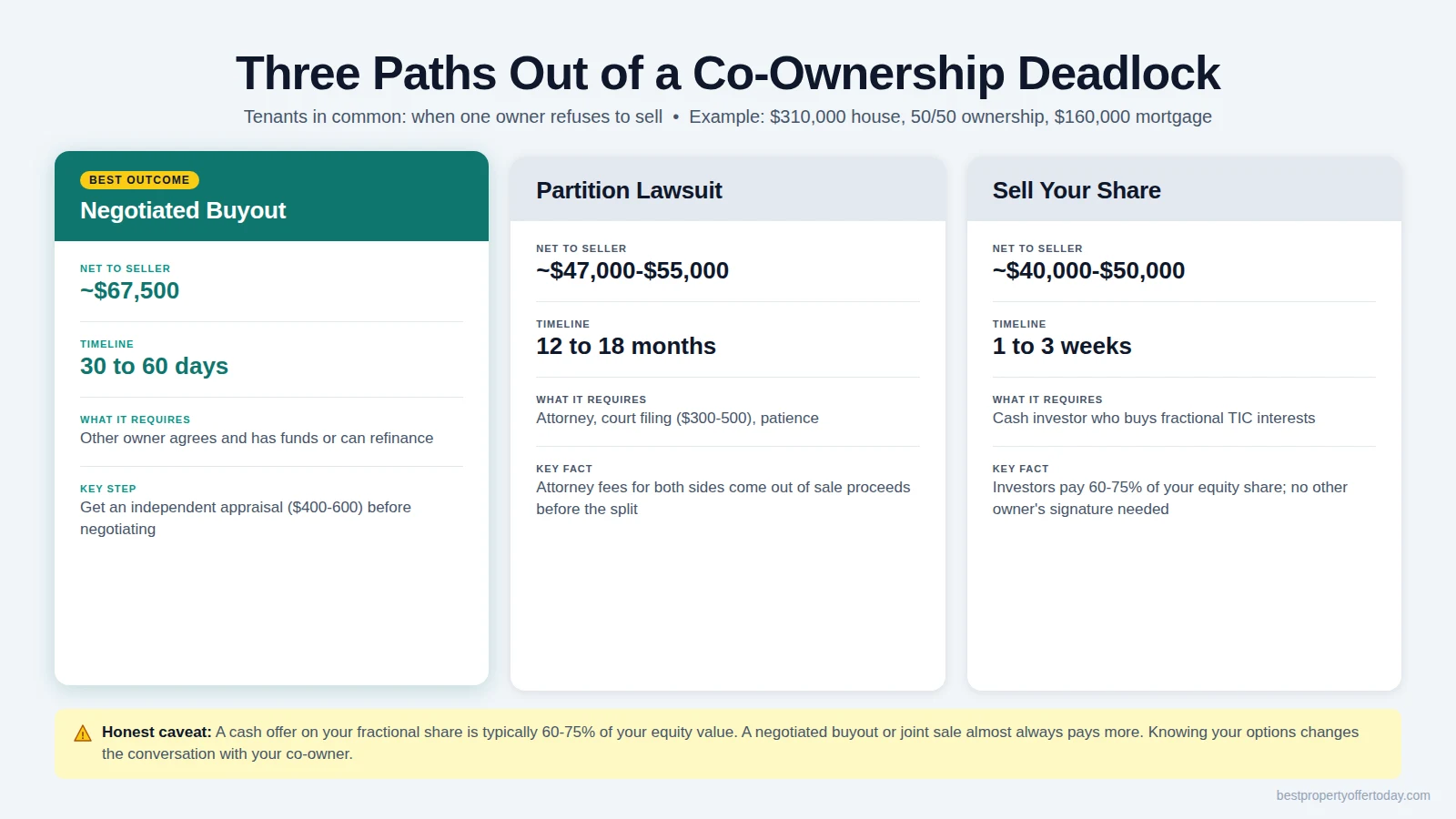
A $310,000 house owned 50/50 by two people. The mortgage balance is $160,000. One owner wants to sell. The other refuses. Here is what each path looks like for the owner who wants out:
| Path | Estimated net to seller | Timeline | Notes |
|---|---|---|---|
| Negotiated buyout | ~$67,500 | 30 to 60 days | Requires the other owner to have funds or qualify for a refinance |
| Partition by sale | ~$47,000 to $55,000 | 12 to 18 months | Attorney fees reduce both sides’ proceeds; court sale may bring below market |
| Sell your share | ~$40,000 to $50,000 | 1 to 3 weeks | No other owner’s signature needed; investor buys your share at a discount |
These are illustrative ranges, not guarantees. The buyout number moves with the appraisal. The partition number moves with how contested the case is and what the court sale actually brings. The share sale number moves with how much investor interest exists in your market and ownership structure. Run the actual numbers for your property with the net proceeds calculator before deciding which path to pursue.
What Happens to the Mortgage While You Wait
Both co-owners’ names are typically on the mortgage. The lender does not care about co-owner disputes. If the mortgage goes delinquent, both borrowers’ credit is affected, and the lender can begin foreclosure proceedings on the full property regardless of which owner stopped paying.
If you are the owner who is making mortgage payments and the other co-owner has stopped contributing, keep records of every payment. Courts can recognize unequal contributions when dividing partition proceeds. The owner who paid more of the carrying costs may receive a credit from the other owner’s share. This does not change the partition timeline, but it does change the final math.
If the other co-owner has gone completely silent on bills for years, the partition process is still the same. Courts do not automatically award the entire property to the owner who paid. They do award credits for documented out-of-pocket contributions. Document everything.
How a Marketplace Fits In
When one co-owner wants to sell and the other does not, a marketplace can help the owner who wants out understand what their fractional share is worth to a cash buyer, without committing to anything. Submit one request and see what investors will pay. That number, even if it is 65 percent of what a full sale would net you, strengthens your position in the buyout conversation. Some co-owners who refused to participate at all become willing to negotiate once the owner who wants to sell has a real offer on the table from an outside investor.
Compare that to the alternative of a traditional listing, which requires the other co-owner’s signature on the listing agreement and the deed. You cannot list the whole house without them. Getting competing offers from vetted cash buyers for your share sidesteps that requirement entirely for the owner who wants out.
The honest caveat: selling a fractional TIC share to a cash investor is a last resort for most sellers, not the first option. The negotiated buyout or a jointly agreed sale almost always nets more. What knowing your options does is change the negotiating dynamic. A co-owner who understands that the alternative is an investor buying in and filing a partition is usually more willing to have the actual financial conversation.
Red Flags to Watch For
- A co-owner offering to buy your share at the assessed tax value, which is usually lower than current market value
- An investor buying your share who will not explain what they intend to do with the remaining co-owner after close
- A partition filed by the other owner in a county where you do not live, requiring you to hire local counsel quickly
- A buyer offering token earnest money plus a long inspection window on a TIC share deal (this is the assignment clause warning sign that also appears in wholesaler transactions)
- An attorney who cannot give you a written estimate of fees and a realistic timeline before you sign an engagement letter
Questions to Ask Before You Act
- What does the recorded deed say about ownership percentages? Do not rely on a verbal agreement from when you bought
- What is the current mortgage balance, and whose name is on the loan?
- Has the other co-owner received formal written notice that you want to sell?
- Does the other owner have the financial capacity to buy you out?
- What is the property’s current market value based on recent comparable sales?
- If you sell your share to an investor, are you comfortable with the new co-owner dynamic that creates?
- How long are you willing to wait for a partition action to work through the court system?
Ready to see real numbers for your house?
Enter your property address to get competing offers from verified cash buyers. No repairs, no agent fees, and you pick the closing date.
Prefer to talk? Call (804) 361-7460
Frequently Asked Questions
What if the co-owner has not paid the mortgage or property taxes for years?
That does not give you unilateral authority to sell. It does change the partition outcome. Courts in most states allow an owner who has paid more than their proportionate share of carrying costs to claim a reimbursement credit from the other owner’s portion of the sale proceeds. Keep records of every mortgage payment, property tax payment, and insurance premium. That documentation becomes your credit claim in the partition proceeding, and it is the most direct financial remedy available without the other owner’s cooperation.
Can one co-owner rent out the house without the other’s permission?
Technically, either co-owner can allow occupancy of the property. In practice, a co-owner who rents the property without the other’s consent and collects rent creates an accounting obligation. They typically owe the non-renting co-owner their proportionate share of the gross rent received. If your co-owner is collecting rent on a property you co-own and not sharing it, that is a separate legal claim that can be resolved either in the partition proceeding or through a separate demand. Document the rental income if you can and raise it with an attorney before confronting the situation directly.
How long does a partition action actually take?
Six to eighteen months is the common range for a contested residential partition. Uncontested cases, where the other owner does not dispute the right to partition but just did not want to initiate it, can sometimes close in four to six months. States vary significantly: a California partition can take longer than a Texas one due to procedural differences. The key variable is how much the other owner contests each stage. Every contested motion adds time and attorney fees to both sides.
Can the other co-owner block a partition action?
In most states, the right to partition is absolute for a tenant in common. A co-owner can slow the process by contesting the appraisal, disputing the ownership percentages, or raising claims about contributions and credits, but they generally cannot block partition itself. The court has the authority to end the co-ownership over their objection. What they can do is make the process more expensive and more time-consuming, which is why the negotiated buyout, when it is possible, is worth pursuing first.
If you are ready to request competing offers on your share or on the full property if both owners eventually agree, you can start the process at Best Property Offers Today with no obligation to accept anything. Knowing what the market will pay is useful regardless of which path you ultimately take.