When a parent enters a nursing home, the house is often the largest asset the family has left. Whether to sell it, hold it, or sign it over raises Medicaid questions most real estate agents do not handle and most financial advisers handle badly.
This post covers what actually happens to the sale proceeds, what the Medicaid five-year lookback means for the transaction, and the three real options a family faces, with numbers on each one.
See what cash buyers would offer for your house
Enter your property address to get competing offers from verified cash buyers. No repairs, no agent fees, and you pick the closing date.
Prefer to talk? Call (804) 361-7460
What nursing home care actually costs
The 2023 Genworth Cost of Care Survey put the national median for a semi-private skilled nursing room at $8,929 per month. A private room runs about $10,025. Those figures translate to between $107,000 and $120,000 per year.
At that rate, a house worth $250,000 funds roughly two to two and a half years of care before the money runs out. That math is why families reach for the house first.
What the math does not include: the Medicaid rules that determine whether selling is the right move at all, and the carrying costs that erode the sale proceeds the longer the process takes. Use the net proceeds calculator to put real numbers on the net-to-seller before committing to any path.
When selling the house is not the answer
Medicaid covers long-term nursing home care for people whose income and assets fall below the program’s limits. In most states, the asset threshold is $2,000 in countable assets. The house is not always a countable asset.
Federal Medicaid rules exempt the principal residence from asset counting while the resident is alive in these situations:
- The person intends to return home and a physician has documented this as medically plausible
- A spouse is still living in the house
- A dependent child, or a blind or disabled child of any age, lives there
- A sibling with an equity interest has lived in the house for at least one year before the nursing home admission
If any of these apply, Medicaid cannot force a sale while the resident is alive. The house is set aside. Many families do not know this, and the first advice from an elder law attorney is often to hold off on selling.
The problem comes after death. Most states run Medicaid estate recovery programs that allow the state to file a claim against the estate for what it spent on care. If the house was never sold, it goes through probate and the recovery claim attaches then. The house survives Medicaid during the resident’s lifetime but can still be taken in the estate settlement.
The five-year lookback: what it means for sellers
This is where families cause themselves the most damage. Federal law requires Medicaid to review any asset transfers made in the five years before an application is filed. If a house was sold below fair market value, gifted to a child, or transferred into a trust during that window, Medicaid treats the difference as a disqualifying transfer.
The penalty is calculated by dividing the transferred amount by the state’s average daily nursing home rate. In Virginia, that rate runs roughly $280 per day. Transfer $140,000 in undervalued assets, and Medicaid imposes a 500-day penalty period during which it pays nothing. The family covers care out of pocket the entire time.
Selling at fair market value is not a transfer. If a house appraised at $265,000 sells for $265,000, Medicaid has no objection. The proceeds become countable assets, and the family may need to spend them down before the resident qualifies for coverage, but the sale itself is clean.
The trap most families fall into: they sign the house over to adult children for $1 to simplify the estate, the parent enters a nursing home 18 months later, and the application triggers a multi-year penalty period with no Medicaid coverage.
Three paths, with real numbers
To make the comparison concrete, take this scenario: a 79-year-old woman entering a skilled nursing facility in Virginia. Her home is a 1,760-square-foot ranch, built in 1979, with deferred maintenance throughout. The family estimates market value at $265,000 in its current condition, or $310,000 fully repaired. Monthly care cost: $8,700.
She is not yet on Medicaid. The family is self-paying while working out the sale.
Path 1: Traditional listing
Preparing this house to list typically involves $15,000 to $22,000 in repairs, roof patching, fresh paint, new flooring in the kitchen and baths. Add a listing agent at five to six percent, standard closing costs, and four months of carrying costs at $8,700 per month:
| Sale price (after repairs) | $295,000 |
| Repairs | -$18,000 |
| Agent commission (5.5%) | -$16,225 |
| Closing costs | -$5,000 |
| Four months of care during sale | -$34,800 |
| Net to family | $220,975 |
The traditional route produces the best number when the house is in good shape and the family can absorb the carrying costs. Here, four months at $8,700 erases a large share of the advantage.
Path 2: Cash sale through a marketplace
Cash buyers evaluate this house on its after-repair value and work backward using repair cost estimates and their required return. Most institutional cash buyers apply the 70 percent rule, which puts offers in the $175,000 to $197,000 range on this property. Submitting to a marketplace, where multiple vetted buyers compete for the same house, pulls offers toward the higher end of that range.
| Cash offer (competitive, as-is) | $193,000 |
| Repairs | $0 |
| Commission | $0 |
| Closing costs (buyer-paid in many cash deals) | $0 to -$2,000 |
| Three weeks of care during sale | -$6,525 |
| Net to family | $184,475 to $193,000 |
The gap between paths 1 and 2 is roughly $28,000 to $36,000 on these numbers. That gap narrows when carrying costs are counted accurately. At $8,700 per month, every additional 30 days the sale takes costs the family about $290 per day. A four-month listing vs. a three-week cash sale is roughly $29,000 in additional care costs alone.
A cash offer is normally below a fully marketed retail price. What it buys is speed and certainty, and no repairs out of pocket. If the house needs substantial work and the alternative is funding care while a listing sits unsold, the discount can be the better trade.
Path 3: Hold the house; pursue Medicaid
If the community spouse exemption or the intent-to-return exemption applies, the family may be better off not selling at all. Medicaid covers the nursing home costs, the house stays in the estate, and the family deals with the estate recovery claim after death. At that point, they may have more options: settling the claim, negotiating a reduced payoff, or in some states, claiming hardship exceptions.
This path requires an elder law attorney to verify eligibility. It is not a do-it-yourself analysis.
All three paths compared
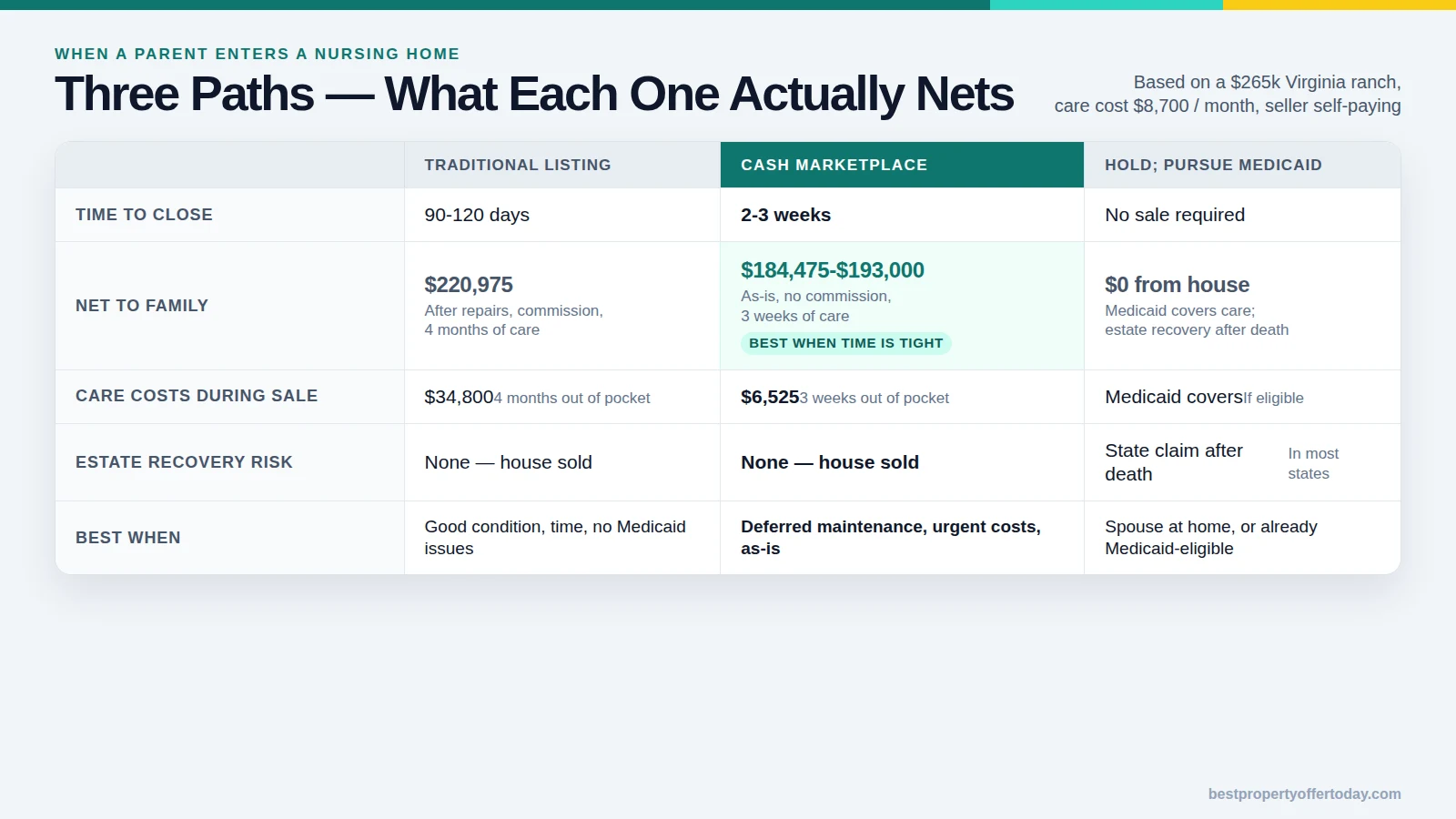
| Factor | Traditional listing | Cash sale | Hold; pursue Medicaid |
|---|---|---|---|
| Timeline to close | 90-120 days | 2-3 weeks | No sale required |
| Net proceeds (this example) | $220,975 | $184,475-$193,000 | $0 from house sale |
| Care costs during sale | $34,800 (4 months) | $6,525 (3 weeks) | Medicaid covers |
| Estate recovery risk | None (house sold) | None (house sold) | State claim after death, in most states |
| Best for | Good condition, time, no Medicaid eligibility issues | Deferred maintenance, urgent costs, house as-is | Spouse at home, or already Medicaid-eligible |
When you should not take a cash offer
If the house is in good condition, the family has 90 to 120 days before care costs become critical, and there are no title complications, a traditional listing almost always produces more. The traditional route exists because it works. A cash offer at 70 to 75 percent of market value is a tradeoff, not a shortcut to a better outcome.
If a spouse lives in the home, selling it may waive Medicaid protections the family did not realize they had. Get the Medicaid question answered by an elder law attorney before listing the property. See also our guide to selling a house with power of attorney, which covers authority questions when the owner can no longer sign for themselves.
Red flags when buyers contact you
A family handling a parent’s affairs is a known target for investors who specialize in urgent situations. Some of these investors are legitimate cash buyers; others use the pressure to push below-market deals through before the family has time to compare. Watch for:
- Unsolicited calls before you have listed the property
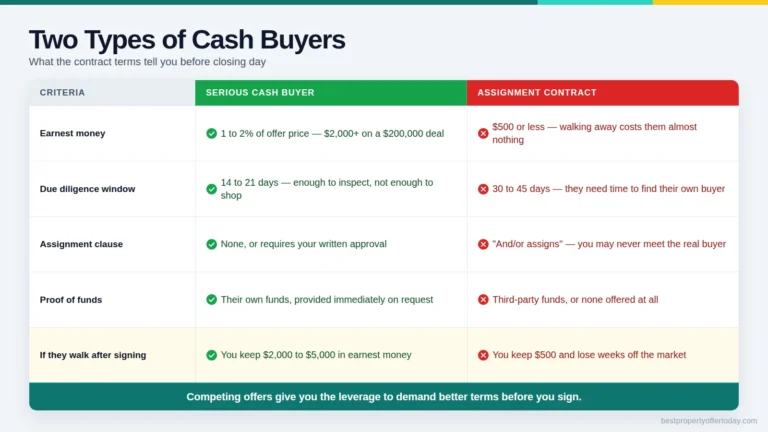
- Earnest money below $1,000 on a purchase price above $150,000. At that level, walking away costs the buyer nothing
- An assignment clause in the purchase agreement, which means the buyer plans to resell the contract to someone else rather than close on the property
- Proof of funds dated more than 30 days ago, or showing a line of credit rather than accessible liquid funds. See our full guide to what proof of funds should actually show
- An inspection window longer than 10 days after describing the sale as as-is
- Post-contract price reductions on a deal already agreed without contingencies
When a family is submitting to a marketplace and comparing buyers side by side, these tactics become visible. A buyer who cannot match the earnest money, the timeline, or the documentation of another offer tends to drop out or improve their position quickly.
To request competing offers from vetted cash buyers on a property in this situation, call 804-361-7460 or submit the address at the main form. Offers typically come back within 24 to 48 hours and carry no obligation to accept any of them.
Questions to ask before signing anything
- Can you show proof of funds dated within the last 30 days, and are those funds liquid rather than a credit line?
- Is this a direct purchase, or will the contract be assigned to another buyer before closing?
- What is your earnest money deposit, and what happens to it if you cancel?
- What is your target closing date, and what has caused your past purchases to miss that date?
- Does this contract contain an inspection or due diligence period, or is there no post-signing renegotiation?
What happens if I sell my mom’s house while she is on Medicaid?
The proceeds become countable assets. In most states, the Medicaid asset limit is $2,000. The difference between the sale proceeds and that limit must be spent on care, qualified medical expenses, or other Medicaid-approved purposes before coverage resumes. This is called a spend-down. The sale itself does not end coverage, but the funds must be spent before the program pays again.
Can a nursing home force you to sell your house?
No. A nursing home is a private creditor. It can pursue collection for unpaid bills, but it cannot compel a sale or place a lien on a property without going through the courts first. Medicaid also cannot force a sale during the resident’s lifetime, though it can file an estate recovery claim on the house after death if the property passes through the estate.
What is Medicaid estate recovery, and does every state do it?
Estate recovery is a federal requirement: every state must attempt to recover Medicaid long-term care expenditures from the estates of recipients who were 55 or older when they received services. What each state can reach varies considerably. Some states limit recovery to assets going through probate. Others pursue non-probate assets as well. An elder law attorney in the specific state can tell you the actual exposure, which often determines whether path 3 is viable.
Do I need a lawyer to sell a parent’s house to pay for nursing home costs?
Not for the real estate transaction itself. But the Medicaid questions almost always require an elder law attorney. Whether selling now costs the family more than holding would, whether an application should be filed before or after the sale, and how to handle the proceeds to avoid a penalty period are not DIY analyses. Attorney fees for Medicaid planning typically run $1,500 to $5,000. Against the exposure, that cost is usually minor.
Ready to see real numbers for your house?
Enter your property address to get competing offers from verified cash buyers. No repairs, no agent fees, and you pick the closing date.
Prefer to talk? Call (804) 361-7460