If your house needs serious work and you are wondering whether anyone would actually buy it, the answer is yes. Selling a house in bad condition is more common than most people realize, and there are real, practical paths forward that do not require you to spend tens of thousands on repairs before you can close. The key is knowing which option fits your situation.
Whether you are dealing with foundation issues, a dated interior, storm damage, or years of deferred maintenance, you have more leverage than you think. The traditional listing route is just one option, and for a house in rough shape, it is often not the best one.
What Does Selling As-Is Actually Mean?
Selling as-is means you are listing the property in its current state and making no repairs, updates, or concessions before closing. It does not mean you hide problems. In most states, you are still required to disclose known issues, but the buyer is accepting the home knowing those issues exist and is pricing their offer accordingly.
For sellers, this is a significant relief. You skip the contractor quotes, the renovation loans, the weeks of construction chaos. You sell, you close, you move on. The tradeoff is that traditional buyers on the open market often shy away from as-is listings, or they come in with offers so low they barely account for the condition. That is where the right buyer type makes all the difference.
At Best Property Offer Today, sellers dealing with difficult property conditions find that comparing multiple cash offers gives them a much clearer picture of what their home is actually worth in its current state, without the guesswork of the open market.
Your Real Options When the House Needs Work
You have three realistic paths when selling a house in bad condition, and each one suits a different situation. The first is listing with a traditional real estate agent as-is. This works if the home is in a high-demand market and the issues are cosmetic rather than structural. Buyers in competitive areas will sometimes overlook dated kitchens or worn flooring, especially if the price reflects it. But if the problems are major, expect your listing to sit, attract low offers, and potentially fall out of contract after inspections.
The second path is selling to a cash home buyer or investor directly. These buyers specifically seek out properties in poor condition because they have the teams and capital to handle repairs at scale. You get a firm offer, usually within 24 to 48 hours, no financing contingencies, no open houses, and a closing timeline that works around you. This is the fastest route and the one that eliminates the most uncertainty.
The third option is a hybrid approach: make a handful of high-ROI cosmetic improvements (fresh paint, cleaned carpets, curb appeal basics) and then list. This can boost your offer price meaningfully without requiring a full renovation, but it only works if the core systems (roof, foundation, HVAC, plumbing) are in reasonable shape.
Properties with active code violations face an extra layer. Recorded enforcement liens must be paid at closing, and most government-backed loans will not fund on a property flagged by an appraiser for health-and-safety violations. If your property is in bad condition and also carries unresolved code issues, cash buyers are almost always the only path that stays open. For a full breakdown of what each option costs in that situation, see the post on selling a house with code violations.

How Cash Buyers Price a Home in Bad Condition
Understanding how cash buyers calculate their offers helps you negotiate from a position of knowledge. The standard formula is: After Repair Value (ARV) minus repair costs minus the investor’s profit margin, minus holding and transaction costs. ARV is what the home would sell for after being fully renovated. Repair costs are estimated by the buyer’s contractor. The margin typically runs 10 to 20 percent depending on the market and risk level.
This means the worse the condition and the higher the repair costs, the lower the offer relative to ARV. But here is what most sellers miss: comparing multiple cash offers is critical. Different buyers have different cost structures, different repair estimates, and different profit targets. The spread between the lowest and highest offer on the same property can be 10 to 15 percent. That is real money.
Platforms like Best Property Offer Today connect you with multiple vetted cash buyers in a single step, so you see competing offers side by side and choose the one that works for you. Get your free cash offer and find out what your home is worth in its current condition, no repairs needed.
Common Situations Where Cash Buyers Make Sense
Some situations almost always point toward a cash sale over the traditional route. Inherited properties are a classic example. If you inherited a home that has not been updated in decades and you live out of state, managing a renovation project remotely while carrying property taxes and utilities is rarely worth it. A clean cash sale lets you settle the estate and move forward.
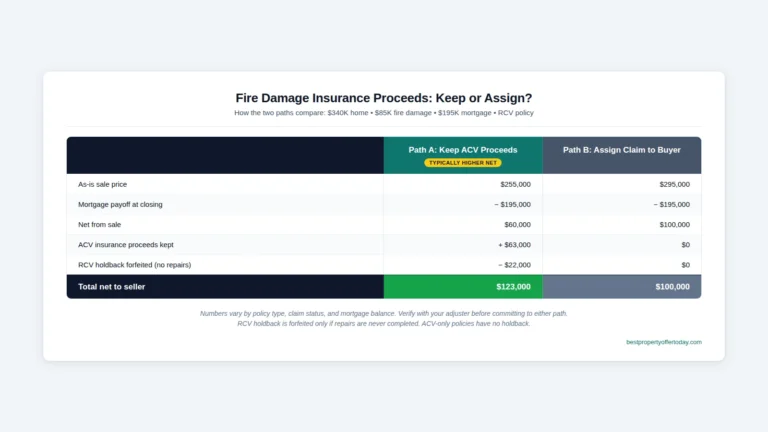
Fire or water damage is another. Insurance payouts often cover less than the actual cost to restore, and coordinating repairs while living elsewhere adds stress and carrying costs. Cash buyers purchase fire and water damaged homes regularly and handle the remediation themselves. Similarly, homes with foundation issues, major roof problems, or outdated electrical systems often scare off traditional buyers but are exactly the kind of deal cash investors look for.
“I had no idea anyone would want my mom’s house in that condition. The roof was bad, the kitchen was stuck in the 80s, and it needed new plumbing. Best Property Offer Today found us three cash offers within two days. We picked the one that fit our timeline and closed in three weeks. No repairs, no open houses, no drama.”, Sarah K., Tennessee seller
What to Watch Out For When Selling As-Is
Not every cash buyer is the same, and the as-is market does attract some bad actors. Watch for buyers who ask for large upfront fees before closing, who send contracts with excessive contingency clauses that let them renegotiate after the fact, or who pressure you to sign quickly without giving you time to review the terms. A legitimate cash buyer will have a clear process, a firm offer, and no hidden fees.
Always read the purchase agreement carefully. Understand what contingencies remain (even cash buyers sometimes include an inspection contingency that can be used to lower the price). Know your closing timeline and confirm the buyer has proof of funds. If something feels off, walk away. You have options.
Working with a platform that vets its buyer network, like Best Property Offer Today, removes most of this risk because the buyers in the network have already been screened for reliability and track record.
Getting the Best Outcome for Your Situation
Selling a house in bad condition is not about settling. It is about finding the right buyer for the right property at the right time. The sellers who come out ahead are the ones who understand their options, compare multiple offers, and choose based on the full picture, not just the headline number. Closing speed, certainty, and avoided repair costs all have real dollar value.
If you are ready to find out what your home is worth today, compare cash offers today and let the market show you what is possible. No repairs. No stress. Just a clear path to closing.