A bad inspection report does not end the sale. What it does is force a decision. You have four realistic exits, and the right one depends on how serious the findings are, whether the buyer is financing, and how much carrying cost you can absorb if this deal falls apart and you relist.
Selling a house with a bad inspection report? Compare cash offers from buyers who price it in.
Enter your property address to get competing offers from verified cash buyers. No repairs, no agent fees, and you pick the closing date.
Prefer to talk? Call (804) 361-7460
What a Home Inspection Actually Is
There is no such thing as a house that passes or fails a home inspection. Inspectors are paid to document conditions, not to issue grades. A 30-page report with 40 items is not unusual for a 20-year-old house, and most of those items are cosmetic or routine maintenance.
The short list of findings that kill financed deals: structural problems (foundation, roof framing, load-bearing walls), active water intrusion, major electrical hazards, a non-functional HVAC system, environmental concerns (mold, asbestos, lead paint), and a septic system that has failed. Everything else is a negotiation.
For buyers using FHA, VA, or USDA loans, the lender adds a second layer. Certain conditions trigger mandatory repair requirements before the loan closes. Peeling exterior paint, a non-functional appliance, broken windows, or missing handrails can each become lender conditions even if the buyer personally does not care about them.
The Disclosure Problem the Next Listing Creates
Once a licensed inspector puts a defect in writing, the seller is on legal notice of that defect. In most states, material issues discovered during a transaction that later falls through must be disclosed on the seller disclosure form for the next listing.
That changes the math on the simple plan of letting the deal die and relisting at the same price. The next buyer receives a disclosure form naming the foundation crack, the roof finding, or the HVAC condition that was documented. That knowledge shifts negotiating power to the buyer before they even make an offer.
Some sellers get a pre-listing inspection before going under contract with anyone, so they can fix issues, accurately price for them, or disclose them on their own terms. That is the cleanest path if the market gives you the time. If it does not, your options are narrower.
Four Exits When the Report Comes Back Ugly
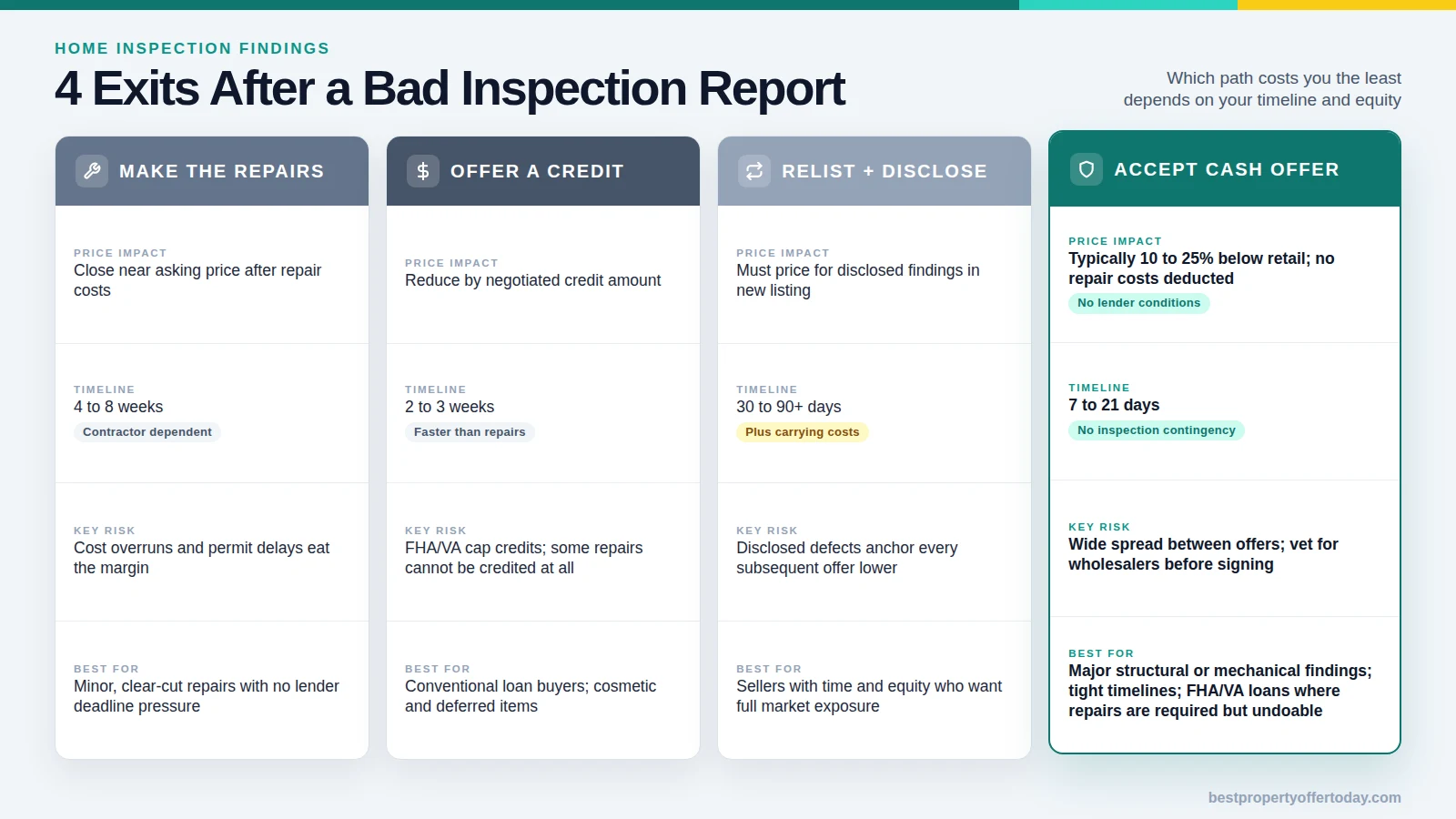
Make the repairs. You fix the documented items, the financed deal proceeds, and you close at or near the original price. This works when repairs are straightforward, cost-effective, and doable before the contract deadline. It breaks down when the repairs are structural, need permits, or cost more than the price concession the buyer is likely to accept anyway.
Offer a credit or price reduction. Instead of fixing, you reduce the purchase price or offer a seller credit so the buyer handles the work after closing. Conventional loans generally allow credits. FHA, VA, and USDA loans cap the amount of seller credits, and some FHA-required repairs cannot be resolved with a credit at all. The lender needs documented evidence of the completed repair before funding.
Let the deal die and relist. The buyer walks. You keep the earnest money if the contract language allows it. You go back on the market. The disclosure obligation follows the property. Your new asking price typically needs to account for the documented findings, or you face the same renegotiation on the next offer.
Accept a cash offer. Cash buyers do not need lender approval, so the lender-required repair list is not a factor. Many cash buyers price the condition in upfront and skip the inspection contingency entirely. You close faster and without a repair obligation. The offer reflects the condition of the house, and that price will be below a fully marketed retail sale. See more on how a cash offer compares to a listing with an agent.
Worked Example: $295,000 Asking Price, $28,000 in Findings
Suppose you are under contract at $295,000 with a conventional loan buyer. Their inspector returns a 42-item report. The material findings: $14,000 for HVAC (heat exchanger cracked, full replacement needed), $8,500 for roof repairs (three sections of failed flashing, soft decking), and $5,600 for electrical (outdated panel, double-tapped breakers). Total documented cost: $28,100.
The buyer sends a repair addendum requesting either all three items be corrected or a $22,000 price reduction.
Path 1 (repair): You hire contractors, spend 4 to 6 weeks getting work done, extend the contract, and close at $295,000. Net after $28,100 in repair costs: approximately $266,900 before agent commissions and closing costs.
Path 2 (credit): You counter with a $15,000 price reduction. The buyer accepts. You close at $280,000. Faster, no repair management, but you still pay commissions on the original sales price in most agreements.
Path 3 (relist): The deal dies. You relist at $275,000 to price for the disclosed findings. The next buyer offers $262,000. You accept after three weeks. Add three months of carrying costs at roughly $1,800 a month, plus a second round of agent fees. Your net is lower than the credit path would have been.
Path 4 (cash offer): You request competing cash offers through a marketplace. The bids come back between $232,000 and $248,000, reflecting the condition. You accept $244,000 and close in 11 days. No commissions if you sell without an agent, no repair costs, no additional carrying time.
The cash path nets roughly $21,000 less than the credit path in this example. What it buys is speed, certainty, and no repair management. Run your actual numbers with the net proceeds calculator before deciding. If the house is in basically sound condition and you have the time, a traditional listing will almost always net more than any cash path.
Comparison: Four Paths After a Bad Inspection
| Path | Price impact | Timeline to close | Key risk |
|---|---|---|---|
| Make all repairs | Close near asking price | 4 to 8 weeks | Cost overruns, permit delays, contractor availability |
| Offer a credit or price cut | Reduce by negotiated amount | 2 to 3 weeks | FHA/VA credit limits; some repairs cannot be credited |
| Relist with disclosure | Price for findings in the new ask | 30 to 90 days or more | Double carrying costs; disclosed defects anchor every offer |
| Accept cash offer | 10 to 25% below retail, condition-dependent | 7 to 21 days | Wide spread between offers; screen for wholesalers |
FHA and VA Required Repairs: What a Credit Cannot Fix
FHA-backed loans require the property to meet HUD Minimum Property Standards. The appraiser, not the inspector, enforces these, but they flag the same items. Functional utilities (water, heat, electricity), no exposed wiring, no broken glass creating a safety hazard, a roof with at least two years of remaining useful life, and a structurally sound foundation are all on that list.
VA loans add a termite inspection requirement in most states. If the VA appraiser flags any required repair items, the loan will not close until the lender receives documented evidence the repair is complete. A seller credit does not satisfy that requirement.
This is one of the practical reasons sellers with serious inspection findings move toward cash buyers. The lender-required repair list is separate from the buyer negotiation, and it does not go away when you offer money off the price.
Red Flags in Cash Offers That Arrive After a Failed Deal
When a deal dies after inspection, some buyers circle back wearing a different hat. Here is what to look for before you sign anything.
- A 30-day inspection period on an as-is transaction. A legitimate cash buyer prices the condition and closes. A long inspection window almost always signals a wholesaler planning to assign the contract to a third party.
- Token earnest money. A deposit of $500 on a $244,000 purchase means walking costs the buyer nothing. Ask for 1 to 2 percent of the purchase price as a sign of seriousness. See how much earnest money is reasonable in a cash sale.
- The phrase “and/or assigns” in the buyer name field. This means the buyer plans to flip the contract to a third party. That is not necessarily a problem if you know it upfront, but it adds closing risk. See how to tell a wholesaler from a real cash buyer.
- A price that drops after due diligence. A real cash buyer makes an offer based on known condition. A renegotiation after the contract is signed is a different thing. Request proof of funds before executing any contract. See what proof of funds actually means and what to ask for.
Questions to Ask Before Choosing a Path
- Are any of the inspection findings on the FHA/VA required repair list? A credit will not close that loan if they are.
- What does a realistic repair actually cost, and can a licensed contractor complete it before your contract deadline?
- What would you have to disclose on the next listing disclosure form if this deal dies today?
- How many months of mortgage, insurance, and property taxes does another 60 to 90 days on the market add to your cost basis?
- If you accept a cash offer, does the buyer have proof of funds, a real earnest deposit, and a contract without an assignment clause?
Does a bad inspection report mean the deal is dead?
Not automatically. Most inspection findings lead to a negotiation, not a cancellation. The deal dies when the cost to address the findings exceeds what either party is willing to absorb, or when lender-required repairs cannot be completed within the contract timeline.
Do I have to make repairs if I decide to relist?
In most states, you are not legally required to fix items found in a prior inspection, but you are typically required to disclose them. A documented defect on your seller disclosure form will affect what buyers offer and how aggressively they negotiate before you even see the first bid.
Can a seller simply refuse a buyer repair request?
Yes. The seller can decline any repair request. The buyer then decides whether to proceed, negotiate further, or cancel using their inspection contingency. If the buyer cancels within the contingency window, they ordinarily receive their earnest money back. See more on what happens when a buyer backs out.
When does a cash offer actually make sense after a bad inspection?
A cash offer is worth considering when the repair cost is high relative to your equity, the timeline is short, a financed buyer lender requires repairs you cannot complete before closing, or when carrying the property through another listing cycle closes the gap between the cash price and the retail price. Call 804-361-7460 if you want to see what competing offers look like on your specific property.
Ready to see real numbers for your house?
Enter your property address to get competing offers from verified cash buyers. No repairs, no agent fees, and you pick the closing date.
Prefer to talk? Call (804) 361-7460